Abstract
Based on the practical engineering of adjacent deep foundation pits in Shanghai, this paper focuses on the prominent safety problem of large-diameter combined sewer affected by excavation of bilateral deep foundation pits. Pipeline protection technology is studied from foundation pit enclosure design and pipeline reinforcement. The foundation pit enclosure design adopted multiple effective technical measures, such as improving the overall rigidity of enclosure structures and reinforcement treatment of the passive earth pressure zone soil, which effectively reduce the adverse disturbance and deformation impact on adjacent large-diameter combined sewer due to excavation. The additional deformation characteristics of the combined sewer are numerically investigated under the superimposed unloading effect of bilateral foundation pit excavation. Based on the numerical analysis, differentiated reinforcement measures are adopted for the combined sewer, including full-ring stainless steel lining reinforcement technology and the composite reinforcement of annular rubber water-stop sealing strips matched with stainless steel sleeve rings. The practice indicates that the foundation pit enclosure design and pipeline reinforcement technology adopted in this project can effectively control the structural deformation of large-diameter combined sewer and fully guarantee the safe and stable operation of municipal pipeline facilities during the excavation of bilateral deep foundation pits.
Keywords
Bilateral Deep Foundation Pit, Superimposed Effect, Combined Sewer, Risk Assessment, Pipeline Reinforcement
1. Introduction
In coastal soft soil areas of China, deep foundation pit excavation will produce significant soil unloading effect, which will inevitably break the original stress balance of surrounding soil mass and further affect the stress state and deformation performance of adjacent underground municipal pipelines
| [1] | Huang P, Yang X, Li X, et al. Influence of Construction of Deep Excavation Groups on Adjacent Shallowly Buried Pipelines in Soft Clay. China Journal of Highway and Transport, 2023, 36(3): 146-155.
https://doi.org/10.19721/j.cnki.1001-7372.2023.03.011 |
| [2] | Jin Y, Gu X W, Ye X, et al. Measurement analysis of influence on metro tunnel caused by nearby excavation in typical stratum. Building Structure, 2023, 53(15): 132-136.
https://doi.org/10.19701/j.jzjg.ls220209 |
| [3] | Gu, X W, Yi, Z H, Wang, Z, et al. Influences of Excavation of Deep Foundation Pits on Deformation of Adjacent Double-line Subway Tunnels through Measurement Analysis. Chinese Journal of Geotechnical Engineering. 2023, 45(S2), 214-219.
https://doi.org/10.11779/CJGE2023S20030 |
[1-3]
. This engineering influence is particularly prominent for large-diameter water conveyance and drainage pipelines and shallow-buried tunnel structures. In the construction process of new foundation pits adjacent to large-diameter pipelines and shallow-buried underground structures, the excavation unloading effect will easily induce uneven settlement and lateral displacement of underground pipelines. In severe engineering cases, structural cracks and local damage will occur on pipeline segments, seriously affecting the normal service function and long-term operational safety of municipal pipeline facilities.
Extensive in-depth studies have been carried out on the impacts of deep foundation pit excavation on adjacent large-diameter pipelines and tunnels. Huang
| [4] | Huang X, Huang H W, Zhang D M. Longitudinal Deflection of Existing Shield Tunnels due to Deep Excavation. Chinese Journal of Geotechnical Engineering, 2012, 34(7): 1241-1249.
https://doi.org/10.11779/CJGE201207015 |
[4]
adopted a two-stage analytical method to explore the longitudinal deformation response law of existing shield tunnels under the unloading disturbance of upper foundation pit excavation. Zhang
| [5] | Zhang Y W, Xie Y L, Weng M S. Centrifugal Test on Influence of Asymmetric Foundation Excavation to an Underlying Subway Tunnel. Rock and Soil Mechanics, 2018, 39(7): 2555-2562. https://doi.org/10.16285/j.rsm.2016.2243 |
[5]
carried out indoor centrifugal model tests to reveal the internal force variation and overall deformation characteristics of adjacent metro tunnels under asymmetric foundation pit excavation conditions. Based on long-term field monitoring data, Ding
| [6] | Ding Z, Zhang X, Jin J K, et al. Measurement Analysis on Whole Excavation of Foundation Pit and Deformation of Adjacent Metro Tunnel. Rock and Soil Mechanics, 2019, 40(S1): 415-423. https://doi.org/10.16285/j.rsm.2019.0190 |
[6]
analyzed the deep horizontal displacement law of surrounding soil mass and the whole-process deformation evolution mechanism of shield tunnels during continuous foundation pit excavation. Yang
summarized the deformation development characteristics of adjacent shield tunnels under the synchronous excavation condition of closely spaced foundation pits through field measured data analysis. Chen
adopted finite element numerical simulation to quantitatively analyze the settlement deformation characteristics of shallow-buried operating tunnels under the superposed unloading effect of bilateral deep foundation pit excavation. Zhang
| [9] | Zhang B, Song X, Liu J Y. Study on the influence of foundation pit excavation on the adjacent large-diameter fully prefabricated tunnel. Water Resources and Hydropower Engineering, 2025, 56(S2): 293-298.
https://doi.org/10.13928/j.cnki.wrahe.2025.S2.052 |
[9]
identified the possible impacts of foundation pit excavation on the large-diameter tunnels and proposed relevant risk control measures. Zhao
| [10] | Zhao Y H, Zhen J, Li Q H, et al. Analysis of influence of ultra-deep foundation pit on deformation of existing subway in soft soil area. Chinese Journal of Geotechnical Engineering, 2025, 47(S2): 293-298.
https://doi.org/10.11779/CJGE2025S20025 |
[10]
analyzed the influence of the ultra-deep foundation pit on the deformation of adjacent subways and revealed the coordinated development between the settlement of the ground surface and the tunnel structure, as well as the horizontal displacement of the station structure and the foundation pit wall. Chen
| [11] | Chen J B, Wu D Z, Wang R, et al. Assessment of the impact of foundation pit excavation on adjacent existing tunnel deformation under dewatering conditions. Journal of Zhejiang Sci-Tech University, 2026, 55(3): 268-279.
https://doi.org/10.3969/j.issn.1673-3851(n).2026.03.004 |
[11]
assessed the deformation of existing tunnel induced by the adjacent foundation pit excavation under dewatering conditions. Up to now, substantial systematic investigations have been undertaken into the protection of pipelines adjacent to foundation pit
| [12] | Wang, W D. Analytical Methods and Controlling Techniques for Deformation and Environmental Influence of Deep Excavations in Soft Soils. Chinese Journal of Geotechnical Engineering. 2024, 46(1), 1-25.
https://doi.org/10.11779/CJGE20231146 |
| [13] | Pang H, Fu Z H, Chen K, et al. Protection Measures of Deep Foundation Excavation to Existing Pipeline and Deformation Mechanism Analysis. Construction Technology, 2025, 54(13): 44-50. https://doi.org/10.7672/sgjs2025130044 |
| [14] | Wang G L. Research on the feasibility of the construction of in-situ suspension protection structure for power pipe gallery. Engineering and Technological Research, 2024, 9(10): 47-49.
https://doi.org/10.19537/j.cnki.2096-2789.2024.10.016 |
| [15] | Li C W, Li W, Liang Z R. Design and Analysis of Synchronous Construction of Deep Foundation Pit on Both Sides of Tunnels in Soft Soils. Chinese Journal of Underground Space and Engineering, 2018, 14(S1): 193-199.
https://doi.org/10.20174/j.juse.2018.s1.029 |
| [16] | Li Z, Hou Z Y, Li J F, et al. Construction Technology of High-difficulty Deformation Protection for Large Diameter Sewage Pipe Adjacent to Deep Foundation Excavation. Construction Technology, 2024, 53(16): 86-91.
https://doi.org/10.7672/sgjs2024160086 |
[12-16]
. Pang
| [13] | Pang H, Fu Z H, Chen K, et al. Protection Measures of Deep Foundation Excavation to Existing Pipeline and Deformation Mechanism Analysis. Construction Technology, 2025, 54(13): 44-50. https://doi.org/10.7672/sgjs2025130044 |
[13]
and Wang
studied the pipeline deformation and support protection measures during the excavation of deep foundation pit across the pipeline. Li
| [15] | Li C W, Li W, Liang Z R. Design and Analysis of Synchronous Construction of Deep Foundation Pit on Both Sides of Tunnels in Soft Soils. Chinese Journal of Underground Space and Engineering, 2018, 14(S1): 193-199.
https://doi.org/10.20174/j.juse.2018.s1.029 |
[15]
presented the design ideas and construction control techniques such as floor reduction, zoned skip excavation, diaphragm wall support, soil reinforcement and steel strut servo regulation, for deep pits beside operating tunnels. Li
| [16] | Li Z, Hou Z Y, Li J F, et al. Construction Technology of High-difficulty Deformation Protection for Large Diameter Sewage Pipe Adjacent to Deep Foundation Excavation. Construction Technology, 2024, 53(16): 86-91.
https://doi.org/10.7672/sgjs2024160086 |
[16]
formed a complete set of deformation protection technologies for large-diameter sewage pipelines adjacent to deep foundation pits by integrating risk assessment, structural deformation control design, on-site construction technology and whole-process safety management.
At present, most of the existing academic researches and engineering studies focus on the design optimization and construction control of single-side foundation pit projects adjacent to large-diameter pipelines or tunnels. A few studies have discussed the construction of bilateral foundation pits adjacent to underground pipelines. In these studies, the excavation depth inside the pipeline protection zone is mostly less than the pipeline burial depth. Thus, the superimposed unloading deformation caused by bilateral excavation is not obvious. There is still a lack of systematic research on extreme working conditions with strong superimposed disturbance.
Based on a practical construction project of bilateral deep foundation pits adjacent to a municipal combined sewer in Shanghai soft soil area, this paper systematically expounds the key technical difficulties in the enclosure design of dense foundation pit groups and the safety protection of intermediate large-diameter combined pipes. A complete set of targeted technical measures for pipeline protection is proposed and implemented in the project. Engineering practice indicates that the adopted foundation pit optimization design and pipeline reinforcement technologies can effectively solve the deformation risk of large-diameter pipelines under bilateral foundation pit excavation, which can provide practical construction references and technical support for similar underground pipeline protection projects in soft soil areas.
2. Project Overview
2.1. General Situation of the Project
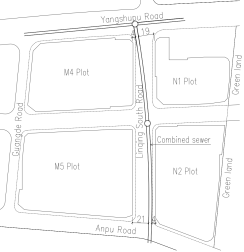
The project is located in Block 119, Daqiao Street, Yangpu Riverside Area, Shanghai, China. The project site is bounded by planned urban green land on the east, Guangde Road on the west, Anpu Road on the south and Yangshupu Road on the north. The whole construction project consists of four independent construction plots, numbered M4, M5, N1 and N2 respectively, with a total land use area of 52606 square meters. All four plots are designed with three-story underground basements to meet the functional requirements of building use and intensive urban land utilization. The foundation pit area of each plot is different, among which the M4 plot foundation pit covers 11355 m2, the M5 plot covers 14916 m2, the N1 plot covers 6024 m2, and the N2 plot covers 11128 m2. The unified excavation depth of all foundation pits in the project is 17.3 m, belonging to typical ultra-deep foundation pit engineering in Shanghai soft soil area.
Linqing South Road runs through the middle of the four construction plots, dividing the whole foundation pit group into east and west independent excavation areas. A large-diameter combined sewer is buried directly below Linqing South Road. The pipeline is constructed by professional pipe jacking technology, with an inner diameter of 3500 mm and an outer diameter of 4140 mm. Socket-type flexible joints are adopted between adjacent pipe segments to adapt to slight soil deformation. The buried depth of the central axis of the combined pipe is 9.5 m below the ground surface. In terms of spatial position relationship, the horizontal distance between the combined pipe and the excavation boundary of the western M4 and M5 foundation pits ranges from 4.2 m to 20.8 m, while the distance to the excavation boundary of the eastern N1 and N2 foundation pits is between 4.4 m and 19.5 m. The pipeline is basically within the influence range of one-time excavation depth of the deep foundation pits, and its buried depth is far smaller than the excavation depth of bilateral foundation pits. The superposed unloading disturbance generated by the excavation of foundation pits on both sides will cause continuous additional deformation of the combined pipe. Therefore, precise control of pipeline deformation induced by foundation pit excavation is the core key and difficult point of the whole project construction.
Figure 1 shows the planar layout of the project and the spatial position relationship between foundation pits and the combined sewer.
Figure 1. Plan view of the foundation pits and the combined sewer.
2.2. Engineering Geological Conditions
According to the detailed geotechnical engineering investigation report of the project, the construction site is located in the alluvial plain of the Yangtze River Estuary, belonging to the typical coastal marine sedimentary plain landform. The site strata are formed by long-term alternating sedimentation of river and seawater, and the soil layers are mainly composed of saturated cohesive soil, silty soil and sandy soil, with typical engineering characteristics of Shanghai soft soil such as high-water content, large void ratio, high compressibility and low structural strength. From top to bottom, the soil layers that have direct influence on the stability and deformation control of the deep foundation pit and adjacent pipelines are determined as follows: (1)
1 miscellaneous fill layer, (1)
3 silty clay (river beach soil) layer, (3) muddy silty clay layer, (4) muddy clay layer, (5)
1₋
1 clay layer, (5)
1₋
2 silty clay layer, (6) silty clay layer, (7)
1₋
1 silty clay layer, (7)
1₋
2 sandy silt layer, (7)
2 silt sand layer, (8) silty clay layer and (9) silt sand layer. The physical and mechanical calculation parameters of each soil layer are summarized in
Table 1.
Table 1. Physical and mechanical parameters of soil layers.
Layer | /kPa | /° | /° | /MPa | /MPa | /MPa | | | /MPa |
(1)3 | 3 | 30.5 | 0 | 7.2 | 8.6 | 50.4 | 0.5 | 0.9 | 200 |
(3) | 1 | 29.3 | 0 | 3.0 | 3.6 | 21.0 | 0.8 | 0.6 | 84 |
(4) | 3 | 25.3 | 0 | 2.1 | 2.5 | 14.7 | 0.8 | 0.6 | 59 |
(5)1₋1 | 3 | 30.3 | 0 | 2.7 | 3.2 | 18.9 | 0.8 | 0.9 | 75 |
(5)1₋2 | 5 | 32.3 | 0 | 4.3 | 5.2 | 30.1 | 0.8 | 0.9 | 120 |
(6) | 12 | 31.6 | 0 | 5.8 | 6.9 | 40.6 | 0.8 | 0.9 | 162 |
(7)1₋1 | 3 | 30.5 | 0.5 | 8.5 | 8.5 | 34.0 | 0.5 | 0.9 | 170 |
(7)1₋2 | 1 | 33.0 | 3 | 12.0 | 12.0 | 48.0 | 0.5 | 0.9 | 240 |
(7)2 | 5 | 35.0 | 5 | 13.6 | 13.6 | 54.4 | 0.5 | 0.9 | 272 |
3. Key Difficulties of Foundation Pit Engineering
1) The foundation pit group of this project consists of four independent deep foundation pits with a uniform excavation depth of 17.3 m. The clear spacing between adjacent foundation pits is only 28 m, which is less than three times the excavation depth of the foundation pit, forming a typical dense deep foundation pit group in soft soil areas. Different from single independent foundation pit excavation, the continuous unloading of multiple adjacent foundation pits will produce obvious stress superposition and deformation amplification effect on the inter-pit soil mass. The range and magnitude of soil displacement and stress change are significantly increased, which brings severe challenges to the overall deformation control of foundation pit group and the safety protection of surrounding underground municipal facilities.
2) The large-diameter combined sewer below Linqing South Road is a key municipal trunk pipeline of urban drainage engineering. The pipeline is directly connected to Songpan Combined Sewer Pumping Station in Yangpu District, undertaking the initial rainwater interception and pollution treatment work within a service area of 1.8 square kilometers. The pipeline is located in the superposed influence zone of bilateral foundation pit excavation, and the unloading deformation generated by the excavation of east and west foundation pits will jointly act on the pipeline, resulting in superposed settlement and lateral displacement. Once the pipeline deformation exceeds the allowable limit, structural defects such as socket joint dislocation and pipe segment cracking will occur. On the one hand, it will damage the normal drainage and pollution interception function of the pipeline; on the other hand, pipeline leakage will cause surrounding soil softening, reduce the stability of foundation pit wall, and even induce pit wall collapse and other major safety hazards. Thus, strict control of pipeline deformation and soil disturbance is the core construction difficulty of the project.
3) Two confined aquifers are developed in the deep stratum of the project site, including the first confined aquifer in Layer (7) and the second confined aquifer in Layer (9). The bottom buried depth of the first confined aquifer ranges from 64 m to 76 m, and local hydraulic connection exists between the two confined aquifers. During the excavation of 17.3 m deep foundation pit, the pit bottom is close to the confined aquifer, leading to a high risk of confined water inrush and soil piping. It is necessary to set up a professional confined water control system to ensure excavation safety. However, the drawdown of confined water will cause consolidation settlement of deep soil mass, which will further induce additional deformation of the adjacent large-diameter pipeline. Balancing foundation pit dewatering safety and pipeline deformation control is another key technical difficulty of the project.
4. Foundation Pit Support Design
4.1. Overall Scheme of Foundation Pit Engineering
In accordance with the local standard Technical Standard for Foundation Pit Engineering of Shanghai, the overall safety grade of all foundation pits in this project is defined as Grade I. Considering the protection requirement of the intermediate large-diameter combined pipe, the environmental protection grade of foundation pits is classified by the horizontal distance from the pipeline. The M5 plot foundation pit adjacent to the pipeline has an environmental protection grade of Grade II, while M4, N1 and N2 plots are all Grade I, putting forward high-standard requirements for enclosure structure deformation control.
To coordinate pipeline safety protection and project construction progress, a staggered zoned excavation scheme is adopted for the foundation pit group. The construction sequence is scientifically optimized: the M4 and N2 plots are excavated and constructed first, and the enclosure support and basement structure construction are completed in sequence. After the floor concrete of the two foundation pits reaches the design strength, the excavation and construction of adjacent M5 and N1 plots are carried out. This staggered excavation mode effectively weakens the superposed unloading effect of simultaneous bilateral excavation, and creates favorable conditions for pipeline deformation control. High-rigidity underground diaphragm walls are adopted for pit enclosure, and reinforced concrete structures are used for internal support. The detailed support design is elaborated with M5 and N1 plots as typical research objects.
4.2. Design of Foundation Pit Support Structure
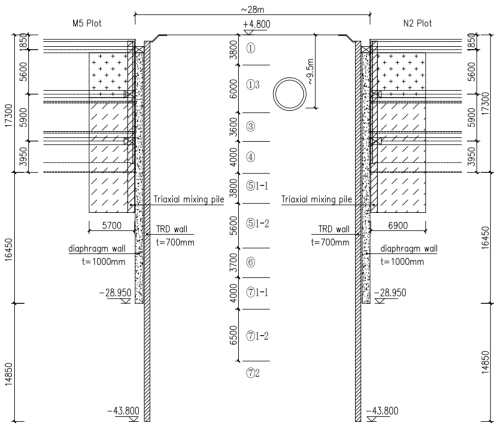
A composite support system of 1000 mm thick underground diaphragm wall matched with three layers of reinforced concrete internal supports is adopted for the foundation pit with 17.3 m excavation depth. The bottom buried depth of the diaphragm wall is 33.75 m, which effectively improves the overall bending stiffness and lateral resistance of the enclosure structure, and meets the stability and deformation control requirements of ultra-deep foundation pits in soft soil areas.
To reduce the construction disturbance of diaphragm wall trenching on surrounding soil and adjacent pipelines, cement-soil mixing piles are arranged on both sides of the wall for trench wall reinforcement. The outer mixing piles serve as the foundation pit water-stop curtain to realize water seepage prevention and trench wall stabilization. Triaxial cement-soil mixing piles are adopted for inner trench wall reinforcement, with the pile bottom extending 5 m below the pit bottom, which significantly improves the stability of deep trench wall and reduces soil disturbance during construction.
4.3. Design of Confined Water Control
Aiming at the confined water inrush risk of Layer (7) during foundation pit excavation, active dewatering and pressure reduction measures are adopted. A number of special dewatering wells are arranged inside the foundation pit. The dewatering wells adopt 273 mm diameter steel pipes with a wall thickness of 4 mm, with a total well depth of 38 m. The 7 m long filter pipe section is buried at 30 m depth, which can efficiently extract confined water in Layer (7) and reduce pit bottom water pressure.
Due to the deep buried depth of the confined aquifer and local hydraulic connection between aquifers, it is impossible to set up a full-depth closed water-stop curtain. Therefore, the suspended curtains made using Trench cutting Re-mixing Deep wall method (abbreviated as TRD) are adopted, with a pile bottom buried depth of 48.6 m. The suspended water-stop curtain can effectively block the horizontal seepage of shallow groundwater, reduce the influence of pit dewatering on the external groundwater field, and weaken the additional consolidation settlement of the combined pipe caused by dewatering.
4.4. Design of In-Pit Soil Reinforcement
To further control the horizontal deformation of the diaphragm wall, triaxial cement-soil mixing piles are used for edge reinforcement of the passive earth pressure zone inside the pit to improve the strength and rigidity of passive zone soil. The passive zone reinforcement width of M5 plot is 5.7 m, and that of N2 plot is 6.9 m. The reinforcement range covers from the bottom of the second concrete support to 5 m below the pit bottom, with a cement mixing content of 20% to ensure reliable reinforcement effect. The soil layer above the second support bottom is reinforced with a low cement content of 8%, which balances the structural stability and project economy.
Figure 2. Typical profile of foundation pit enclosure structure.
5. Pipeline Deformation Analysis and Reinforcement Measures
5.1. Numerical Analysis Model for Pipeline Deformation
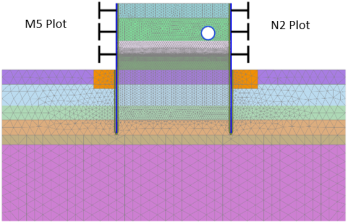
To quantitatively evaluate the deformation response law of the intermediate large-diameter combined pipe under bilateral foundation pit excavation, a finite element numerical model is established for the typical enclosure section of the foundation pit. The model has a horizontal width of 90 m and a vertical depth of 56 m. Full vertical displacement constraints are set at the model bottom, and horizontal displacement constraints are applied on the left and right boundaries to simulate the infinite boundary of natural stratum.
In the numerical model, the underground diaphragm wall is simulated by beam elements, the reinforced concrete internal supports are simulated by anchor rod elements, and the large-diameter jacking combined pipe is simulated by special tunnel structural elements. The Hardening Soil Small-strain (abbreviated as HSS) constitutive model, which is suitable for the small-strain deformation analysis of soft soils, is adopted for soil mass to accurately reflect the nonlinear deformation characteristics and stiffness degradation law of soft soil under unloading conditions. All soil model parameters are determined based on field test data, as shown in
Table 1. The enclosure structure and pipeline are defined as linear elastic materials with an elastic modulus of 30 GPa and a Poisson's ratio of 0.2.
Figure 3. Numerical analysis model of the foundation pit project.
The element deactivation technology is used to simulate the layered excavation and layered support construction process consistent with the actual site construction steps. The specific numerical simulation working conditions are shown in
Table 2.
Table 2. Simulation conditions of foundation pit excavation.
Analysis Step | Simulation Working Condition |
Step 1 | Balance of initial in-situ stress field |
Step 2 ~ Step 5 | Layered earthwork excavation and support construction of N1 plot foundation pit until excavation to pit bottom and floor structure completion |
Step 6 ~ Step 9 | Layered earthwork excavation and support construction of M5 plot foundation pit until full excavation to pit bottom |
5.2. Simulation Results of Pipeline Deformation
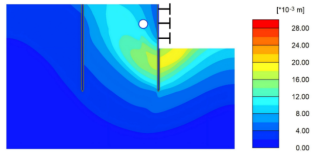
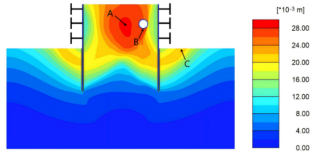
The soil displacement after N2 plot and M5 plot excavation are extracted for comparative analysis. After the completion of N2 plot excavation, the maximum horizontal displacement of the enclosure wall is 16.9 mm, the maximum surface settlement outside the pit is 11.4 mm, and the maximum pit bottom soil displacement is 20.0 mm, with limited deformation influence on the intermediate combined pipe. After the subsequent excavation of M5 plot, the superposed unloading effect is fully reflected. The maximum horizontal displacement of N2 enclosure wall increases to 19.1 mm, and the maximum horizontal displacement of M5 enclosure wall reaches 18.5 mm. The maximum external surface settlement rises to 26.4 mm, and the maximum soil displacement in the middle area between the two pits reaches 28.3 mm. The simulation results verify that single-side foundation pit excavation mainly causes pit bottom soil deformation, while sequential bilateral excavation produces superposed deformation in the intermediate soil layer, which is the main cause of pipeline additional deformation.
Figure 4. Soil displacement after excavation of N2 plot.
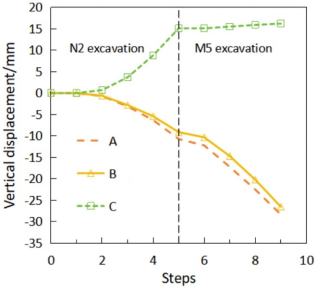
Three typical monitoring points are selected to analyze the vertical displacement evolution law: Point A is the maximum settlement position of inter-pit soil, Point B is the bottom of the combined pipe, and Point C is the maximum uplift position of N2 pit bottom. The monitoring data show that Point C presents continuous elastic rebound during N2 plot excavation, with a final rebound of 15.2 mm after pit excavation. The rebound value slightly increases to 16.2 mm during M5 plot excavation. Both Point A and Point B show continuous cumulative settlement. After N2 plot excavation, the settlement of Point A and Point B is 10.7 mm and 9.1 mm respectively. After the completion of bilateral foundation pit excavation, the maximum cumulative settlement of the pipeline at Point B reaches 26.5 mm, which is close to the safety deformation limit of the operating pipeline, requiring targeted reinforcement treatment.
Figure 5. Soil displacement after excavation of M5 plot.
Figure 6. Vertical displacement curves of typical points.
5.3. Design of Pipeline Reinforcement
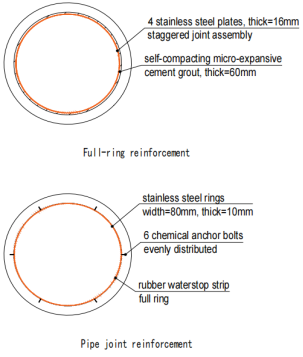
Based on numerical simulation results, pipeline spatial position and engineering economy, a differentiated targeted reinforcement scheme is formulated for the large-diameter combined pipe to eliminate structural safety risks. For pipeline sections with a net distance less than 3 m from the foundation pit enclosure wall, which are located in the strong deformation influence zone, full-ring stainless steel lining reinforcement is adopted. Prefabricated stainless steel pipe segments are assembled and welded into an integral structure inside the pipeline, which effectively improves the overall stiffness, crack resistance and impermeability of the pipeline structure.
For pipeline sections with a net distance greater than 3 m from the enclosure wall, the overall pipeline deformation is small, and the socket joint between pipe segments is the weak structural part prone to water seepage and dislocation. Therefore, a composite reinforcement technology of annular rubber water-stop sealing strips and stainless steel sleeve rings is adopted for pipe joints. The rubber sealing strip plays a buffering and water-stop role, and the outer stainless steel sleeve ring limits the relative displacement of adjacent pipe segments, effectively improving the anti-dislocation and anti-leakage performance of pipe joints.
Figure 7. Profile of combined sewer pipe reinforcement design.
6. Project Implementation Effect
A professional third-party monitoring unit is entrusted to carry out full-process automatic deformation monitoring and manual inspection of the large-diameter combined pipe during the whole foundation pit construction period. A total of 56 monitoring points is arranged along the pipeline axis to cover all key deformation sections. After the completion of M5 plot basement structure construction, statistical analysis of monitoring data shows that the maximum cumulative settlement of the combined pipe is 29.4 mm, which is basically consistent with the numerical simulation result of 26.5 mm. The minor deviation is caused by on-site construction disturbance and environmental factors. Combined with daily on-site inspection, no structural cracks, joint dislocation, water seepage and other abnormal defects are found in the pipeline, and the pipeline maintains stable and normal operation.
7. Conclusions
Based on the typical soft soil foundation pit group project in Shanghai, this paper systematically studies the safety protection technology of large-diameter municipal combined pipes under the superposed unloading effect of bilateral dense deep foundation pit excavation. A complete set of pipeline protection technical system integrating optimized foundation pit support design and differentiated pipeline reinforcement is formed.
In terms of foundation pit support design, the composite support system of high-rigidity underground diaphragm wall, multi-layer reinforced concrete internal support and passive zone soil reinforcement is adopted, which effectively controls the deformation of enclosure structures from the source, reduces the soil unloading disturbance outside the pit, and weakens the additional deformation of adjacent pipelines.
The finite element numerical simulation method is used to reveal the superposed deformation mechanism of large-diameter pipelines under bilateral foundation pit excavation, and the maximum cumulative deformation of the pipeline is quantitatively obtained. A differentiated reinforcement scheme is proposed accordingly, adopting full-ring stainless steel lining for strong influence zones and joint composite reinforcement for general influence zones, realizing precise and economical pipeline reinforcement.
Field monitoring data and on-site inspection results verify that the adopted technical system can effectively control the structural deformation of large-diameter combined pipes, avoid pipeline structural damage and leakage risks, and fully guarantee the safe and stable operation of municipal pipelines during foundation pit group construction. The research conclusions and technical experience can provide valuable references for similar pipeline protection and deep foundation pit construction projects in soft soil areas.
Abbreviations
TRD | Trench Cutting Re-mixing Deep Wall Method |
HSS | Hardening Soil Small-strain |
Acknowledgments
Zhirong Liang and Jun Zhao are acknowledged for their support of this work.
Author Contributions
Jingde Liu: Investigation, Writing – original draft
Xiang Wei: Supervision
Chong He: Project administration
Funding
This work is sponsored by Shanghai Rising-Star Pro-gram (B type) (NO. 20QB1404500) and Research Project of Arcplus Group (NO. 24-1-0113-Di).
Data Availability Statement
The data is available from the corresponding author upon reasonable request.
Conflicts of Interest
The authors declare no conflicts of interest.
References
| [1] |
Huang P, Yang X, Li X, et al. Influence of Construction of Deep Excavation Groups on Adjacent Shallowly Buried Pipelines in Soft Clay. China Journal of Highway and Transport, 2023, 36(3): 146-155.
https://doi.org/10.19721/j.cnki.1001-7372.2023.03.011
|
| [2] |
Jin Y, Gu X W, Ye X, et al. Measurement analysis of influence on metro tunnel caused by nearby excavation in typical stratum. Building Structure, 2023, 53(15): 132-136.
https://doi.org/10.19701/j.jzjg.ls220209
|
| [3] |
Gu, X W, Yi, Z H, Wang, Z, et al. Influences of Excavation of Deep Foundation Pits on Deformation of Adjacent Double-line Subway Tunnels through Measurement Analysis. Chinese Journal of Geotechnical Engineering. 2023, 45(S2), 214-219.
https://doi.org/10.11779/CJGE2023S20030
|
| [4] |
Huang X, Huang H W, Zhang D M. Longitudinal Deflection of Existing Shield Tunnels due to Deep Excavation. Chinese Journal of Geotechnical Engineering, 2012, 34(7): 1241-1249.
https://doi.org/10.11779/CJGE201207015
|
| [5] |
Zhang Y W, Xie Y L, Weng M S. Centrifugal Test on Influence of Asymmetric Foundation Excavation to an Underlying Subway Tunnel. Rock and Soil Mechanics, 2018, 39(7): 2555-2562.
https://doi.org/10.16285/j.rsm.2016.2243
|
| [6] |
Ding Z, Zhang X, Jin J K, et al. Measurement Analysis on Whole Excavation of Foundation Pit and Deformation of Adjacent Metro Tunnel. Rock and Soil Mechanics, 2019, 40(S1): 415-423.
https://doi.org/10.16285/j.rsm.2019.0190
|
| [7] |
Yang Z F, Chen H X, Luo M M. Analysis of the Measurements of Excavation Adjacent to Large-diameter Shield Tunnel [J]. Ground Improvement, 2023, 5(1): 67-75.
https://doi.org/10.3785/j.issn.2096-7195.2023.01.010
|
| [8] |
Chen J J, Wang J H, Du Y. Movement of Shallow Operating Tunnel due to Adjacent Deep Excavation on Both Sides. Chinese Journal of Underground Space and Engineering, 2011, 7(6): 1163-1167.
https://doi.org/10.3969/j.issn.1673-0836.2011.06.021
|
| [9] |
Zhang B, Song X, Liu J Y. Study on the influence of foundation pit excavation on the adjacent large-diameter fully prefabricated tunnel. Water Resources and Hydropower Engineering, 2025, 56(S2): 293-298.
https://doi.org/10.13928/j.cnki.wrahe.2025.S2.052
|
| [10] |
Zhao Y H, Zhen J, Li Q H, et al. Analysis of influence of ultra-deep foundation pit on deformation of existing subway in soft soil area. Chinese Journal of Geotechnical Engineering, 2025, 47(S2): 293-298.
https://doi.org/10.11779/CJGE2025S20025
|
| [11] |
Chen J B, Wu D Z, Wang R, et al. Assessment of the impact of foundation pit excavation on adjacent existing tunnel deformation under dewatering conditions. Journal of Zhejiang Sci-Tech University, 2026, 55(3): 268-279.
https://doi.org/10.3969/j.issn.1673-3851(n).2026.03.004
|
| [12] |
Wang, W D. Analytical Methods and Controlling Techniques for Deformation and Environmental Influence of Deep Excavations in Soft Soils. Chinese Journal of Geotechnical Engineering. 2024, 46(1), 1-25.
https://doi.org/10.11779/CJGE20231146
|
| [13] |
Pang H, Fu Z H, Chen K, et al. Protection Measures of Deep Foundation Excavation to Existing Pipeline and Deformation Mechanism Analysis. Construction Technology, 2025, 54(13): 44-50.
https://doi.org/10.7672/sgjs2025130044
|
| [14] |
Wang G L. Research on the feasibility of the construction of in-situ suspension protection structure for power pipe gallery. Engineering and Technological Research, 2024, 9(10): 47-49.
https://doi.org/10.19537/j.cnki.2096-2789.2024.10.016
|
| [15] |
Li C W, Li W, Liang Z R. Design and Analysis of Synchronous Construction of Deep Foundation Pit on Both Sides of Tunnels in Soft Soils. Chinese Journal of Underground Space and Engineering, 2018, 14(S1): 193-199.
https://doi.org/10.20174/j.juse.2018.s1.029
|
| [16] |
Li Z, Hou Z Y, Li J F, et al. Construction Technology of High-difficulty Deformation Protection for Large Diameter Sewage Pipe Adjacent to Deep Foundation Excavation. Construction Technology, 2024, 53(16): 86-91.
https://doi.org/10.7672/sgjs2024160086
|
Cite This Article
-
APA Style
Liu, J., Wei, X., He, C. (2026). Research on Protection Technology of Large-Diameter Pipeline Adjacent to Bilateral Deep Foundation Pits. Journal of Civil, Construction and Environmental Engineering, 11(4), 242-250. https://doi.org/10.11648/j.jccee.20261104.18
 Copy
|
Copy
|
 Download
ACS Style
Liu, J.; Wei, X.; He, C. Research on Protection Technology of Large-Diameter Pipeline Adjacent to Bilateral Deep Foundation Pits. J. Civ. Constr. Environ. Eng. 2026, 11(4), 242-250. doi: 10.11648/j.jccee.20261104.18
Copy
|
Download
AMA Style
Liu J, Wei X, He C. Research on Protection Technology of Large-Diameter Pipeline Adjacent to Bilateral Deep Foundation Pits. J Civ Constr Environ Eng. 2026;11(4):242-250. doi: 10.11648/j.jccee.20261104.18
Copy
|
Download
-
@article{10.11648/j.jccee.20261104.18,
  author = {Jingde Liu and Xiang Wei and Chong He},
  title = {Research on Protection Technology of Large-Diameter Pipeline Adjacent to Bilateral Deep Foundation Pits},
  journal = {Journal of Civil, Construction and Environmental Engineering},
  volume = {11},
  number = {4},
  pages = {242-250},
  doi = {10.11648/j.jccee.20261104.18},
  url = {https://doi.org/10.11648/j.jccee.20261104.18},
  eprint = {https://article.sciencepublishinggroup.com/pdf/10.11648.j.jccee.20261104.18},
  abstract = {Based on the practical engineering of adjacent deep foundation pits in Shanghai, this paper focuses on the prominent safety problem of large-diameter combined sewer affected by excavation of bilateral deep foundation pits. Pipeline protection technology is studied from foundation pit enclosure design and pipeline reinforcement. The foundation pit enclosure design adopted multiple effective technical measures, such as improving the overall rigidity of enclosure structures and reinforcement treatment of the passive earth pressure zone soil, which effectively reduce the adverse disturbance and deformation impact on adjacent large-diameter combined sewer due to excavation. The additional deformation characteristics of the combined sewer are numerically investigated under the superimposed unloading effect of bilateral foundation pit excavation. Based on the numerical analysis, differentiated reinforcement measures are adopted for the combined sewer, including full-ring stainless steel lining reinforcement technology and the composite reinforcement of annular rubber water-stop sealing strips matched with stainless steel sleeve rings. The practice indicates that the foundation pit enclosure design and pipeline reinforcement technology adopted in this project can effectively control the structural deformation of large-diameter combined sewer and fully guarantee the safe and stable operation of municipal pipeline facilities during the excavation of bilateral deep foundation pits.},
 year = {2026}
}
Copy
|
Download
-
TY  - JOUR
T1  - Research on Protection Technology of Large-Diameter Pipeline Adjacent to Bilateral Deep Foundation Pits
AU  - Jingde Liu
AU  - Xiang Wei
AU  - Chong He
Y1  - 2026/08/26
PY  - 2026
N1  - https://doi.org/10.11648/j.jccee.20261104.18
DO  - 10.11648/j.jccee.20261104.18
T2  - Journal of Civil, Construction and Environmental Engineering
JF  - Journal of Civil, Construction and Environmental Engineering
JO  - Journal of Civil, Construction and Environmental Engineering
SP  - 242
EP  - 250
PB  - Science Publishing Group
SN  - 2637-3890
UR  - https://doi.org/10.11648/j.jccee.20261104.18
AB  - Based on the practical engineering of adjacent deep foundation pits in Shanghai, this paper focuses on the prominent safety problem of large-diameter combined sewer affected by excavation of bilateral deep foundation pits. Pipeline protection technology is studied from foundation pit enclosure design and pipeline reinforcement. The foundation pit enclosure design adopted multiple effective technical measures, such as improving the overall rigidity of enclosure structures and reinforcement treatment of the passive earth pressure zone soil, which effectively reduce the adverse disturbance and deformation impact on adjacent large-diameter combined sewer due to excavation. The additional deformation characteristics of the combined sewer are numerically investigated under the superimposed unloading effect of bilateral foundation pit excavation. Based on the numerical analysis, differentiated reinforcement measures are adopted for the combined sewer, including full-ring stainless steel lining reinforcement technology and the composite reinforcement of annular rubber water-stop sealing strips matched with stainless steel sleeve rings. The practice indicates that the foundation pit enclosure design and pipeline reinforcement technology adopted in this project can effectively control the structural deformation of large-diameter combined sewer and fully guarantee the safe and stable operation of municipal pipeline facilities during the excavation of bilateral deep foundation pits.
VL  - 11
IS  - 4
ER  -
Copy
|
Download





 Share This Article
 Twitter
 Linked In
 Facebook