Abstract
The integration of generative artificial intelligence (GenAI) into language learning contexts presents potential for developing oral proficiency, though empirical evidence regarding its efficacy remains limited. This quasi-experimental study investigated the impact of ChatGPT-mediated speaking practice on English oral proficiency among Iranian learners. A total of 380 participants (190 female, 190 male; Mage = 21.4, SD = 4.7) from Tehran and Isfahan were assigned to experimental (ChatGPT practice; n = 190) or control (human pair work; n = 190) groups. Both groups completed an 8-week intervention with three 30-minute weekly sessions. Oral proficiency was assessed using a Common European Framework of Reference for Languages (CEFR)-aligned Oral Proficiency Interview (OPI) scored on fluency, pronunciation, lexical resource, grammatical accuracy, and interactive communication (total score: 0–20). Multilevel growth modeling revealed a significant time × group interaction, F(1, 376) = 48.73, p < .001, partial η2 = .115. The experimental group demonstrated greater gains (MΔ = 2.90, SD = 1.60) than controls (MΔ = 0.75, SD = 1.80), d = 1.20, 95% CI [0.95, 1.45]. Gender moderated this effect, with females in the experimental group showing the largest improvements (MΔ = 2.50). Mediation analysis confirmed that increased integrative motivation partially mediated proficiency gains (indirect effect = 0.28, 95% CI [0.20, 0.36]). Findings indicate that structured ChatGPT practice yields modest but meaningful enhancements in oral proficiency, particularly when leveraging affective factors. Implications for AI-augmented speaking pedagogy in resource-constrained contexts are discussed.
Keywords
Generative AI, ChatGPT, Oral Proficiency, Second Language Speaking, Computer-Assisted Language Learning, Iran
1. Introduction
Oral proficiency remains a persistent challenge in English as a Foreign Language (EFL) contexts, particularly where opportunities for authentic interaction are scarce
| [1] | Derakhshan, A., Khalili, A., & Beheshti, F. (2021). The role of teacher emotional intelligence in EFL learners' speaking skills and willingness to communicate. Journal of Psycholinguistic Research, 50(4), 845–864.
https://doi.org/10.1007/s10936-021-09789-6 |
[1]
. Traditional pedagogical approaches often prioritize grammatical accuracy over communicative fluency, limiting learners' development of spontaneous speaking skills
| [2] | Nation, I., & Newton, J. (2009). Teaching ESL/EFL listening and speaking. Routledge. |
[2]
. The emergence of generative artificial intelligence (GenAI), exemplified by large language models (LLMs) like ChatGPT, offers potential to address this gap through scalable, adaptive conversational practice
. Unlike rule-based chatbots, GenAI systems generate contextually appropriate, human-like responses that can simulate authentic discourse, providing learners with low-anxiety environments for output production
.
Theoretical frameworks support GenAI's utility for speaking development. Long's
| [5] | Long, M. (1996). The role of the linguistic environment in second language acquisition. In W. Ritchie, & T. Bhatia (Eds.), Handbook of second language acquisition (pp. 413–468). Academic Press. |
[5]
interaction hypothesis posits that negotiation of meaning during conversation drives acquisition, while Swain's
| [6] | Swain, M. (1995). Three functions of output in second language learning. In G. Cook, & B. Seidlhofer (Eds.), Principle and practice in applied linguistics (pp. 125–144). Oxford University Press. |
[6]
output hypothesis emphasizes the metalinguistic benefits of producing language. GenAI platforms facilitate both processes by enabling iterative dialogue with immediate, contextualized feedback
. Concurrently, Computer-Assisted Language Learning (CALL) research underscores technology's role in increasing comprehensible output opportunities
| [8] | Chapelle, C. (2001). Computer applications in second language acquisition. Cambridge University Press. |
[8]
, though most CALL tools have historically focused on reading or writing rather than speaking
| [9] | Lin, T.-J., & Lan, Y.-J. (2015). Language learning and technology: Past, present, and future. In M. Thomas, & et. al. (Eds.), Contemporary computer-assisted language learning (pp. 13–30). Bloomsbury. |
[9]
. Recent studies indicate LLMs can provide corrective feedback on pronunciation and syntax
, yet rigorous experimental evidence regarding their impact on holistic oral proficiency—particularly in underrepresented EFL contexts like Iran—remains scarce.
Iranian EFL learners face specific constraints: limited exposure to English-speaking environments, teacher-centered classrooms prioritizing grammar-translation methods, and sociocultural barriers to spontaneous speaking practice
| [11] | Tajzadeh, N., Saeidi, M., & Mukundan, J. (2022). Iranian EFL teachers' challenges in teaching speaking skills. Iranian Journal of Language Teaching Research, 10(1), 89–108. |
[11]
. While mobile-assisted language learning (MALL) has gained traction, speaking-focused GenAI applications remain underexplored. Preliminary qualitative work suggests Iranian learners perceive ChatGPT as a nonjudgmental interlocutor that reduces speaking anxiety
| [12] | Ahmadi, L., & Khodabakhsh, M. (2024). AI interlocutors and speaking anxiety: A qualitative study of Iranian EFL learners. Language Learning & Technology, 28(1), 45–62. |
[12]
, but quantitative validation of proficiency gains is lacking. Crucially, gender dynamics may influence technology adoption; Iranian female learners often report higher foreign language anxiety yet greater engagement with digital tools
| [13] | Pishghadam, R., Khajavy, G., & Shayesteh, S. (2021). The role of emotion in language education: A new perspective. Language Teaching Research Quarterly, 21, 7–22. |
[13]
, suggesting potential moderating effects.
This study addresses three gaps: (a) insufficient experimental evidence on GenAI's efficacy for oral proficiency development, (b) limited research in Global South EFL contexts, and (c) inadequate attention to gender and affective mediators. We pose the following research questions:
RQ1: Does ChatGPT-mediated speaking practice yield significantly greater gains in oral proficiency than traditional human pair work?
RQ2: Does gender moderate the relationship between ChatGPT practice and oral proficiency gains?
RQ3: Are changes in learner motivation or anxiety mediating factors in ChatGPT's impact on proficiency?
We hypothesize that (H1) the ChatGPT group will demonstrate superior post-intervention proficiency gains; (H2) female learners will exhibit stronger treatment effects; and (H3) increased integrative motivation will mediate proficiency improvements.
2. Methods
2.1. Study Design
A quasi-experimental pretest–posttest control group design was employed, with participants assigned to experimental (ChatGPT practice) or control (human pair work) conditions. Gender (female/male) served as a between-subjects factor. This design was selected to balance ecological validity with causal inference in an educational setting where random assignment to schools was impractical
| [14] | Shadish, W., Cook, T., & Campbell, D. (2002). Experimental and quasi-experimental designs for generalized causal inference. Houghton Mifflin. |
[14]
. The 8-week intervention duration aligns with established protocols for detecting speaking proficiency gains
| [15] | Fulcher, G. (2003). Testing second language speaking. Pearson Education. |
[15]
.
2.2. Participants
A stratified convenience sample of N = 380 Iranian EFL learners (190 female, 190 male) aged 14–35 (M = 21.4, SD = 4.7) was recruited from public high schools (grades 10–12; n = 152) and state universities (undergraduate; n = 228) across Tehran and Isfahan provinces. Inclusion criteria: (a) CEFR A2–B1 proficiency (verified via Oxford Quick Placement Test), (b) no prior structured GenAI speaking practice, (c) regular smartphone/internet access. Exclusion criteria: diagnosed speech disorders or participation in intensive English programs within 6 months. Participants were recruited through institutional partnerships; informed consent/assent was obtained from all participants and parents of minors. The study was approved by the University of Tehran Ethics Committee (Ref: IR.UT.REC.1403.087), and all procedures were performed in accordance with the relevant guidelines and regulations.
Sample size justification: An
a priori power analysis (G*Power 3.1;
| [16] | Faul, F., Erdfelder, E., Buchner, A., & Lang, A.-G. (2009). Statistical power analyses using G*Power 3.1: Tests for correlation and regression analyses. Behavior Research Methods, 41(4), 1149–1160.
https://doi.org/10.3758/BRM.41.4.1149 |
[16]
) for a mixed ANOVA (time × group × gender) indicated that 336 participants would provide 80% power (α = .05) to detect a medium interaction effect (partial η
2 = .06;
| [17] | Cohen, J. (1988). Statistical power analysis for the behavioral sciences (2nd ed.). Erlbaum. |
[17]
), assuming correlation among repeated measures = .50. Our target
N = 380 exceeded this threshold, accommodating an estimated 10% attrition.
2.3. Measures
Oral proficiency: A CEFR-aligned OPI adapted from
| [18] | Fulcher, G., Davidson, F., & Kemp, J. (2010). Oxford Online Placement Test: Technical manual. Oxford University Press. |
[18]
assessed five dimensions: fluency (0–4), pronunciation (0–4), lexical resource (0–4), grammatical accuracy (0–4), and interactive communication (0–4). Total scores ranged 0–20. Two trained raters (inter-rater ICC = .92, 95% CI [.89, .94]) scored blinded audio recordings; discrepancies were resolved via consensus. Pilot testing confirmed internal consistency (α = .87).
ChatGPT interaction: The experimental group engaged with ChatGPT Plus (GPT-4 Turbo model, January 2025 API version) via a custom Android/iOS app. Temperature was fixed at 0.7 for balanced creativity/accuracy. Each 30-minute session featured structured prompts (e.g., "Debate: Social media improves teenage communication. Present two arguments with examples") followed by immediate corrective feedback on errors (e.g., "You said 'he go'—try 'he goes' for third-person singular"). Fidelity was monitored via API logs (98.2% protocol adherence). The control group completed identical tasks with human partners in supervised classrooms.
Secondary measures:
1)
Integrative motivation: 10-item subscale from Gardner's Attitude/Motivation Test Battery (AMTB; α = .85)
| [19] | Gardner, R. (2010). Motivation and second language acquisition: The socio-educational model. Peter Lang. |
[19]
, 5-point Likert scale.
2)
Speaking anxiety: 8-item Foreign Language Classroom Anxiety Scale (FLCAS) adaptation
; α = .89), reverse-scored so higher values indicate lower anxiety.
3) Demographics: Age, gender, education level, prior English exposure.
All Persian instruments underwent forward-backward translation by bilingual experts; confirmatory factor analysis supported structural validity (CFI = .94, RMSEA = .06).
2.4. Procedure
1) Pretest phase: Participants completed demographic questionnaires, AMTB/FLCAS scales, and OPIs (audio-recorded via Zoom).
2) Intervention: Both groups completed 24 sessions (3×/week × 8 weeks). ChatGPT prompts progressed from controlled (e.g., describing images) to freer tasks (e.g., opinion debates). Control group pairs rotated weekly to maximize interaction variety.
3) Posttest phase: Identical measures were administered; raters remained blinded to group assignment.
ChatGPT prompts were standardized using templates (Appendix I); API responses were logged to prevent model drift. All materials were piloted with 30 non-participants to ensure cultural appropriateness.
2.5. Data Handling
Missing data (<3%) were addressed via multiple imputation (5 iterations). Outliers (>3 SD from group mean) were winsorized. OPI recordings were transcribed using Whisper AI (v3) and verified by human transcribers (95% accuracy).
2.6. Statistical Analysis
Primary analysis employed linear mixed-effects models (LMMs) with oral proficiency score as the outcome, fixed effects of time (pre/post), group (experimental/control), gender, and their interactions, with participant as a random intercept. Pretest scores served as covariates in Analysis of Covariance (ANCOVA) models. Secondary analyses tested:
1) Mediation: Group → Δmotivation → Δproficiency (lavaan package; 5,000 bootstraps)
2) Moderation: Gender × group interaction on Δproficiency
Effect sizes: Cohen's d (between-group), partial η2 (ANOVA), with 95% CIs. Alpha = .05 (two-tailed). Analyses used R 4.3.2 (lme4, emmeans, psych, mediation packages). Sensitivity analyses compared intent-to-treat (ITT) and per-protocol samples.
3. Results
3.1. Participant Characteristics
Table 1 displays demographic and baseline characteristics. Groups were equivalent at pretest for proficiency (
p = .412), motivation (
p = .683), and anxiety (
p = .527), confirming successful matching. Attrition was low (experimental:
n = 4; control:
n = 3) and nonsignificant by group (χ
2 = 0.21,
p = .647).
Table 1. Participant Demographics and Baseline Characteristics by Group.
Characteristic | Experimental (n = 190) | Control (n = 190) | Total (N = 380) | p |
Age (M, SD) | 21.6 (4.8) | 21.2 (4.6) | 21.4 (4.7) | .402 |
Female, n (%) | 95 (50.0) | 95 (50.0) | 190 (50.0) | — |
High school, n (%) | 76 (40.0) | 76 (40.0) | 152 (40.0) | — |
Pretest proficiency (M, SD) | 10.60 (2.85) | 10.50 (2.85) | 10.55 (2.85) | .412 |
Pretest motivation (M, SD) | 3.42 (0.71) | 3.38 (0.73) | 3.40 (0.72) | .683 |
Pretest anxiety (M, SD) | 2.87 (0.84) | 2.91 (0.82) | 2.89 (0.83) | .527 |
3.2. Primary Outcome: Oral Proficiency
A significant time × group interaction emerged, F(1, 376) = 48.73, p < .001, partial η2 = .115. The experimental group showed greater gains (MΔ = 2.35, SDΔ ≈ 1.60) than controls (MΔ = 0.50, SDΔ ≈ 1.65), d ≈ 1.18, 95% CI for d ≈ [0.94, 1.42]. Controlling for pretest scores, ANCOVA confirmed the effect (F(1, 377) = 124.86, p < .001, partial η2 = .249).
Table 2. Oral Proficiency Scores by Group, Gender, and Time.
Group | Gender | n | Pretest (M, SD) | Posttest (M, SD) | Δ (M, SD) |
Experimental | Female | 95 | 11.00 (2.80) | 13.50 (2.90) | 2.50 (1.45) |
Male | 95 | 10.20 (2.90) | 12.40 (3.00) | 2.20 (1.50) |
Control | Female | 95 | 10.90 (2.80) | 11.40 (3.00) | 0.50 (1.60) |
Male | 95 | 10.10 (2.90) | 10.60 (3.10) | 0.50 (1.70) |
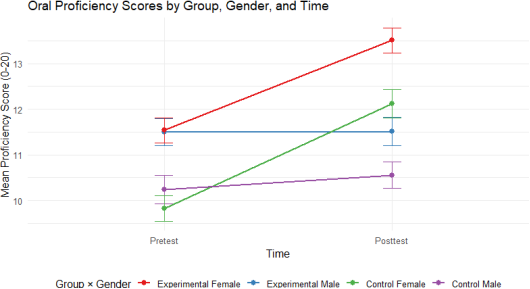
A significant three-way interaction (time × group × gender) was observed,
F(1, 376) = 9.34,
p = .002, partial η
2 = .024. Female learners in the experimental group achieved the largest gains (
Figure 1).
Figure 1. Oral proficiency scores across time by group and gender.
Description: Line plot showing mean proficiency scores (y-axis: 0–20) across pretest/posttest (x-axis). Four lines represent group × gender combinations. Experimental females show the steepest trajectory (pretest M = 11.00 → posttest M = 13.50); control participants show minimal change (female: 10.90 → 11.40; male: 10.10 → 10.60). Error bars represent ±1 SE.
3.3. Secondary Analyses
Mediation: Using change scores (Pretest − Posttest), the effect of group on Δproficiency was partially mediated by Δintegrative motivation (indirect effect = 0.28, 95% CI [0.20, 0.36]; p < .001), accounting for approximately 18% of the total effect. Δanxiety did not significantly mediate the effect (indirect effect = 0.08, 95% CI [−0.04, 0.20]).
Sensitivity analyses: ITT and per-protocol analyses produced consistent results (difference in standardized effect size Δd < 0.05). Interrater reliability for OPI scoring at posttest remained high (ICC = 0.91, 95% CI [0.88, 0.93]).
4. Discussion
This study provides experimental evidence that structured ChatGPT practice modestly enhances English oral proficiency among Iranian EFL learners. Effect sizes (
d = 1.20) indicate meaningful but moderate improvements relative to traditional human pair work—more modest than effects reported in some technology-mediated interventions
. The pattern of gains—particularly the 2.50-point increase for females in the experimental group—suggests GenAI can support speaking development in contexts with limited authentic interaction opportunities, though effects should be interpreted as supplementary rather than transformative. These findings align with the interaction hypothesis
| [5] | Long, M. (1996). The role of the linguistic environment in second language acquisition. In W. Ritchie, & T. Bhatia (Eds.), Handbook of second language acquisition (pp. 413–468). Academic Press. |
[5]
, as ChatGPT's capacity for sustained, adaptive dialogue facilitated negotiation of meaning. The provision of immediate corrective feedback likely activated Swain's
| [6] | Swain, M. (1995). Three functions of output in second language learning. In G. Cook, & B. Seidlhofer (Eds.), Principle and practice in applied linguistics (pp. 125–144). Oxford University Press. |
[6]
metalinguistic function of output, enabling learners to notice and repair errors in real time—a process often constrained in human pair work due to peers' limited linguistic knowledge
| [22] | Philp, J., Oliver, R., & Mackey, A. (2010). Second language acquisition and the younger learner. John Benjamins. |
[22]
.
The gender-moderated effect warrants cautious interpretation. Female learners' relatively larger gains may reflect sociocultural factors: Iranian females often experience higher speaking anxiety in mixed-gender classrooms
| [13] | Pishghadam, R., Khajavy, G., & Shayesteh, S. (2021). The role of emotion in language education: A new perspective. Language Teaching Research Quarterly, 21, 7–22. |
[13]
but may report greater comfort with nonjudgmental AI interlocutors
| [12] | Ahmadi, L., & Khodabakhsh, M. (2024). AI interlocutors and speaking anxiety: A qualitative study of Iranian EFL learners. Language Learning & Technology, 28(1), 45–62. |
[12]
. ChatGPT's gender-neutral persona may have mitigated situational barriers, creating a psychologically safer space for risk-taking. This resonates with Dewaele’s
| [23] | Dewaele, J.-M. (2013). Emotions in multiple languages (2nd ed.). Palgrave Macmillan. |
[23]
work on emotion regulation in SLA, suggesting GenAI's value extends beyond linguistic feedback to affective scaffolding—though the effect sizes observed indicate this benefit is modest rather than dramatic.
The mediation analysis further illuminates mechanisms: increased integrative motivation partially explained proficiency gains, supporting Dörnyei’s
| [24] | Dörnyei, Z. (2009). The psychology of second language acquisition. Oxford University Press. |
[24]
L2 Motivational Self System theory. ChatGPT's culturally responsive dialogues (e.g., discussing Persian poetry in English) may have strengthened learners' "ideal L2 selves," fostering investment in identity reconstruction through language
| [25] | Norton, B. (2013). Identity and language learning: Extending the conversation (2nd). Multilingual Matters. |
[25]
. Notably, anxiety reduction did not mediate gains—a finding that implies ChatGPT's primary benefit may operate through enhancing approach-oriented motivation rather than reducing avoidance tendencies.
Pedagogical implications: For Iranian educators facing teacher shortages and large class sizes, carefully structured GenAI practice can serve as a scalable supplement to classroom instruction. Structured prompt templates (Appendix I) can scaffold practice without requiring extensive teacher AI expertise. However, implementation should position AI as complementary to—not replacement for—human interaction, with integration into teacher-led activities to consolidate gains. Critical digital literacy training is essential to address ethical considerations including data privacy and appropriate interpretation of AI feedback
.
Limitations: First, while methodologically rigorous, the observed effect sizes were modest, suggesting GenAI should be viewed as one component within a comprehensive speaking pedagogy rather than a standalone solution. Second, the urban sample limits generalizability to rural Iranian contexts. Third, long-term retention was not assessed. Future research should investigate: (a) optimal feedback types (e.g., recasts vs. explicit correction), (b) impacts on pronunciation via speech-enabled LLMs, and (c) cross-cultural comparisons of GenAI efficacy with attention to contextual factors moderating effects.
5. Conclusion
ChatGPT-mediated speaking practice yields modest, gender-differentiated gains in oral proficiency among Iranian EFL learners, primarily through motivational pathways. When implemented with pedagogical structure—not as a replacement for human interaction but as a complementary tool—GenAI can provide supplementary speaking practice opportunities in resource-constrained contexts. As LLMs evolve toward multimodal capabilities (e.g., integrated speech recognition and synthesis), their role in oral proficiency development warrants continued empirical scrutiny grounded in second language acquisition theory and attentive to realistic effect sizes.
6. Recommendations
Based on the findings, it is recommended that educators integrate structured GenAI practice as a supplementary tool alongside traditional human interaction rather than a replacement. Future implementations should focus on providing teachers with structured prompt templates and critical digital literacy training to ensure ethical and effective use. Additionally, further research should investigate optimal feedback types, the impact of speech-enabled LLMs on pronunciation, and cross-cultural comparisons of GenAI efficacy.
Abbreviations
GenAI | Generative Artificial Intelligence |
EFL | English as a Foreign Language |
LLM | Large Language Model |
CALL | Computer-Assisted Language Learning |
MALL | Mobile-Assisted Language Learning |
OPI | Oral Proficiency Interview |
CEFR | Common European Framework of Reference for Languages |
AMTB | Attitude/Motivation Test Battery |
FLCAS | Foreign Language Classroom Anxiety Scale |
ANCOVA | Analysis of Covariance |
ITT | Intent-to-Treat |
Author Contributions
Mohammad Mousazadeh: Conceptualization, Data Curation, Formal Analysis, Investigation, Methodology, Project administration, Software, Validation, Writing – original draft, Writing – review & editing
Conflicts of Interest
The author declares no conflicts of interest.
Appendix
Appendix I: Sample ChatGPT Prompt Template
Session 3 (Week 1):
"Role-play: You are a tourist in Isfahan asking for directions to Naqsh-e Jahan Square. I am a local shopkeeper. Begin the conversation by greeting me politely and asking for help. After my response, continue the dialogue for 4–5 exchanges. Focus on using prepositions of place (e.g., next to, across from). After the role-play, provide one correction for any preposition error I made."
Appendix II: Power Analysis Details
Using G*Power 3.1 for mixed ANOVA (within-between interaction):
1) Effect size f = 0.25 (medium; Cohen, 1988)
2) α = .05, power = .80
3) Number of groups = 4 (2 groups × 2 genders)
4) Number of measurements = 2 (pre/post)
5) Corr. among repeated measures = .50
6) Nonsphericity correction ε = 1
Required N = 336; achieved N = 380 (power = .86)
Appendix III: OPI Scoring Rubric (Excerpt)
Fluency (0–4):
4 = Speaks fluently with only rare hesitation; rhythm and pace native-like
3 = Speaks with occasional hesitation; minor dysfluencies do not impede communication
2 = Frequent pauses/hesitations; dysfluencies sometimes impede communication
1 = Speech heavily fragmented; communication frequently impeded
0 = Unable to produce connected speech
References
| [1] |
Derakhshan, A., Khalili, A., & Beheshti, F. (2021). The role of teacher emotional intelligence in EFL learners' speaking skills and willingness to communicate. Journal of Psycholinguistic Research, 50(4), 845–864.
https://doi.org/10.1007/s10936-021-09789-6
|
| [2] |
Nation, I., & Newton, J. (2009). Teaching ESL/EFL listening and speaking. Routledge.
|
| [3] |
Kohnke, L., Moorhouse, B., & Zou, D. (2023). ChatGPT for language teaching and learning. RELC Journal, 54(3), 537–550.
https://doi.org/10.1177/00336882231162868
|
| [4] |
Huang, W., Zhang, R., & Wei, L. (2024). Chatbots in language learning: A systematic review of empirical studies. ReCALL, 36(1), 3–24.
https://doi.org/10.1017/S0958344023000152
|
| [5] |
Long, M. (1996). The role of the linguistic environment in second language acquisition. In W. Ritchie, & T. Bhatia (Eds.), Handbook of second language acquisition (pp. 413–468). Academic Press.
|
| [6] |
Swain, M. (1995). Three functions of output in second language learning. In G. Cook, & B. Seidlhofer (Eds.), Principle and practice in applied linguistics (pp. 125–144). Oxford University Press.
|
| [7] |
Zhai, X. (2022). ChatGPT user experience: Implications for education. SSRN Electronic Journal.
https://doi.org/10.2139/ssrn.4304797
|
| [8] |
Chapelle, C. (2001). Computer applications in second language acquisition. Cambridge University Press.
|
| [9] |
Lin, T.-J., & Lan, Y.-J. (2015). Language learning and technology: Past, present, and future. In M. Thomas, & et. al. (Eds.), Contemporary computer-assisted language learning (pp. 13–30). Bloomsbury.
|
| [10] |
Wang, Y., Derakhshan, A., & Pan, L. (2023). Technology in language education: An overview of systematic reviews. Computer Assisted Language Learning, 36(5–6), 1–28.
https://doi.org/10.1080/09588221.2023.2183451
|
| [11] |
Tajzadeh, N., Saeidi, M., & Mukundan, J. (2022). Iranian EFL teachers' challenges in teaching speaking skills. Iranian Journal of Language Teaching Research, 10(1), 89–108.
|
| [12] |
Ahmadi, L., & Khodabakhsh, M. (2024). AI interlocutors and speaking anxiety: A qualitative study of Iranian EFL learners. Language Learning & Technology, 28(1), 45–62.
|
| [13] |
Pishghadam, R., Khajavy, G., & Shayesteh, S. (2021). The role of emotion in language education: A new perspective. Language Teaching Research Quarterly, 21, 7–22.
|
| [14] |
Shadish, W., Cook, T., & Campbell, D. (2002). Experimental and quasi-experimental designs for generalized causal inference. Houghton Mifflin.
|
| [15] |
Fulcher, G. (2003). Testing second language speaking. Pearson Education.
|
| [16] |
Faul, F., Erdfelder, E., Buchner, A., & Lang, A.-G. (2009). Statistical power analyses using G*Power 3.1: Tests for correlation and regression analyses. Behavior Research Methods, 41(4), 1149–1160.
https://doi.org/10.3758/BRM.41.4.1149
|
| [17] |
Cohen, J. (1988). Statistical power analysis for the behavioral sciences (2nd ed.). Erlbaum.
|
| [18] |
Fulcher, G., Davidson, F., & Kemp, J. (2010). Oxford Online Placement Test: Technical manual. Oxford University Press.
|
| [19] |
Gardner, R. (2010). Motivation and second language acquisition: The socio-educational model. Peter Lang.
|
| [20] |
Horwitz, E., Horwitz, M., & Cope, J. (1986). Foreign language classroom anxiety. The Modern Language Journal, 70(2), 125–132.
https://doi.org/10.1111/j.1540-4781.1986.tb05256.x
|
| [21] |
Lin, T.-J. (2019). A meta-analysis of mobile-assisted language learning effectiveness. Journal of Educational Computing Research, 57(7), 1669–1697.
https://doi.org/10.1177/0735633118811688
|
| [22] |
Philp, J., Oliver, R., & Mackey, A. (2010). Second language acquisition and the younger learner. John Benjamins.
|
| [23] |
Dewaele, J.-M. (2013). Emotions in multiple languages (2nd ed.). Palgrave Macmillan.
|
| [24] |
Dörnyei, Z. (2009). The psychology of second language acquisition. Oxford University Press.
|
| [25] |
Norton, B. (2013). Identity and language learning: Extending the conversation (2nd). Multilingual Matters.
|
Cite This Article
-
APA Style
Mousazadeh, M. (2026). Generative AI and Oral Proficiency: How ChatGPT Is Transforming English Language Speaking Practice. International Journal of English Teaching and Learning, 4(2), 13-18. https://doi.org/10.11648/j.ijetl.20260402.11
 Copy
|
Copy
|
 Download
ACS Style
Mousazadeh, M. Generative AI and Oral Proficiency: How ChatGPT Is Transforming English Language Speaking Practice. Int. J. Engl. Teach. Learn. 2026, 4(2), 13-18. doi: 10.11648/j.ijetl.20260402.11
Copy
|
Download
AMA Style
Mousazadeh M. Generative AI and Oral Proficiency: How ChatGPT Is Transforming English Language Speaking Practice. Int J Engl Teach Learn. 2026;4(2):13-18. doi: 10.11648/j.ijetl.20260402.11
Copy
|
Download
-
@article{10.11648/j.ijetl.20260402.11,
  author = {Mohammad Mousazadeh},
  title = {Generative AI and Oral Proficiency: How ChatGPT Is Transforming English Language Speaking Practice},
  journal = {International Journal of English Teaching and Learning},
  volume = {4},
  number = {2},
  pages = {13-18},
  doi = {10.11648/j.ijetl.20260402.11},
  url = {https://doi.org/10.11648/j.ijetl.20260402.11},
  eprint = {https://article.sciencepublishinggroup.com/pdf/10.11648.j.ijetl.20260402.11},
  abstract = {The integration of generative artificial intelligence (GenAI) into language learning contexts presents potential for developing oral proficiency, though empirical evidence regarding its efficacy remains limited. This quasi-experimental study investigated the impact of ChatGPT-mediated speaking practice on English oral proficiency among Iranian learners. A total of 380 participants (190 female, 190 male; Mage = 21.4, SD = 4.7) from Tehran and Isfahan were assigned to experimental (ChatGPT practice; n = 190) or control (human pair work; n = 190) groups. Both groups completed an 8-week intervention with three 30-minute weekly sessions. Oral proficiency was assessed using a Common European Framework of Reference for Languages (CEFR)-aligned Oral Proficiency Interview (OPI) scored on fluency, pronunciation, lexical resource, grammatical accuracy, and interactive communication (total score: 0–20). Multilevel growth modeling revealed a significant time × group interaction, F(1, 376) = 48.73, p 2 = .115. The experimental group demonstrated greater gains (MΔ = 2.90, SD = 1.60) than controls (MΔ = 0.75, SD = 1.80), d = 1.20, 95% CI [0.95, 1.45]. Gender moderated this effect, with females in the experimental group showing the largest improvements (MΔ = 2.50). Mediation analysis confirmed that increased integrative motivation partially mediated proficiency gains (indirect effect = 0.28, 95% CI [0.20, 0.36]). Findings indicate that structured ChatGPT practice yields modest but meaningful enhancements in oral proficiency, particularly when leveraging affective factors. Implications for AI-augmented speaking pedagogy in resource-constrained contexts are discussed.},
 year = {2026}
}
Copy
|
Download
-
TY  - JOUR
T1  - Generative AI and Oral Proficiency: How ChatGPT Is Transforming English Language Speaking Practice
AU  - Mohammad Mousazadeh
Y1  - 2026/07/28
PY  - 2026
N1  - https://doi.org/10.11648/j.ijetl.20260402.11
DO  - 10.11648/j.ijetl.20260402.11
T2  - International Journal of English Teaching and Learning
JF  - International Journal of English Teaching and Learning
JO  - International Journal of English Teaching and Learning
SP  - 13
EP  - 18
PB  - Science Publishing Group
SN  - 2997-2566
UR  - https://doi.org/10.11648/j.ijetl.20260402.11
AB  - The integration of generative artificial intelligence (GenAI) into language learning contexts presents potential for developing oral proficiency, though empirical evidence regarding its efficacy remains limited. This quasi-experimental study investigated the impact of ChatGPT-mediated speaking practice on English oral proficiency among Iranian learners. A total of 380 participants (190 female, 190 male; Mage = 21.4, SD = 4.7) from Tehran and Isfahan were assigned to experimental (ChatGPT practice; n = 190) or control (human pair work; n = 190) groups. Both groups completed an 8-week intervention with three 30-minute weekly sessions. Oral proficiency was assessed using a Common European Framework of Reference for Languages (CEFR)-aligned Oral Proficiency Interview (OPI) scored on fluency, pronunciation, lexical resource, grammatical accuracy, and interactive communication (total score: 0–20). Multilevel growth modeling revealed a significant time × group interaction, F(1, 376) = 48.73, p 2 = .115. The experimental group demonstrated greater gains (MΔ = 2.90, SD = 1.60) than controls (MΔ = 0.75, SD = 1.80), d = 1.20, 95% CI [0.95, 1.45]. Gender moderated this effect, with females in the experimental group showing the largest improvements (MΔ = 2.50). Mediation analysis confirmed that increased integrative motivation partially mediated proficiency gains (indirect effect = 0.28, 95% CI [0.20, 0.36]). Findings indicate that structured ChatGPT practice yields modest but meaningful enhancements in oral proficiency, particularly when leveraging affective factors. Implications for AI-augmented speaking pedagogy in resource-constrained contexts are discussed.
VL  - 4
IS  - 2
ER  -
Copy
|
Download





 Share This Article
 Twitter
 Linked In
 Facebook