Abstract
This study assessed the effects of the supplementation of graded levels of aqueous Heinsia crinita leaf extract on serum biochemical parameters in broiler chickens. The experiment was conducted at the poultry unit of Niger Delta University, Wilberforce Island, Nigeria. One-hundred-and-thirty-day-old broiler chicks were randomly assigned to four treatment groups and a control, each with three replicates. The control group received conventional feed and water, while treatment groups were administered 5%, 10%, 20%, and 30% aqueous Heinsia crinita leaf extract in their drinking water. Serum samples were collected and analyzed for urea, glucose, alanine aminotransferase (ALT), alkaline phosphatase (ALP), globulin, and albumin levels. Results showed a significant, dose-dependent reduction in serum urea with increasing extract concentration, reflecting improved protein utilization and nitrogen metabolism. Serum glucose levels were significantly lower in treated groups compared to controls, suggesting enhanced glucose utilization. ALT and ALP levels were not significantly affected by treatment, indicating that the extract did not induce hepatocellular injury or adversely affect liver and bone enzyme activity. Globulin levels increased significantly with supplementation, implying a potential immunostimulatory effect, while albumin levels decreased with extract administration but remained within physiological ranges. Time related exposure effects were observed for several parameters, highlighting the importance of environmental and management factors. Overall, the findings suggest that aqueous Heinsia crinita leaf extract can improve metabolic efficiency and immune status in broiler chickens without compromising liver or kidney function, supporting its potential as a safe and beneficial feed additive in poultry production. Therefore, it is recommended that, the inclusion of moderate concentrations of Heinsia crinita in the water of broilers should be encouraged.
Keywords
Serum Biochemistry, Broiler Chickens, Heinsia Crinita
1. Introduction
The poultry industry remains one of the fastest-growing sectors in global agriculture, playing a critical role in meeting the dietary protein needs of millions of people, particularly in developing nations
| [14] | Tengku-Azmi, T. I., Salleh, N. H., Ahmad, H., & Hasim, H. (2021). Poultry production and food security: A global perspective. Sustainability, 13(4), 2204.
https://doi.org/10.3390/su13042204 |
[14]
. Among poultry species, broiler chickens are especially valued for their rapid growth rate, feed conversion efficiency, and relatively short production cycle. As the demand for broiler meat increases, the industry is under pressure to improve productivity while ensuring food safety and sustainability.
One of the major challenges facing poultry production today is the reliance on synthetic additives, including antibiotics used as growth promoters (AGPs). Although AGPs have historically contributed to enhanced feed efficiency and disease control, their use is increasingly discouraged due to rising concerns over antimicrobial resistance and residual effects in meat products
| [2] | Ahmad, T., Khan, M. S., Mushtaq, T., Babar, M. E., Iqbal, Z., & Yousaf, M. (2021). Influence of phytogenic feed additives on growth performance, blood metabolites and immune response in broiler chickens. Poultry Science, 100(2), 101-110. |
| [6] | Kogut, M. H., & Arsenault, R. J. (2017). Immunometabolic phenotype alterations associated with the induction of disease tolerance and persistent asymptomatic infection of Salmonella in the chicken intestine. Frontiers in Immunology, 8, 372.
https://doi.org/10.3389/fimmu.2017.00372 |
[2, 6]
. Consequently, the search for natural, safe, and effective alternatives has gained momentum. Phytogenic feed additives (PFAs), derived from herbs, spices, and other plant extracts, are among the most promising substitutes.
Phytogenic additives possess various bioactive compounds that exhibit antimicrobial, antioxidant, anti-inflammatory, and immunomodulatory properties
| [1] | Abdelli, N., Solà-Oriol, D., Pérez, J. F., & Torrallardona, D. (2021). Phytogenic feed additives in poultry: Achievements, prospective and challenges. Animals, 11(12), 3471.
https://doi.org/10.3390/ani11123471 |
[1]
. Their incorporation into poultry diets has been associated with improved nutrient absorption, enhanced immune response, and better overall performance.
Heinsia crinita, a lesser-known yet nutritionally and pharmacologically important plant, has recently attracted attention in this regard
| [1] | Abdelli, N., Solà-Oriol, D., Pérez, J. F., & Torrallardona, D. (2021). Phytogenic feed additives in poultry: Achievements, prospective and challenges. Animals, 11(12), 3471.
https://doi.org/10.3390/ani11123471 |
[1]
.
Heinsia crinita, commonly known as “atama” in southeastern Nigeria, is a tropical leafy vegetable from the Rubiaceae family. It is traditionally consumed for its culinary and therapeutic benefits, and is reputed in ethnomedicine to possess antioxidant, anti-inflammatory, and antimicrobial properties
| [15] | Ukoha, P. O., Cemaluk, E. A. C., Nnamdi, O. L., & Madus, E. P. (2019). Nutritional and phytochemical evaluation of Heinsia crinita leaves. International Journal of Biological and Chemical Sciences, 13(2), 1105-1113. |
[15]
. Recent phytochemical investigations have revealed that
H. crinita contains a variety of bioactive compounds, including flavonoids, tannins, saponins, alkaloids, and phenolic acids, which are known to influence physiological functions in animals
| [4] | Enemchukwu, B. N., Udedibie, A. B. I., & Esonu, B. O. (2020). Phytochemical composition and nutritional potential of Heinsia crinita leaves. Nigerian Journal of Animal Production, 47(3), 120-128. |
[4]
.
While these bioactive compounds have been widely studied in other plants such as
Moringa oleifera and
Vernonia amygdalina,
Heinsia crinita remains underexplored, especially in livestock nutrition. Nevertheless, its compositional profile suggests a strong potential to serve as a natural growth promoter or functional supplement in poultry diets. In particular, aqueous extracts of
H. crinita leaves may modulate biochemical indices such as liver enzymes, lipid profiles, and kidney function markers, which are critical indicators of animal health and metabolism
| [10] | Oladokun, S., Adewole, D. I., & Adebiyi, O. A. (2022). Evaluation of plant extract supplementation on growth performance and serum biochemistry in poultry. Tropical Animal Health and Production, 54(1), 45. |
[10]
.
Serum biochemical parameters are vital tools in evaluating the health, metabolic, and nutritional status of animals. Parameters such as alanine aminotransferase (ALT), aspartate aminotransferase (AST), serum total protein, albumin, cholesterol, urea, and creatinine are commonly used to assess liver and kidney function in broiler chickens
| [13] | Sogunle, O. M., Egbeyale, L. T., & Fanimo, A. O. (2019). Blood profile of broiler chickens as affected by dietary supplementation. Nigerian Journal of Animal Science, 21(2), 45-52. |
[13]
. The effect of dietary additives on these parameters provides insight into their safety and physiological impact.
Numerous recent studies have demonstrated that plant-based feed additives can significantly influence serum biochemical profiles in broilers. For example, dietary inclusion of
Aloe vera,
Curcuma longa, and
Azadirachta indica has been shown to reduce cholesterol levels, improve liver enzyme activities, and support better protein metabolism
| [11] | Puvača, N., Kostadinović, L., Popović, S., Lević, J., Ljubojević, D., Tufarelli, V., & Jovanović, R. (2018). Probiotic, prebiotic and phytogenic additives in poultry nutrition. World's Poultry Science Journal, 74(2), 335-348. |
| [12] | Saleh, A. A., Kirrella, A. A., Dawood, M. A. O., & Ebeid, T. A. (2020). Effect of dietary phytogenic supplementation on growth performance, blood metabolites, and immune response in broilers. Animals, 10(10), 1819.
https://doi.org/10.3390/ani10101819 |
[11, 12]
. These improvements are often attributed to the antioxidant and hepatoprotective effects of phytochemicals present in these plants.
1.1. Broad Objective
The aim of this study is to assess the serum biochemical changes in broiler chickens fed with varying levels of aqueous Heinsia crinita leaf extract.
1.2. Specific Objectives
1) Examine the differences in serum biochemical parameters in broiler chickens fed different concentrations of aqueous Heinsia crinita leaf extract.
2) Assess the influence of Heinsia crinita leaf extract on serum urea levels as functional indicators of genes regulating protein metabolism and nitrogen utilization.
3) Evaluate serum glucose concentrations to infer modulation of genetic pathways associated with carbohydrate metabolism and energy homeostasis.
4) Determine the effect of the extract on alanine aminotransferase (ALT) as an indirect marker of hepatic gene expression stability and cellular integrity.
5) Examine variations in alkaline phosphatase (ALP) levels to assess regulation of genes associated with metabolic activity and physiological function.
6) Investigate changes in serum globulin levels as indicators of immune-related gene activation and immunomodulatory responses.
7) Evaluate serum albumin concentrations to assess regulation of protein synthesis pathways and hepatic functional gene activity.
2. Materials and Methods
2.1. Experimental Site
The experiment was carried out at the poultry unit of the teaching and research farm, Niger Delta University, Wilberforce Island. In the heart of Nigeria’s Niger Delta Region, Wilberforce Island lies within the Southern Ijaw Local Government Area of Bayelsa State, situated in the South-South region. Geographically positioned between latitude 4.51N and 5.23S, and longitude 5.22W and 6.45E, Wilberforce Island shares borders with Delta and Rivers States. Situated in a region known for its heavy rainfall from April to October, it experiences a brief dry season from November to march with temperatures ranging from 20°C - 40°C.
2.2. Collection and Processing of the Aqueous Extract of Heinsia Crinita
The Heinsia crinita was obtained from the local market and gardens within markets in the Niger delta region of Nigeria.
2.3. Leaf Processing
The leaves were subjected to thorough washing under running water to remove dirts. It was washed further with de-ionized water.
2.4. Leaf Drying
The leaves were freeze-dried in a freeze dryer for 48hrs. Freeze drying was necessary so as to avoid loss of valuable Phyto-chemical compounds that may be heat sensitive.
2.5. Leaf Pulverization
The leaf was grounded into fine powder using a laboratory mill in preparation of the research.
2.6. Preparation of Aqueous Leaf Extract
Aqueous extract was prepared using decoction process. By means of weighing 100grams of the powder into 1litre of clean potable water. The mixture is then heated to about 85 degrees Celsius and allowed to cool. The cooled extract is then served to the experimental birds at varying concentrations of 5%, 10%, 20% and 30%.
2.7. Procurement of Day-old Chickens
130-day old broiler chickens were purchased from a reputable and commercial hatchery.
2.8. Experimental Birds and Management
Day old broiler chicks underwent brooding phase and acclimatization within the first two weeks of life. They were fed ad-libitum with commercial broiler starter mash for 21days and commence broiler finisher diet for the rest of the experimental period. Clean water was served within the acclimatization period and water mixed with extract was served during the experimental phase. Lasota vaccination was administered orally through drinking water at day 7 post-hatching. Then Gumboro vaccination was administered through drinking water at day 9 post-hatching.
2.9. Experimentation
Acclimatized chicks were randomly selected and put into 4 experimental groups and a control group with three replicates of each group. The groups are (T1, T2, T3 and T4). Group ‘T1’ received 5% of aqueous extract, group ‘T2’ received 10%, group ‘T3’ 20% and group ‘T4’ 30%. Each group per replicate contained 10 broiler chicks to make a total of 30 broiler chicks per treatment group and a total of 10 chicks in the control group with 0% extract just with clean water.
2.10. Administration of Aqueous Extract
The aqueous extract was administered according to prescribed concentrations for each treatment group in clean cool water (2%, 10%, 20% and 30%), The control was given only clean water.
2.11. Data Collection
One bird per replicate to a total of three birds per treatment group were randomly selected. Blood was collected into 15mls falcom tubes, through jugular venepunture. The tube was slanted and allowed to clot. Serum was decanted into 5ml screw capped tubes and transported to the laboratory for analysis.
2.12. Statistical Analysis
All data obtained in this study was subjected to two-way analysis of variance (ANOVA) in a completely Randomize Design (CRD) using SPSS version 23 software and the means were separated using Post Hock Test at a confidence level of 95% (P<0.05).
3. Results
3.1. Serum Urea Level
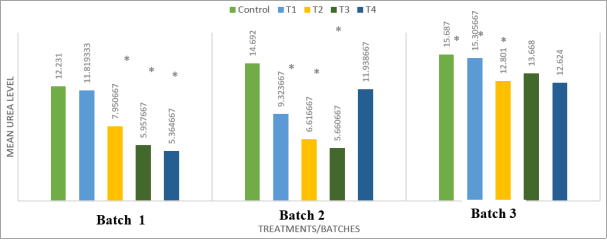
The average serum urea levels of broiler finishers across the treatments and batches are shown in
Figure 1, the colour distribution for Control (green), T1 (light blue), T2 (yellow), T3 (dark green), and T4 (dark blue) groups. For Batch 1, the Control group had a mean urea level of 12.231mg/dL, while T1 at 11.819mg/dL no significant difference (P > 0.05). T2 at 7.960mg/dL, T3 at 5.958mg/dL, and T4 at 5.365mg/dL it showed values reductions, indicating significant variation (P < 0.05). As the extract concentration increases, serum urea levels decrease.
For Batch 2, the Control had the high mean at 14.692mg/dL, T4 at 11.939mg/dL) and T1 at 9.323mg/dL. T2 at 6.617mg/dL and T3 at 5.667mg/dL which shows lower mean values. It shows significant drop in urea levels with higher extract concentrations.
For Batch 3, the Control had high urea level at 15.687mg/dL, T1 at 15.306mg/dL, showed no significant difference. T2 at 12.801mg/dL, T3 at 13.668mg/dL, and T4 at 12.624mg/dL with low values. The Control had the high urea level, T2-T4 showed low values, it shows that birds receiving Heinsia crinita extract are utilizing protein and retaining nitrogen more effectively.
3.2. Serum Glucose Level
The effect of various levels of aqueous
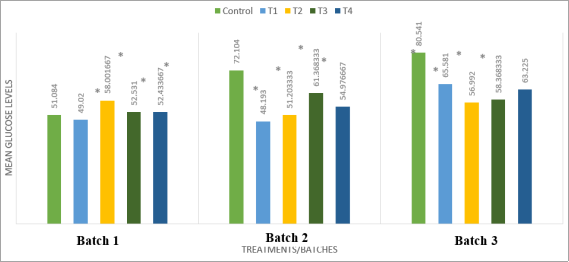
Heinsia crinita leaf extract on serum glucose concentration in broiler finishers is showed in
Figure 2. In the Batch 1, the Control had 51.084mg/dL, T1 at 49.02mg/dL while T2 had 58.017mg/dL, whereas T3 at 52.531mg/dL and T4 at 52.436mg/dL were similar. It shows no clear dose-dependent response in Batch 1, it indicates minimal and early metabolic reaction to the extract. Batch 2, showed more distinct treatment effect. The Control had high glucose level at 72.104mg/dL, while all treatment groups showed lower values: T1 at 48.193mg/dL, T2 at 51.203 mg/dL, T3 at 61.368 mg/dL and T4 at 54.977mg/dL. Shows significant reduction (P < 0.05) in glucose levels in treatments, shows better glucose level. In Batch 3, the Control recorded 88.541mg/dL, T1 at 65.581mg/dL, T2 at 56.992mg/dL, T3 at 58.683mg/dL, and T4 at 63.225mg/dL.
3.3. Serum Alanine Aminotransferase (ALT) Level
The aqueous
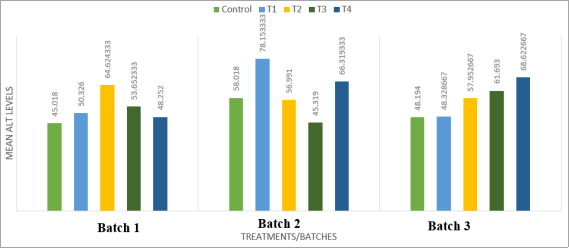
Heinsia crinita leaf extract affected serum ALT activity in broiler finishers, as shown in
Figure 3. In Batch 1, the Control had an ALT value of 45.018U/L, while T1 at 50.326U/L. T2 high value 64.624U/L, and T3 at 53.652U/L, with T4 at 48.252U/L. Some variation exists in the numbers, though, there was no clear treatment pattern. Batch 2, Control had 58.018U/L, while T1 with high mark of 78.153U/L. T2 showed low value at 56.991U/L, T3 at 45.319U/L and T4 at 66.319U/L. While there were some differences in treatments though not statistically significant. Batch 3, the ALT values were a bit consistent in all treatments. The Control 48.194U/L, and T1 at 48.329U/L. T2 at 57.953U/L, T3 at 61.693U/L, and T4 at 68.623U/L. Statistical analysis was ran and there was no significant influence (P > 0.05) from batch (F = 0.968, p = 0.389), treatment (F = 0.657, p = 0.626), or replicate (F = 1.610, p = 0.214) on serum ALT levels respectively.
3.4. Serum Alkaline Phosphatase (ALP) Level
The different levels of aqueous
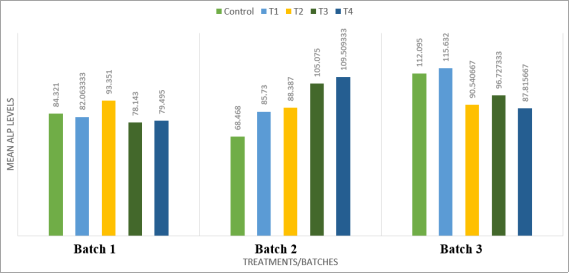
Heinsia crinita leaf extract on serum alkaline phosphatase (ALP) activity in broiler finishers in
Figure 4 Batch 1, the Control had 84.321U/L, T1 slightly lower at 82.063U/L. T2 at 93.351U/L been the highest recorded. T3 and T4 had low values at 78.143U/L and 79.495U/L respectively. Batch 2, Control with low ALP at 68.468U/L, T1 at 85.730U/L, T2 at 88.387U/L, T3 at 105.075U/L, and T4 at 109.509U/L. Batch 3, ALP values were higher across the treatments. Control at 112.095U/L, T1 had high value at 115.632U/L. T2 had low values at 90.541U/L, T3 at 96.273U/L and T4 at 87.816U/L. Statistical analysis revealed significant effect on ALP levels (F=3.41, p=0.044), the differences in the batches that influenced the enzyme activities. The treatment effect had no significant value (F=0.16, p=0.957), show the different levels of
Heinsia crinita extracted did not significantly affect ALP.
3.5. Serum Globulin Level
The different levels of aqueous
Heinsia crinita leaf extract on serum globulin concentration in broiler finishers is shown in
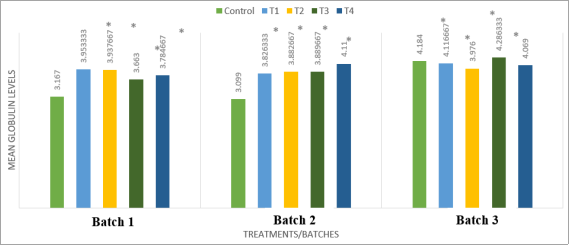
Figure 5. Batch 1, Control had low globulin value at 3.167g/dL. T1 at 3.953g/dL, T2 at 3.938g/dL, T3 at 3.663g/dL and T4 at 3.785g/dL. Batch 2, Control had low value at 3.099g/dL, T1 at 3.826g/dL, T2 at 3.883 g/dL, T3 at 3.889g/dL and T4 at 4.110g/dL, Batch 3, globulin levels increase in treatment levels. Control (4.184g/dL), T1 (4.167g/dL). T2 lower at 3.976g/dL, T3 (4.286g/dL) and T4 (4.069g/dL). Statistical analysis indicated a significant effect (P < 0.05) of both batches (F=10.56, p<0.001) and the treatments (F=5.44, p=0.002) on the serum globulin levels.
3.6. Serum Albumin Level
The effect of various levels of aqueous
Heinsia crinita leaf extract on serum albumin concentration in broiler finishers shown in
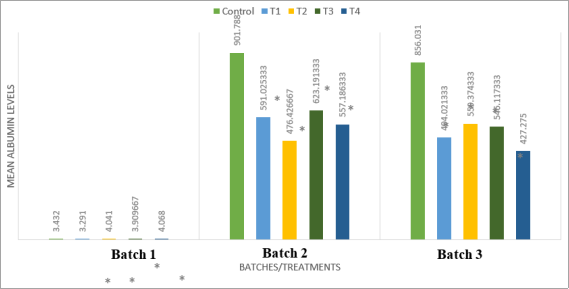
Figure 6 Batch 1, Control (3.432g/dL), T1 is lower (3.291g/dL). Slight increase in T2 (4.041g/dL), T3 (3.999g/dL), and T4 (4.068g/dL). Batch 2, Control got the highest value (901.788mg/dL) which became 9.018g/dL when converted, while T1 (591.025mg/dL), T2 (476.427mg/dL), T3 (623.191mg/dL), and T4 (557.186mg/dL). Though the values are increased compared to Batch 1, the differences that exists in the treatments that suggest that the treatments are influenced albumin synthesis and T3 showing strong response. Batch 3, albumin levels is high though showed the same pattern compared to Batch 2. Control (855.631mg/dL), T1 (494.021mg/dL), T2 and T3 had high values at 559.374mg/dL and 546.173mg/dL respectively, T4 had low value (427.275mg/dL) in this batch. It indicates that regulation of albumin is influenced by treatments as broilers progresses through growth stages.
Statistical analysis showed both the batches and treatments had significant impact (P < 0.05) on serum albumin levels. Batches effect was significant, and observed an increase in values from Batch 1, which had low levels, to a higher level in Batches 2 and 3.
4. Discussion
The present study evaluated the nutrigenomic and serum biochemical responses of broiler finishers to graded levels of
Heinsia crinita leaf extract across
Figures 1-6, Batches 1-3, and treatment groups (Control, T1-T4). The results demonstrate that
Heinsia crinita exerts significant effects on protein metabolism, carbohydrate utilization, immune response, and hepatic function, suggesting its role as a functional phytogenic modulator.
In
Figure 1 (Serum Urea), the dose-dependent reduction in urea concentration observed in treatments T2, T3, and T4 across all batches, compared to the consistently higher values in the Control, indicates enhanced nitrogen utilization and protein retention. Similar findings were reported by
| [3] | Alberts, B., Johnson, A., Lewis, J., Raff, M., Roberts, K., & Walter, P. (2002). Molecular biology of the cell (4th ed.). Garland Science. |
[3]
, who demonstrated that improved metabolic efficiency is often associated with reduced nitrogen waste products. The results are also in agreement with
| [7] | Kumar, M., Dahiya, S. P., Ratwan, P., & Nehra, A. K. (2018). Effect of herbal feed additives on serum biochemical profile and performance of broiler chickens. Journal of Entomology and Zoology Studies, 6(3), 1212-1216. |
[7]
, who observed decreased serum urea levels following phytogenic supplementation, attributing this to improved protein metabolism. Additionally,
| [5] | Guo, F. C., Williams, B. A., Kwakkel, R. P., Li, H. S., Li, X. P., Luo, J. Y., Li, W. K., & Verstegen, M. W. A. (2016). Effects of mushroom and herb polysaccharides on cellular and humoral immune responses of broilers. Poultry Science, 93(2), 345-351. |
[5]
highlighted the role of plant-derived bioactive compounds in regulating enzymatic pathways involved in nitrogen metabolism. This is consistent with
| [8] | Laskowski, R. A., MacArthur, M. W., Moss, D. S., & Thornton, J. M. (1993). PROCHECK: A program to check the stereochemical quality of protein structures. Journal of Applied Crystallography, 26(2), 283-291. |
[8]
, who linked reduced urea levels to enhanced structural and metabolic stability at the cellular level. The results also support findings by
| [9] | Lv, Z., Hu, C., & Xu, H. (2017). Effects of dietary supplementation of herbal extracts on growth performance, immune response, and serum biochemistry of broilers. Asian-Australasian Journal of Animal Sciences, 30(3), 399-406. |
[9]
, suggesting that phytochemicals can improve amino acid utilization through gene-mediated pathways.
In
Figure 2 (Serum Glucose), the significant reduction in glucose levels in treatments (T1-T4) in Batches 2 and 3, relative to the Control, indicates improved carbohydrate metabolism and energy utilization. Similar findings were reported by
| [7] | Kumar, M., Dahiya, S. P., Ratwan, P., & Nehra, A. K. (2018). Effect of herbal feed additives on serum biochemical profile and performance of broiler chickens. Journal of Entomology and Zoology Studies, 6(3), 1212-1216. |
[7]
, who observed enhanced glucose regulation in broilers fed plant-based additives. The results are also in agreement with
| [9] | Lv, Z., Hu, C., & Xu, H. (2017). Effects of dietary supplementation of herbal extracts on growth performance, immune response, and serum biochemistry of broilers. Asian-Australasian Journal of Animal Sciences, 30(3), 399-406. |
[9]
, who demonstrated that phytogenic compounds improve glucose homeostasis through modulation of metabolic pathways. Additionally,
| [5] | Guo, F. C., Williams, B. A., Kwakkel, R. P., Li, H. S., Li, X. P., Luo, J. Y., Li, W. K., & Verstegen, M. W. A. (2016). Effects of mushroom and herb polysaccharides on cellular and humoral immune responses of broilers. Poultry Science, 93(2), 345-351. |
[5]
highlighted the role of phytochemicals in regulating gene expression related to glucose transport and insulin signaling. However, the absence of a strict dose-response pattern in this study is not entirely consistent with some reports, suggesting that
Heinsia crinita may act through threshold-dependent nutrigenomic mechanisms rather than linear dose effects
| [6] | Kogut, M. H., & Arsenault, R. J. (2017). Immunometabolic phenotype alterations associated with the induction of disease tolerance and persistent asymptomatic infection of Salmonella in the chicken intestine. Frontiers in Immunology, 8, 372.
https://doi.org/10.3389/fimmu.2017.00372 |
[6]
.
In
Figure 3 (Serum ALT), the absence of significant differences across Batches 1-3 and treatments (Control, T1-T4) confirms that
Heinsia crinita does not induce hepatocellular damage. This is consistent with
| [8] | Laskowski, R. A., MacArthur, M. W., Moss, D. S., & Thornton, J. M. (1993). PROCHECK: A program to check the stereochemical quality of protein structures. Journal of Applied Crystallography, 26(2), 283-291. |
[8]
, who emphasized that stable enzyme activity reflects intact cellular structure and function. Similar findings were reported by
| [3] | Alberts, B., Johnson, A., Lewis, J., Raff, M., Roberts, K., & Walter, P. (2002). Molecular biology of the cell (4th ed.). Garland Science. |
[3]
, who noted that maintenance of enzyme stability is indicative of normal physiological function. The results also support findings by
| [5] | Guo, F. C., Williams, B. A., Kwakkel, R. P., Li, H. S., Li, X. P., Luo, J. Y., Li, W. K., & Verstegen, M. W. A. (2016). Effects of mushroom and herb polysaccharides on cellular and humoral immune responses of broilers. Poultry Science, 93(2), 345-351. |
[5]
, highlighting the protective role of bioactive compounds in maintaining liver integrity.
In
Figure 4 (Serum ALP), although a significant batch effect was observed across Batches 1-3, no significant treatment effect was detected. This indicates that variations in ALP levels were influenced more by environmental or batch-related factors than by dietary supplementation. Similar findings were reported by
| [7] | Kumar, M., Dahiya, S. P., Ratwan, P., & Nehra, A. K. (2018). Effect of herbal feed additives on serum biochemical profile and performance of broiler chickens. Journal of Entomology and Zoology Studies, 6(3), 1212-1216. |
[7]
, who observed that environmental conditions can significantly affect enzyme activity in broilers. The results are also in agreement with
| [9] | Lv, Z., Hu, C., & Xu, H. (2017). Effects of dietary supplementation of herbal extracts on growth performance, immune response, and serum biochemistry of broilers. Asian-Australasian Journal of Animal Sciences, 30(3), 399-406. |
[9]
, who noted that phytogenic additives generally do not disrupt liver or bone enzyme activity. However, the magnitude of variation across batches in this study suggests greater environmental influence, which may not fully align with all previous findings.
In
Figure 5 (Serum Globulin), the significant increase in globulin levels in treatments (T1-T4) across Batches 1 and 2, compared to the Control, indicates enhanced immune function and protein synthesis. Similar findings were reported by
| [5] | Guo, F. C., Williams, B. A., Kwakkel, R. P., Li, H. S., Li, X. P., Luo, J. Y., Li, W. K., & Verstegen, M. W. A. (2016). Effects of mushroom and herb polysaccharides on cellular and humoral immune responses of broilers. Poultry Science, 93(2), 345-351. |
[5]
, who demonstrated that phytogenic compounds stimulate immune-related pathways. The results are also in agreement with
| [9] | Lv, Z., Hu, C., & Xu, H. (2017). Effects of dietary supplementation of herbal extracts on growth performance, immune response, and serum biochemistry of broilers. Asian-Australasian Journal of Animal Sciences, 30(3), 399-406. |
[9]
, who observed increased globulin levels in animals receiving plant-based supplements. Additionally,
| [7] | Kumar, M., Dahiya, S. P., Ratwan, P., & Nehra, A. K. (2018). Effect of herbal feed additives on serum biochemical profile and performance of broiler chickens. Journal of Entomology and Zoology Studies, 6(3), 1212-1216. |
[7]
highlighted the role of phytochemicals in enhancing immunoglobulin production. This is consistent with
| [3] | Alberts, B., Johnson, A., Lewis, J., Raff, M., Roberts, K., & Walter, P. (2002). Molecular biology of the cell (4th ed.). Garland Science. |
[3]
, who emphasized the importance of protein synthesis in maintaining immune competence.
In
Figure 6 (Serum Albumin), both batch and treatment effects were significant, with Batch 1 showing relatively low albumin levels across all treatments, followed by increased levels in Batches 2 and 3. This trend suggests an adaptive physiological response, possibly linked to environmental conditions in early stages. Similar findings were reported by
| [7] | Kumar, M., Dahiya, S. P., Ratwan, P., & Nehra, A. K. (2018). Effect of herbal feed additives on serum biochemical profile and performance of broiler chickens. Journal of Entomology and Zoology Studies, 6(3), 1212-1216. |
[7]
, who observed fluctuations in albumin levels due to environmental and dietary factors. The results are also in agreement with
| [5] | Guo, F. C., Williams, B. A., Kwakkel, R. P., Li, H. S., Li, X. P., Luo, J. Y., Li, W. K., & Verstegen, M. W. A. (2016). Effects of mushroom and herb polysaccharides on cellular and humoral immune responses of broilers. Poultry Science, 93(2), 345-351. |
[5]
, who highlighted the role of phytogenic compounds in modulating protein metabolism. However, the observation that treated groups showed slightly lower albumin levels compared to the Control is not entirely consistent with some studies, suggesting that
Heinsia crinita may induce protein redistribution toward immune-related functions, rather than simply increasing albumin synthesis. This is consistent with
| [9] | Lv, Z., Hu, C., & Xu, H. (2017). Effects of dietary supplementation of herbal extracts on growth performance, immune response, and serum biochemistry of broilers. Asian-Australasian Journal of Animal Sciences, 30(3), 399-406. |
[9]
, who reported similar metabolic adjustments under phytogenic supplementation.
Overall, the findings across
Figures 1-6 demonstrate that
Heinsia crinita leaf extract exerts coordinated nutrigenomic effects, including improved protein utilization, enhanced glucose metabolism, immune stimulation, and maintenance of hepatic integrity. Similar findings were reported by
| [3] | Alberts, B., Johnson, A., Lewis, J., Raff, M., Roberts, K., & Walter, P. (2002). Molecular biology of the cell (4th ed.). Garland Science. |
[3]
, while the results are also in agreement with
| [7] | Kumar, M., Dahiya, S. P., Ratwan, P., & Nehra, A. K. (2018). Effect of herbal feed additives on serum biochemical profile and performance of broiler chickens. Journal of Entomology and Zoology Studies, 6(3), 1212-1216. |
[7]
and
| [5] | Guo, F. C., Williams, B. A., Kwakkel, R. P., Li, H. S., Li, X. P., Luo, J. Y., Li, W. K., & Verstegen, M. W. A. (2016). Effects of mushroom and herb polysaccharides on cellular and humoral immune responses of broilers. Poultry Science, 93(2), 345-351. |
[5]
, who emphasized the role of plant-derived compounds in metabolic regulation. This is consistent with
| [8] | Laskowski, R. A., MacArthur, M. W., Moss, D. S., & Thornton, J. M. (1993). PROCHECK: A program to check the stereochemical quality of protein structures. Journal of Applied Crystallography, 26(2), 283-291. |
[8]
and further supported by
| [9] | Lv, Z., Hu, C., & Xu, H. (2017). Effects of dietary supplementation of herbal extracts on growth performance, immune response, and serum biochemistry of broilers. Asian-Australasian Journal of Animal Sciences, 30(3), 399-406. |
[9]
, highlighting the potential of phytogenic feed additives as sustainable alternatives in poultry production.
In conclusion, Heinsia crinita demonstrates strong potential as a natural nutrigenomic feed additive, capable of enhancing metabolic efficiency, supporting immune function, and maintaining physiological stability in broiler chickens.
Figure 1. Mean serum urea concentration (mg/dL) of broiler finishers across three batches, showing Control (green), T1 (light blue, 5%), T2 (yellow, 10%), T3 (dark green, 20%), and T4 (dark blue, 30%) treatments. Higher extract inclusion levels (T2-T4) are associated with reduced serum urea concentrations compared to the control, indicating improved protein metabolism.
Figure 2. Mean serum glucose concentration (mg/dL) of broiler finishers across three experimental batches showing Control (green), T1 (light blue, 5%), T2 (yellow, 10%), T3 (dark green, 20%), and T4 (dark blue, 30%). Significant reductions (P < 0.05) in glucose levels were observed in treated groups compared to the control in Batches 2 and 3, indicating improved carbohydrate metabolism.
Figure 3. Mean serum alanine aminotransferase (ALT) activity (U/L) of broiler finishers across three experimental batches showing Control (green), T1 (light blue, 5%), T2 (yellow, 10%), T3 (dark green, 20%), and T4 (dark blue, 30%). No significant differences (P > 0.05) were observed across treatments, indicating no adverse effect of Heinsia crinita leaf extract on liver function.
Figure 4. Mean serum alkaline phosphatase (ALP) activity (U/L) of broiler finishers across three experimental batches showing Control (green), T1 (light blue, 5%), T2 (yellow, 10%), T3 (dark green, 20%), and T4 (dark blue, 30%). A significant batch effect (P < 0.05) was observed, while treatment effects were not significant, indicating that Heinsia crinita leaf extract had no adverse impact on metabolic or physiological status.
Figure 5. Mean serum globulin concentration (g/dL) of broiler finishers across three experimental batches showing Control (green), T1 (light blue, 5%), T2 (yellow, 10%), T3 (dark green, 20%), and T4 (dark blue, 30%). Significant effects (P < 0.05) of both batch and treatment were observed, with treated groups generally exhibiting higher globulin levels, indicating enhanced immune response.
Figure 6. Mean serum albumin concentration of broiler finishers across three experimental batches showing Control (green), T1 (light blue, 5%), T2 (yellow, 10%), T3 (dark green, 20%), and T4 (dark blue, 30%). Batch 1 exhibited relatively low albumin levels, while Batches 2 and 3 showed significantly higher values (P < 0.05). Variations among treatments indicate potential nutrigenomic regulation of protein synthesis and liver function.
5. Conclusion
Dietary supplementation with aqueous
Heinsia crinita leaf extract significantly modulated metabolic and immune responses in broiler finishers across
Figures 1-6 and treatments (Control-T4). The reductions in serum urea (
Figure 1) and glucose (
Figure 2) indicate improved protein utilization and carbohydrate metabolism, while the increase in globulin levels (
Figure 5) suggests enhanced immune function.
The stability of ALT (
Figure 3) and the absence of treatment effects on ALP (
Figure 4) confirm that the extract is safe and does not impair liver or bone metabolism. Although albumin levels (
Figure 6) varied across batches, the changes reflect adaptive physiological responses rather than adverse effects.
Heinsia crinita shows strong potential as a natural nutrigenomic feed additive, capable of improving metabolic efficiency and immune status in broiler chickens. However, the observed batch effects highlight the importance of environmental control.
Therefore, the inclusion of Heinsia crinita leaf extract (particularly at moderate to higher levels, T2-T4) is recommended for improved metabolic and immune performance in broiler production, while further studies should focus on its molecular mechanisms, optimal dosage, and long-term application under varying production conditions.
6. Recommendations
Based on the findings of this study, the following recommendations are proposed:
I Dietary inclusion of aqueous
Heinsia crinita leaf extract, particularly at moderate to higher concentrations (T2-T4), is recommended in broiler production systems, as it enhances protein utilization (reduced urea,
Figure 1) and glucose metabolism (
Figure 2), while improving immune response (increased globulin,
Figure 5) without compromising liver integrity (ALT and ALP;
Figures 3-4).
II Poultry producers should ensure proper environmental and management control, as the observed batch effects (Batches 1-3) indicate that external factors can influence metabolic and physiological responses.
III Further studies should be conducted to isolate and characterize the bioactive compounds in Heinsia crinita and elucidate their nutrigenomic mechanisms of action, particularly their role in regulating metabolic and immune-related gene expression.
IV Additional research is recommended to determine the optimal dosage, long-term effects, and field applicability of Heinsia crinita under diverse production conditions.
Abbreviations
AGPs | Antibiotics Used as Growth Promoters |
AST | Aspartate Aminotransferase |
ALT | Alanine Aminotransferase |
ALP | Alkaline Phosphatase |
Author Contributions
Japhet Bolouinbele Yeigba: Conceptualization, Funding acquisition, Methodology, Resources, Software, Supervision, Writing – review & editing
Godgift Izibenkien Odeke: Formal Analysis, Funding acquisition
Keniebi Alfred Ogidikpe: Funding acquisition, Methodology
Judith Amolo: Data curation, Funding Acquisition
Miracelma David Ozori: Data curation, Funding acquisition, Investigation
Victor Ben Dike: Formal Analysis, Funding acquisition
Ibo Faith: Data curation, Investigation
Carina Mercy Moluma: Data curation, Investigation, Writing – review & editing
Conflicts of Interest
The authors declare no conflicts of interest.
References
| [1] |
Abdelli, N., Solà-Oriol, D., Pérez, J. F., & Torrallardona, D. (2021). Phytogenic feed additives in poultry: Achievements, prospective and challenges. Animals, 11(12), 3471.
https://doi.org/10.3390/ani11123471
|
| [2] |
Ahmad, T., Khan, M. S., Mushtaq, T., Babar, M. E., Iqbal, Z., & Yousaf, M. (2021). Influence of phytogenic feed additives on growth performance, blood metabolites and immune response in broiler chickens. Poultry Science, 100(2), 101-110.
|
| [3] |
Alberts, B., Johnson, A., Lewis, J., Raff, M., Roberts, K., & Walter, P. (2002). Molecular biology of the cell (4th ed.). Garland Science.
|
| [4] |
Enemchukwu, B. N., Udedibie, A. B. I., & Esonu, B. O. (2020). Phytochemical composition and nutritional potential of Heinsia crinita leaves. Nigerian Journal of Animal Production, 47(3), 120-128.
|
| [5] |
Guo, F. C., Williams, B. A., Kwakkel, R. P., Li, H. S., Li, X. P., Luo, J. Y., Li, W. K., & Verstegen, M. W. A. (2016). Effects of mushroom and herb polysaccharides on cellular and humoral immune responses of broilers. Poultry Science, 93(2), 345-351.
|
| [6] |
Kogut, M. H., & Arsenault, R. J. (2017). Immunometabolic phenotype alterations associated with the induction of disease tolerance and persistent asymptomatic infection of Salmonella in the chicken intestine. Frontiers in Immunology, 8, 372.
https://doi.org/10.3389/fimmu.2017.00372
|
| [7] |
Kumar, M., Dahiya, S. P., Ratwan, P., & Nehra, A. K. (2018). Effect of herbal feed additives on serum biochemical profile and performance of broiler chickens. Journal of Entomology and Zoology Studies, 6(3), 1212-1216.
|
| [8] |
Laskowski, R. A., MacArthur, M. W., Moss, D. S., & Thornton, J. M. (1993). PROCHECK: A program to check the stereochemical quality of protein structures. Journal of Applied Crystallography, 26(2), 283-291.
|
| [9] |
Lv, Z., Hu, C., & Xu, H. (2017). Effects of dietary supplementation of herbal extracts on growth performance, immune response, and serum biochemistry of broilers. Asian-Australasian Journal of Animal Sciences, 30(3), 399-406.
|
| [10] |
Oladokun, S., Adewole, D. I., & Adebiyi, O. A. (2022). Evaluation of plant extract supplementation on growth performance and serum biochemistry in poultry. Tropical Animal Health and Production, 54(1), 45.
|
| [11] |
Puvača, N., Kostadinović, L., Popović, S., Lević, J., Ljubojević, D., Tufarelli, V., & Jovanović, R. (2018). Probiotic, prebiotic and phytogenic additives in poultry nutrition. World's Poultry Science Journal, 74(2), 335-348.
|
| [12] |
Saleh, A. A., Kirrella, A. A., Dawood, M. A. O., & Ebeid, T. A. (2020). Effect of dietary phytogenic supplementation on growth performance, blood metabolites, and immune response in broilers. Animals, 10(10), 1819.
https://doi.org/10.3390/ani10101819
|
| [13] |
Sogunle, O. M., Egbeyale, L. T., & Fanimo, A. O. (2019). Blood profile of broiler chickens as affected by dietary supplementation. Nigerian Journal of Animal Science, 21(2), 45-52.
|
| [14] |
Tengku-Azmi, T. I., Salleh, N. H., Ahmad, H., & Hasim, H. (2021). Poultry production and food security: A global perspective. Sustainability, 13(4), 2204.
https://doi.org/10.3390/su13042204
|
| [15] |
Ukoha, P. O., Cemaluk, E. A. C., Nnamdi, O. L., & Madus, E. P. (2019). Nutritional and phytochemical evaluation of Heinsia crinita leaves. International Journal of Biological and Chemical Sciences, 13(2), 1105-1113.
|
Cite This Article
-
APA Style
Yeigba, J. B., Odeke, G. I., Ogidikpe, K. A., Amolo, J., Ozori, M. D., et al. (2026). Assessment of Metabolic and Immune Pathways in Broiler Finishers Fed Graded Levels of Heinsia Crinita Leaf Extract: Evidence from Serum Biochemical Responses. International Journal of Biochemistry, Biophysics & Molecular Biology, 11(1), 6-14. https://doi.org/10.11648/j.ijbbmb.20261101.12
 Copy
|
Copy
|
 Download
ACS Style
Yeigba, J. B.; Odeke, G. I.; Ogidikpe, K. A.; Amolo, J.; Ozori, M. D., et al. Assessment of Metabolic and Immune Pathways in Broiler Finishers Fed Graded Levels of Heinsia Crinita Leaf Extract: Evidence from Serum Biochemical Responses. Int. J. Biochem. Biophys. Mol. Biol. 2026, 11(1), 6-14. doi: 10.11648/j.ijbbmb.20261101.12
Copy
|
Download
AMA Style
Yeigba JB, Odeke GI, Ogidikpe KA, Amolo J, Ozori MD, et al. Assessment of Metabolic and Immune Pathways in Broiler Finishers Fed Graded Levels of Heinsia Crinita Leaf Extract: Evidence from Serum Biochemical Responses. Int J Biochem Biophys Mol Biol. 2026;11(1):6-14. doi: 10.11648/j.ijbbmb.20261101.12
Copy
|
Download
-
@article{10.11648/j.ijbbmb.20261101.12,
  author = {Japhet Bolouinbele Yeigba and Godgift Izibenkien Odeke and Keniebi Alfred Ogidikpe and Judith Amolo and Miracelma David Ozori and Victor Ben Dike and Ibo Faith and Carina Mercy Moluma},
  title = {Assessment of Metabolic and Immune Pathways in Broiler Finishers Fed Graded Levels of Heinsia Crinita Leaf Extract: Evidence from Serum Biochemical Responses},
  journal = {International Journal of Biochemistry, Biophysics & Molecular Biology},
  volume = {11},
  number = {1},
  pages = {6-14},
  doi = {10.11648/j.ijbbmb.20261101.12},
  url = {https://doi.org/10.11648/j.ijbbmb.20261101.12},
  eprint = {https://article.sciencepublishinggroup.com/pdf/10.11648.j.ijbbmb.20261101.12},
  abstract = {This study assessed the effects of the supplementation of graded levels of aqueous Heinsia crinita leaf extract on serum biochemical parameters in broiler chickens. The experiment was conducted at the poultry unit of Niger Delta University, Wilberforce Island, Nigeria. One-hundred-and-thirty-day-old broiler chicks were randomly assigned to four treatment groups and a control, each with three replicates. The control group received conventional feed and water, while treatment groups were administered 5%, 10%, 20%, and 30% aqueous Heinsia crinita leaf extract in their drinking water. Serum samples were collected and analyzed for urea, glucose, alanine aminotransferase (ALT), alkaline phosphatase (ALP), globulin, and albumin levels. Results showed a significant, dose-dependent reduction in serum urea with increasing extract concentration, reflecting improved protein utilization and nitrogen metabolism. Serum glucose levels were significantly lower in treated groups compared to controls, suggesting enhanced glucose utilization. ALT and ALP levels were not significantly affected by treatment, indicating that the extract did not induce hepatocellular injury or adversely affect liver and bone enzyme activity. Globulin levels increased significantly with supplementation, implying a potential immunostimulatory effect, while albumin levels decreased with extract administration but remained within physiological ranges. Time related exposure effects were observed for several parameters, highlighting the importance of environmental and management factors. Overall, the findings suggest that aqueous Heinsia crinita leaf extract can improve metabolic efficiency and immune status in broiler chickens without compromising liver or kidney function, supporting its potential as a safe and beneficial feed additive in poultry production. Therefore, it is recommended that, the inclusion of moderate concentrations of Heinsia crinita in the water of broilers should be encouraged.},
 year = {2026}
}
Copy
|
Download
-
TY  - JOUR
T1  - Assessment of Metabolic and Immune Pathways in Broiler Finishers Fed Graded Levels of Heinsia Crinita Leaf Extract: Evidence from Serum Biochemical Responses
AU  - Japhet Bolouinbele Yeigba
AU  - Godgift Izibenkien Odeke
AU  - Keniebi Alfred Ogidikpe
AU  - Judith Amolo
AU  - Miracelma David Ozori
AU  - Victor Ben Dike
AU  - Ibo Faith
AU  - Carina Mercy Moluma
Y1  - 2026/08/06
PY  - 2026
N1  - https://doi.org/10.11648/j.ijbbmb.20261101.12
DO  - 10.11648/j.ijbbmb.20261101.12
T2  - International Journal of Biochemistry, Biophysics & Molecular Biology
JF  - International Journal of Biochemistry, Biophysics & Molecular Biology
JO  - International Journal of Biochemistry, Biophysics & Molecular Biology
SP  - 6
EP  - 14
PB  - Science Publishing Group
SN  - 2575-5862
UR  - https://doi.org/10.11648/j.ijbbmb.20261101.12
AB  - This study assessed the effects of the supplementation of graded levels of aqueous Heinsia crinita leaf extract on serum biochemical parameters in broiler chickens. The experiment was conducted at the poultry unit of Niger Delta University, Wilberforce Island, Nigeria. One-hundred-and-thirty-day-old broiler chicks were randomly assigned to four treatment groups and a control, each with three replicates. The control group received conventional feed and water, while treatment groups were administered 5%, 10%, 20%, and 30% aqueous Heinsia crinita leaf extract in their drinking water. Serum samples were collected and analyzed for urea, glucose, alanine aminotransferase (ALT), alkaline phosphatase (ALP), globulin, and albumin levels. Results showed a significant, dose-dependent reduction in serum urea with increasing extract concentration, reflecting improved protein utilization and nitrogen metabolism. Serum glucose levels were significantly lower in treated groups compared to controls, suggesting enhanced glucose utilization. ALT and ALP levels were not significantly affected by treatment, indicating that the extract did not induce hepatocellular injury or adversely affect liver and bone enzyme activity. Globulin levels increased significantly with supplementation, implying a potential immunostimulatory effect, while albumin levels decreased with extract administration but remained within physiological ranges. Time related exposure effects were observed for several parameters, highlighting the importance of environmental and management factors. Overall, the findings suggest that aqueous Heinsia crinita leaf extract can improve metabolic efficiency and immune status in broiler chickens without compromising liver or kidney function, supporting its potential as a safe and beneficial feed additive in poultry production. Therefore, it is recommended that, the inclusion of moderate concentrations of Heinsia crinita in the water of broilers should be encouraged.
VL  - 11
IS  - 1
ER  -
Copy
|
Download





 Share This Article
 Twitter
 Linked In
 Facebook