
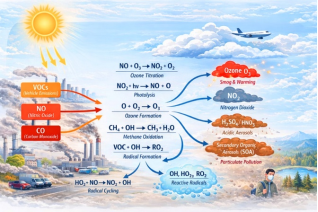
Atmospheric trace gases such as ozone (O3), carbon monoxide (CO), and nitrogen oxides (NO and NO2, collectively termed NOx) play a central role in tropospheric photochemistry and strongly influence air quality, climate forcing, and ecosystem health. This manuscript explores the current understanding of the sources, chemical transformation pathways, and environmental impacts of these trace gases by integrating from observational studies and atmospheric modeling research. The literature was compiled through a structured review of peer-reviewed research published in science journals, with emphasis on recent advances in photochemical mechanisms, boundary layer dynamics and regional air pollution processes. Particular attention is given to nonlinear O3 formation regimes, radical chemistry involving volatile organic compounds (VOCs), and the interactions between trace gases and climate processes. This manuscript highlights how the balance between NOx and VOC emissions determines O3 production efficiency in different atmospheric environments, ranging from NOx limited rural regions to VOC limited urban areas. Regional perspectives from South Asia illustrate how rapid urbanization, biomass burning, and meteorological variability influence trace gas distributions. The analysis identifies major knowledge gaps related to radical chemistry uncertainties, climate–chemistry feedback mechanisms, and the integration of observational networks with chemical transport models. Improved monitoring strategies and advanced modeling approaches are essential for developing effective air quality management policies and understanding the evolving role of trace gases in the Earth’s climate system.
| Published in | International Journal of Atmospheric and Oceanic Sciences (Volume 10, Issue 1) |
| DOI | 10.11648/j.ijaos.20261001.12 |
| Page(s) | 13-24 |
| Creative Commons |
This is an Open Access article, distributed under the terms of the Creative Commons Attribution 4.0 International License (http://creativecommons.org/licenses/by/4.0/), which permits unrestricted use, distribution and reproduction in any medium or format, provided the original work is properly cited. |
| Copyright |
Copyright © The Author(s), 2026. Published by Science Publishing Group |
Air Pollution, Surface Ozone, Nitrogen Oxides, Carbon Monoxide, Atmospheric Oxidative Capacity
O3 | Ozone |
CO | Carbon Monoxide |
NOx | Nitrogen Oxides |
VOCs | Volatile Organic Compounds |
CH4 | Methane |
SO2 | Sulfur Dioxide |
O3 | Ozone |
CO | Carbon Monoxide |
NOx | Nitrogen Oxides |
| [1] | World Health Organization (WHO), 2021. WHO Global Air Quality Guidelines: Particulate Matter (PM2.5 and PM₁₀), Ozone, Nitrogen Dioxide, Sulfur Dioxide and Carbon Monoxide. WHO Press, Geneva. |
| [2] | Intergovernmental Panel on Climate Change (IPCC), 2021. Climate Change 2021: The Physical Science Basis. Cambridge University Press, Cambridge. |
| [3] | Seinfeld, J. H., Pandis, S. N., 2016. Atmospheric Chemistry and Physics: From Air Pollution to Climate Change, 3rd ed. John Wiley & Sons, New York. |
| [4] | Jacob, D. J., 1999. Introduction to Atmospheric Chemistry. Princeton University Press, Princeton. |
| [5] | Pope, C. A., Dockery, D. W., 2006. Health effects of fine particulate air pollution: lines that connect. Journal of the Air & Waste Management Association 56(6), 709–742. |
| [6] | Finlayson-Pitts, B. J., Pitts, J. N., 2000. Chemistry of the Upper and Lower Atmosphere: Theory, Experiments, and Applications. Academic Press, San Diego. |
| [7] | Monks, P. S., Granier, C., Fuzzi, S., Stohl, A., Williams, M. L., Akimoto, H., Amann, M., Baklanov, A., Baltensperger, U., Bey, I., Blake, N., Blake, R. S., Carslaw, K. S., Cooper, O. R., Dentener, F., Fowler, D., Fragkou, E., Frost, G. J., Generoso, S., Zhang, Y., 2009. Atmospheric composition change – global and regional air quality. Atmospheric Environment 43(33), 5268–5350. |
| [8] | Monks, P. S., Archibald, A. T., Colette, A., Cooper, O., Coyle, M., Derwent, R., et al., 2015. Tropospheric ozone and its precursors from the urban to the global scale: from air quality to short-lived climate forcer. Atmospheric Chemistry and Physics 15, 8889–8973. |
| [9] | Myhre, G., Shindell, D., Bréon, F. M., Collins, W., Fuglestvedt, J., Huang, J., Koch, D., Lamarque, J. F., Lee, D., Mendoza, B., Nakajima, T., Robock, A., Stephens, G., Takemura, T., Zhang, H., 2013. Anthropogenic and natural radiative forcing. In: Climate Change 2013: The Physical Science Basis. Cambridge University Press, Cambridge. |
| [10] | Novelli, P. C., et al., 1998. An internally consistent set of global CO measurements and their interpretation. Journal of Geophysical Research: Atmospheres 103(D15), 19285–19308. |
| [11] | Duncan, B. N., et al., 2007. Intercontinental transport of pollution and its impact on air quality. Journal of Geophysical Research: Atmospheres 112, D12S90. |
| [12] | Lelieveld, J., Evans, J. S., Fnais, M., Giannadaki, D., Pozzer, A., 2015. The contribution of outdoor air pollution sources to premature mortality on a global scale. Nature 525(7569), 367–371. |
| [13] | Stull, R. B., 1988. An Introduction to Boundary Layer Meteorology. Kluwer Academic Publishers, Dordrecht. |
| [14] | Garratt, J. R., 1994. The Atmospheric Boundary Layer. Cambridge University Press, Cambridge. |
| [15] | Hallquist, M., Wenger, J. C., Baltensperger, U., Rudich, Y., Simpson, D., Claeys, M., Dommen, J., Donahue, N. M., George, C., Goldstein, A. H., et al., 2009. The formation, properties and impact of secondary organic aerosol: current and emerging issues. Atmospheric Chemistry and Physics 9, 5155–5236. |
| [16] | Jacob, D. J., Winner, D. A., 2009. Effect of climate change on air quality. Atmospheric Environment 43(1), 51–63. |
| [17] | Trainer, M., Parrish, D. D., Buhr, M. P., Norton, R. B., Fehsenfeld, F. C., Anlauf, K. G., Bottenheim, J. W., Tang, Y., Wiebe, H. A., Roberts, J. M., Tanner, R. L., Newman, L., Bowersox, V. C., Meagher, J. F., Olszyna, K. J., Rodgers, M. O., Wang, T., Berresheim, H., Demerjian, K. L., Roychowdhury, U. K., 2000. Correlation of ozone with NOy in photochemically aged air. Journal of Geophysical Research: Atmospheres 105(D17), 22179–22196. |
| [18] | Zhang, J., Tian, W., Xie, F., Tian, H., Luo, J., Zhang, J., Che, H., 2018. Stratospheric ozone loss over the Eurasian continent induced by the polar vortex shift. Nature Communications 9, 206. |
| [19] | Li, K., Jacob, D. J., Shen, L., Lu, X., De Smedt, I., Liao, H., 2020. Increases in surface ozone pollution in China from 2013 to 2019: anthropogenic and meteorological influences. Atmospheric Chemistry and Physics 20, 11423–11433. |
| [20] | Pleim, J. E., 2007. A combined local and nonlocal closure model for the atmospheric boundary layer. Part I: model description and testing. Journal of Applied Meteorology and Climatology 46, 1383–1395. |
| [21] | Stohl, A., 2001. A 1-year Lagrangian climatology of airstreams in the Northern Hemisphere. Journal of Geophysical Research 106, 7263–7279. |
| [22] | Arya, S. P., 1999. Air Pollution Meteorology and Dispersion. Oxford University Press, New York. |
| [23] | IPCC, 2023. Climate Change 2023: Synthesis Report. Intergovernmental Panel on Climate Change, Geneva. |
| [24] | United Nations Environment Programme (UNEP), 2022. Emissions Gap Report 2022: The Closing Window—Climate Crisis Calls for Rapid Transformation of Societies. UNEP, Nairobi. |
| [25] | Lelieveld, J., Klingmüller, K., Pozzer, A., Burnett, R. T., Haines, A., Ramanathan, V., 2019. Effects of fossil fuel and total anthropogenic emission removal on public health and climate. Proceedings of the National Academy of Sciences 116(15), 7192–7197. |
| [26] | Environmental Protection Agency (EPA), 2022. Our Nation’s Air: Trends Through 2021. Office of Air and Radiation, U. S. Environmental Protection Agency, Washington, DC. |
| [27] | Cooper, O. R., Parrish, D. D., Ziemke, J., Balashov, N. V., Cupeiro, M., Galbally, I. E., Gilge, S., Horowitz, L., Jensen, N. R., Lamarque, J. F., Naik, V., Oltmans, S. J., Schwab, J., Shindell, D. T., Thompson, A. M., Thouret, V., Wang, Y., Zbinden, R. M., 2014. Global distribution and trends of tropospheric ozone: an observation-based review. Elementa: Science of the Anthropocene 2, 000029. |
| [28] | European Environment Agency (EEA), 2023. Air Quality in Europe — 2023 Report. European Environment Agency, Copenhagen. |
| [29] | Beelen, R., Raaschou-Nielsen, O., Stafoggia, M., Andersen, Z. J., Weinmayr, G., Hoffmann, B., Wolf, K., Samoli, E., Fischer, P., Nieuwenhuijsen, M. J., Vineis, P., Xun, W. W., Katsouyanni, K., Dimakopoulou, K., Oudin, A., Forsberg, B., Modig, L., Havulinna, A. S., Lanki, T., Hoek, G., 2014. Effects of long-term exposure to air pollution on natural-cause mortality: an analysis of 22 European cohorts within the multicentre ESCAPE project. The Lancet 383(9919), 785–795. |
| [30] | Zheng, B., Tong, D., Li, M., Liu, F., Hong, C., Geng, G., Li, H., Li, X., Peng, L., Qi, J., Yan, L., Zhang, Y., Zhao, H., Zheng, Y., He, K., Zhang, Q., 2018. Trends in China’s anthropogenic emissions since 2010 as the consequence of clean air actions. Nature Sustainability 1(10), 552–559. |
| [31] | Zhao, B., Wang, S., Liu, H., Xu, J., Fu, K., Klimont, Z., Amann, M., Hao, J., 2013. NOx emissions in China: historical trends and future perspectives. Atmospheric Chemistry and Physics 13(19), 9869–9897. |
| [32] | Wang, T., Xue, L., Brimblecombe, P., Lam, Y. F., Li, L., Zhang, L., 2020. Ozone pollution in China: a review of concentrations, meteorological influences, chemical precursors, and effects. Proceedings of the National Academy of Sciences 117(49), 30927–30936. |
| [33] | Itahashi, S., Yumimoto, K., Uno, I., Irie, H., Osada, K., Kurokawa, J., 2020. A 15-year record (2001–2015) of the tropospheric ozone simulation over East Asia using a regional chemical transport model. Atmospheric Chemistry and Physics 20, 8479–8498. |
| [34] | van der Werf, G. R., Randerson, J. T., Giglio, L., van Leeuwen, T. T., Chen, Y., Rogers, B. M., Mu, M., van Marle, M. J. E., Morton, D. C., Collatz, G. J., Yokelson, R. J., Kasibhatla, P. S., 2017. Global fire emissions estimates during 1997–2016. Earth System Science Data 9, 697–720. |
| [35] | Marais, E. A., Jacob, D. J., Wecht, K., Lerot, C., Zhang, L., Yu, K., Kurosu, T. P., Chance, K., Sauvage, B., 2014. Anthropogenic emissions in Nigeria and implications for ozone air quality: a view from space. Atmospheric Environment 99, 32–40. |
| [36] | Maasakkers, J. D., Jacob, D. J., Sulprizio, M. P., Turner, A. J., Weitz, M., Wirth, T., Hight, C., DeFigueiredo, M., Desai, M., Schmeltz, R., Hockstad, L., Bloom, A. A., Bowman, K. W., Jeong, S., Fischer, M. L., 2019. 2010–2015 North American methane emissions, sectoral contributions, and trends: a high-resolution inversion of GOSAT satellite observations. Environmental Science & Technology 53(5), 2387–2397. |
| [37] | Jerrett, M., Burnett, R. T., Pope, C. A., Ito, K., Thurston, G., Krewski, D., Shi, Y., Calle, E., Thun, M., 2009. Long-term ozone exposure and mortality. New England Journal of Medicine 360(11), 1085–1095. |
| [38] | GBD 2019 Risk Factors Collaborators, 2020. Global burden of 87 risk factors in 204 countries and territories, 1990–2019: a systematic analysis for the Global Burden of Disease Study 2019. The Lancet 396(10258), 1223–1249. |
| [39] | Martin, R. V., et al., 2003. Global inventory of nitrogen oxide emissions constrained by space-based observations of NO2 columns. Journal of Geophysical Research: Atmospheres 108(D17), 4537. |
| [40] | Guttikunda, S. K., Gurjar, B. R., 2012. Role of meteorology in seasonality of air pollution in megacity Delhi, India. Environmental Monitoring and Assessment 184, 3199–3211. |
| [41] | Ghude, S. D., Jena, C., Chate, D. M., Beig, G., Kumar, R., Barth, M. C., Pfister, G. G., Fadnavis, S., Pithani, P., 2016. Reductions in India’s crop yield due to ozone. Geophysical Research Letters 41, 5685–5691. |
| [42] | Central Pollution Control Board (CPCB), 2022. National Air Quality Monitoring Programme (NAMP) Annual Report. Ministry of Environment, Forest and Climate Change, Government of India, New Delhi. |
| [43] | Krotkov, N. A., et al., 2016. Aura OMI observations of regional SO2 and NO2 pollution changes. Atmospheric Chemistry and Physics 16, 4605–4629. |
| [44] | Kumar, U., Prakash, A., & Jain, V. K. 2008. A photochemical modelling approach to investigate O3 sensitivity to NOx and VOCs in the urban atmosphere of Delhi. Aerosol and Air Quality Research, 8, 147–159. |
| [45] | Jethva, H., Torres, O., Field, R. D., 2019. Linking crop residue burning to air quality in India using satellite data. Atmospheric Environment 205, 127–138. |
| [46] | Pandey, A., Brauer, M., Cropper, M. L., Balakrishnan, K., Mathur, P., Dey, S., Turkgulu, B., Kumar, G. A., Khare, M., Beig, G., Gupta, T., Krishnankutty, R. P., Causey, K., Cohen, A. J., Dandona, L., 2018. Health and economic impact of air pollution in India. The Lancet Planetary Health 2(7), e301–e312. |
| [47] | Saunois, M., Stavert, A. R., Poulter, B., Bousquet, P., Canadell, J. G., Jackson, R. B., Raymond, P. A., Dlugokencky, E. J., Houweling, S., Patra, P. K., Ciais, P., Arora, V. K., Bastviken, D., Bergamaschi, P., Blake, D. R., Brailsford, G., Bruhwiler, L., Carlson, K. M., Carroll, M., Zhuang, Q., 2020. The global methane budget 2000–2017. Earth System Science Data 12(3), 1561–1623. |
| [48] | Nair, P. R., et al., 2012. Seasonal variability of surface ozone and NOx at a tropical coastal site in India. Journal of Atmospheric Chemistry 69(2), 123–138. |
| [49] | Nair, P. R., et al., 2014. Surface ozone variability over southern India during pre-monsoon season. Atmospheric Environment 94, 540–551. |
| [50] | Srivastava, S., et al., 2016. Characterization of volatile organic compounds over a coastal urban site in India. Environmental Monitoring and Assessment 188, 567. |
| [51] | Revathy, S., Ajayakumar, A., Girach, I. A., Soni, M., Ojha, N., Suresh Babu, S., 2024. Processes governing the surface ozone over a tropical hill station in the Western Ghats. Atmospheric Environment 319, 120286. |
| [52] | Kumar, R., et al., 2020. Satellite observations of NO2 and SO2 over India: implications for regional air quality. Atmospheric Pollution Research 11(6), 1030–1042. |
| [53] | Nishanth, T., Praseed, K. M., Satheesh Kumar, M. K., Valsaraj, K. T., 2014. Influence of ozone precursors and PM₁₀ on the variation of surface O3 over Kannur, India. Atmospheric Research 138, 112–124. |
| [54] | Resmi, C. T., Ye, F., Satheesh, S., Nishanth, T., Satheesh Kumar, M. K., Balachandramohan, M., Manivannan, D., Hu, J., Valsaraj, K. T., 2021. Variation of trace gases in Kannur Town, a coastal South Indian city. Environmental Challenges 5, 100336. |
| [55] | Bell, M. L., McDermott, A., Zeger, S. L., Samet, J. M., Dominici, F., 2004. Ozone and short-term mortality in 95 US urban communities, 1987–2000. JAMA 292(19), 2372–2378. |
| [56] | Raub, J. A., Mathieu-Nolf, M., Hampson, N. B., Thom, S. R., 2000. Carbon monoxide poisoning—A public health perspective. Toxicology 145(1), 1–14. |
| [57] | Brunekreef, B., Holgate, S. T., 2002. Air pollution and health. The Lancet 360(9341), 1233–1242. |
| [58] | Emberson, L. D., Ashmore, M. R., Cambridge, H. M., Simpson, D., Tuovinen, J. P., 2001. Modelling stomatal ozone flux across Europe. Environmental Pollution 115(3), 95–102. |
| [59] | Galloway, J. N., Townsend, A. R., Erisman, J. W., Bekunda, M., Cai, Z., Freney, J. R., Martinelli, L. A., Seitzinger, S. P., Sutton, M. A., 2008. Transformation of the nitrogen cycle: recent trends, questions, and potential solutions. Science 320(5878), 889–892. |
| [60] | Sitch, S., Cox, P. M., Collins, W. J., Huntingford, C., 2007. Indirect radiative forcing of climate change through ozone effects on the land-carbon sink. Nature 448(7155), 791–794. |
| [61] | Fiore, A. M., West, J. J., Horowitz, L. W., Naik, V., Schwarzkopf, M. D., 2008. Characterizing the tropospheric ozone response to methane emission controls and the benefits to climate and air quality. Journal of Geophysical Research: Atmospheres 113, D08307. |
| [62] | Stevenson, D. S., Young, P. J., Naik, V., Lamarque, J. F., Shindell, D. T., Voulgarakis, A., Skeie, R. B., Dalsøren, S. B., Myhre, G., Berntsen, T. K., Folberth, G. A., Rumbold, S. T., Collins, W. J., MacKenzie, I. A., Doherty, R. M., Zeng, G., van Noije, T. P. C., Strunk, A., Bergmann, D., Sudo, K., 2013. Tropospheric ozone changes and radiative forcing from 1850 to 2100. Atmospheric Chemistry and Physics 13(6), 3063–3085. |
| [63] | Wild, O., Prather, M. J., Akimoto, H., 2001. Indirect long-term global radiative cooling from NOx emissions. Nature 410(6826), 295–298. |
| [64] | Bellouin, N., Boucher, O., Haywood, J., Reddy, M. S., 2011. Aerosol forcing of climate. Nature Geoscience 4(6), 379–381. |
| [65] | Andreae, M. O., Rosenfeld, D., 2008. Aerosol–cloud–precipitation interactions. Earth-Science Reviews 89(1–2), 13–41. |
| [66] | Shindell, D., Kuylenstierna, J. C. I., Vignati, E., Van Dingenen, R., Amann, M., Klimont, Z., Anenberg, S. C., Muller, N., Janssens-Maenhout, G., Raes, F., Schwartz, J., Faluvegi, G., Pozzoli, L., Kupiainen, K., Höglund-Isaksson, L., Emberson, L., Streets, D., Ramanathan, V., Hicks, K., Williams, M., 2012. Simultaneously mitigating near-term climate change and improving human health and food security. Science 335(6065), 183–189. |
| [67] | World Health Organization (WHO), 2021. WHO Global Air Quality Guidelines: Particulate Matter (PM2.5 and PM₁₀), Ozone, Nitrogen Dioxide, Sulfur Dioxide and Carbon Monoxide. WHO Press, Geneva. |
| [68] | Intergovernmental Panel on Climate Change (IPCC), 2021. Climate Change 2021: The Physical Science Basis. Cambridge University Press, Cambridge. |
| [69] | Seinfeld, J. H., Pandis, S. N., 2016. Atmospheric Chemistry and Physics: From Air Pollution to Climate Change, 3rd ed. John Wiley & Sons, New York. |
| [70] | Jacob, D. J., 1999. Introduction to Atmospheric Chemistry. Princeton University Press, Princeton. |
| [71] | Pope, C. A., Dockery, D. W., 2006. Health effects of fine particulate air pollution: lines that connect. Journal of the Air & Waste Management Association 56(6), 709–742. |
| [72] | Finlayson-Pitts, B. J., Pitts, J. N., 2000. Chemistry of the Upper and Lower Atmosphere: Theory, Experiments, and Applications. Academic Press, San Diego. |
| [73] | Monks, P. S., Granier, C., Fuzzi, S., Stohl, A., Williams, M. L., Akimoto, H., Amann, M., Baklanov, A., Baltensperger, U., Bey, I., Blake, N., Blake, R. S., Carslaw, K. S., Cooper, O. R., Dentener, F., Fowler, D., Fragkou, E., Frost, G. J., Generoso, S., Zhang, Y., 2009. Atmospheric composition change – global and regional air quality. Atmospheric Environment 43(33), 5268–5350. |
| [74] | Monks, P. S., Archibald, A. T., Colette, A., Cooper, O., Coyle, M., Derwent, R., et al., 2015. Tropospheric ozone and its precursors from the urban to the global scale: from air quality to short-lived climate forcer. Atmospheric Chemistry and Physics 15, 8889–8973. |
| [75] | Myhre, G., Shindell, D., Bréon, F. M., Collins, W., Fuglestvedt, J., Huang, J., Koch, D., Lamarque, J. F., Lee, D., Mendoza, B., Nakajima, T., Robock, A., Stephens, G., Takemura, T., Zhang, H., 2013. Anthropogenic and natural radiative forcing. In: Climate Change 2013: The Physical Science Basis. Cambridge University Press, Cambridge. |
| [76] | Novelli, P. C., et al., 1998. An internally consistent set of global CO measurements and their interpretation. Journal of Geophysical Research: Atmospheres 103(D15), 19285–19308. |
| [77] | Duncan, B. N., et al., 2007. Intercontinental transport of pollution and its impact on air quality. Journal of Geophysical Research: Atmospheres 112, D12S90. |
| [78] | Lelieveld, J., Evans, J. S., Fnais, M., Giannadaki, D., Pozzer, A., 2015. The contribution of outdoor air pollution sources to premature mortality on a global scale. Nature 525(7569), 367–371. |
| [79] | Stull, R. B., 1988. An Introduction to Boundary Layer Meteorology. Kluwer Academic Publishers, Dordrecht. |
| [80] | Garratt, J. R., 1994. The Atmospheric Boundary Layer. Cambridge University Press, Cambridge. |
| [81] | Hallquist, M., Wenger, J. C., Baltensperger, U., Rudich, Y., Simpson, D., Claeys, M., Dommen, J., Donahue, N. M., George, C., Goldstein, A. H., et al., 2009. The formation, properties and impact of secondary organic aerosol: current and emerging issues. Atmospheric Chemistry and Physics 9, 5155–5236. |
| [82] | Jacob, D. J., Winner, D. A., 2009. Effect of climate change on air quality. Atmospheric Environment 43(1), 51–63. |
| [83] | Trainer, M., Parrish, D. D., Buhr, M. P., Norton, R. B., Fehsenfeld, F. C., Anlauf, K. G., Bottenheim, J. W., Tang, Y., Wiebe, H. A., Roberts, J. M., Tanner, R. L., Newman, L., Bowersox, V. C., Meagher, J. F., Olszyna, K. J., Rodgers, M. O., Wang, T., Berresheim, H., Demerjian, K. L., Roychowdhury, U. K., 2000. Correlation of ozone with NOy in photochemically aged air. Journal of Geophysical Research: Atmospheres 105(D17), 22179–22196. |
| [84] | Zhang, J., Tian, W., Xie, F., Tian, H., Luo, J., Zhang, J., Che, H., 2018. Stratospheric ozone loss over the Eurasian continent induced by the polar vortex shift. Nature Communications 9, 206. |
| [85] | Li, K., Jacob, D. J., Shen, L., Lu, X., De Smedt, I., Liao, H., 2020. Increases in surface ozone pollution in China from 2013 to 2019: anthropogenic and meteorological influences. Atmospheric Chemistry and Physics 20, 11423–11433. |
| [86] | Pleim, J. E., 2007. A combined local and nonlocal closure model for the atmospheric boundary layer. Part I: model description and testing. Journal of Applied Meteorology and Climatology 46, 1383–1395. |
| [87] | Stohl, A., 2001. A 1-year Lagrangian climatology of airstreams in the Northern Hemisphere. Journal of Geophysical Research 106, 7263–7279. |
| [88] | Arya, S. P., 1999. Air Pollution Meteorology and Dispersion. Oxford University Press, New York. |
| [89] | IPCC, 2023. Climate Change 2023: Synthesis Report. Intergovernmental Panel on Climate Change, Geneva. |
| [90] | United Nations Environment Programme (UNEP), 2022. Emissions Gap Report 2022: The Closing Window—Climate Crisis Calls for Rapid Transformation of Societies. UNEP, Nairobi. |
| [91] | Lelieveld, J., Klingmüller, K., Pozzer, A., Burnett, R. T., Haines, A., Ramanathan, V., 2019. Effects of fossil fuel and total anthropogenic emission removal on public health and climate. Proceedings of the National Academy of Sciences 116(15), 7192–7197. |
| [92] | Environmental Protection Agency (EPA), 2022. Our Nation’s Air: Trends Through 2021. Office of Air and Radiation, U. S. Environmental Protection Agency, Washington, DC. |
| [93] | Cooper, O. R., Parrish, D. D., Ziemke, J., Balashov, N. V., Cupeiro, M., Galbally, I. E., Gilge, S., Horowitz, L., Jensen, N. R., Lamarque, J. F., Naik, V., Oltmans, S. J., Schwab, J., Shindell, D. T., Thompson, A. M., Thouret, V., Wang, Y., Zbinden, R. M., 2014. Global distribution and trends of tropospheric ozone: an observation-based review. Elementa: Science of the Anthropocene 2, 000029. |
| [94] | European Environment Agency (EEA), 2023. Air Quality in Europe — 2023 Report. European Environment Agency, Copenhagen. |
| [95] | Beelen, R., Raaschou-Nielsen, O., Stafoggia, M., Andersen, Z. J., Weinmayr, G., Hoffmann, B., Wolf, K., Samoli, E., Fischer, P., Nieuwenhuijsen, M. J., Vineis, P., Xun, W. W., Katsouyanni, K., Dimakopoulou, K., Oudin, A., Forsberg, B., Modig, L., Havulinna, A. S., Lanki, T., Hoek, G., 2014. Effects of long-term exposure to air pollution on natural-cause mortality: an analysis of 22 European cohorts within the multicentre ESCAPE project. The Lancet 383(9919), 785–795. |
| [96] | Zheng, B., Tong, D., Li, M., Liu, F., Hong, C., Geng, G., Li, H., Li, X., Peng, L., Qi, J., Yan, L., Zhang, Y., Zhao, H., Zheng, Y., He, K., Zhang, Q., 2018. Trends in China’s anthropogenic emissions since 2010 as the consequence of clean air actions. Nature Sustainability 1(10), 552–559. |
| [97] | Zhao, B., Wang, S., Liu, H., Xu, J., Fu, K., Klimont, Z., Amann, M., Hao, J., 2013. NOx emissions in China: historical trends and future perspectives. Atmospheric Chemistry and Physics 13(19), 9869–9897. |
| [98] | Wang, T., Xue, L., Brimblecombe, P., Lam, Y. F., Li, L., Zhang, L., 2020. Ozone pollution in China: a review of concentrations, meteorological influences, chemical precursors, and effects. Proceedings of the National Academy of Sciences 117(49), 30927–30936. |
| [99] | Itahashi, S., Yumimoto, K., Uno, I., Irie, H., Osada, K., Kurokawa, J., 2020. A 15-year record (2001–2015) of the tropospheric ozone simulation over East Asia using a regional chemical transport model. Atmospheric Chemistry and Physics 20, 8479–8498. |
| [100] | van der Werf, G. R., Randerson, J. T., Giglio, L., van Leeuwen, T. T., Chen, Y., Rogers, B. M., Mu, M., van Marle, M. J. E., Morton, D. C., Collatz, G. J., Yokelson, R. J., Kasibhatla, P. S., 2017. Global fire emissions estimates during 1997–2016. Earth System Science Data 9, 697–720. |
| [101] | Marais, E. A., Jacob, D. J., Wecht, K., Lerot, C., Zhang, L., Yu, K., Kurosu, T. P., Chance, K., Sauvage, B., 2014. Anthropogenic emissions in Nigeria and implications for ozone air quality: a view from space. Atmospheric Environment 99, 32–40. |
| [102] | Maasakkers, J. D., Jacob, D. J., Sulprizio, M. P., Turner, A. J., Weitz, M., Wirth, T., Hight, C., DeFigueiredo, M., Desai, M., Schmeltz, R., Hockstad, L., Bloom, A. A., Bowman, K. W., Jeong, S., Fischer, M. L., 2019. 2010–2015 North American methane emissions, sectoral contributions, and trends: a high-resolution inversion of GOSAT satellite observations. Environmental Science & Technology 53(5), 2387–2397. |
| [103] | Jerrett, M., Burnett, R. T., Pope, C. A., Ito, K., Thurston, G., Krewski, D., Shi, Y., Calle, E., Thun, M., 2009. Long-term ozone exposure and mortality. New England Journal of Medicine 360(11), 1085–1095. |
| [104] | GBD 2019 Risk Factors Collaborators, 2020. Global burden of 87 risk factors in 204 countries and territories, 1990–2019: a systematic analysis for the Global Burden of Disease Study 2019. The Lancet 396(10258), 1223–1249. |
| [105] | Martin, R. V., et al., 2003. Global inventory of nitrogen oxide emissions constrained by space-based observations of NO2 columns. Journal of Geophysical Research: Atmospheres 108(D17), 4537. |
| [106] | Guttikunda, S. K., Gurjar, B. R., 2012. Role of meteorology in seasonality of air pollution in megacity Delhi, India. Environmental Monitoring and Assessment 184, 3199–3211. |
| [107] | Ghude, S. D., Jena, C., Chate, D. M., Beig, G., Kumar, R., Barth, M. C., Pfister, G. G., Fadnavis, S., Pithani, P., 2016. Reductions in India’s crop yield due to ozone. Geophysical Research Letters 41, 5685–5691. |
| [108] | Central Pollution Control Board (CPCB), 2022. National Air Quality Monitoring Programme (NAMP) Annual Report. Ministry of Environment, Forest and Climate Change, Government of India, New Delhi. |
| [109] | Krotkov, N. A., et al., 2016. Aura OMI observations of regional SO2 and NO2 pollution changes. Atmospheric Chemistry and Physics 16, 4605–4629. |
| [110] | Kumar, U., Prakash, A., & Jain, V. K. 2008. A photochemical modelling approach to investigate O3 sensitivity to NOx and VOCs in the urban atmosphere of Delhi. Aerosol and Air Quality Research, 8, 147–159. |
| [111] | Jethva, H., Torres, O., Field, R. D., 2019. Linking crop residue burning to air quality in India using satellite data. Atmospheric Environment 205, 127–138. |
| [112] | Pandey, A., Brauer, M., Cropper, M. L., Balakrishnan, K., Mathur, P., Dey, S., Turkgulu, B., Kumar, G. A., Khare, M., Beig, G., Gupta, T., Krishnankutty, R. P., Causey, K., Cohen, A. J., Dandona, L., 2018. Health and economic impact of air pollution in India. The Lancet Planetary Health 2(7), e301–e312. |
| [113] | Saunois, M., Stavert, A. R., Poulter, B., Bousquet, P., Canadell, J. G., Jackson, R. B., Raymond, P. A., Dlugokencky, E. J., Houweling, S., Patra, P. K., Ciais, P., Arora, V. K., Bastviken, D., Bergamaschi, P., Blake, D. R., Brailsford, G., Bruhwiler, L., Carlson, K. M., Carroll, M., Zhuang, Q., 2020. The global methane budget 2000–2017. Earth System Science Data 12(3), 1561–1623. |
| [114] | Nair, P. R., et al., 2012. Seasonal variability of surface ozone and NOx at a tropical coastal site in India. Journal of Atmospheric Chemistry 69(2), 123–138. |
| [115] | Nair, P. R., et al., 2014. Surface ozone variability over southern India during pre-monsoon season. Atmospheric Environment 94, 540–551. |
| [116] | Srivastava, S., et al., 2016. Characterization of volatile organic compounds over a coastal urban site in India. Environmental Monitoring and Assessment 188, 567. |
| [117] | Revathy, S., Ajayakumar, A., Girach, I. A., Soni, M., Ojha, N., Suresh Babu, S., 2024. Processes governing the surface ozone over a tropical hill station in the Western Ghats. Atmospheric Environment 319, 120286. |
| [118] | Kumar, R., et al., 2020. Satellite observations of NO2 and SO2 over India: implications for regional air quality. Atmospheric Pollution Research 11(6), 1030–1042. |
| [119] | Nishanth, T., Praseed, K. M., Satheesh Kumar, M. K., Valsaraj, K. T., 2014. Influence of ozone precursors and PM₁₀ on the variation of surface O3 over Kannur, India. Atmospheric Research 138, 112–124. |
| [120] | Resmi, C. T., Ye, F., Satheesh, S., Nishanth, T., Satheesh Kumar, M. K., Balachandramohan, M., Manivannan, D., Hu, J., Valsaraj, K. T., 2021. Variation of trace gases in Kannur Town, a coastal South Indian city. Environmental Challenges 5, 100336. |
| [121] | Bell, M. L., McDermott, A., Zeger, S. L., Samet, J. M., Dominici, F., 2004. Ozone and short-term mortality in 95 US urban communities, 1987–2000. JAMA 292(19), 2372–2378. |
| [122] | Raub, J. A., Mathieu-Nolf, M., Hampson, N. B., Thom, S. R., 2000. Carbon monoxide poisoning—A public health perspective. Toxicology 145(1), 1–14. |
| [123] | Brunekreef, B., Holgate, S. T., 2002. Air pollution and health. The Lancet 360(9341), 1233–1242. |
| [124] | Emberson, L. D., Ashmore, M. R., Cambridge, H. M., Simpson, D., Tuovinen, J. P., 2001. Modelling stomatal ozone flux across Europe. Environmental Pollution 115(3), 95–102. |
| [125] | Galloway, J. N., Townsend, A. R., Erisman, J. W., Bekunda, M., Cai, Z., Freney, J. R., Martinelli, L. A., Seitzinger, S. P., Sutton, M. A., 2008. Transformation of the nitrogen cycle: recent trends, questions, and potential solutions. Science 320(5878), 889–892. |
| [126] | Sitch, S., Cox, P. M., Collins, W. J., Huntingford, C., 2007. Indirect radiative forcing of climate change through ozone effects on the land-carbon sink. Nature 448(7155), 791–794. |
| [127] | Fiore, A. M., West, J. J., Horowitz, L. W., Naik, V., Schwarzkopf, M. D., 2008. Characterizing the tropospheric ozone response to methane emission controls and the benefits to climate and air quality. Journal of Geophysical Research: Atmospheres 113, D08307. |
| [128] | Stevenson, D. S., Young, P. J., Naik, V., Lamarque, J. F., Shindell, D. T., Voulgarakis, A., Skeie, R. B., Dalsøren, S. B., Myhre, G., Berntsen, T. K., Folberth, G. A., Rumbold, S. T., Collins, W. J., MacKenzie, I. A., Doherty, R. M., Zeng, G., van Noije, T. P. C., Strunk, A., Bergmann, D., Sudo, K., 2013. Tropospheric ozone changes and radiative forcing from 1850 to 2100. Atmospheric Chemistry and Physics 13(6), 3063–3085. |
| [129] | Wild, O., Prather, M. J., Akimoto, H., 2001. Indirect long-term global radiative cooling from NOx emissions. Nature 410(6826), 295–298. |
| [130] | Bellouin, N., Boucher, O., Haywood, J., Reddy, M. S., 2011. Aerosol forcing of climate. Nature Geoscience 4(6), 379–381. |
| [131] | Andreae, M. O., Rosenfeld, D., 2008. Aerosol–cloud–precipitation interactions. Earth-Science Reviews 89(1–2), 13–41. |
| [132] | Shindell, D., Kuylenstierna, J. C. I., Vignati, E., Van Dingenen, R., Amann, M., Klimont, Z., Anenberg, S. C., Muller, N., Janssens-Maenhout, G., Raes, F., Schwartz, J., Faluvegi, G., Pozzoli, L., Kupiainen, K., Höglund-Isaksson, L., Emberson, L., Streets, D., Ramanathan, V., Hicks, K., Williams, M., 2012. Simultaneously mitigating near-term climate change and improving human health and food security. Science 335(6065), 183–189. |
APA Style
A, K. L. K., T, N., Puliyasseri, R., R, B. (2026). Photochemical Dynamics of Surface Ozone (O3), Carbon Monoxide (CO), and Nitrogen Oxides (NOx): Implications for Air Pollution, Health and Climate. International Journal of Atmospheric and Oceanic Sciences, 10(1), 13-24. https://doi.org/10.11648/j.ijaos.20261001.12
ACS Style
A, K. L. K.; T, N.; Puliyasseri, R.; R, B. Photochemical Dynamics of Surface Ozone (O3), Carbon Monoxide (CO), and Nitrogen Oxides (NOx): Implications for Air Pollution, Health and Climate. Int. J. Atmos. Oceanic Sci. 2026, 10(1), 13-24. doi: 10.11648/j.ijaos.20261001.12
@article{10.11648/j.ijaos.20261001.12,
  author = {Keerthi Lakshmi K A and Nishanth T and Rohini Puliyasseri and Brinesh R},
  title = {Photochemical Dynamics of Surface Ozone (O3), Carbon Monoxide (CO), and Nitrogen Oxides (NOx): Implications for Air Pollution, Health and Climate},
  journal = {International Journal of Atmospheric and Oceanic Sciences},
  volume = {10},
  number = {1},
  pages = {13-24},
  doi = {10.11648/j.ijaos.20261001.12},
  url = {https://doi.org/10.11648/j.ijaos.20261001.12},
  eprint = {https://article.sciencepublishinggroup.com/pdf/10.11648.j.ijaos.20261001.12},
  abstract = {Atmospheric trace gases such as ozone (O3), carbon monoxide (CO), and nitrogen oxides (NO and NO2, collectively termed NOx) play a central role in tropospheric photochemistry and strongly influence air quality, climate forcing, and ecosystem health. This manuscript explores the current understanding of the sources, chemical transformation pathways, and environmental impacts of these trace gases by integrating from observational studies and atmospheric modeling research. The literature was compiled through a structured review of peer-reviewed research published in science journals, with emphasis on recent advances in photochemical mechanisms, boundary layer dynamics and regional air pollution processes. Particular attention is given to nonlinear O3 formation regimes, radical chemistry involving volatile organic compounds (VOCs), and the interactions between trace gases and climate processes. This manuscript highlights how the balance between NOx and VOC emissions determines O3 production efficiency in different atmospheric environments, ranging from NOx limited rural regions to VOC limited urban areas. Regional perspectives from South Asia illustrate how rapid urbanization, biomass burning, and meteorological variability influence trace gas distributions. The analysis identifies major knowledge gaps related to radical chemistry uncertainties, climate–chemistry feedback mechanisms, and the integration of observational networks with chemical transport models. Improved monitoring strategies and advanced modeling approaches are essential for developing effective air quality management policies and understanding the evolving role of trace gases in the Earth’s climate system.},
 year = {2026}
}
TY  - JOUR
T1  - Photochemical Dynamics of Surface Ozone (O3), Carbon Monoxide (CO), and Nitrogen Oxides (NOx): Implications for Air Pollution, Health and Climate
AU  - Keerthi Lakshmi K A
AU  - Nishanth T
AU  - Rohini Puliyasseri
AU  - Brinesh R
Y1  - 2026/04/07
PY  - 2026
N1  - https://doi.org/10.11648/j.ijaos.20261001.12
DO  - 10.11648/j.ijaos.20261001.12
T2  - International Journal of Atmospheric and Oceanic Sciences
JF  - International Journal of Atmospheric and Oceanic Sciences
JO  - International Journal of Atmospheric and Oceanic Sciences
SP  - 13
EP  - 24
PB  - Science Publishing Group
SN  - 2640-1150
UR  - https://doi.org/10.11648/j.ijaos.20261001.12
AB  - Atmospheric trace gases such as ozone (O3), carbon monoxide (CO), and nitrogen oxides (NO and NO2, collectively termed NOx) play a central role in tropospheric photochemistry and strongly influence air quality, climate forcing, and ecosystem health. This manuscript explores the current understanding of the sources, chemical transformation pathways, and environmental impacts of these trace gases by integrating from observational studies and atmospheric modeling research. The literature was compiled through a structured review of peer-reviewed research published in science journals, with emphasis on recent advances in photochemical mechanisms, boundary layer dynamics and regional air pollution processes. Particular attention is given to nonlinear O3 formation regimes, radical chemistry involving volatile organic compounds (VOCs), and the interactions between trace gases and climate processes. This manuscript highlights how the balance between NOx and VOC emissions determines O3 production efficiency in different atmospheric environments, ranging from NOx limited rural regions to VOC limited urban areas. Regional perspectives from South Asia illustrate how rapid urbanization, biomass burning, and meteorological variability influence trace gas distributions. The analysis identifies major knowledge gaps related to radical chemistry uncertainties, climate–chemistry feedback mechanisms, and the integration of observational networks with chemical transport models. Improved monitoring strategies and advanced modeling approaches are essential for developing effective air quality management policies and understanding the evolving role of trace gases in the Earth’s climate system.
VL  - 10
IS  - 1
ER  -
Department of Physics, Sree Krishna College Guruvayur, Kerala, India
Department of Physics, Sree Krishna College Guruvayur, Kerala, India
Department of Physics, Sree Krishna College Guruvayur, Kerala, India
Department of Zoology, Sree Krishna College Guruvayur, Kerala, India

Information



 Share This Article
 Twitter
 Linked In
 Facebook
 Copy
Copy Download