Abstract
Agricultural commercialization is widely promoted as a strategy for improving rural livelihoods and reducing poverty among smallholder farmers. However, its association with household dietary outcomes remains unclear, particularly in developing countries where households often balance income generation with food production. This study examined the association between cash crop production and household dietary diversity among smallholder farmers in Tanzania. The study used secondary data from the Tanzania National Panel Survey (NPS) 2020/21 and focused on 86 farming households with complete information on dietary diversity and crop production. Household Dietary Diversity Score (HDDS) was used as an indicator of dietary quality. Ordinary Least Squares (OLS) regression was employed to examine the association between cash crop production and household dietary diversity, followed by a robustness analysis using robust standard errors. The results showed that participation in cash crop production was significantly associated with lower household dietary diversity. Households engaged in cash crop production recorded lower HDDS than those not engaged in cash crop production, indicating that agricultural commercialization did not necessarily correspond to more diverse diets. Education level was the only socio-economic characteristic positively associated with dietary diversity, whereas food crop production, age, gender, marital status, and main occupation showed no significant associations with dietary diversity. The findings are consistent with the Agricultural Household Model, which emphasizes that farm households make production and consumption decisions simultaneously under resource constraints. The study concludes that agricultural commercialization alone may be insufficient to improve household dietary diversity and should be complemented by nutrition-sensitive extension services, farmer education, and policies that promote balanced crop production systems.
Keywords
Agricultural Commercialization, Cash Crop Production, Household Dietary Diversity, Smallholder Farmers, Nutrition, Tanzania, Agricultural Household Model, Rural Livelihoods
1. Introduction
With the majority of agriculture production and food supply by smallholder farmers in Sub-Saharan Africa (SSA), agriculture is still the basis of livelihoods for millions of rural households in the region
| [1] | Sithole, A., & Olorunfemi, O. D. (2024). Sustainable agricultural practices in Sub-Saharan Africa: a review of adoption trends, impacts, and challenges among smallholder farmers. Sustainability, 16(22), 9766.
https://doi.org/10.3390/su16229766 |
[1]
. In addition to its contribution to household income, agriculture has direct impacts on household nutrition through its production, purchase and employment generation
| [1] | Sithole, A., & Olorunfemi, O. D. (2024). Sustainable agricultural practices in Sub-Saharan Africa: a review of adoption trends, impacts, and challenges among smallholder farmers. Sustainability, 16(22), 9766.
https://doi.org/10.3390/su16229766 |
[1]
. Many rural communities are experiencing food and nutrition insecurity, despite major efforts to modernize the agricultural sector. The Food and Agriculture Organization (FAO) estimates that roughly 733 million people were hungry in 2023 and billions of people could not afford a healthy diet, especially in low and middle-income countries
. These challenges have further bolstered the interest in commercialization of agriculture as a means of enhancing rural welfare and poverty alleviation.
Commercialization of agriculture is the process of changing subsistence oriented agricultural production to market oriented agricultural production which is to say, the production of crops primarily for sale in the market, rather than for home consumption
. In Africa commercialization has been encouraged by governments and development agencies as a way to enhance farm incomes, productivity and economic trans-formation
| [4] | Nguimkeu, P., & Okou, C. (2021). Leveraging digital technologies to boost productivity in the informal sector in Sub‐Saharan Africa. Review of Policy Research, 38(6), 707-731.
https://doi.org/10.1111/ropr.12441 |
[4]
. In several countries, market participation has been associated with higher household income and increased investment in education, health, and agricultural technologies
. However, commercialization may also shift land and labour from food crops to cash crops, raising concerns about its implications for household nutrition.
Despite its economic benefits, the nutritional implications of agricultural commercialization remain uncertain
. Despite increases in agricultural production and market integration, many rural households still suffer from poor dietary quality
. This is because food security is not just about food availability, but also access to diversified and nutritious food. Households can also generate extra income from cash crops, but be affected by high food prices, income shocks in the season and lack of access to nutrient-rich foods. Therefore, raising agricultural incomes alone does not necessarily lead to better nutrition.
The impact of commercialization on household diet has been studied recently and results have been inconsistent. In the context of potato commercialization in Ethiopia, Gebru et al reported that income benefits associated with the commercialization of potato crops were sometimes accompanied by a decrease in land use for food crops and greater exposure to market risks, resulting in food insecurity for some households
| [7] | Bsrat, A. B., Gebru, K. M., Ayele, T. H., & Lema, G. G. (2025). Impact of potato business on household food security: An empirical study from Tigray regional state, Ethiopia. Journal of Agriculture and Rural Development in the Tropics and Subtropics (JARTS), 126(1), 53-63.
https://doi.org/10.17170/kobra-2025011410818 |
[7]
. In the same way, commercial farming has been reported by FAO to sometimes negatively affect the diversity of crops and increase reliance on purchased food where food markets are unreliable
. These findings suggest that the relationship between commercialization and household diets depends on household characteristics, market conditions, and institutional support.
Meanwhile, other research has reported positive results of market-oriented agriculture. According to Majiwa et al., the livelihood diversification resulted in higher food security and dietary diversity of the households in Tanzania, because they had more sources of income and less vulnerability to agricultural shocks
| [9] | Majiwa, E., Mwangi, C., Kiage, B., Obebo, F., Ateka, J., & Mbeche, R. (2025). Impact of livelihood diversification on household food security and dietary diversity in Tanzania. BMC Agriculture, 1(1), 17.
| https://doi.org/10.1186/s44399-025-00017-7 |
[9]
. Other studies in Africa have also demonstrated that commercialization can increase household welfare, provided that there are functioning markets that allow farmers to use agricultural income to purchase nutritious foods and household necessities
| [10] | Abraham, M., & Pingali, P. (2020). Transforming smallholder agriculture to achieve the SDGs. In The role of smallholder farms in food and nutrition security (pp. 173-209). Cham: Springer International Publishing.
https://doi.org/10.1007/978-3-030-42148-9_9 |
| [11] | Ogutu, S. O., Gödecke, T., & Qaim, M. (2020). Agricultural commercialisation and nutrition in smallholder farm households. Journal of Agricultural Economics, 71(2), 534-555.
https://doi.org/10.1111/1477-9552.12359 |
| [12] | Ochieng, J., Knerr, B., Owuor, G., & Ouma, E. (2020). Food crops commercialization and household livelihoods: Evidence from rural regions in Central Africa. Agribusiness, 36(2), 318-338. https://doi.org/10.1002/agr.21619 |
[10-12]
. Together, these findings demonstrate that the relationship between agricultural commercialization and household dietary outcomes remains context-specific.
Agriculture accounts for around 25% of Tanzania's Gross Domestic Product (GDP) and employs around 66% of labourers
. It is dominated by smallholder farmers with relatively small farm size producing both food and cash crops to meet household needs. The Government of Tanzania has been interested in agriculture for economic development and has prioritized agricultural commercialisation with the implementation of Agricultural Sector Development Programme II aimed at enhancing market access, boosting productivity and improving livelihoods in rural areas
.
Despite such efforts, food and nutrition challenges are still significant. The Tanzania Demographic and Health Survey 2022 indicated that the stunting rate of children under five years was about 32%, which is an indication of the continuing nutritional deficiencies experienced by many households
| [14] | Ministry of Health (MoH) [Tanzania Mainland], Ministry of Health (MoH) [Zanzibar], National Bureau of Statistics (NBS), Office of the Chief Government Statistician (OCGS), and ICF. 2023 Tanzania Demographic and Health Survey and Malaria Indicator Survey 2022 Key Indicators Report. Dodoma, Tanzania, and Rockville, Maryland, USA: MoH, NBS, OCGS, and ICF. https://dhsprogram.com/pubs/pdf/PR144/PPR144.pdf |
[14]
. Furthermore, the increased prices of foodstuffs and shocks due to climate change have raised concerns about rural families' capacity to provide them with diverse and nutritious food
. Chegere and Macha conclude that rising food prices have a negative impact on dietary diversity of Tanzanian households, specifically of vulnerable rural households. These challenges raise important questions about whether agricultural commercialization is associated with improved household dietary diversity or increased nutrition risks among rural households
| [17] | Chegere, M. J., & Macha, D. E. (2025). The Effect of Food Costs on Dietary Diversity: Insights from Rural and Urban Households, Gender Dynamics, and Agricultural Involvement in Tanzania. VeriXiv, 2(122), 122.
https://doi.org/10.12688/verixiv.864.1 |
[17]
.
A number of recent studies have explored agricultural commercialisation and food security in Tanzania. In the Southern Highlands, Mpogole et al. studied smallholder commercialization and found that commercialization led to higher agricultural income
. Likewise, Mpehongwa and Cassian reported that the commercialization of food crops helped to improve household welfare in Southern Tanzania
| [19] | Mpehongwa, G., & Cassian, D. (2024). Effects of food crops commercialization on smallholders’ food security in Southern Tanza-nia. International Journal of Agricultural Economics, 13(2), 158-162. https://doi.org/10.11648/j.ijae.20240903.13 |
[19]
. However, most of these studies focused on income and market participation rather than household dietary diversity. Consequently, there is little evidence of whether or not engaging in cash crop production affects house-hold dietary diversity, a key measure of nutritional well-being.
Household Dietary Diversity Score (HDDS) has emerged as one of the most frequently used measures of household food access and diet quality since it reflects the number of food groups consumed over a reference period
. A higher HDDS reflects greater consumption of different food groups and is widely used as an indicator of household dietary quality
. As commercialization can impact both food production and household purchasing power, analyzing the link between commercialization and dietary diversity offers important insights into the nutrition impact of agricultural transformation.
Although previous studies have examined agricultural commercialization, most have focused on income, productivity, or broad food security outcomes rather than household dietary diversity using nationally representative data from Tanzania. Consequently, evidence on the association between cash crop production and household dietary diversity among Tanzanian smallholder farmers remains limited, leaving an important gap for policy and research.
This study therefore examines the association between cash crop production and household dietary diversity among smallholder farmers in Tanzania using data from the Tanzania National Panel Survey 2020/21. By focusing on household dietary diversity as an indicator of dietary quality, the study contributes to the growing literature on agricultural commercialization and provides evidence to inform policies that promote both agricultural growth and improved nutrition.
2. Materials and Methods
2.1. Data Source
The study was based on secondary data collected from the Tanzania National Panel Survey (NPS) 2020/21 conducted by the National Bureau of Statistics (NBS) as part of the Living Standards Measurement Study – Integrated Surveys on Agriculture (LSMS-ISA) programme in partnership with the World Bank. The survey contains nationally representative data on household characteristics, agricultural output, income sources, food consumption and welfare measures. Because the dataset contains comprehensive information on household livelihoods, agricultural production, food consumption, and welfare, it has been widely used in agricultural and rural development research.
The NPS 2020/21 used a stratified multi-stage cluster sampling design with four analytical strata: Dar es Salaam, Other Urban Mainland, Rural Mainland and Zanzibar. The survey was built on the base of households previously interviewed in the NPS 2014/15 round (Re-fresh Panel) with an added urban boost sample from Arusha, Dodoma, Mbeya, Mwanza, and Tanga to increase the representation of urban households. The last survey was conducted in Tanzania, reaching 4,709 households with 23,592 people.
2.2. Sample Selection
This study focused on smallholder farming households with complete information on the Household Dietary Diversity Score (HDDS), cash crop production, food crop production, and all socio-economic variables included in the empirical model. The initial NPS 2020/21 dataset contained 4,709 households; however, only households engaged in agricultural production and with complete observations for all study variables were eligible for analysis. Observations with missing values for one or more variables were excluded using complete-case (listwise deletion) analysis to ensure consistency across model estimation. After data cleaning and matching of variables from the relevant survey modules, the final analytical sample comprised 86 households. This sample size corresponds to the number of observations used in all regression analyses presented in this study.
2.3. Measurement of Household Dietary Diversity
The dependent variable in this study was the Household Dietary Diversity Score (HDDS) to assess household dietary diversity. HDDS is a widely adopted measure of the quality of household diets and is based on the number of food groups eaten by household members over a reference period. A higher HDDS indicates greater dietary diversity and reflects household consumption of a wider range of food groups.
The HDDS variable was downloaded from the NPS data set. The mean and standard deviation of HDDS in the analytical sample were 8.97 and 1.93, respectively, suggesting moderate variation in dietary diversity among households.
2.4. Variables Included in the Analysis
Cash crop production was the principal explanatory variable and measured household participation in the cultivation of crops primarily intended for market sale. The variable was selected because agricultural commercialization may influence household dietary diversity through changes in income, resource allocation, and market participation.
To isolate the association between cash crop production and household dietary diversity, several control variables were included in the model. These included food crop production, education level, gender, age, primary occupation and marital status. Own-farm food production has been added to take into account the role of food crops in household nutrition. Education level was included because the level of education could affect nutritional knowledge, access to information and household decision-making. Household life-cycle characteristics and differences in farming experience were captured by including age. Gender and marital status accounted for differences in the socio-demographic characteristics of the respondents, and main occupation was incorporated to adjust for different livelihood activities and income sources that might influence the food consumption patterns of the respondents.
Table 1. Description of Variables Used in the Analysis.
Variable | Description | Measurement |
HDDS | Household Dietary Diversity Score | Continuous |
Cash Crops | Household engaged in cash crop production | Dummy |
Food Crops | Household engaged in food crop production | Dummy |
Education Level | Highest level of education attained | Ordinal |
Gender | Sex of respondent | Dummy |
Age | Age of respondent (years) | Continuous |
Main Occupation | Principal occupation of respondent | Categorical |
Marital Status | Marital status of respondent | Categorical |
2.5. Theoretical Framework
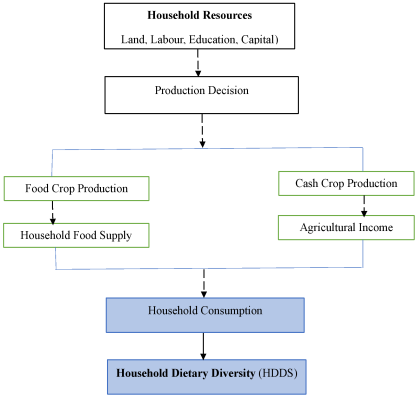
The Agricultural Household Model (AHM) of Singh, Squire and Strauss (1986) was followed as a guide in the study. The model explains how farm households simultaneously make production and consumption decisions while operating under resource constraints. The model assumes that households use the available resources (land, labour, capital and knowledge) to produce across competing production activities so as to maximize the household welfare.
In smallholder farming systems, households' consumption outcomes are closely tied to their crop production choices. The production of food crops has a direct impact on household food availability, while cash crops can be sold for income to buy food and other household items. Therefore, shifts in production decisions can impact dietary outcomes both directly, through food availability, and indirectly, through income channels.
The Agricultural Household Model provides a suitable theoretical framework for examining the relationship between cash crop production and household dietary diversity. It recognizes that commercialization may increase household purchasing power while simultaneously reducing resources available for food crop production, creating potential trade-offs between income generation and dietary outcomes.
Figure 1. Agricultural Household Model Framework Linking Cash Crop Production and Household Dietary Diversity. (Adapted from Singh, Squire, and Strauss (1986).
2.6. Empirical Model Specification
To examine the association of cash crop production on household dietary diversity, the following linear regression model was estimated:
where represents the Household Dietary Diversity Score for household ; denotes participation in cash crop production; represents food crop production; , , , , and represent household socio-economic characteristics; is the intercept term; are parameters to be estimated; and is the random error term.
2.7. Estimation Procedure
Ordinary Least Squares (OLS) regression was initially used to estimate the association between cash crop production and household dietary diversity. OLS provided the baseline estimates of the relationship between the dependent and explanatory variables. To assess the robustness of the findings, the model was subsequently re-estimated using robust standard errors, which produce reliable statistical inference when the assumption of constant error variance is violated. Because the coefficient estimates remained unchanged while the standard errors were adjusted, the robust specification was used as the primary model for statistical inference. All analyses were performed using Stata version 15.0.
3. Results
This section presents the empirical findings on the association between cash crop production and household dietary diversity among smallholder farmers in Tanzania. The analysis proceeds in three stages. First, an ordinary least squares (OLS) regression model is estimated to establish the baseline relationship between cash crop production and household dietary diversity. Second, the robustness of the findings is assessed using heteroskedasticity-robust standard errors. Finally, the two models are compared to identify the preferred specification for interpretation.
3.1. Main Model: Ordinary Least Squares Regression
An ordinary least squares (OLS) regression model was initially estimated to examine the association between cash crop production and household dietary diversity. The results are presented in
Table 1.
Cash crop production was negatively associated with household dietary diversity. Households engaged in cash crop production recorded an average HDDS that was 3.14 points lower than households not engaged in cash crop production. However, the association was only marginally significant (P = .07). Food crop production also showed a negative but statistically non-significant association with household dietary diversity (P = .17).
Education level was the only variable positively and significantly associated with household dietary diversity. A one-unit increase in education level was associated with an average increase of 0.12 points in HDDS (P = .003). Gender, age, marital status, and main occupation were not significantly associated with household dietary diversity. Even though main occupation showed a negative coefficient, the evidence was not strong enough to conclude that there was a significant effect of occupational differences on household dietary diversity.
The model explained approximately 15.4% of the variation in household dietary diversity (R² = 0.154). Although the explanatory power was modest, the overall model was marginally significant (P = .062).
Table 1. Ordinary Least Squares Regression Results for Household Dietary Diversity.
Variable | Coefficient | Standard Error | t-value | P Value | 95% Confidence Interval |
Food Crops | -1.560 | 1.126 | -1.39 | P = .17 | -3.801 to 0.681 |
Cash Crops | -3.142 | 1.708 | -1.84 | P = .07 | -6.542 to 0.257 |
Education Level | 0.123 | 0.040 | 3.06 | P = .003 | 0.043 to 0.203 |
Gender | -0.597 | 0.696 | -0.86 | P = .394 | -1.984 to 0.789 |
Age | 0.015 | 0.016 | 0.91 | P = .363 | -0.017 to 0.047 |
Main Occupation | -0.089 | 0.057 | -1.58 | P = .119 | -0.202 to 0.024 |
Marital Status | 0.054 | 0.137 | 0.39 | P = .695 | -0.219 to 0.327 |
Constant | 8.350 | 1.696 | 4.92 | P < .001 | 4.974 to 11.726 |
Model Summary: R² = 0.154; F = 2.024; P = .062; Observations = 86; AIC = 357.868; BIC = 377.503.
Source: Computed from Tanzania National Panel Survey (NPS) 2020/21.
3.2. Robustness Check: Linear Regression with Robust Standard Errors
To assess the robustness of the findings, the model was re-estimated using robust standard errors. The results are presented in
Table 2. The robust regression produced coefficient estimates identical in magnitude and direction to those of the baseline model. However, the association between cash crop production and household dietary diversity became statistically significant (P = .005), providing stronger evidence of a negative association.
Education level remained positively and significantly associated with household dietary diversity (P < .001), demonstrating the stability of this relationship across model specifications. Main occupation was marginally significant (P = .084), whereas food crop production, gender, age, and marital status remained statistically non-significant. The robust model retained the same explanatory power (R² = 0.154) but showed a substantially higher F-statistic (9.532) and an overall significance level of P < .001. These results indicate that the robust specification provides more reliable statistical inference.
Table 2. Linear Regression Results with Robust Standard Errors for Household Dietary Diversity.
Variable | Coefficient | Robust Standard Error | t-value | P Value | 95% Confidence Interval |
Food Crops | -1.560 | 1.101 | -1.42 | P = .16 | -3.752 to 0.632 |
Cash Crops | -3.142 | 1.082 | -2.90 | P = .005 | -5.296 to -0.988 |
Education Level | 0.123 | 0.026 | 4.74 | P < .001 | 0.071 to 0.175 |
Gender | -0.597 | 0.742 | -0.80 | P = .423 | -2.075 to 0.881 |
Age | 0.015 | 0.018 | 0.81 | P = .419 | -0.021 to 0.051 |
Main Occupation | -0.089 | 0.051 | -1.75 | P = .084 | -0.191 to 0.012 |
Marital Status | 0.054 | 0.136 | 0.40 | P = .692 | -0.216 to 0.324 |
Constant | 8.350 | 1.515 | 5.51 | P < .001 | 5.334 to 11.366 |
Model Summary: R² = 0.154; F = 9.532; P < .001; Observations = 86; AIC = 357.868; BIC = 377.503.
Source: Computed from Tanzania National Panel Survey (NPS) 2020/21.
3.3. Model Evaluation and Comparison
Table 3 compares the baseline OLS and robust regression models. The coefficient estimates remained unchanged across both models, indicating that the magnitude and direction of the estimated associations were stable. The main difference was the level of statistical significance, particularly for cash crop production.
Cash crop production remained negatively associated with household dietary diversity in both models but became statistically significant after applying robust standard errors (P = .005). Education level remained positively associated with dietary diversity under both specifications.
Both models explained 15.4% of the variation in household dietary diversity. However, the robust model produced stronger overall statistical evidence (F = 9.532; P < .001) while maintaining identical coefficient estimates. Therefore, the robust regression model was adopted as the primary model for interpretation in the Discussion section.
Table 3. Model Evaluation and Comparison.
Statistic | OLS Model | Robust Model |
Observations | 86 | 86 |
R² | 0.154 | 0.154 |
F-statistic | 2.024 | 9.532 |
Model Significance | P = .062 | P < .001 |
AIC | 357.868 | 357.868 |
BIC | 377.503 | 377.503 |
The comparison confirms that the central finding of the study is robust across model specifications. Participation in cash crop production is consistently associated with lower household dietary diversity, while higher educational attainment contributes positively to dietary diversity among smallholder farming households in Tanzania. Consequently, the robust regression model is adopted as the basis for subsequent discussion and interpretation.
4. Discussion
4.1. Cash Crop Production and Household Dietary Diversity
This study examined the association between cash crop production and household dietary diversity among smallholder farmers in Tanzania. The Household Dietary Diversity Score (HDDS) was used as an indicator of household dietary diversity. The findings showed that participation in cash crop production was associated with lower household dietary diversity, suggesting that increased commercialization does not necessarily correspond to more diverse household diets.
One possible explanation is that specialization in cash crops may reduce the land, labour, and other resources available for food crops consumed at home. As households become more dependent on purchased food, dietary diversity may increasingly depend on food prices, income stability, and market access. Similar concerns have been reported by FAO
and Geffersa and Tabe-Ojong
| [21] | Geffersa, A. G., & Tabe-Ojong, M. P. J. (2024). Smallholder commercialisation and rural household welfare: panel data evidence from Ethiopia. European Review of Agricultural Economics, 51(1), 54-90. https://doi.org/10.1093/erae/jbad040 |
[21]
.
The findings support the theory of the Agricultural Household Model (AHM) proposed by Singh, Squire, and Strauss (1986), that the farm household decides on the production and consumption of its needs at the same time and is also resource constrained
| [22] | Singh, I., Squire, L., & Strauss, J. (1986). Agricultural household models: Extensions, applications, and policy. Baltimore, MD: Johns Hopkins University Press.
https://documents.worldbank.org |
[22]
. The negative association between cash crop production and dietary diversity suggests that households may allocate limited resources toward market-oriented crops at the expense of crops consumed within the household. This finding supports the AHM's proposition that production and consumption decisions are closely linked in smallholder farming systems.
The results are also consistent with international and regional evidence. FAO stated that commercialisation can lead to an income gain but to a lower crop diversity and a higher reliance on bought food
. Likewise, Geffersa and Tabe-Ojong discovered that the impact of commercialization on welfare depends on the household and market conditions
| [21] | Geffersa, A. G., & Tabe-Ojong, M. P. J. (2024). Smallholder commercialisation and rural household welfare: panel data evidence from Ethiopia. European Review of Agricultural Economics, 51(1), 54-90. https://doi.org/10.1093/erae/jbad040 |
[21]
. In Ethiopia, Gebru et al. have demonstrated that potato commercialisation did not lead to a reduction in food-related vulnerability among all potato commercialising households, and instead created the food vulnerability in some households despite the increase in their income
| [7] | Bsrat, A. B., Gebru, K. M., Ayele, T. H., & Lema, G. G. (2025). Impact of potato business on household food security: An empirical study from Tigray regional state, Ethiopia. Journal of Agriculture and Rural Development in the Tropics and Subtropics (JARTS), 126(1), 53-63.
https://doi.org/10.17170/kobra-2025011410818 |
[7]
whilst Muche and Tolossa have found that the coffee producers' households suffered from seasonal food insecurity despite the improved income level
| [23] | Muche, M., & Tolossa, D. (2022). Comparative analysis of household food insecurity between selected coffee and wheat growers of Ethiopia. Cogent Food & Agriculture, 8(1), 2149134. https://doi.org/10.1080/23311932.2022.2149134 |
[23]
. These findings indicate that income gains from cash crops may not necessarily translate into improved household diets where food production declines or market conditions are unstable.
The results also corroborate Akpatsu et al
who noted that the benefits of cash crop value chains may not be realized by all farmers in the value chain due to unequal access to resources, extension services and agricultural information. Similarly, Nhlengetfwa and Mamba
pointed out that the welfare impact of commercialization is conditional on the overall socio-economic situation and household decision making. Although these factors were not directly examined in this study, they may help explain the observed association between cash crop production and lower household dietary diversity.
But the results are not in line with other studies that have found positive impacts of commercialization on household welfare. Justine et al.
| [26] | Justine, P., Csorba, Á., Ocansey, C. M., Rotich, B., Maket, I., Lameck, A. S.,... & Gelsleichter, Y. A. (2025). Awareness and adoption strategies for improved agricultural practices (IAPs) by smallholder farmers in the Mbeya Region, Tanzania. Discover Sustainability, 6(1), 198.
https://doi.org/10.1007/s43621-025-00970-y |
[26]
determined that in Tanzania, market aware farmers with larger land holdings were more likely to integrate commercial production and better welfare. Likewise, Geffersa and Tabe-Ojong
| [21] | Geffersa, A. G., & Tabe-Ojong, M. P. J. (2024). Smallholder commercialisation and rural household welfare: panel data evidence from Ethiopia. European Review of Agricultural Economics, 51(1), 54-90. https://doi.org/10.1093/erae/jbad040 |
[21]
. found that commercialization can enhance household welfare provided that the markets are efficient, the infrastructure is adequate, and agricultural services are available. These contrasting findings suggest that the relationship between commercialization and household dietary diversity is context-specific and influenced by the surrounding economic and institutional environment.
Overall, the findings indicate that cash crop production was negatively associated with household dietary diversity among smallholder farmers in Tanzania. Consistent with the Agricultural Household Model, the results highlight the trade-offs households face between income generation and household consumption, emphasizing the need for commercialization strategies that support both economic and nutritional well-being.
4.2. The Role of Education and Household Characteristics
Beyond cash crop production, education was the only household characteristic consistently associated with higher household dietary diversity. Households with higher education levels were more likely to consume a wider variety of foods, suggesting that education improves access to information, market opportunities, and household resource management
| [26] | Justine, P., Csorba, Á., Ocansey, C. M., Rotich, B., Maket, I., Lameck, A. S.,... & Gelsleichter, Y. A. (2025). Awareness and adoption strategies for improved agricultural practices (IAPs) by smallholder farmers in the Mbeya Region, Tanzania. Discover Sustainability, 6(1), 198.
https://doi.org/10.1007/s43621-025-00970-y |
[26]
.
The result is similar to the Agricultural Household Model (AHM) which identifies human capital as an important determinant of household production and consumption choices
| [22] | Singh, I., Squire, L., & Strauss, J. (1986). Agricultural household models: Extensions, applications, and policy. Baltimore, MD: Johns Hopkins University Press.
https://documents.worldbank.org |
[22]
. In this context, education has the potential to boost a household's capacity to use available resources in an efficient manner and make decisions that lead to an increase in welfare. The positive association between education and dietary diversity suggests that educational attainment enhances households' capacity to achieve better dietary outcomes. The finding is also in line with previous empirical studies. Ocansey et al.
| [26] | Justine, P., Csorba, Á., Ocansey, C. M., Rotich, B., Maket, I., Lameck, A. S.,... & Gelsleichter, Y. A. (2025). Awareness and adoption strategies for improved agricultural practices (IAPs) by smallholder farmers in the Mbeya Region, Tanzania. Discover Sustainability, 6(1), 198.
https://doi.org/10.1007/s43621-025-00970-y |
[26]
found that education had the effect of raising farmers' awareness of better farming practices and market dynamics. Together, these findings indicate that education contributes to improved agricultural decision-making, household welfare, and dietary quality.
However, food crop production had no significant effect on household dietary diversity. This suggests that producing food crops alone may not guarantee a diverse diet, particularly when production is concentrated on staple foods. As noted by FAO, dietary diversity depends not only on food availability but also on access to a variety of food groups
.
Gender, age, marital status, and main occupation were not significantly associated with household dietary diversity. These findings suggest that dietary outcomes were influenced more by education and production-related factors than by demographic characteristics. The weak association observed for main occupation may reflect the fact that many rural households combine farming with other income-generating activities
| [8] | FAO. (2023). The State of Food and Agriculture 2023. Rome: Food and Agriculture Organization.
https://openknowledge.fao.org/handle/20.500.14283/cc7724en |
| [26] | Justine, P., Csorba, Á., Ocansey, C. M., Rotich, B., Maket, I., Lameck, A. S.,... & Gelsleichter, Y. A. (2025). Awareness and adoption strategies for improved agricultural practices (IAPs) by smallholder farmers in the Mbeya Region, Tanzania. Discover Sustainability, 6(1), 198.
https://doi.org/10.1007/s43621-025-00970-y |
[8, 26]
.
Overall, the findings suggest that education plays a more important role in shaping household dietary diversity than most demographic characteristics. Strengthening farmer education, nutrition awareness, and access to information may therefore contribute to improved dietary quality among smallholder households.
4.3. Implications for Agricultural Commercialization and Rural Nutrition Policy
The findings suggest that promoting cash crop production alone may be insufficient to improve household dietary diversity among smallholder farmers. Commercialization can help to improve income, but as the results show, more involvement in cash crop production might not necessarily lead to higher dietary diversity. This indicates the importance of policies for agriculture that are inclusive of nutritional goals of households as well as income generation. Commercialization programmes should thus promote farming systems that include both cash crops and food crops, so that households can access a variety of foods as well as gain access to markets.
The positive impact of education on dietary diversity also indicates that education, nutrition awareness and agricultural extension services can be a key factor in enhancing household diets. Extension programmes, incorporating agriculture production, nutrition education and market information should be reinforced. These interventions have the potential to enable smallholder households to make production and consump-tion choices that can lead to better economic welfare as well as better diet quality, and thus better sustainable rural development outcomes.
5. Conclusions and Recommendations
5.1. Conclusion
This study examined the association between cash crop production and household dietary diversity among smallholder farmers in Tanzania. The findings showed that participation in cash crop production was negatively associated with household dietary diversity, whereas education was positively associated with dietary diversity. These results suggest that agricultural commercialization alone does not necessarily correspond to improved household dietary diversity and that education plays an important role in promoting better dietary outcomes. The findings are consistent with the Agricultural Household Model, which emphasizes the close relationship between production and consumption decisions in smallholder farming households.
5.2. Recommendations
The Ministry of Agriculture and local government authorities should integrate nutrition education into agricultural extension programmes and promote farming systems that combine cash and food crops. Efforts should also focus on improving farmer education and access to market information to help households translate agricultural income into more diverse diets. In the medium to long term, investments in rural market infrastructure and food storage facilities should be prioritized to improve food access and reduce market-related risks. Future research should examine the relationship between cash crop production and household dietary diversity using larger and longitudinal datasets while considering pathways such as income use, food purchasing behaviour, and market access.
Abbreviations
AHM | Agricultural Household Model |
FAO | Food and Agriculture Organization |
HDDS | Household Dietary Diversity Score |
NPS | National Panel Survey |
OLS | Ordinary Least Squares |
Acknowledgments
The authors would like to express their sincere appreciation to the National Bureau of Statistics (NBS) of Tanzania and the World Bank for making the Tanzania National Panel Survey (NPS) 2020/21 data available for research purposes. The authors also gratefully acknowledge Yusuf Kilanga for his valuable support and assistance during the data analysis process. His technical input contributed significantly to the successful completion of this study.
Author Contributions
Selemani Zuberi Omari: Conceptualization, Data curation, Formal Analysis, Investigation, Methodology, Project administration, Software, Validation, Visualization, Writing – original draft, Writing – review & editing
Charles Katiya: Conceptualization, Project administration, Validation, Visualization, Writing – review & editing
Data Availability Statement
The data that support the findings of this study can be found at: https://microdata.worldbank.org/index.php/catalog/5639 and https://microdata.nbs.go.tz/index.php/catalog/35. The dataset is publicly available subject to the data access policies of the National Bureau of Statistics (NBS) of Tanzania and the World Bank.
Conflicts of Interest
The authors declare no conflicts of interest.
References
| [1] |
Sithole, A., & Olorunfemi, O. D. (2024). Sustainable agricultural practices in Sub-Saharan Africa: a review of adoption trends, impacts, and challenges among smallholder farmers. Sustainability, 16(22), 9766.
https://doi.org/10.3390/su16229766
|
| [2] |
FAO, IFAD, UNICEF, WFP, & WHO. (2024). The State of Food Security and Nutrition in the World 2024. Rome: Food and Agriculture Organization.
https://www.fao.org/agrifood-economics/publications/detail/en/c/1707842/
|
| [3] |
Getahun, A. (2020). Smallholder farmers agricultural commercialization in Ethiopia: A review. Agriculture, Forestry and Fisheries, 9(3), 67.
https://doi.org/10.11648/j.aff.20200903.14
|
| [4] |
Nguimkeu, P., & Okou, C. (2021). Leveraging digital technologies to boost productivity in the informal sector in Sub‐Saharan Africa. Review of Policy Research, 38(6), 707-731.
https://doi.org/10.1111/ropr.12441
|
| [5] |
World Bank. (2024). Tanzania Economic Update: Transforming Agriculture for Inclusive Growth. Washington, DC: World Bank.
https://documents1.worldbank.org/curated/en/099031124044543127/pdf/P1796101f356d10fa1b47215b969e1205b2.pdf
|
| [6] |
Beyene, A. M., & Gashu, A. T. (2022). Smallholder crop commercialization and food and nutrition security: A review. Journal of Rice Research, 10, 1-8.
https://doi.org/10.4172/2375-4338.1000340
|
| [7] |
Bsrat, A. B., Gebru, K. M., Ayele, T. H., & Lema, G. G. (2025). Impact of potato business on household food security: An empirical study from Tigray regional state, Ethiopia. Journal of Agriculture and Rural Development in the Tropics and Subtropics (JARTS), 126(1), 53-63.
https://doi.org/10.17170/kobra-2025011410818
|
| [8] |
FAO. (2023). The State of Food and Agriculture 2023. Rome: Food and Agriculture Organization.
https://openknowledge.fao.org/handle/20.500.14283/cc7724en
|
| [9] |
Majiwa, E., Mwangi, C., Kiage, B., Obebo, F., Ateka, J., & Mbeche, R. (2025). Impact of livelihood diversification on household food security and dietary diversity in Tanzania. BMC Agriculture, 1(1), 17.
|
https://doi.org/10.1186/s44399-025-00017-7
|
| [10] |
Abraham, M., & Pingali, P. (2020). Transforming smallholder agriculture to achieve the SDGs. In The role of smallholder farms in food and nutrition security (pp. 173-209). Cham: Springer International Publishing.
https://doi.org/10.1007/978-3-030-42148-9_9
|
| [11] |
Ogutu, S. O., Gödecke, T., & Qaim, M. (2020). Agricultural commercialisation and nutrition in smallholder farm households. Journal of Agricultural Economics, 71(2), 534-555.
https://doi.org/10.1111/1477-9552.12359
|
| [12] |
Ochieng, J., Knerr, B., Owuor, G., & Ouma, E. (2020). Food crops commercialization and household livelihoods: Evidence from rural regions in Central Africa. Agribusiness, 36(2), 318-338.
https://doi.org/10.1002/agr.21619
|
| [13] |
Rweyemamu, M. R., Mruma, T., & Nkanyani, S. (2024). Tanzania agricultural policy profile.
https://hdl.handle.net/10568/140471
|
| [14] |
Ministry of Health (MoH) [Tanzania Mainland], Ministry of Health (MoH) [Zanzibar], National Bureau of Statistics (NBS), Office of the Chief Government Statistician (OCGS), and ICF. 2023 Tanzania Demographic and Health Survey and Malaria Indicator Survey 2022 Key Indicators Report. Dodoma, Tanzania, and Rockville, Maryland, USA: MoH, NBS, OCGS, and ICF.
https://dhsprogram.com/pubs/pdf/PR144/PPR144.pdf
|
| [15] |
Randell, H., Gray, C., & Shayo, E. H. (2022). Climatic conditions and household food security: Evidence from Tanzania. Food Policy, 112, 102362.
https://doi.org/10.1016/j.foodpol.2022.102362
|
| [16] |
Rupia, S. A. (2020). Impacts of Climate Change on Food Security in Northern Tanzania: A Case of Monduli District (Doctoral dissertation, The Open University of Tanzania).
http://repository.out.ac.tz/2639/1/SCARION%20ANATORY%20RUPIA%20tyr.pdf
|
| [17] |
Chegere, M. J., & Macha, D. E. (2025). The Effect of Food Costs on Dietary Diversity: Insights from Rural and Urban Households, Gender Dynamics, and Agricultural Involvement in Tanzania. VeriXiv, 2(122), 122.
https://doi.org/10.12688/verixiv.864.1
|
| [18] |
Mpogole, H., Kauki, B., Ngilangwa, E., Namwata, B. M., & Hauli, E. (2022). Commercialization of smallholder agriculture in the southern highlands of Tanzania.
https://repository.mocu.ac.tz/handle/123456789/1538
|
| [19] |
Mpehongwa, G., & Cassian, D. (2024). Effects of food crops commercialization on smallholders’ food security in Southern Tanza-nia. International Journal of Agricultural Economics, 13(2), 158-162.
https://doi.org/10.11648/j.ijae.20240903.13
|
| [20] |
Manikas, I., Ali, B. M., & Sundarakani, B. (2023). A systematic literature review of indicators measuring food security. Agriculture & food security, 12(1), 10.
https://doi.org/10.1186/s40066-023-00415-7
|
| [21] |
Geffersa, A. G., & Tabe-Ojong, M. P. J. (2024). Smallholder commercialisation and rural household welfare: panel data evidence from Ethiopia. European Review of Agricultural Economics, 51(1), 54-90.
https://doi.org/10.1093/erae/jbad040
|
| [22] |
Singh, I., Squire, L., & Strauss, J. (1986). Agricultural household models: Extensions, applications, and policy. Baltimore, MD: Johns Hopkins University Press.
https://documents.worldbank.org
|
| [23] |
Muche, M., & Tolossa, D. (2022). Comparative analysis of household food insecurity between selected coffee and wheat growers of Ethiopia. Cogent Food & Agriculture, 8(1), 2149134.
https://doi.org/10.1080/23311932.2022.2149134
|
| [24] |
Akpatsu, I. B., Ma, N., Jizorkuwie, A. L. B., Masoud, J., & Abera, W. (2024). Designing gender-and youth-responsive agronomic solutions: Ghana CerLeg GAIP use case.
https://cgspace.cgiar.org/bitstreams/3d5c0c50-29ec-4ab5-b3e1-988bba9d75b3/download
|
| [25] |
Nhlengetfwa, N., & Mamba, S. F. (2024). Socio-economic impacts of commercialisation of agriculture in the Kingdom of Eswatini: A case of Siphofaneni. Heliyon, 10(13).
https://doi.org/10.1016/j.heliyon.2024.e33722
|
| [26] |
Justine, P., Csorba, Á., Ocansey, C. M., Rotich, B., Maket, I., Lameck, A. S.,... & Gelsleichter, Y. A. (2025). Awareness and adoption strategies for improved agricultural practices (IAPs) by smallholder farmers in the Mbeya Region, Tanzania. Discover Sustainability, 6(1), 198.
https://doi.org/10.1007/s43621-025-00970-y
|
Cite This Article
-
APA Style
Omari, S. Z., Katiya, C. (2026). Agricultural Commercialization and Household Dietary Diversity: Evidence from Smallholder Farmers in Tanzania. International Journal of Agricultural Economics, 11(4), 143-152. https://doi.org/10.11648/j.ijae.20261104.17
 Copy
|
Copy
|
 Download
ACS Style
Omari, S. Z.; Katiya, C. Agricultural Commercialization and Household Dietary Diversity: Evidence from Smallholder Farmers in Tanzania. Int. J. Agric. Econ. 2026, 11(4), 143-152. doi: 10.11648/j.ijae.20261104.17
Copy
|
Download
AMA Style
Omari SZ, Katiya C. Agricultural Commercialization and Household Dietary Diversity: Evidence from Smallholder Farmers in Tanzania. Int J Agric Econ. 2026;11(4):143-152. doi: 10.11648/j.ijae.20261104.17
Copy
|
Download
-
@article{10.11648/j.ijae.20261104.17,
  author = {Selemani Zuberi Omari and Charles Katiya},
  title = {Agricultural Commercialization and Household Dietary Diversity: Evidence from Smallholder Farmers in Tanzania},
  journal = {International Journal of Agricultural Economics},
  volume = {11},
  number = {4},
  pages = {143-152},
  doi = {10.11648/j.ijae.20261104.17},
  url = {https://doi.org/10.11648/j.ijae.20261104.17},
  eprint = {https://article.sciencepublishinggroup.com/pdf/10.11648.j.ijae.20261104.17},
  abstract = {Agricultural commercialization is widely promoted as a strategy for improving rural livelihoods and reducing poverty among smallholder farmers. However, its association with household dietary outcomes remains unclear, particularly in developing countries where households often balance income generation with food production. This study examined the association between cash crop production and household dietary diversity among smallholder farmers in Tanzania. The study used secondary data from the Tanzania National Panel Survey (NPS) 2020/21 and focused on 86 farming households with complete information on dietary diversity and crop production. Household Dietary Diversity Score (HDDS) was used as an indicator of dietary quality. Ordinary Least Squares (OLS) regression was employed to examine the association between cash crop production and household dietary diversity, followed by a robustness analysis using robust standard errors. The results showed that participation in cash crop production was significantly associated with lower household dietary diversity. Households engaged in cash crop production recorded lower HDDS than those not engaged in cash crop production, indicating that agricultural commercialization did not necessarily correspond to more diverse diets. Education level was the only socio-economic characteristic positively associated with dietary diversity, whereas food crop production, age, gender, marital status, and main occupation showed no significant associations with dietary diversity. The findings are consistent with the Agricultural Household Model, which emphasizes that farm households make production and consumption decisions simultaneously under resource constraints. The study concludes that agricultural commercialization alone may be insufficient to improve household dietary diversity and should be complemented by nutrition-sensitive extension services, farmer education, and policies that promote balanced crop production systems.},
 year = {2026}
}
Copy
|
Download
-
TY  - JOUR
T1  - Agricultural Commercialization and Household Dietary Diversity: Evidence from Smallholder Farmers in Tanzania
AU  - Selemani Zuberi Omari
AU  - Charles Katiya
Y1  - 2026/07/28
PY  - 2026
N1  - https://doi.org/10.11648/j.ijae.20261104.17
DO  - 10.11648/j.ijae.20261104.17
T2  - International Journal of Agricultural Economics
JF  - International Journal of Agricultural Economics
JO  - International Journal of Agricultural Economics
SP  - 143
EP  - 152
PB  - Science Publishing Group
SN  - 2575-3843
UR  - https://doi.org/10.11648/j.ijae.20261104.17
AB  - Agricultural commercialization is widely promoted as a strategy for improving rural livelihoods and reducing poverty among smallholder farmers. However, its association with household dietary outcomes remains unclear, particularly in developing countries where households often balance income generation with food production. This study examined the association between cash crop production and household dietary diversity among smallholder farmers in Tanzania. The study used secondary data from the Tanzania National Panel Survey (NPS) 2020/21 and focused on 86 farming households with complete information on dietary diversity and crop production. Household Dietary Diversity Score (HDDS) was used as an indicator of dietary quality. Ordinary Least Squares (OLS) regression was employed to examine the association between cash crop production and household dietary diversity, followed by a robustness analysis using robust standard errors. The results showed that participation in cash crop production was significantly associated with lower household dietary diversity. Households engaged in cash crop production recorded lower HDDS than those not engaged in cash crop production, indicating that agricultural commercialization did not necessarily correspond to more diverse diets. Education level was the only socio-economic characteristic positively associated with dietary diversity, whereas food crop production, age, gender, marital status, and main occupation showed no significant associations with dietary diversity. The findings are consistent with the Agricultural Household Model, which emphasizes that farm households make production and consumption decisions simultaneously under resource constraints. The study concludes that agricultural commercialization alone may be insufficient to improve household dietary diversity and should be complemented by nutrition-sensitive extension services, farmer education, and policies that promote balanced crop production systems.
VL  - 11
IS  - 4
ER  -
Copy
|
Download





 Share This Article
 Twitter
 Linked In
 Facebook