
Background: Lung cancer remains one of the leading causes of cancer-related mortality worldwide. Despite the numerous advantages of video-assisted thoracoscopic surgery (VATS) in thoracic surgery, postoperative pain continues to pose a significant challenge, contributing to pulmonary complications and delayed recovery. Given the limited efficacy and notable adverse effects of systemic opioids, opioid-sparing multimodal analgesic strategies—including regional nerve block techniques such as the paravertebral block—have gained increasing attention for optimizing postoperative pain management and enhancing recovery. Objective: This case report aims to illustrate the clinical application and analgesic efficacy of an ultrasound-guided single-injection TPVB, combined with a preoperative nonsteroidal anti-inflammatory drug (NSAID), as a component of an opioid-sparing multimodal regimen in a patient undergoing VATS sublobar resection. Methods: A 36-year-old female underwent VATS sublobar resection of a right upper lobe nodule. To achieve opioid-sparing multimodal analgesia, the anesthesiologist implemented a regimen consisting of an intravenous NSAID (flurbiprofen axetil 50 mg) administered 30 minutes before the end of surgery, followed by an ultrasound-guided thoracic paravertebral block (TPVB) with 25 mL of 0.25% ropivacaine injected as a single shot postoperatively. Conclusions: A single-injection thoracic paravertebral block (TPVB) represents a highly effective component of a multimodal analgesic strategy, offering profound and opioid-sparing analgesia for thoracic surgical procedures.
| Published in | International Journal of Anesthesia and Clinical Medicine (Volume 14, Issue 2) |
| DOI | 10.11648/j.ijacm.20261402.12 |
| Page(s) | 127-130 |
| Creative Commons |
This is an Open Access article, distributed under the terms of the Creative Commons Attribution 4.0 International License (http://creativecommons.org/licenses/by/4.0/), which permits unrestricted use, distribution and reproduction in any medium or format, provided the original work is properly cited. |
| Copyright |
Copyright © The Author(s), 2026. Published by Science Publishing Group |
Video-assisted Thoracoscopic Surgery (VATS), Thoracic Paravertebral Block (TPVB)
VATS | Video-assisted Thoracoscopic Surgery |
NSAIDS | Nonsteroidal Anti-inflammatory Drug |
ACS | American Cancer Society |
TPVB | Thoracic Paravertebral Block |
TPVS | Thoracic Paravertebral Space |
NSCLC | Non-small Cell Lung Cancer |
TP | Transverse Process |
PACU | The Post-anesthesia Care Unit |
VAS | Visual Analog Scale |
| [1] | Sun L, Mu J, Gao B, et al. Comparison of the efficacy of ultrasound-guided erector spinae plane block and thoracic paravertebral block combined with intercostal nerve block for pain management in video-assisted thoracoscopic surgery: a prospective, randomized, controlled clinical trial [J]. BMC Anesthesiol, 2022, 22(1): 283. |
| [2] | Zhu J, Wei B, Wu L, et al. Effect of Thoracic Paravertebral Block on Postoperative Pulmonary Complications After Video-Assisted Thoracoscopic Surgery: A Dual-Center Randomized Clinical Trial [J]. Ther Clin Risk Manag, 2025, 21: 691-703. |
| [3] | Murakawa T, Sato H, Okumura S, et al. Thoracoscopic surgery versus open surgery for lung metastases of colorectal cancer: a multi-institutional retrospective analysis using propensity score adjustment† [J]. Eur J Cardiothorac Surg, 2017, 51(6): 1157-1163. |
| [4] | Kinjo Y, Kurita N, Nakamura F, et al. Effectiveness of combined thoracoscopic-laparoscopic esophagectomy: comparison of postoperative complications and midterm oncological outcomes in patients with esophageal cancer [J]. Surg Endosc, 2012, 26(2): 381-90. |
| [5] | Karnik P P, Dave N M, Garasia M. Comparison of analgesic efficacy and safety of continuous epidural infusion versus local infiltration and systemic opioids in video-assisted thoracoscopic surgery decortication in pediatric empyema patients [J]. Saudi J Anaesth, 2018, 12(2): 240-244. |
| [6] | Beltran R, Veneziano G, Bhalla T, et al. Postoperative pain management in patients undergoing thoracoscopic repair of pectus excavatum: A retrospective analysis of opioid consumption and adverse effects in adolescents [J]. Saudi J Anaesth, 2017, 11(4): 427-431. |
| [7] | Rahman N M, Pepperell J, Rehal S, et al. Effect of Opioids vs NSAIDs and Larger vs Smaller Chest Tube Size on Pain Control and Pleurodesis Efficacy Among Patients With Malignant Pleural Effusion: The TIME1 Randomized Clinical Trial [J]. Jama, 2015, 314(24): 2641-53. |
| [8] | Sung C S, Wei T J, Hung J J, et al. Comparisons in analgesic effects between ultrasound-guided erector spinae plane block and surgical intercostal nerve block after video-assisted thoracoscopic surgery: A randomized controlled trial [J]. J Clin Anesth, 2024, 95: 111448. |
| [9] | Turhan Ö, Sivrikoz N, Sungur Z, et al. Thoracic Paravertebral Block Achieves Better Pain Control Than Erector Spinae Plane Block and Intercostal Nerve Block in Thoracoscopic Surgery: A Randomized Study [J]. J Cardiothorac Vasc Anesth, 2021, 35(10): 2920-2927. |
| [10] | Hu Z, Liu D, Wang Z Z, et al. The efficacy of thoracic paravertebral block for thoracoscopic surgery: A meta-analysis of randomized controlled trials [J]. Medicine (Baltimore), 2018, 97(51): e13771. |
| [11] | Sandeep B, Huang X, Li Y, et al. A comparison of regional anesthesia techniques in patients undergoing video-assisted thoracic surgery: A network meta-analysis [J]. Int J Surg, 2022, 105: 106840. |
APA Style
Lin, S. (2026). Ultrasound-Guided Thoracic Paravertebral Block for Uniportal VATS Sublobar Resection: A Case Report. International Journal of Anesthesia and Clinical Medicine, 14(2), 127-130. https://doi.org/10.11648/j.ijacm.20261402.12
ACS Style
Lin, S. Ultrasound-Guided Thoracic Paravertebral Block for Uniportal VATS Sublobar Resection: A Case Report. Int. J. Anesth. Clin. Med. 2026, 14(2), 127-130. doi: 10.11648/j.ijacm.20261402.12
@article{10.11648/j.ijacm.20261402.12,
  author = {Shizhu Lin},
  title = {Ultrasound-Guided Thoracic Paravertebral Block for Uniportal VATS Sublobar Resection: A Case Report},
  journal = {International Journal of Anesthesia and Clinical Medicine},
  volume = {14},
  number = {2},
  pages = {127-130},
  doi = {10.11648/j.ijacm.20261402.12},
  url = {https://doi.org/10.11648/j.ijacm.20261402.12},
  eprint = {https://article.sciencepublishinggroup.com/pdf/10.11648.j.ijacm.20261402.12},
  abstract = {Background: Lung cancer remains one of the leading causes of cancer-related mortality worldwide. Despite the numerous advantages of video-assisted thoracoscopic surgery (VATS) in thoracic surgery, postoperative pain continues to pose a significant challenge, contributing to pulmonary complications and delayed recovery. Given the limited efficacy and notable adverse effects of systemic opioids, opioid-sparing multimodal analgesic strategies—including regional nerve block techniques such as the paravertebral block—have gained increasing attention for optimizing postoperative pain management and enhancing recovery. Objective: This case report aims to illustrate the clinical application and analgesic efficacy of an ultrasound-guided single-injection TPVB, combined with a preoperative nonsteroidal anti-inflammatory drug (NSAID), as a component of an opioid-sparing multimodal regimen in a patient undergoing VATS sublobar resection. Methods: A 36-year-old female underwent VATS sublobar resection of a right upper lobe nodule. To achieve opioid-sparing multimodal analgesia, the anesthesiologist implemented a regimen consisting of an intravenous NSAID (flurbiprofen axetil 50 mg) administered 30 minutes before the end of surgery, followed by an ultrasound-guided thoracic paravertebral block (TPVB) with 25 mL of 0.25% ropivacaine injected as a single shot postoperatively. Conclusions: A single-injection thoracic paravertebral block (TPVB) represents a highly effective component of a multimodal analgesic strategy, offering profound and opioid-sparing analgesia for thoracic surgical procedures.},
 year = {2026}
}
TY  - JOUR
T1  - Ultrasound-Guided Thoracic Paravertebral Block for Uniportal VATS Sublobar Resection: A Case Report
AU  - Shizhu Lin
Y1  - 2026/07/17
PY  - 2026
N1  - https://doi.org/10.11648/j.ijacm.20261402.12
DO  - 10.11648/j.ijacm.20261402.12
T2  - International Journal of Anesthesia and Clinical Medicine
JF  - International Journal of Anesthesia and Clinical Medicine
JO  - International Journal of Anesthesia and Clinical Medicine
SP  - 127
EP  - 130
PB  - Science Publishing Group
SN  - 2997-2698
UR  - https://doi.org/10.11648/j.ijacm.20261402.12
AB  - Background: Lung cancer remains one of the leading causes of cancer-related mortality worldwide. Despite the numerous advantages of video-assisted thoracoscopic surgery (VATS) in thoracic surgery, postoperative pain continues to pose a significant challenge, contributing to pulmonary complications and delayed recovery. Given the limited efficacy and notable adverse effects of systemic opioids, opioid-sparing multimodal analgesic strategies—including regional nerve block techniques such as the paravertebral block—have gained increasing attention for optimizing postoperative pain management and enhancing recovery. Objective: This case report aims to illustrate the clinical application and analgesic efficacy of an ultrasound-guided single-injection TPVB, combined with a preoperative nonsteroidal anti-inflammatory drug (NSAID), as a component of an opioid-sparing multimodal regimen in a patient undergoing VATS sublobar resection. Methods: A 36-year-old female underwent VATS sublobar resection of a right upper lobe nodule. To achieve opioid-sparing multimodal analgesia, the anesthesiologist implemented a regimen consisting of an intravenous NSAID (flurbiprofen axetil 50 mg) administered 30 minutes before the end of surgery, followed by an ultrasound-guided thoracic paravertebral block (TPVB) with 25 mL of 0.25% ropivacaine injected as a single shot postoperatively. Conclusions: A single-injection thoracic paravertebral block (TPVB) represents a highly effective component of a multimodal analgesic strategy, offering profound and opioid-sparing analgesia for thoracic surgical procedures.
VL  - 14
IS  - 2
ER  -
West China Hospital, Sichuan University, Chengdu, China
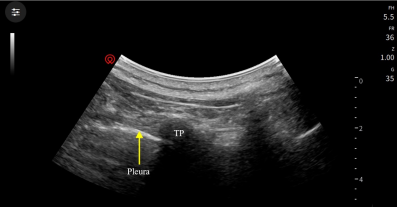
Figure 1. Using an in-plane approach with lateral-to-medial needle trajectory, the needle was advanced until its tip pierced the superior border of the costotransverse ligament and reached the paravertebral space. Transverse process (TP).
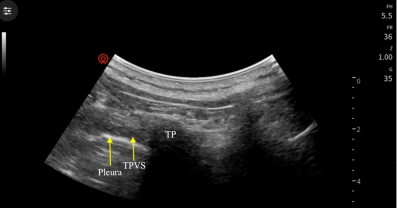
Figure 2. After the pleura was gently displaced, 25 mL of 0.25% ropivacaine was injected into the paravertebral space. TPVS: Thoracic paravertebral space.

Information



 Share This Article
 Twitter
 Linked In
 Facebook
 Copy
Copy Download