Abstract
One of the crucial post-harvest processes that contribute to the unique color, flavor, and taste of a coffee drink is drying technique. Solar drying refers to a technique that utilizes incident solar radiation to convert it into thermal energy required for drying purposes. A polyhouse solar dryer is a unique and cost-efficient method of drying agricultural products on a small as well as commercial scale. The fabricated dryer has three major units: a solar collector unit, a drying unit, and chimney unit components. The aim of this study was to manufacture and evaluate a 5-meter length and 2-meter width half-circled tunnel polyhouse type solar dryer using parchment coffee and hot pepper. The experimental results showed that the developed dryer has the capacity to dry averagely about 150 kg of hot pepper and 50 kg of wet coffee per batch. The obtained data were analyzed using software such as simple descriptive statistics and Origin Pro 2019 according to their suitability. Hot pepper was dried from an initial moisture content of about 82.95% to 10.42% in a polyhouse-type solar dryer within 6 days, while conventional sun drying took around 9 days. Using hot pepper, the average temperature inside the dryer was 53.90 °C to 62.57 °C in the full load condition, which was greater than the ambient temperature in all six days of the experiment. While the ambient relative humidity varies between 34.5% and 43.5%, the dryer's relative humidity using hot pepper was altered between 21.07% and 24.69%. In all six days of the experimental period, the relative humidity of the dryer was found to be less than that of ambient relative humidity due to the polyhouse effect. The wet coffee bean was dried from an initial moisture content of about 51.89% to 11.10% in a polyhouse-type solar dryer within 3 days, while by open-sun drying it took around 6 days. Using wet coffee, the temperature inside the dryer chamber were 50.08 °C to 54.08 °C at full load condition, which was greater than the ambient temperature in all three days of a tests. Whereas the ambient humidity in the air ranges from 39.77% to 42.22%, the dryer's relative humidity using wet coffee ranged between 22.22% and 23.46%. The average dryer thermal efficiencies of a polyhouse dryer use wet coffee beans and hot pepper were 64.48% and 86.87%, respectively.
Keywords
Drying Efficiency, Evaluation, Hot Pepper, Moisture Content, Polyhouse Type, Relative Humidity, Solar Dryer, Solar Radiation Temperature and Wet Coffee
1. Introduction
Solar energy is energy comes from the sun. Every day, the sun radiates an enormous amount of energy
| [1] | S. K. Tonui, “Design and evaluation of solar maize grain dryer with a back-up heater.” University of Nairobi, 2014. |
[1]
. There are a number of ways to classify solar dryers, including type, working temperature, material to be dried, and operating mode (batch or continuous).
| [2] | L. Büscher, “Further development of a solar thermal chamber dryer for fish: based on a previous device,” 2018. |
[2]
.
The process of removing a liquid component from a damp product through volatilization or evaporation is known as drying. The product can be a liquid, pulp, or solid, and either mechanical or thermal processing could be utilized
| [2] | L. Büscher, “Further development of a solar thermal chamber dryer for fish: based on a previous device,” 2018. |
[2]
.
Jimma zone is one of the major coffee-producing areas, with about 105,140 hectares of land covered with coffee. According to Jimma Zone Agricultural Office, the total annual coffee produced in 2009/10 was 36,408.69 tons; about 30.45% is washed and 69.55% is unwashed coffee, of which sun-dried coffee accounts for about 76% of the total coffee marketed in the Jimma area
| [3] | S. E. Gomma-Ii, “Influence Of Sun Drying Methods And Layer Thickness On Quality Of Midland Arabica Coffee Varieties At,” 2015. |
[3]
. The average daily consumption of hot pepper by an Ethiopian adult is estimated at 15 g, which is higher than tomatoes and most other vegetables
. The potential areas of southwestern Oromia for hot pepper production are estimated to be about 59,991 hectares of land with a total production of 72,466 tons for dry pods and, 4783 ha of land with a production of 44,273 tons for fresh pods
| [5] | S. Delelegn, “Evaluation of elite hot pepper varieties (Capsicum species) for growth, dry pod yield and quality under Jimma condition, South West Ethiopia.” Jimma University, 2011. |
[5]
. Most of the farmers produce coffee and hot pepper in southwestern Oromia and dry their production by natural sun dryers in their environment and even on street roads, but this method has impacts like taking a long period of time, reducing the quality of crops, and increasing the work load on farmers. Most developing countries, including Ethiopia, are unable to solve their food problems because of the rapidly increasing population.
A classic method for preserving food and crops is drying, which entails heating the product to eliminate moisture. The moisture in the product is removed by the applied heat, which also raises the vapor pressure of the moisture above the ambient air temperature. As a result, drying increases the product's shelf life, makes it portable, and takes up less storage space. Among all the drying methods, sun drying is a well-known method for drying agricultural commodities immediately after harvest, especially in developing countries. However, sun drying is plagued with in-built problems, since the product during drying is unprotected from rain, storm, windborne dirt, dust and infestation by insects, rodents, and other animals
| [6] | R. J. Mongi, N. Bernadette, B. Chove, and T. Wicklund, “Descriptive sensory analysis, consumer liking and preference mapping for solar dried mango cv Dodo,” Food Sci. Qual. Manag., vol. 16, pp. 16–23, 2013. |
[6]
. As a result, dried goods' quality could suffer and come below of the necessary national and international requirements
| [7] | D. K. Verma, M. Thakur, P. P. Srivastav, V. M. Karizaki, and H. A. R. Suleria, “Effects of drying technology on physiochemical and nutritional quality of fruits and vegetables,” in Emerging thermal and nonthermal technologies in food processing, Apple Academic Press, 2020, pp. 69–116. |
[7]
. However, mechanical drying methods like freeze, drum, and cyclone drying are expensive and environmentally harmful; for this reason, solar energy is increasingly being considered as a substitute for mechanical drying of agricultural products.
| [8] | L. Krishnan et al., “Seaweed-based polysaccharides-Review of extraction, characterization, and bioplastic application,” Green Chem., 2024. |
[8]
. Solar driers are more effective than sun drying, with lower operating costs than mechanized driers. In recent years, polyhouse type solar drying technologies have become a preferred option for drying majority of agricultural-based products
| [9] | D. R. H. Kamatham, A. Prathyusha, K. Kavitha, B. Kumar, K. Manasa, And K. Sowmya, “Iot Based Smart And Solar Operated Multi Tasking Agriculture Robot,” 2022. |
[9]
.
A distinctive and economical way to dry agricultural products on a small or large scale is the polyhouse dryer. It consists of a drying chamber, an exhaust chimney. The roof and the wall of a polyhouse solar dryer (PSD) are made by transparent plastic films that are mounted on a metal frame. The polyhouse solar dryer is belongs to the polyhouse type of dryers. In indirect solar dryers, a separate solar collector is used to heat the air entering into the cabinet. The heat required for the drying operation in mixed mode solar dryer is produced by the combined action of solar radiation incident on the produce and the preheated air in the solar collector. Polyhouse type method of drying may result in physical and structural alterations in the final product, including shrinkage, case-hardening, loss of volatile nutrient components and lower water re-absorption during rehydration. Consequently, sun drying yields low quality product that in most instances does not meet the desired international standards.
Polyhouse dryers are now being increasingly used because they are more efficient option of direct solar driers
| [10] | A. Sangamithra, G. J. Swamy, R. S. Prema, R. Priyavarshini, V. Chandrasekar, and S. Sasikala, “An overview of a polyhouse dryer,” Renew. Sustain. Energy Rev., vol. 40, pp. 902–910, 2014. |
[10]
. The purpose of this study was to determine the appropriate drying technique for coffee and hot peppers by conducting an experimental comparison of their drying capabilities using a polyhouse solar dryer and the open sun drying method.
1.1. Objectives of the Study
The objectives of this study were to fabricate and evaluate a polyhouse type solar dryer using wet coffee and hot pepper.
1.2. The Related Literature Review
The polyhouse dryer is an aspect of the polyhouse dryer category. In indirect solar dryers, the air entering the cabinet is heated by a separate solar collector. The combination of the preheated air in the solar collector and the solar radiation that strikes the product produces the heat required to complete the drying process in a mixed mode solar dryer
| [11] | I. C. Ugwuoke, I. B. Ikechukwu, and O. E. Ifianyi, “Design and development of a mixed-mode domestic solar dryer,” 2019. |
[11]
. Variations in insulation, ambient temperature, and relative humidity all affect how effectively the aforementioned driers perform. Hybrid solar dryers rely on solar power to some extent. They utilize heating systems that operate on fossil fuels, electricity, or solar energy
| [12] | A. Lingayat, R. Zachariah, and A. Modi, “Current status and prospect of integrating solar air heating systems for drying in various sectors and industries,” Sustain. Energy Technol. Assessments, vol. 52, p. 102274, 2022. |
[12]
. Compared to mechanized driers, solar driers have lower operating costs and are more efficient than sun drying. Many designs with fewer applications have been technically proven. Numerous direct sun dryer types, including box/cabinet, tent, and polyhouse models, have been thoroughly studied for the purpose of drying agricultural products. Since polyhouse dryers are a more effective alternative to direct solar driers, their use is now increasing
| [13] | P. Singh and M. K. Gaur, “Review on development, recent advancement and applications of various types of solar dryers,” Energy Sources, Part A Recover. Util. Environ. Eff., pp. 1–21, 2020. |
[13]
.
A distinctive and economical way to dry agricultural products on a small or large scale is the polyhouse dryer. It is made up of an exhaust chimney and a drying chamber. A PSD's wall and roof are constructed from transparent plastic films that are attached to a metal frame. The sheet retains the ideal temperature for drying products throughout the day because of its transitivity of about 92% for visible radiation. UV-stabilized coatings are crucial for polyhouse dryers. Sunlight's UV rays have a tendency to alter food materials' organoleptic qualities, including their texture, color, and flavor
| [14] | M. Lavilla, A. Lasagabaster, and I. Martínez-de-Marañón, “Impact of ultraviolet processing on food composition,” Eff. Emerg. Process. methods food Qual. advantages challenges, pp. 173–196, 2019. |
[14]
. Therefore, To prevent this kind of loss, UV-stabilized polyethylene sheets are utilized. The sheet only permits short wavelengths, which are transformed into long wavelengths upon impact with a blackbody or product surface. The long wavelength raises the dryer's internal temperature because it is unable to escape
| [15] | A. Ibrahim, T. M. P. Cattaneo, A. Amer, and L. Helyes, “Drying technology evolution and global concerns related to food security and sustainability,” in Food processing and packaging technologies-recent advances, IntechOpen, 2023. |
[15]
. In addition to the benefits listed above, the sheet is outstanding in terms of its transparency, transitivity, anti-corrosion, self-adhesive, retraction ratio, tensile, tear-, puncture-, moisture-, and dust-resistant qualities.
S. Suherman worked on hybrid solar dryer using coffee bean
| [16] | S. Suherman, H. Widuri, S. Patricia, and E. E. Susanto, “Energy Analysis of a Hybrid Solar Dryer for Drying Coffee Beans,” vol. 9, no. 1, pp. 131–139, 2020. |
[16]
, The results showed that the coffee beans' initial moisture content was 54.23% w.b. and that it eventually decreased to between 11 and 12% w.b. Indirect solar coffee drying was also conducted
, and the results showed that, when used at specific rates and operating hours, the solar collector improves parchment coffee drying efficiency by roughly 20 to 40%, or 3.4 times, when compared to natural sun drying.
| [18] | Z. Admass, A. O. Salau, B. Mhari, and E. Tefera, “Red pepper drying with a double pass solar air heater integrated with aluminium cans,” Sci. Rep., pp. 1–12, 2024, https://doi.org/10.1038/s41598-024-53563-6 |
[18]
developed the red pepper dryer and results indicated that the drying rate of 0.0003395 kg/s was achieved for the open sun dryer system and 0.0000365 kg/s for the mixed mode solar dryer.
| [19] | P. Process et al., “Performance evaluation of a cabinet solar dryer for drying red pepper in Bangladesh m er ci al us e er al,” vol. XLIX, 2018, https://doi.org/10.4081/jae.2018.774 |
[19]
designed and fabricated the red pepper dryer and the experimental results indicate that the upper tray and lower tray pepper drying needed 36 and 41 h to reduce moisture from 73% (wet basis) to 10% (wet basis) respectively and found 9 kg dried pepper from 30 kg fresh red ripe pepper.
studied the drying of hot red pepper in the open air, under greenhouse and in a solar drier and the experiment results obtained showed that, drying times (including nights) are about 73 hours in the dryer, 79 hours in the greenhouse and 118 hours in open sun.
2. Materials and Methods
2.1. Materials Used
Plywood, transparent plastic, water pipe, round and square pipe, aluminum sheet metal, wire mesh, bolts and nuts, sacks, black paint, brush, nail, and screw, wet coffee, and hot pepper were used.
Instruments used for testing
Infrared thermometer, digital hygrometer, multimeter, calorimeter, digital balance, anemometer, and drying oven were used.
2.2. Methods
2.2.1. Description of the Study Areas
The Jimma zone's Omo Nada and Manna districts were used as the study areas. Manna district, Kentere Kebele, which was located between 7° 44' 59.99" N latitude and 36° 44' 59.99" E longitude, and at an altitude of 1820 m.a.s.l., was the site of the wet coffee experiment
| [21] | A. Tesfaye, “Smallholder coffee producer’s perception to climate change and variability: the evidence from Mana district, South-Western Ethiopia,” GeoJournal, vol. 87, no. 6, pp. 4901–4912, 2022. |
[21]
. The district's average minimum and maximum temperatures were 14°C and 27°C, respectively. The hot pepper experiment was conducted in the Waktola kebele of the Omo Nada district, which is located at latitude 7036'41"N and longitude 36044'12" E. The location's height spans from 1100 to 1600 m.a.s.l., its mean annual temperature ranges from 18°C to 25°C the sections
| [22] | B. Endalew, M. Zeleke, W. Yenewa, and Z. Ayalew, “Determinants of farm households’ participation in fish production in Southwest Ethiopia,” Cogent Food Agric., vol. 6, no. 1, 2020, https://doi.org/10.1080/23311932.2020.1728107 |
[22]
, and its minimum and maximum annual rainfall varies from 1066 to 1200 mm. The average sunshine and daily solar insolation at the site of Omo Nada district were 12 hours per day and 7.35-7.73 kW/m
2 surfaces per day, respectively, while for Mana district it was 12 hours per day and 6.36-685 kW/m
2 surfaces per day, respectively.
2.2.2. Descriptions of the Polyhouse Type Solar Dryer
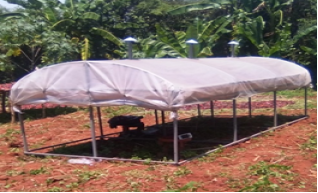
The solar dryer of the polyhouse type is made up of various parts. A base frame, a semi-cylinder drying chamber, a solar collector, an absorber, and a chimney-equipped air distribution system make up this device. Additionally, the PSD prototype was manufactured in the workshop of the Jimma Agricultural Engineering Research Center (JAERC).
Figure 1. The manufactured solar dryer prototype.
No load test
The performance of the prototype dryer was evaluated under no load condition. The highest and lowest temperature absorbed on the drying chamber by the dryer was recorded for sun-shine hours of the study area. The average temperature inside the PSD was compared with the average ambient temperature.
Load test
Sample preparation
The farmer's land yielded hot pepper and fresh, matured coffee. To get eliminate of any dirt or dust particles that might have been attached, the obtained samples were cleaned. After being cleaned, the sample was placed in a tray and weighed for various loading densities using a digital balance. After removing surface water with a tray, the pretreated sample was loaded into the tray.
Drying in polyhouse type solar dryer
On a PSD tray, samples of wet coffee and treated hot pepper were evenly layered. The washer was filled to overflowing for every experiment. The oven method (24 hours at 105 °C) was used to determine the initial moisture content. Temperature (ambient air, inside the STD, and at exhaust), relative humidity (ambient and inside the STD), air velocity, and solar radiation were all measured during the drying of the process. Each of the 30 minutes, the data were recorded.
2.2.3. Performance Evaluation Parameters of the PSD
The operational parameters that have a significant impact on a dryer's performance were used to evaluate the solar dryers' performance: (a) drying air characteristics (temperature, humidity, and airflow rate); (b) product variables (throughput, initial and final moisture contents, size, and size distribution); and (c) dimensional variables (dryer width, length, height, or diameter, number of passes, and dryer configuration).
Drying thermal efficiency
The drying efficiency was calculated as the drying section's energy output divided by its energy consumption. Given that sensible heating of the sample is far less than latent heat, the dryer's energy output has been the amount of heat required for removing moisture from the material.
Where, Od - Output of the dryer, kJ, mr - moisture removed,
Lv - latent heat of vaporization of moisture, kJ/kg. Thus, efficiency of the dryer was calculated as:
Moisture contents
Where,
Wi = initial weight of the hot pepper/wet coffee sample plus container
Wf = weight of hot pepper/wet coffee sample plus container after dry
Wc = weight of the empty container
Parameters considered for data collection
Drying air characteristics (temperature, humidity, and airflow rate), product variables (throughput, initial and final moisture contents, size and size distribution), sunshine duration, wind speed, moisture content, and input material weight were the primary data collected for testing the polyhouse solar dryer. Dimensional variables (dryer width, length, height, or diameter, number of passes, and dryer configuration) were also measured.
2.3. Data Analysis Method
The collected data’s were statistically analyzed and graph lined using software such as simple descriptive statistics and Origin Pro 2019b respectively according to their suitability.
3. Results and Discussion
3.1. No Load Test
When the solar dryer was operating without any load, the system's temperatures were recorded.
The dryer's testing under no load conditions was completed during harvest in the winter.
Table 1. The average variation of temperature and insolation during different months and location at no load conditions.
Months | Product | Location | Ambient temperature (°C) | Temperature inside dryer (°C) | Insolation (w/m2) |
Oct. (04-08/2020) | Hot pepper | Latitude = 7.7198 Longitude = 37.2174 | (25-27) | (53-63) | (735-773) |
Nov. (13-18/2022) | Wet coffee | Latitude 7.8594 Longitude 36.7978 | (24-26) | (51-59) | (636-685) |
From
Table 1, the result showed that, the highest temperature attained inside the dryer under no load condition were 59°C and 63°C at 12: 00 hr. using wet coffee and hot pepper respectively. The results from the table indicated that, the temperature inside the dryer was greater than ambient temperature. The result obtained was better than the polyhouse type solar dryer in which inside temperature range was 33.4°C -58.6°C by
| [23] | N. C. Shahi, J. N. Khan, U. C. Lohani, A. Singh, and A. Kumar, “Development of polyhouse type solar dryer for Kashmir valley,” J. Food Sci. Technol., vol. 48, pp. 290–295, 2011. |
[23]
.
3.2. Full Load Conditions
Under full load condition, the temperature within the polyhouse was always higher than the ambient temperature. The relative humidity inside the polyhouse was also always less than the ambient relative humidity.
Table 2. Drying test results of polyhouse solar dryer using hot pepper at full load conditions.
Days | Weight of hot pepper =150 kg | MC (wet basis) (%) | solar radiation in (kW/m2) | drying chamber Temperature (°C) | Relative humidity in drying chamber (%) | Ambient temperature (°C) | Ambient Relative humidity (%) |
Day 1 | | 76.45 | 987.50 | 53.90 | 24.69 | 26.65 | 36.31 |
Day 2 | | 64.36 | 1035.00 | 59.00 | 21.79 | 27.39 | 34.50 |
Day 3 | | 43.45 | 1036.25 | 57.41 | 23.21 | 25.34 | 43.50 |
Day 4 | | 30.95 | 1063.75 | 61.07 | 22.86 | 26.93 | 41.43 |
Day 5 | | 20.21 | 1083.75 | 61.57 | 21.36 | 26.45 | 42.79 |
Day 6 | | 10.42 | 1085.00 | 60.57 | 21.07 | 26.09 | 42.71 |
From
table 2, the highest temperature attained inside the dryer under full load condition was 61.57°C using hot pepper. The result obtained was better than the polyhouse type solar dryer in which inside temperature range was 32.2°C -51.3°C by
| [23] | N. C. Shahi, J. N. Khan, U. C. Lohani, A. Singh, and A. Kumar, “Development of polyhouse type solar dryer for Kashmir valley,” J. Food Sci. Technol., vol. 48, pp. 290–295, 2011. |
[23]
.
Table 3. Drying test results of polyhouse solar dryer using wet coffee with full load conditions.
Days | Weight of coffee =50 kg | MC (wet basis) (%) | solar radiation in (kW/m2) | drying chamber Temperature (°C) | RH in drying chamber (%) | Ambient temperature (°C) | Ambient Relative humidity (%) |
Day 1 | | 47.39 | 937.5 | 50.08 | 23.46 | 24.23 | 40.08 |
Day 2 | | 41.01 | 952.5 | 54.08 | 22.22 | 25.34 | 42.22 |
Day 3 | | 25.67 | 965 | 53.51 | 22.31 | 26.34 | 39.77 |
From
table 3, the highest temperature attained inside the dryer under full load condition was 54.08°C using wet coffee. The result obtained was better than the polyhouse type solar dryer in which inside temperature range was 32.2°C -51.3°C by
| [23] | N. C. Shahi, J. N. Khan, U. C. Lohani, A. Singh, and A. Kumar, “Development of polyhouse type solar dryer for Kashmir valley,” J. Food Sci. Technol., vol. 48, pp. 290–295, 2011. |
[23]
.
3.3. Dryer Thermal Efficiency
Table 4. The average dryer thermal efficiency of the solar tunnel during drying of different product.
Product | Area of collector | Mass of water evaporated kg | Cp | Average insolation | Dryer thermal efficiency (%) |
Hot pepper | 10 | 31.60 | 2260 | 838 | 86.87 |
Wet coffee | 10 | 21.3 | 2260 | 761 | 64.48 |
The
table 4 results indicated that, the dryer thermal efficiencies of polyhouse dryer using wet coffee and hot pepper were 64.48% and 86.87% respectively.
Variation of solar intensity and temperature with time for hot pepper
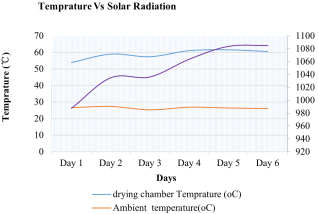
Variations in solar intensity, ambient temperature, and dryer temperature over the course of the experiment (October 09–October 14, 2020) were depicted in
Figure 2. The experiment's variables included changing the sun's intensity from 987 W/m
2 to 1085 W/m
2, changing the temperature of the surrounding air from 26.09°C to 27.39°C, with a peak of 27.39°C on October 10, 2020, and changing the dryer's temperature from 53.9°C to 61.57°C, with a peak of 61.57°C on October 13, 2020.
Figure 2. Variation of solar intensity and temperature with time using hot pepper.
The acquired result also demonstrated that the dryer temperature increased efficiently due to the polyhouse effect, rising between 27.81 °C and 34.18 °C above the ambient temperature over the course of the six-day trial.
Variation of relative humidity with time for hot pepper
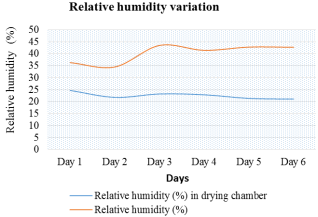
Figure 3. Variation of relative humidity with time for hot pepper.
Figure 3 shows that while the relative humidity of the surrounding air fluctuates between 34.5% and 43.5%, the dryer's humidity ranges between 21.07% and 24.69%. Because of the high temperature within the dryer caused by the polyhouse effect, the relative humidity of the dryer was found to be lower than the ambient relative humidity throughout each of the six days of the experiment. Compared to the open sun drying method, the hot pepper dries faster thanks to the dryer's high temperature. Therefore, the polyhouse type solar drier was found to have a shorter drying time for spicy peppers.
Variation of moisture content with time for hot pepper
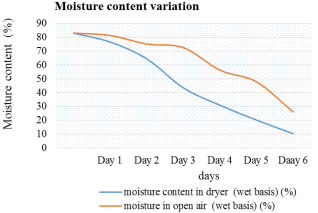
Figure 4. Variation of moisture content with time using hot pepper.
Figure 4 showed how the moisture content of hot peppers dried in the open sun and inside a drier varied during the course of the experiment. The MC of the hot pepper dried in the drier decreased from 82.95% to 76.45% on the first day of the trial, while the MC of the hot pepper dried in the open-sun drying method decreased from 82.95% to 81.25%. The MC of the hot pepper dried in the drier decreased from 76.45% to 64.36% on the second day of the trial, while the MC of the hot pepper dried using the open sun drying method decreased from 81.25% to 75.05%. The MC of the hot pepper dried in the dryer decreased from 64.36% to 43.45% on the third day, while the MC of the hot pepper dried in the open sun technique decreased from 75.05% to 72.43%.
The hot pepper dried using the open sun drying method saw a decrease in moisture content from 72.43% to 56.25% on the fourth day of the trial, while the hot pepper inside the dryer saw a decrease from 43.45% to 30.95%. While the hot pepper dried using the open sun drying method saw a decrease in moisture content from 56.25% to 47.75% on the fifth day, the hot pepper inside the dryer saw a decrease from 30.95% to 20.21%. On the sixth day, the hot pepper dried in the dryer's moisture content decreased from 20.21% to 10.42%, whereas the hot pepper dried in the open sun method showed a reduction in moisture content from 47.75% to 26.11%.
The hot pepper's moisture content within the dryer was lowered to 10.42% by the end of the sixth day, which was the highest amount that could be removed to keep the pepper safe and prevent spoiling.
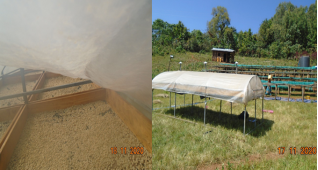
Figure 5. The photo of dryer using hot pepper at farm site.
Variation of solar intensity and temperature with time for wet coffee
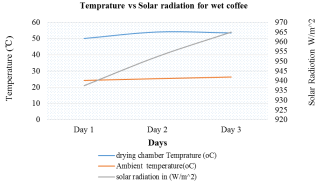
Figure 6. Variation of solar intensity and temperature with time for wet coffee.
Figure 6 showed how the dryer temperature, ambient temperature, and solar intensity changed over the course of the experiment (November 18–November 20, 2020). The solar intensity fluctuated between 937.5 W/m2 and 965 W/m2 over the course of the experiment, the ambient temperature fluctuated between 24.23°C and 26.34°C, reaching its highest value on November 20, 2020, and the dryer temperature fluctuated between 50.08°C and 54.08°C, reaching its highest value on November 19, 2020.
The graph showed that during the three days of the experiment, the dryer temperature was 25.85°C to 27.75°C higher than the surrounding air temperature, indicating that the polyhouse effect effectively raised the dryer temperature. Compared to the open-sun drying procedure, the drier dries the cleaned coffee earlier thanks to this temperature increase.
Variation of relative humidity with time for hot pepper
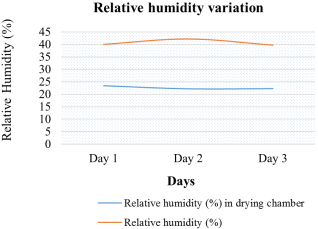
Figure 7 illustrated how the relative humidity of the dryer and the surrounding air changed over the course of the experiment. While the ambient relative humidity fluctuated between 39.77% and 42.22% across the experiment's days, the dryer's relative humidity fluctuated between 22.22% and 23.46%. Because of the high temperature within the dryer caused by the polyhouse effect, the relative humidity of the dryer was found to be lower than the ambient relative humidity for all three days of the experiment. Compared to the open sun drying method, the high temperature in the dryer is what causes the coffee to dry more quickly. Therefore, it is discovered that the polyhouse-type solar system has a shorter drying time for hot peppers.
Figure 7. Variation of relative humidity with time using hot pepper.
Variation of moisture content with time for wet coffee
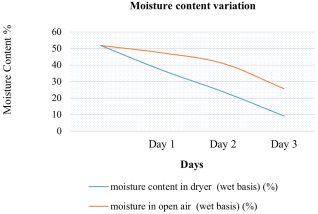
Figure 8. Variation of moisture content with time using wet coffee.
Figure 8 indicated how the moisture content of coffee that had been washed and dried in the sun and a dryer varied throughout the course of the experiment. The moisture content of the coffee that dried inside the dryer decreased from 52.8% to 36.94% on the first day of the trial, while the moisture content of the coffee that washed in the open-sun drying method decreased from 52.8% to 47.39%. The moisture content of the coffee that washed inside the dryer decreased from 36.94% to 23.87% on the second day of the trial, while the moisture content of the coffee that washed in the open sun drying method decreased from 47.39% to 41.01%.
On the third day, the moisture content of the coffee that had been dried inside the dryer decreased from 23.87% to 11.10%, whereas the coffee that had been dried in the open sun decreased from 41.01% to 25.67%. The quality of rinsed coffee would not deteriorate in the polyhouse-style solar dryer due to contamination, animal and bird damage, or wind-borne issues such dust and dirt, which were mostly observed in the open-sun dried coffee.
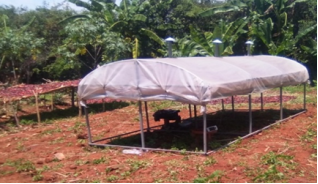
Figure 9. The experimental site during data collection using parchment coffee.
4. Conclusions and Recommendation
The developed polyhouse-type solar dryer was tested under real working conditions, obtaining good thermal performance during sunny days. The prototype of the dryer was tested using hot pepper and coffee bean as load products, obtaining a good drying rate considering the final moisture content and dried product aspect. The no-load tests clearly indicated that the drying temperature can be easily raised to 26–35°C above the ambient temperature. It was found that hot pepper was dried from an initial moisture content of about 82.95% to 10.42% in a polyhouse type solar dryer within 6 days, while by open sun drying it required above 9 days, and wet coffee was dried from an initial moisture content of about 51.8.9% to 11.10% in a polyhouse type solar dryer within days, while by open sun drying it required above 3 days. Comparing the drying time to natural open-air solar drying, a significant reduction was achieved. For drying most agricultural-based items, including wet coffee and hot peppers, the polyhouse-type solar drying technique was the most popular preference, according to the experiment study.
The technique of polyhouse solar dryers is easy to use, inexpensive, and has a lot of potential as an environmentally friendly method to lower post-harvest losses in countries with low or middle incomes. It is also preferable to incorporate solar fun into the system in order to improve the dryer's thermal efficiency. Based on the result obtained from all performance parameters, it is recommended for a demonstration to coffee and hot pepper producing potential areas of the countries.
For further refinements the following future suggestions were recommended; 1. Better to increase the size & capacity of the dryer, 2. Better to include different insulation materials to reduce heat loss, 3. Add the blower or fun to the system, 4. Food graded materials should be used for internal part of the dryer (tray components).
Abbreviations
AAERC | Asella Agricultural Engineering Research Center |
JAERC | Jimma Agricultural Engineering Research Center |
Kg/hr | Kilogram per Hour |
KW/m2 | Kilowatt per Meter Square |
MC | Moisture Content |
m.a.s.l | Above Mean Sea Level |
PSD | Polyhouse Solar Dryer |
RH | Relative Humidity |
STD | Solar Tunnel Dryer |
UV | Ultra-Violet |
w.b | Wet Basis |
Acknowledgments
For funding support, the author was grateful to Oromia Agricultural Research Institute and Jimma Agricultural Engineering Research Center (JAERC). A particular thanks to the technical workers of the JAERC Workshop.
Author Contributions
Adem Tibesso: Conceptualization, Data curation, Formal Analysis, Funding acquisition, Investigation, Methodology, Project administration, Resources, Software, Supervision, Validation, Visualization, Writing – original draft, Writing – review & editing
Abduselam Aliyi: Conceptualization, Data curation, Formal Analysis, Funding acquisition, Investigation, Project administration, Resources, Software, Supervision, Validation, Visualization, Writing – original draft, Writing – review & editing
Teka Tesfaye: Conceptualization, Investigation, Methodology, Project administration, Resources, Supervision, Visualization, Writing – original draft, Writing – review & editing
Ephrem Asefa: Conceptualization, Data curation, Investigation, Methodology, Project administration, Supervision, Validation, Visualization, Writing – original draft, Writing – review & editing
Funding
This work was supported by Oromia Agricultural Research Institute (OARI), Ethiopia.
Data Availability Statement
The analyzed data during this study which supports its findings are available only upon official request to the corresponding authors.
Conflicts of Interest
The authors declare no conflicts of interest.
References
| [1] |
S. K. Tonui, “Design and evaluation of solar maize grain dryer with a back-up heater.” University of Nairobi, 2014.
|
| [2] |
L. Büscher, “Further development of a solar thermal chamber dryer for fish: based on a previous device,” 2018.
|
| [3] |
S. E. Gomma-Ii, “Influence Of Sun Drying Methods And Layer Thickness On Quality Of Midland Arabica Coffee Varieties At,” 2015.
|
| [4] |
D. Bekele, “Opportunities and Potential of hot pepper (Capsicum annuum L.) production in Ethiopia,” Eur. J. Agric. For. Res., vol. 10, no. 2, pp. 14–20, 2022,
https://doi.org/10.37745/ejafr.2013/vol9n21420
|
| [5] |
S. Delelegn, “Evaluation of elite hot pepper varieties (Capsicum species) for growth, dry pod yield and quality under Jimma condition, South West Ethiopia.” Jimma University, 2011.
|
| [6] |
R. J. Mongi, N. Bernadette, B. Chove, and T. Wicklund, “Descriptive sensory analysis, consumer liking and preference mapping for solar dried mango cv Dodo,” Food Sci. Qual. Manag., vol. 16, pp. 16–23, 2013.
|
| [7] |
D. K. Verma, M. Thakur, P. P. Srivastav, V. M. Karizaki, and H. A. R. Suleria, “Effects of drying technology on physiochemical and nutritional quality of fruits and vegetables,” in Emerging thermal and nonthermal technologies in food processing, Apple Academic Press, 2020, pp. 69–116.
|
| [8] |
L. Krishnan et al., “Seaweed-based polysaccharides-Review of extraction, characterization, and bioplastic application,” Green Chem., 2024.
|
| [9] |
D. R. H. Kamatham, A. Prathyusha, K. Kavitha, B. Kumar, K. Manasa, And K. Sowmya, “Iot Based Smart And Solar Operated Multi Tasking Agriculture Robot,” 2022.
|
| [10] |
A. Sangamithra, G. J. Swamy, R. S. Prema, R. Priyavarshini, V. Chandrasekar, and S. Sasikala, “An overview of a polyhouse dryer,” Renew. Sustain. Energy Rev., vol. 40, pp. 902–910, 2014.
|
| [11] |
I. C. Ugwuoke, I. B. Ikechukwu, and O. E. Ifianyi, “Design and development of a mixed-mode domestic solar dryer,” 2019.
|
| [12] |
A. Lingayat, R. Zachariah, and A. Modi, “Current status and prospect of integrating solar air heating systems for drying in various sectors and industries,” Sustain. Energy Technol. Assessments, vol. 52, p. 102274, 2022.
|
| [13] |
P. Singh and M. K. Gaur, “Review on development, recent advancement and applications of various types of solar dryers,” Energy Sources, Part A Recover. Util. Environ. Eff., pp. 1–21, 2020.
|
| [14] |
M. Lavilla, A. Lasagabaster, and I. Martínez-de-Marañón, “Impact of ultraviolet processing on food composition,” Eff. Emerg. Process. methods food Qual. advantages challenges, pp. 173–196, 2019.
|
| [15] |
A. Ibrahim, T. M. P. Cattaneo, A. Amer, and L. Helyes, “Drying technology evolution and global concerns related to food security and sustainability,” in Food processing and packaging technologies-recent advances, IntechOpen, 2023.
|
| [16] |
S. Suherman, H. Widuri, S. Patricia, and E. E. Susanto, “Energy Analysis of a Hybrid Solar Dryer for Drying Coffee Beans,” vol. 9, no. 1, pp. 131–139, 2020.
|
| [17] |
A. Gachen, Z. Hirpesa, and L. N. Woyessa, “Design and Construction of Indirect Solar Coffee Dryer,” no. April 2024, 2020,
https://doi.org/10.35940/ijitee.D2004.029420
|
| [18] |
Z. Admass, A. O. Salau, B. Mhari, and E. Tefera, “Red pepper drying with a double pass solar air heater integrated with aluminium cans,” Sci. Rep., pp. 1–12, 2024,
https://doi.org/10.1038/s41598-024-53563-6
|
| [19] |
P. Process et al., “Performance evaluation of a cabinet solar dryer for drying red pepper in Bangladesh m er ci al us e er al,” vol. XLIX, 2018,
https://doi.org/10.4081/jae.2018.774
|
| [20] |
S. Kooli and A. Farhat, “International Journal of Renewable Energy & Biofuels”,
https://doi.org/10.5171/2014.515285
|
| [21] |
A. Tesfaye, “Smallholder coffee producer’s perception to climate change and variability: the evidence from Mana district, South-Western Ethiopia,” GeoJournal, vol. 87, no. 6, pp. 4901–4912, 2022.
|
| [22] |
B. Endalew, M. Zeleke, W. Yenewa, and Z. Ayalew, “Determinants of farm households’ participation in fish production in Southwest Ethiopia,” Cogent Food Agric., vol. 6, no. 1, 2020,
https://doi.org/10.1080/23311932.2020.1728107
|
| [23] |
N. C. Shahi, J. N. Khan, U. C. Lohani, A. Singh, and A. Kumar, “Development of polyhouse type solar dryer for Kashmir valley,” J. Food Sci. Technol., vol. 48, pp. 290–295, 2011.
|
Cite This Article
-
ACS Style
Tibesso, A.; Aliyi, A.; Tesfaye, T.; Assefa, E. Fabrication and Evaluation of Polyhouse Type Solar Dryer for Drying Wet Coffee and Hot Pepper. Ind. Eng. 2024, 8(2), 20-29. doi: 10.11648/j.ie.20240802.11
 Copy
|
Copy
|
 Download
AMA Style
Tibesso A, Aliyi A, Tesfaye T, Assefa E. Fabrication and Evaluation of Polyhouse Type Solar Dryer for Drying Wet Coffee and Hot Pepper. Ind Eng. 2024;8(2):20-29. doi: 10.11648/j.ie.20240802.11
Copy
|
Download
-
@article{10.11648/j.ie.20240802.11,
  author = {Adem Tibesso and Abduselam Aliyi and Teka Tesfaye and Ephrem Assefa},
  title = {Fabrication and Evaluation of Polyhouse Type Solar Dryer for Drying Wet Coffee and Hot Pepper
},
  journal = {Industrial Engineering},
  volume = {8},
  number = {2},
  pages = {20-29},
  doi = {10.11648/j.ie.20240802.11},
  url = {https://doi.org/10.11648/j.ie.20240802.11},
  eprint = {https://article.sciencepublishinggroup.com/pdf/10.11648.j.ie.20240802.11},
  abstract = {One of the crucial post-harvest processes that contribute to the unique color, flavor, and taste of a coffee drink is drying technique. Solar drying refers to a technique that utilizes incident solar radiation to convert it into thermal energy required for drying purposes. A polyhouse solar dryer is a unique and cost-efficient method of drying agricultural products on a small as well as commercial scale. The fabricated dryer has three major units: a solar collector unit, a drying unit, and chimney unit components. The aim of this study was to manufacture and evaluate a 5-meter length and 2-meter width half-circled tunnel polyhouse type solar dryer using parchment coffee and hot pepper. The experimental results showed that the developed dryer has the capacity to dry averagely about 150 kg of hot pepper and 50 kg of wet coffee per batch. The obtained data were analyzed using software such as simple descriptive statistics and Origin Pro 2019 according to their suitability. Hot pepper was dried from an initial moisture content of about 82.95% to 10.42% in a polyhouse-type solar dryer within 6 days, while conventional sun drying took around 9 days. Using hot pepper, the average temperature inside the dryer was 53.90 °C to 62.57 °C in the full load condition, which was greater than the ambient temperature in all six days of the experiment. While the ambient relative humidity varies between 34.5% and 43.5%, the dryer's relative humidity using hot pepper was altered between 21.07% and 24.69%. In all six days of the experimental period, the relative humidity of the dryer was found to be less than that of ambient relative humidity due to the polyhouse effect. The wet coffee bean was dried from an initial moisture content of about 51.89% to 11.10% in a polyhouse-type solar dryer within 3 days, while by open-sun drying it took around 6 days. Using wet coffee, the temperature inside the dryer chamber were 50.08 °C to 54.08 °C at full load condition, which was greater than the ambient temperature in all three days of a tests. Whereas the ambient humidity in the air ranges from 39.77% to 42.22%, the dryer's relative humidity using wet coffee ranged between 22.22% and 23.46%. The average dryer thermal efficiencies of a polyhouse dryer use wet coffee beans and hot pepper were 64.48% and 86.87%, respectively.
},
 year = {2024}
}
Copy
|
Download
-
TY  - JOUR
T1  - Fabrication and Evaluation of Polyhouse Type Solar Dryer for Drying Wet Coffee and Hot Pepper

AU  - Adem Tibesso
AU  - Abduselam Aliyi
AU  - Teka Tesfaye
AU  - Ephrem Assefa
Y1  - 2024/12/25
PY  - 2024
N1  - https://doi.org/10.11648/j.ie.20240802.11
DO  - 10.11648/j.ie.20240802.11
T2  - Industrial Engineering
JF  - Industrial Engineering
JO  - Industrial Engineering
SP  - 20
EP  - 29
PB  - Science Publishing Group
SN  - 2640-1118
UR  - https://doi.org/10.11648/j.ie.20240802.11
AB  - One of the crucial post-harvest processes that contribute to the unique color, flavor, and taste of a coffee drink is drying technique. Solar drying refers to a technique that utilizes incident solar radiation to convert it into thermal energy required for drying purposes. A polyhouse solar dryer is a unique and cost-efficient method of drying agricultural products on a small as well as commercial scale. The fabricated dryer has three major units: a solar collector unit, a drying unit, and chimney unit components. The aim of this study was to manufacture and evaluate a 5-meter length and 2-meter width half-circled tunnel polyhouse type solar dryer using parchment coffee and hot pepper. The experimental results showed that the developed dryer has the capacity to dry averagely about 150 kg of hot pepper and 50 kg of wet coffee per batch. The obtained data were analyzed using software such as simple descriptive statistics and Origin Pro 2019 according to their suitability. Hot pepper was dried from an initial moisture content of about 82.95% to 10.42% in a polyhouse-type solar dryer within 6 days, while conventional sun drying took around 9 days. Using hot pepper, the average temperature inside the dryer was 53.90 °C to 62.57 °C in the full load condition, which was greater than the ambient temperature in all six days of the experiment. While the ambient relative humidity varies between 34.5% and 43.5%, the dryer's relative humidity using hot pepper was altered between 21.07% and 24.69%. In all six days of the experimental period, the relative humidity of the dryer was found to be less than that of ambient relative humidity due to the polyhouse effect. The wet coffee bean was dried from an initial moisture content of about 51.89% to 11.10% in a polyhouse-type solar dryer within 3 days, while by open-sun drying it took around 6 days. Using wet coffee, the temperature inside the dryer chamber were 50.08 °C to 54.08 °C at full load condition, which was greater than the ambient temperature in all three days of a tests. Whereas the ambient humidity in the air ranges from 39.77% to 42.22%, the dryer's relative humidity using wet coffee ranged between 22.22% and 23.46%. The average dryer thermal efficiencies of a polyhouse dryer use wet coffee beans and hot pepper were 64.48% and 86.87%, respectively.

VL  - 8
IS  - 2
ER  -
Copy
|
Download






 Share This Article
 Twitter
 Linked In
 Facebook