1. Introduction
“Wherever there is seawater, there are Chinese people”
, they traveled along the Maritime Silk Road, from the late Tang Dynasty onward, Chinese emigrants began to increase,
maritime transportation had become more developed than in previous eras, and the number of overseas Chinese continued to grow. The main emigrants came from China’s southeastern coastal regions. It was during the Wan Li period of the Ming Dynasty that large-scale emigration overseas truly became a social phenomenon
| [57] | Zhuang, Guotu (2014). History of Chinese Overseas. Guangdong: Jinan University Press. |
[57]
. This historical fact of population movement coincided with the early globalization of the Manila Galleons controlled by Spain
| [40] | Wang, Tao (2016). The Rise and Fall of Pirates and Merchants in the Ming and Qing Dynasties: A Perspective from Global Economic Development. Beijing: Social Sciences Academic Press. |
[40]
.
Nan Yang was the term used in Chinese literature during the Ming and Qing dynasties to refer to Southeast Asia
| [36] | Luo, Zhaodong (2016). China’s Tributary Trade and Sword-wielding Commerce: A Study of the Foreign Trade Policies of the Ming and Qing Dynasties from a Global Economic Perspective. Beijing: Social Sciences Academic Press. |
[36]
, Chinese people traveling to Southeast Asia for livelihood and settlement was called “Xia Nan Yang”
.
It is undeniable that this migration was driven by economic factors
| [35] | Liu, Xiaomin (1987). An Economic History of the Chinese in Southeast Asia. Xiamen: Xia Men University Press. |
[35]
. Frequent wars in the north caused continuous southward migration of northerners—a trend that became especially pronounced after the An Lu Shan Rebellion
| [55] | Zhuang, Guotu and Liu, Wenzheng (2009). The Formation and Development of Chinese Communities in East Asia. Xiamen: Xia Men University Press. |
[55]
, until the Ming Dynasty, coastal provinces in southern China such as Jiang Su, Zhe Jiang, Fu Jian, and Guang Dong, experienced varying degrees of land scarcity relative to population
, arable land was extremely limited, and land annexation led to excessive concentration of land ownership, as a result, many peasants lost their homes and were forced to leave their native places, crossing the oceans to seek livelihoods
.
Consequently, groups primarily composed of southern Chinese peasants, fishermen, boatmen, artisans, and small merchants
gradually appeared across Southeast Asia. However, there were also many Chinese who emigrated overseas for political reasons or due to military conflicts: after Zhang Shicheng and Fang Guozhen’s forces were defeated by Zhu Yuanzhang during the Yuan Dynasty, many of their remaining followers fled to the seas and ended up in Southeast Asia. During the mid-Ming Dynasty, short-lived maritime trading groups emerged in China—figures such as Wang Zhi, Lin Feng, and Zheng Zhilong
—who clashed militarily with the Ming government on multiple occasions, after being defeated, many of them also drifted to and settled on various islands in Southeast Asian waters.
From a global historical perspective, the arrival of Spanish expeditions in Asia—and their enthusiasm for Chinese goods
—greatly stimulated population movements from China’s southeastern coastal regions
. Europeans’ high demand for Chinese silk, porcelain, tea, and other everyday goods encouraged a growing number of maritime merchants to risk illegal private trade with them. Some of these merchants settled long-term in places, Manila, Cebu and so on, and facilitated the migration of their family members. On the other hand, powerful European nations such as Portugal, Spain, and the Netherlands, “in order to manage their global colonies and exploit local resources, need large amounts of labor”
, “they spared no effort in recruiting Chinese laborers to work in their colonies”
| [46] | Zhang, Kai (2013). History of Relations between China and Spain. Beijing: China Intercontinental Communication Co., Ltd. |
[46]
.
In the early globalization, overseas Chinese were mostly concentrated in the Philippine archipelago, with natives of Fu Jian and Guang Dong provinces, were naturally known for their business acumen and willingness to take risks, these two provinces were among the most developed in foreign trade during China’s feudal history, maintained extensive contacts with Southeast Asian countries, their climates, cuisines, and local customs also shared similarities with those of Southeast Asia, people from these two provinces continuously flowed into Southeast Asia for trade or labor. During the Ming Dynasty, the Philippines—referred to collectively in Chinese literature as
Lu Zon—hosted the largest number of overseas Chinese. In Spanish historical documents from AGI in Seville, they are often recorded as
sangleyes, derived from the Minnan’s pronunciation and used by Philippine colonial authorities as a general designation for the groups
.
The Philippine colonial authorities and their many Governors formed a set of basic consensuses: they were numerous, inexpensive, hardworking, easy to manage, and so on
| [46] | Zhang, Kai (2013). History of Relations between China and Spain. Beijing: China Intercontinental Communication Co., Ltd. |
[46]
, these consensuses all became prerequisites for recruiting Chinese laborers to Cuba. In 1847, the first batch of Chinese laborers arrived in Cuba
| [4] | Chen Hansheng (1982). A Compilation of Historical Materials on Chinese Emigrant Laborers, Ming Dynasty Beijing: Zhong Hua Book Company. |
[4]
, became an important issue in diplomatic negotiations between the Qing and Western countries
| [8] | Chen Lanbin (1998). The Diary of Chen Lanbin, vol. 4. Guangzhou: Zhong Shan University Press. |
[8]
.
After the Second Opium War, the number of treaties signed, and included provisions concerning the emigration of Chinese laborers. On March 12, 1866, Yi Xin, drafted the “Regulations for Labor Recruitment Agreed upon with Britain and France”
| [19] | First Historical Archives of China, Beijing (1982). Compilation of Old Treaties and Regulations between China and Foreign Countries. Beijing: San Lian Joint Publishing Company. |
[19]
, “accordingly, all matters of labor recruitment by foreign countries at treaty ports were required to be handled in accordance with the Twenty-Two Articles”
| [19] | First Historical Archives of China, Beijing (1982). Compilation of Old Treaties and Regulations between China and Foreign Countries. Beijing: San Lian Joint Publishing Company. |
[19]
. However, Spain’s Chinese laborers’ recruitment was not explicitly included in the above regulations, the Qing central government (QCG) demanded that Spain “close its recruitment offices”
| [7] | Chen Hansheng (1982). A Compilation of Historical Materials on Chinese Emigrant Laborers, Asia. Beijing: Zhong Hua Book Company. |
[7]
, but the Spanish minister in China,
Carlos Antonio, denied and disagreed, leading to a disagreement
| [12] | Chen, Xiaoyan and Yang Yanqiong (2005). The Case of Chinese Laborers in Cuba and the Modernization of Late Qing Diplomacy. Zhejiang Social Sciences, no. 03, pp. 159-165.
https://doi.org/10.14167/j.zjss.2005.03.031 |
[12]
.
2. Manila’s Routes Spurred a Large-scale Chinese Migration to Southeast Asia
Fu Jian, located in the southeastern part of China’s territory, the migration of local coastal residents to Lu Zon and the Philippines can be traced back as far as the Song Dynasty, this evolved into frequent Chinese migration during the Ming Dynasty, “the majority of the people were from Guang Dong, Zhang Zhou, and Quan Zhou”.
.
When the Portuguese and Spanish arrived in Southeast Asia, this presented a rare opportunity for development in world history for Fu Jian’s overseas migrants. However, for the Spanish colonial governors of the Philippines, “they both needed Chinese immigrants”
| [41] | Yang, Guozhen (1997). A Study of Coastal Society and Overseas Migration in Ming and Qing China. Beijing: Higher Education Press. |
[41]
and “greatly feared their growing strength”
, “the Chinese residing in the Philippines engaged in various trades. Among them were tailors, shoemakers, bakers, carpenters, candlemakers, confectioners, apothecaries, painters, silversmiths, barbers, and even artisans such as block printers and bookbinders; there were wealthy merchants dealing in Chinese goods, primarily silk and porcelain; there were petty vendors selling meat, poultry, fish, and other foodstuffs in the Parian; there were doctors and caregivers practicing liberal professions; and there were employed shop assistants and domestic servants”
, “during the Spanish colonial period, the economic life of the Philippines depended mainly on the labor and diligent work of the Chinese”
; “without the contribution of the Chinese, this country could not survive”
. Driving the formation of a global market, relying on the maritime routes of Macau –Manila–Mexico –Europe, intercontinental commercial ties became greatly intensified
| [48] | Zhang, Xie (2000). Investigation of the Eastern and Western Oceans during the Ming Dynasty. Beijing: Zhonghua Book Company. |
[48]
. The commercial networks established overseas by southern Fujianese maritime merchants and migrants were a link in the circulatory operation of the maritime economy, creating overseas markets for the coastal commodity economy, spreading Chinese commercial civilization, and expanding Chinese overseas influence. Meanwhile, the feedback from overseas migrants to their hometowns served as a bridge for introducing foreign material civilization into China's coastal regions. The massive inflow of silver into China: during the galleon trade, Spanish galleons transported large quantities of silver from Mexico to Manila in exchange for Chinese daily goods, resulted in a substantial influx of silver into China
, prompting the official monetization of silver in Ming Dynasty and fostering the only capitalist sprouting in China’s long feudal history
.
The interplay of three internal factors and one external factor shaped the movement of people in the early globalization.
2.1. The Limited Arable Land Forced the Local People to Seek Survival by Turning to the Ocean
It is a mountainous province, surrounded on three sides by mountains, to the west lie the Wu Yi Mountains; to the north, the Yan Dang Mountains form the border with Zhe Jiang; and to the south, a complex of smaller mountain ranges separates it from Guang Dong. Within the province, crisscrossing mountain range divided it into several small units, leaving only small sporadic plains along the lower reaches of a few rivers, its eastern part faces Taiwan Province across the Taiwan Strait. The terrain is high in the northwest and low in the southeast, dominated by mountains and hills. Situated at the strategic passage between the East China Sea and the South China Sea, it is one of the Chinese provinces closest to Southeast Asia, South Asia, East Africa, and Oceania, was called
Ba Min, indicating that the mountain ranges divided the province’s people into eight distinct tribes. In general, the region has many mountains but few arable valley plains. Such geographical conditions were not conducive to supporting a large agricultural population, and its agriculture could never rival that of the central plains. Moreover, as China’s economic center of gravity shifted southward, Fu Jian’s population grew, and the contradiction between limited arable land and increasing population became increasingly acute. “Fu Jian Province, backed by mountains and surrounded by sea, has narrow land and dense population. The four prefectures of Yan Ping, Jian Ning, Ting Zhou, and Shao Wu were located upstream, with many mountains and little farmland. The five prefectures of Fu Zhou, Xing Hua, Ning De, Quan Zhou, and Zhang Zhou lie along the coast, where the soil was poor and the people were impoverished—this was especially severe in Zhang Zhou and Quan Zhou”
| [23] | He, Mianshan (1996). On the Culture of Southern Fujian in China. Beijing: Peking University Press. |
[23]
. This situation fostered a tradition: taking the sea as farmland. For example, in July of the 21st year of the Wan Li period, in 1593, Chen Zizhen, the Imperial Inspector touring Fu Jian, submitted a memorial stating: “Fu Jian Province had narrow land and dense population, with a scarcity of grains. Therefore, the coastal people made boats their homes and the sea their fields, traveling back and forth, finding peace both inside and outside”
| [23] | He, Mianshan (1996). On the Culture of Southern Fujian in China. Beijing: Peking University Press. |
[23]
, “the land was salty and barren; the fields cannot provide enough food. Nine out of ten people live by the sea and make ocean-going ships in their homes”
. Monsoons provided great convenience for the maritime trade and transport of coastal residents, people were no longer tied exclusively to the land, representing the earliest form of migration. Large numbers of local migrants, taking advantage of the north wind during autumn and winter, sailed south to the Nan Yang, mainly to Taiwan and the vicinity of the Philippine Islands, the ancient
Land Silk Road was gradually replaced by the
Maritime Silk Road. Maritime trade in the southern regions experienced due development, with Quan Zhou and Guang Zhou becoming the starting points, “the sea there is called Penghu Channel, where the waters divide into eastward and westward flows. Once past this channel, the water flows eastward to Lu Zon; upon returning and passing this channel, the water flows westward to Quan Zhou and Zhang Zhou”.
| [31] | Liao, Dake (2002). A Study of the Maritime Transportation History of Fu jian. Fuzhou: Fu Jian People’s Publishing House. |
[31]
.
All the above illustrates that the local people fully utilized their advantages in facing the vast ocean to develop themselves, laying the foundation for future overseas migration. Due to differences in the roughness of sea and land surfaces, the annual average wind speed decreases sharply from the sea toward the land. Coastal islands and protruding parts of the mainland experience the highest wind speeds, allowing local people to go to coastal ports and islands to sail smoothly using the wind. The annual variation in wind speed is very pronounced: during the winter monsoon, the average wind speed is high and stable; in contrast, during the summer monsoon, the wind speed is considerably lower, most local emigrants set sail in winter to seek a Nan Yang’s livelihood, returning home the following summer with the summer monsoon convenience brought to Fu Jian emigrants by the monsoons. Moreover, driven by international and domestic developments, overseas migration and maritime trade yielded substantial profits, prompting them to fully exploit the conveniences of the sea for maritime trade. “The impoverished coastal people live by the sea; fishing and trading salt are their occupations. However, the profits from these are meager, and only the foolish and weak rely on them. The clever, skilled, and robust, on the other hand, board foreign ships to obtain the profits of foreign lands, which are ten times greater”
.
2.2. Political Corruption and Strict Maritime Bans Forced Migration Outsides
Based on the fundamental patterns of Chinese feudal history, during the middle and late periods of any given dynasty, various internal flaws would invariably become fully exposed: persistent political corruption in officialdom, heavy tax burdens on peasants in fiscal matters, and severe land annexation at the local level, with land concentrated in the hands of a small number of high-ranking bureaucrats. For Fu Jian’s residents, who already had little arable land, this meant “being oppressed by greed and cruelty and trapped by hunger and cold”
| [23] | He, Mianshan (1996). On the Culture of Southern Fujian in China. Beijing: Peking University Press. |
[23]
, “the rich become arrogant, extravagant, and increasingly wasteful; the authorities press for tax payments, becoming ever more oppressive. When a poor tenant farmer is exploited by two or three landlords, how can he avoid becoming a fugitive or a bandit?”
| [27] | John King Fairbank (2020). Trade and Diplomacy on the China Coast. Shanxi: Shan Xi People’s Publishing House. |
[27]
. Many impoverished peasants abandoned their property, leaving their hometowns, leading to a situation along the coast where “families were ruined and households emptied, with nine out of ten homes deserted”
| [27] | John King Fairbank (2020). Trade and Diplomacy on the China Coast. Shanxi: Shan Xi People’s Publishing House. |
[27]
.
However, at the beginning of the Ming Dynasty to achieve political stability, Zhu Yuanzhang ordered the abolition of the Maritime Trade Supervisor and implemented a strict maritime ban, decreeing that “not even a single plank of wood was allowed to be put to sea”
| [31] | Liao, Dake (2002). A Study of the Maritime Transportation History of Fu jian. Fuzhou: Fu Jian People’s Publishing House. |
[31]
. Firstly, a strict prohibition against private maritime trade. “Coastal residents were forbidden from privately communicating with overseas countries”
, and stringent laws were enacted to restrict those engaging in overseas trade, with provisions stating that “those engaging in illicit overseas trade, plundering, or piracy were to be executed, and their entire families were to be banished to guard the frontier garrisons”
, “all illegal large ships were to be completely destroyed”
| [31] | Liao, Dake (2002). A Study of the Maritime Transportation History of Fu jian. Fuzhou: Fu Jian People’s Publishing House. |
[31]
. Secondly, strict restrictions were imposed on goods exported through trade. Essential commodities for private maritime trade, such as silk fabrics, raw silk, copper coins, and ironware, were all listed as contraband, “anyone privately transporting these goods overseas was to receive one hundred strokes with a heavy stick, with goods and ships confiscated by the authorities”
. Moreover, those who built unapproved large ships with two or more masts and transported contraband goods abroad for sale would face “execution for the principal offender, with the entire family banished to guard the frontier garrisons”
. This was the strict maritime ban implemented nationwide by the central Ming government. For Fu Jian, being a coastal province, the ban was particularly severe. The local authorities not only faithfully enforced the policy but also applied it even more harshly in practice: “any ship found at sea carrying weapons or firearms was to be seized and its crew punished, regardless of whether the cargo was foreign; grains, fish, salt, and similar goods were all strictly forbidden”
| [27] | John King Fairbank (2020). Trade and Diplomacy on the China Coast. Shanxi: Shan Xi People’s Publishing House. |
[27]
. The natural geographical conditions could not provide sufficient livelihood for the local population. Under the maritime ban, the lives of those who originally relied on the sea were severely restricted, based on basic human instinct, residents eventually had no choice but to risk emigrating overseas.
Another economic reality that cannot be ignored is that handicrafts and commerce developed, which in turn fostered the development of a feudal commodity economy. Notably, in the Jiang Nan area, capitalist sprouts, marked by a commodity economy, emerged. Influenced by these capitalist sprouts, Fu Jian’s handicraft industry became relatively advanced, providing material resources for overseas trade. This precisely constituted the logic behind the rampant maritime smuggling trade in China, as well as the rise of a maritime economy and merchant organizations within the interstices of the traditional system. After the mid-Ming Dynasty, with the near disappearance of the tribute trade system
, private maritime trade gradually became the main force of overseas trade. “Going overseas for illicit trade had become a custom, and the government was powerless to prohibit it”
| [31] | Liao, Dake (2002). A Study of the Maritime Transportation History of Fu jian. Fuzhou: Fu Jian People’s Publishing House. |
[31]
, “in the Eastern Seas, countries such as Lu Zon and Su Lu; in the Western Seas, were all tributary vassal states that did not encroach upon our borders. Merchant ships were no longer prohibited from trading with them”
. This situation forced the central Ming government to partially lift the maritime ban in 1567, legalizing private maritime trade from Fu Jian, private overseas trade on China’s southern seas developed rapidly, and overseas emigrants became the main force driving this maritime trade.
2.3. Frequent Natural Disasters and Lack of Effective Relief
It was simultaneously plagued by frequent natural disasters—droughts, floods, hailstorms, epidemics, typhoons along the coast, and other calamities. These disasters compounded the already difficult living conditions, making their plight even more severe. Technology was underdeveloped, the population’s ability to resist natural disasters was extremely weak, in the Fu Jian area, the disasters that most significantly impacted people’s lives were droughts and floods, which directly affected grain production and were the primary causes of famine. According to historical records of the Ming Dynasty, in the 12th year of the Hong Zhi era, in the Nan Ping area, “from May until December there was no rain; the grain harvest was poor, and the people suffered great famine”
| [33] | Lin, Jinshui (1997). History of Fu Jian’s Foreign Cultural Exchanges and Related Archives. Fuzhou: Fu Jian Education Press. |
[33]
. In the 16th year of the Jia Jing era, in 1537, in the Chang Le area, “from April until July there was no rain; the grain crop was completely lost”
. In the 21st year of the Cheng Hua era, in 1485, “it rained continuously from March until the end of the intercalary April; streams overflowed their banks, and floodwaters surged into the cities. In the eight counties of Min, Hou Guan, Huai’an, Gu Tian, Bian Jiang, Luo Yuan, Min Qing, and Yong Fu, official and private residences were swept away, granaries and documents were submerged, people and livestock drowned, and damage to crops was incalculable. Following this, a great epidemic broke out, and the dead lay upon one another”
| [33] | Lin, Jinshui (1997). History of Fu Jian’s Foreign Cultural Exchanges and Related Archives. Fuzhou: Fu Jian Education Press. |
[33]
. In 1486, “there was a drought in March of spring, followed by a great drought in May and June; the grain crops died, leading to a year of famine, and many people fled to other prefectures”
| [40] | Wang, Tao (2016). The Rise and Fall of Pirates and Merchants in the Ming and Qing Dynasties: A Perspective from Global Economic Development. Beijing: Social Sciences Academic Press. |
[40]
, in 1487, “there was a spring drought, ruining the wheat harvest, and a great autumn drought, ruining the grain harvest”
, in 1518, “a tidal surge suddenly rushed in, reaching over twenty Zhang in height, with a thunderous roar; it inundated coastal residences, and a great famine ensued”
| [22] | Ge, Jianxiong (1989). Chinese Population Studies, 1368–1953. Shanghai: Shanghai Chinese Classics Publishing House. |
[22]
, in 1540, “in May there was a great flood, washing away the Zhen Zan Bridge, destroying riverside dwellings, silting the fields, drowning people and livestock, and again causing a great famine; an official named Liang Sui was ordered to provide relief”
| [22] | Ge, Jianxiong (1989). Chinese Population Studies, 1368–1953. Shanghai: Shanghai Chinese Classics Publishing House. |
[22]
. The floods were almost entirely concentrated after the mid-Ming period. The Cheng Hua, with the most prominent being the 1480s, from the 18th year of Cheng Hua to the 22nd year—when four out of five years witnessed catastrophic floods. Moreover, during this period, the Ming Dynasty experienced its only instance of five consecutive years of flooding. The Jia Jing reign lasted a total of 45 years, during which floods occurred in different parts of the province in 39 of those years, meaning 86.7% of the years were marked by flood disasters.
In addition to the natural disasters mentioned above, there were also hailstorms and epidemics. It is located near the tropic of cancer and has a humid subtropical maritime monsoon climate. Although snow is rare, hailstorms and frosts occur from time to time, causing local temperatures to drop, hindering crop growth, and severely affecting grain production in the region. Beyond the disasters listed above, its coastal areas were also subjected to devastating typhoon strikes. When typhoons struck the Fu Jian coast, they often whipped up storm surges, and the winds carried salt-laden sea spray onto crops, causing salt damage. Affected plants would shed their leaves, and in severe cases, the trees would die. “In Quan Zhou Prefecture and other places, there were heavy rains and floods; the sea swelled dramatically, and a sudden typhoon arose, drowning over ten thousand people and sweeping away countless residents and property”
. In July of the 10th year of the Hong Zhi era, in 1497, “a typhoon brought a great thunderstorm, uprooting trees and destroying houses”
| [32] | Lin, Guoping and Qiu Jiduan (2004). A Study of the Migration History of Fu Jian Province. Beijing: Local Chronicles Publishing House. |
[32]
. In August of the 7th year of the Jia Jing, 1528, “…… a strong wind uprooted trees and tore off roofs; by the night of the tenth day, rain poured down like a cascade, and the wind finally ceased”
| [27] | John King Fairbank (2020). Trade and Diplomacy on the China Coast. Shanxi: Shan Xi People’s Publishing House. |
[27]
. In July of the 14th year of the Chong Zhen era, in 1641, “in Fu Zhou, wind and tidal surges caused widespread flooding, drowning and washing` away a great many people”
| [32] | Lin, Guoping and Qiu Jiduan (2004). A Study of the Migration History of Fu Jian Province. Beijing: Local Chronicles Publishing House. |
[32]
.
2.4. The Drive of Early Globalization and Colonial Trade Was an External Force
Among all the maritime explorations undertaken by China’s feudal dynasties, the largest in scale was likely Zheng He’s voyages to the Western Ocean, “these large-scale maritime activities did not lead China to become a maritime power; the costly and labor-intensive fleet ultimately became an unaffordable burden, forcing it to terminate the expeditions”
, but rather “merely to demonstrate the authority of a great power and satisfy the extravagant lifestyle of the rulers”
| [10] | Chen Shangsheng (2007). Thought, Institutions, and Policies in Traditional China’s Foreign Relations. Qingdao: Shan Dong University Press. |
[10]
—neither of which could sustain continued exploration, “before the Portuguese navigators invented their methods in the 15th century, these Chinese ships were unparalleled in the world, and the rulers of the lands they visited regarded them with awe. If they had persisted, Chinese power could have made it truly the central kingdom of the global civilized world. They should have occupied the Strait of Hormuz and rounded the Cape of Good Hope before the Portuguese; they should have discovered and conquered the Americas before the Spanish”
| [10] | Chen Shangsheng (2007). Thought, Institutions, and Policies in Traditional China’s Foreign Relations. Qingdao: Shan Dong University Press. |
[10]
.
Another aspect that cannot be overlooked is that, although these voyages did not directly stimulate the domestic population to profit from overseas trade, they did inspire the maritime ambitions of coastal residents, especially in Fu Jian’s coastal areas, which served as the starting point for Zheng He’s voyages. Most of the ships were built in Fu Jian, which enhanced the maritime technology, this was a cumulative process that combined technology, ambition, and the persistent pursuit of profit.
Portugal, Spain, and other European maritime powers began overseas colonization and trade, gradually connecting the entire world through the oceans. The connections between different parts of the world grew increasingly stronger, and a global maritime trade network began to take shape. China, as a major producer of consumer goods at the time, was inevitably drawn into this maritime revolution
| [43] | Yang, Yang(2025)Origins of China's Private International Law with Shu Without Dao --- from Tang Lv Shu Yi to Application Law (653-1918). International Journal of Law and Society, vol. 08, no. 01, pp. 55-63. https://doi.org/10.11648/j.ijls.20250801.17 |
[43]
. Including this historical panorama, Yue Gang, Quan Zhou, and the migrants from Fu Jian served as crucial mediating agents, people, goods, ships, and behind them, technology, ideas, and culture, etc. Western capitalism was just emerging, with few competitive commodities, and the colonial powers were rife with internal conflicts, they were no match for China's private maritime traders, who temporarily held a dominant position
. However, this dominance was only temporary. Since Chinese private trade was not supported by the Ming court but instead faced severe suppression and restriction
| [41] | Yang, Guozhen (1997). A Study of Coastal Society and Overseas Migration in Ming and Qing China. Beijing: Higher Education Press. |
[41]
, Western colonial trading powers enjoyed strong support from their own governments. After European powers arrived in Asia one after another, and Southeast Asia gradually became their colony, the colonizers had to rely on overseas Chinese to serve as intermediaries between themselves and the indigenous societies. Spain opened a Pacific shipping route—from Acapulco in Mexico to Manila, and then from Manila to Chinese Yue Gang in Zhang Zhou and the port of Guang Zhou. The Manila galleons were supplied from Yue Gang, a free trade port on the Fu Jian coast, “the flow of Chinese goods and Chinese ships inevitably drove the movement of local populations”
| [44] | Yang, Yang. (2025). A Pirate, a Broker, and a Sentry Between the Emperor Wan Li and King Felipe II --- Based on Du Fu Shu Yi and Dong Xi Yang Kao. International Journal of European Studies, no. 02, pp. 41-48. https://doi.org/10.11648/j.ijes.20250902.11 |
[44]
.
As trade developed, Nan Yang merchants gradually moved to Manila, specializing in trade brokerage and other commercial and industrial activities. Manila became a transit core on the maritime silk road between China and the Americas
.
“China was often the main source of goods for the galleon trade.
For the people of New Spain (Mexico and the vast surrounding areas), the galleons were Chinese ships,
and Manila was the transshipment point between China and Mexico.
Chinese silk, the most important commodity of the galleon trade,
was collected and distributed there before crossing the Pacific.
The Spanish in Mexico spoke of the Philippines as freely and casually.
as if they were referring to a province of the Chinese Empire” . From 1593 to 1821, when Mexico gained independence, spanning over two hundred years, there was a peak in Chinese migration to the Philippines. “Among the merchants trading in the Eastern and Western Seas, some were delayed by adverse winds and currents and remained abroad over winter; this was especially true in Lu Zon. The people of Zhang Zhou treated it as their market; fathers and elder brothers long resided there, while sons and younger brothers traveled back and forth. Those who remained in Lu Zon were no fewer than several thousand”
. During these more than two hundred years, Chinese raw silk was very popular in Europe. The board of directors of the Dutch East India Company once issued instructions to do everything possible to resolve trade with China to obtain Chinese raw silk. “From time to time, they seized residents from the Fu Jian coast to serve as laborer”
, “… and transporting them to Peng Hu to build castles, giving each person only half a catty of rice per day”
| [34] | Lin, Manhong (2018). China Upside Down: Currency, Society, and Ideologies, 1808–1856: 19th Century World and China. Nanjing: Jiang Su People’s Publishing House. |
[34]
. These facts demonstrate that, aided by Chinese goods, the Chinese people—especially those from the southeastern coastal regions—had already been drawn into the world market and had become elements of global history.
3. Motivations Behind the Investigations into Chinese Laborers in Cuba
This ethnic last minority from the northern grasslands seemed to have little affinity for the sea, the Manchu rulers, skilled in grassland warfare and glorying in the conquest of land, learned from the Ming Dynasty that the populace must be closely tied to the land; overly prosperous economy and commerce were not conducive to the stability of the state. “Struggling to deal with the Han left over from the Ming Dynasty left them with no spare capacity”
| [14] | Cheng, Xi (2025). The Role of Overseas Chinese in Early Modern Southeast Asian Trade Networks: A Study Based on the Rise and Fall of Currencies Used by Chinese Merchants. Southeast Asian Studies, vol. 06, pp. 132-153+158.
https://doi.org/10.19561/j.cnki.sas.2025.06.132 |
[14]
. Based on the Ming’s maritime ban policy, the Qing Dynasty introduced an even more stringent version: extending five kilometers inland from the entire coastline, erecting fences and walls, all coastal residents living within this five-kilometer zone were forced to relocate, and their houses were demolished. This policy lasted until the early 19th century. “Although there were occasional so-called golden ages, they were marked by ignorance of the world”
, “like the glow of a setting sun”
| [38] | Mao, Haijian (2005). The Collapse of the Celestial Empire: A Re-examination of the Opium Wars. Beijing: San Lian Book Store. |
[38]
, it had slowly entered the final phase of feudal history
| [34] | Lin, Manhong (2018). China Upside Down: Currency, Society, and Ideologies, 1808–1856: 19th Century World and China. Nanjing: Jiang Su People’s Publishing House. |
[34]
.
In October 1860, QCG signed the
Bei Jing Treaty with Britain, France, and Russia, for the first time, provisions legalizing the recruitment of Chinese laborers, with the growing demand for labor on Latin American plantations—particularly in Cuba, eagerly sought to reach a commercial agreement with QCG to legalize recruitment in China. In 1864, Spain and QCG signed the
Treaty of Friendship and Trade, legalizing the CLC’s recruitment, in 1887, QCG signed the
Lisbon Draft Treaty and the
Sino-Portuguese Treaty of Friendship and Trade with Portugal, solidifying Portugal’s occupation of Macau as an accomplished fact, and the Macau coolie trade entered its heyday
| [18] | First Historical Archives of China (1999). A Compilation of Archival Documents on Macau during the Ming and Qing Dynasties. Beijing: People’s Publishing House. |
[18]
.
Comparing the emigration of Chinese laborers during the Ming and Qing dynasties, a systemic shift occurred after the Second Opium War, firstly, the method by which major European powers seized Chinese laborers shifted from covert, illegal activities to formal, legal ones
| [51] | Zhou, Meng and Xie, Wenkan (2025). Silk-Silver Convection in the Monsoon Sea: A Picture of East Asian Migration, Trade and Culture in the 16th and 17th Centuries. Beijing: Central Publishing Group. |
[51]
. Because successive Chinese governments strictly prohibited the private emigration of their people and banned foreigners from abducting and trading people from Chinese ports, both voluntary emigration and foreign abduction of Chinese laborers were illegal and clandestine
. While Britain continued to illegally abduct Chinese laborers in secret, it also sought to formalize and legalize this practice—an objective achieved by signing a series of treaties with QCG. On October 24 and 25, 1860, Britain and France signed the
Additional Treaties, “any Chinese willing to emigrate voluntarily, to work in British (o French) possessions or elsewhere overseas, are permitted to sign agreements. Whether single or wishing to bring their families, they may board British and French ships at treaty ports without any prohibition or obstruction”
| [18] | First Historical Archives of China (1999). A Compilation of Archival Documents on Macau during the Ming and Qing Dynasties. Beijing: People’s Publishing House. |
[18]
, not only formally granted Britain and France the legal right to recruit Chinese laborers within China via treaty but also extended this right from Guang Dong to all treaty ports nationwide. In 1864, the Qing signed the
Treaty of Friendship and Trade with Spain in Tian Jin, allowing Spain to recruit “Chinese willing to emigrate voluntarily to work in Spanish possessions”
through “signed agreements”
at treaty ports. In 1866, QCG negotiated with British and French ministers and signed the
Additional Treaty on Recruitment Regulations | [19] | First Historical Archives of China, Beijing (1982). Compilation of Old Treaties and Regulations between China and Foreign Countries. Beijing: San Lian Joint Publishing Company. |
[19]
, which detailed the procedures for foreign recruitment of Chinese laborers at treaty ports and their treatment, further formalizing the process.
Secondly, QCG shifted from neglecting personal rights to protecting them through international treaties and regulating foreign recruitment practices, this is an example of actively applying international public law
| [53] | Zhu, Yingui and Ouyang, Fei (1999). International Opportunities in Modern and Contemporary China. Beijing: China Social Sciences Press. |
[53]
. While formally granting foreign nations the right to recruit laborers in China, QCG also demanded protection of the rights of Chinese laborers. This demand was first raised in the
Additional Treaties signed with Britain and France in 1860, which stated that “the high officials of the provinces where treaty ports are located shall, in consultation with the British (o French) ministers, establish regulations according to local conditions at each port to protect the aforementioned Chinese laborers”
, “they shall not harbor Chinese fugitives or engage in any illegal activities such as abduction. If such abuses occur, upon notification by local authorities to the consular officer, the individuals shall be handed over to China for prosecution without delay”
.
Additional Treaty on Recruitment Regulations of 1866 outlined for the first time the rights of Chinese laborers and the responsibilities of recruiting nations:
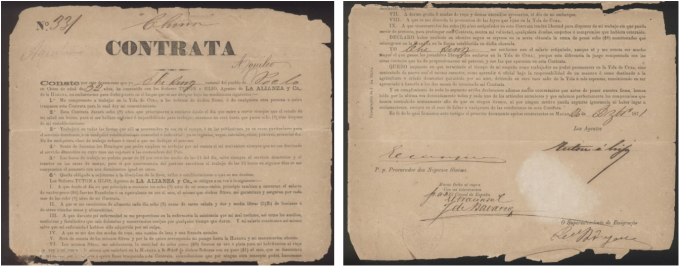
Article 8. The contract must clearly specify:
1) The country and place of work and the contract duration.
2) Upon contract completion and return to China, the estimated passage and travel expenses per person.
3) The agreed working days and hours at the destination.
4) The clothing, food, and other benefits to be received while working.
5) In case of illness, medical treatment and medicine shall be provided without deducting the laborer's wages.
6) For those going alone while leaving dependents in China
wishing to send regular remittances for family support, the amount to be deducted shall be specified. | [7] | Chen Hansheng (1982). A Compilation of Historical Materials on Chinese Emigrant Laborers, Asia. Beijing: Zhong Hua Book Company. |
[7]
.
Article 9. The contract term shall not exceed five years.
1) Subject of approval by local authorities to stay,
The full travel expenses stipulated in the original contract shall be paid for his use.
2) He may renew employment under a new contract, receiving half the amount specified in the original contract for his personal use, provided that the new contract does not exceed five years.
3) If a Chinese laborer was ill at the destination and cannot work, he shall be repatriated before the contract term expires with full payment as stipulated; otherwise, he may appeal to the local authorities. | [7] | Chen Hansheng (1982). A Compilation of Historical Materials on Chinese Emigrant Laborers, Asia. Beijing: Zhong Hua Book Company. |
[7]
.
Article 21. Except for Chinese who emigrate voluntarily without recruitment,
whom Chinese authorities shall not obstruct,
any attempt to recruit laborers by not following the regulations,
or by other means to induce Chinese to contract for overseas work,
was strictly prohibited and should be severely punished upon discovery. | [5] | Chen Hansheng (1982). A Compilation of Historical Materials on Chinese Emigrant Laborers, Qing Dynasty Beijing: Zhong Hua Book Company. |
[5]
.
In the following years, no disputes arose or recruitment practices, however, this was not because foreign recruitment of Chinese laborers fully complied with the treaties, but rather because QCG was still unaware of the actual conditions under which foreign recruitment took place and the hardships suffered by Chinese laborers, and moreover, it lacked the power and the time to address these issues. By 1869, QCG had gradually and in large numbers learned of the abuses suffered by Chinese laborers overseas. “In the eighth year of the Tong Zhi reign, 1869, over 30,000 Chinese laborers in Peru submitted petitions describing the suffering they endured there”
, “... (1872), it was learned that CLC suffered hardships roughly comparable to those in Peru”
. QCG received a report from the U.S. consul stating: “the recruitment of laborers was carried out by idle vagrants seeking profit, who hire people to lure and deceive simple villagers, transporting them to distant islands to mine guano, treating them like slaves, working them like oxen and horses, their suffering beyond words. Prohibition by public notice is requested”
| [7] | Chen Hansheng (1982). A Compilation of Historical Materials on Chinese Emigrant Laborers, Asia. Beijing: Zhong Hua Book Company. |
[7]
. “The U.S. consul, together with the consuls of Denmark, Germany (Prussia), Britain, France, the Netherlands, and Sweden, issued a joint note to the Xiamen intendant, requesting an investigation”
| [6] | Chen Hansheng (1982). A Compilation of Historical Materials on Chinese Emigrant Laborers, Latin America Beijing: Zhong Hua Book Company. |
[6]
. Zong Li Ya Men (ZLYM) then issued a note to the Spanish minister: “all recruitment of laborers not conducted in accordance with the 22 articles of regulations shall be prohibited, and recruitment for Cuba shall be suspended”
| [19] | First Historical Archives of China, Beijing (1982). Compilation of Old Treaties and Regulations between China and Foreign Countries. Beijing: San Lian Joint Publishing Company. |
[19]
, “simultaneously, the provinces of Fu Jian and Guang Dong were notified to carry out the prohibition”
| [7] | Chen Hansheng (1982). A Compilation of Historical Materials on Chinese Emigrant Laborers, Asia. Beijing: Zhong Hua Book Company. |
[7]
. However, the Spanish minister denied and claimed: “if China can specify which officials or merchants, and in what locations, had abused Chinese laborers, then those who had violated the regulations shall be punished”
. In March 1873, the Spanish minister threatened ZLYM, “if China wishes to protect its laborers, it must send a consul to Havana to oversee and protect them”
, “since China has permitted Britain and France to recruit laborers, why should Spain alone be excluded? Is this not unfair?”
| [7] | Chen Hansheng (1982). A Compilation of Historical Materials on Chinese Emigrant Laborers, Asia. Beijing: Zhong Hua Book Company. |
[7]
. In April, the Spanish minister again addressed, “Spanish merchants who sought permission in Guangdong last year to recruit laborers for Havana were denied by the Governor of Guang Dong, causing losses of over 300,000 yuan to these merchants, and compensation is demanded on their behalf”
.
Given that various consuls had previously issued notes concerning the abuse of Chinese laborers in Cuba, ZLYM in July 1873 invited the ministers of Britain, Russia, France, the United States, the Netherlands, and Germany to a joint consultation, inquiring “whether there was any abuse of Chinese laborers in Havana, Cuba”
| [7] | Chen Hansheng (1982). A Compilation of Historical Materials on Chinese Emigrant Laborers, Asia. Beijing: Zhong Hua Book Company. |
[7]
. The foreign ministers suggested that “China should send its own representatives to investigate”
| [7] | Chen Hansheng (1982). A Compilation of Historical Materials on Chinese Emigrant Laborers, Asia. Beijing: Zhong Hua Book Company. |
[7]
. “Regarding the alleged mistreatment of Chinese laborers and civil unrest in Cuba, there was currently no conclusive evidence. However, when nationals of one country reside in another, the host country ought to protect them. If your country possesses solid evidence that Chinese laborers have been mistreated in another country, then suspending the recruitment of laborers for that country would be an appropriate course of action”
| [6] | Chen Hansheng (1982). A Compilation of Historical Materials on Chinese Emigrant Laborers, Latin America Beijing: Zhong Hua Book Company. |
[6]
, “whether Chinese laborers have been mistreated can only be determined on the ground. Yet based on what has been seen and heard, there is indeed CLC’s mistreatment. Your country should send representatives to conduct a strict investigation. If such mistreatment is found to exist, China would be fully justified in prohibiting the recruitment of laborers for that country”
| [7] | Chen Hansheng (1982). A Compilation of Historical Materials on Chinese Emigrant Laborers, Asia. Beijing: Zhong Hua Book Company. |
[7]
. “If rumors suggested that British merchants had mistreated Chinese laborers, the British government would certainly urge China to send investigators. As for compensation, if British merchants had not mistreated Chinese laborers, then compensation would not be warranted; but if the rumors prove true, then the question of compensation should naturally be set aside”
| [6] | Chen Hansheng (1982). A Compilation of Historical Materials on Chinese Emigrant Laborers, Latin America Beijing: Zhong Hua Book Company. |
[6]
. On September 21, 1873, Yi Xin, recommended Chen Lanbin, a second-class secretary of the Board of Punishments and supervisor of Chinese students in the United States, as the investigative commissioner.
On February 19, 1874, Chen departed, and on March 17, he arrived in Havana and began this investigation into the conditions of Chinese laborers across Cuba. Chen, a prominent Qing official who had studied in the United States, led China’s first investigation of overseas Chinese laborers. Although this was a difficult choice made by QCG under pressure from Spain and encouragement from the foreign ministers’ resident in China, it nonetheless represented a positive effort by QCG to protect the CLC’s rights, it thus marked the beginning of concrete action by China to safeguard the rights of its emigrant laborers.
5. TCLC’s Signing in 1877
ZLYM immediately notified the diplomatic envoys of various countries in China and relevant domestic officials of the report’s contents, seeking to gain the sympathy and support of these envoys and striving to compel Spain to acknowledge the facts.
“We had carefully reviewed the report, which provided extremely detailed accounts of the Chinese laborers’ employment conditions, vividly depicting the horrific and cruel treatment they endured.
We propose to have it printed and distributed to the envoys, and to inform the high-ranking officials”. | [5] | Chen Hansheng (1982). A Compilation of Historical Materials on Chinese Emigrant Laborers, Qing Dynasty Beijing: Zhong Hua Book Company. |
“We might invite the envoys to make a collective judgment……
and whether we can fully resolve the situation of the Chinese laborers in Cuba.
However, having this detailed testimony as a basis may help refute the evasions of the Spanish”. | [6] | Chen Hansheng (1982). A Compilation of Historical Materials on Chinese Emigrant Laborers, Latin America Beijing: Zhong Hua Book Company. |
This investigation and the recorded CLC’s realities provided ZLYM with Spain and the envoys of other countries, placing them in an advantageous position. ZLYM’s suggestion, the Spanish minister, and the envoys of other countries each drafted a new set of regulations, “CLC must be returned to China in batches. In the future, … shall be given the same protection as nationals of other countries residing there, and there must be no further abuse”
| [11] | Chen Shangsheng (2009). On the Inequitable Treatment of Domestic and Foreign Merchants in China's International Trade Policy during the Early Qing Dynasty. Journal of Literature, History and Philosophy, vol. 02, pp. 17-29.
https://doi.org/10.16334/j.cnki.cn31-1652/k.2009.02.017 |
[11]
, “rescuing the Chinese laborers currently suffering abuse will demonstrate our ability to protect future laborers, after which recruitment might proceed”
| [12] | Chen, Xiaoyan and Yang Yanqiong (2005). The Case of Chinese Laborers in Cuba and the Modernization of Late Qing Diplomacy. Zhejiang Social Sciences, no. 03, pp. 159-165.
https://doi.org/10.14167/j.zjss.2005.03.031 |
[12]
. The Spanish and other foreign envoys, however, advocated “simultaneous protection and recruitment of laborers”
| [11] | Chen Shangsheng (2009). On the Inequitable Treatment of Domestic and Foreign Merchants in China's International Trade Policy during the Early Qing Dynasty. Journal of Literature, History and Philosophy, vol. 02, pp. 17-29.
https://doi.org/10.16334/j.cnki.cn31-1652/k.2009.02.017 |
[11]
. At the end of 1875, “appointed Chen as an envoy to the United States, Spain, and Peru to handle diplomatic negotiations”
| [7] | Chen Hansheng (1982). A Compilation of Historical Materials on Chinese Emigrant Laborers, Asia. Beijing: Zhong Hua Book Company. |
[7]
. It was not until 1877, after unremitting efforts, Carlos Antonio led to an agreement: “the previously discussed articles were revised and expanded. Both parties finalized them, and on the 13th of October, the clauses were mutually signed”
| [19] | First Historical Archives of China, Beijing (1982). Compilation of Old Treaties and Regulations between China and Foreign Countries. Beijing: San Lian Joint Publishing Company. |
[19]
.
Treaty of Chinese Laborers in Cuba (TCLC) was signed. This was the first concrete action since the Ming Dynasty concerning the emigration of Chinese laborers abroad and the protection of their rights, it marked, the first time, “international law as a means”
and legal channels to safeguard the rights of Chinese nationals overseas. “This represented not only a formal step forward but also a reflection of the establishment of a national consciousness, as the Qing Dynasty positioned itself as a subject of international law”.
.
TCLC marked the beginning of the Qing’s adoption of international governmental norms and its entry into modern diplomacy, a key symbol of this progress was the emulation of Western powers in implementing a passport system to grant nationality and identity certification to overseas Chinese, thereby protecting and regulating the treatment of Chinese laborers and other emigrants abroad.
“If any Chinese person voluntarily wishes to go abroad,
they must first register at the customs office, apply for a stamped license,
and submit it to the consular official of the relevant country for countersignature and sealing”. | [19] | First Historical Archives of China, Beijing (1982). Compilation of Old Treaties and Regulations between China and Foreign Countries. Beijing: San Lian Joint Publishing Company. |
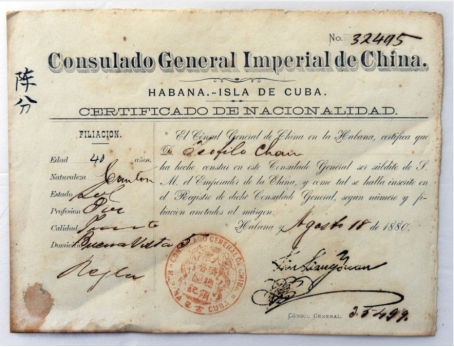
Figure 3 shows the nationality certificate of Chen Fen, it was issued by Liu Liangyuan, then the Chinese Consul General in Havana
, Cuba, in the sixth year of the Guang Xu reign of the Qing Dynasty, in 1880, the document is in Spanish, includes a serial number, the worker’s age, the consul general’s signature, and the official seal of the Qing Consulate General, featuring a double-dragon insignia, this identity certificate was regarded as a symbol of personal freedom and protection and is referred to in Chinese historical documents as Xing Jie Zhi
.





 Share This Article
 Twitter
 Linked In
 Facebook
 Copy
Copy Download