Abstract
Iraqi cities suffer from a shortage of electric power due to poor production and deterioration of transmission and distribution lines. There is no prospect currently for improving the grid, despite the government's promises. So it has become necessary to find alternatives, at least at the local level. This research, presented a successful alternative, which applied all over the world, which is the local microgrid. Also, it’s developed a design for this microgrid that suits the conditions of Iraq and supports the integration of clean energy produced by the consumer. The results indicate the success of investing in this microgrid by small investors, foreign companies or local administrations of the cities that want to develop their cities in isolation from the problems of the country's national electrical grid. This solution reduce the pressure on the national grid on one hand and improve the electricity service for the consumer on the other hand, by providing the pivotal key to the solution, which is replacing the blind system of paying wages (for electricity service) currently followed in Iraq with the billing system followed in all developed countries of the world. This solution provides the possibility of deploying the economic solar PV system (without batteries) in Iraqi houses to reduce the bills and also allows personal monitoring of electricity consumption so that the consumer can reduce loads during peak times to reduce bills as well.
Keywords
Mini Grid, Micro Grid, Iraq Electricity, Investment in Electricity, Renewable Energy, Feed in Tariff
1. Introduction
The Microgrid
The US National Renewable Energy Center (NREL) defines a microgrid (or mini-grid) as a collection of interconnected loads and distributed energy resources that operate as a single, controllable entity. This microgrid can connect to the main grid or separate to work independently according to the available capabilities. Microgrid enable local power generators - including diesel generators, renewables and storage to keep supplying power even when the main grid outages or remote areas become inaccessible to the main grid. In addition, local microgrids allow working with the main grid to save costs, connect power supplies, and collect revenue through a convenient billing system
. There are 692 small local microgrids in the United States alone, with a total energy of 4.4GW, representing 0.3% of the country's electricity, and most of them are in remote areas that are not connected to the main grid
. The small local microgrids are operating with a mixture of conventional diesel generators and renewable energy resources. The capacity of each of which ranges worldwide currently from 10KW to 10MW, and avoids the world millions of tons of pollutants daily
| [3] | International Renewable Energy Agency (IRNA), The Big Impact of Mini-Grids in Mali’s Rural Areas, 11-5-2022 available from: https://www.irena.org/news/articles/2022/May/The-Big-Impact-of-Mini-Grids-in-Malis-Rural-Areas |
| [4] | Xuan Hoa Thi Pham, Toi Thanh Le, Hieu Tran Trong. (2019). Control Power Sharing of Parallel Inverters in Microgrid with Consideration of Line Impedance Effect. American Journal of Electrical Power and Energy Systems, 8(5), 127-144. https://doi.org/10.11648/j.epes.20190805.15 |
| [5] | Abiy Mokennen Weldegiyorgis, Ravikumar Hiremath, Derje Shiferaw. (2021). Design and Simulation of Renewable Energy Resources for Micro Grid Based Rural Electrification in Ethiopia. American Journal of Electrical Power and Energy Systems, 10(4), 51-59. https://doi.org/10.11648/j.epes.20211004.11 |
| [6] | Unwana Macaulay Ekpe, Vincent Bassey Umoh. (2019). Comparative Analysis of Electrical Power Utilization in Nigeria: From Conventional Grid to Renewable Energy-based Mini-grid Systems. American Journal of Electrical Power and Energy Systems, 8(5), 111-119. https://doi.org/10.11648/j.epes.20190805.12 |
[3-6]
.
Figure 1. Diagram of simple Smart Local microgrid.
Figure 1 shows a simple Local microgrid, independent of the main grid, with its conventional and renewable components. The main objective of these networks is to maintain the continuity of power flowing in a regular and reliable manner to the load. Even in the absence of all renewable energy resources, the diesel generator must remains suffice the entire load. The presence of a battery bank is not desirable in large loads due to its high cost and relatively short life, as well as the difficulty of its maintenance and operating conditions. Battery bank can be used in certain places such as hospitals to save lives of patients during the transition from one electrical source to another in the microgrid.
Iraq's national electrical grid
Iraq suffers from a severe shortage in electric power supply since the US occupation of the country, despite spending more than 81 billion dollars in this sector. This shortage is due to several reasons, including political, security, economic and technical. Iraq currently needs 34GW of electric power, of which only 24GW is produced, including 5 GW, depending on Iranian liquid gas. In the result, the consumer reaches much less than that due to deficiencies in transmission and distribution lines and the continuous outages of liquid gas from the Iranian side. Iran is supposed to meet 40% of the electricity needs in Iraq as gas supplies and direct purchase of electricity, at a cost of about $4 billion annually
| [7] | Noam Raydan, Iraq’s Power Problem (Part 1): Persistent Financial and Technical Challenges, The Washington Institute for near east policy, 17-7-2023. |
[7]
.
Baghdad is taking procedures for energy self-sufficiency and reducing dependence on abroad by reducing waste in domestic gas associated with oil extraction and establishing solar power stations. Iraq burns 1,200 million standard cubic feet per day of gas while importing 1,000 million standard cubic feet per day from Iran, with a loss of $4 billion annually, as stated by the current Prime Minister. These losses in addition to the pollution resulting from the release of millions of tons of carbon dioxide and methane in the atmosphere
| [8] | Bilal Wahab, Dennis Ross, Iraq’s Power Problem (Part 2): Implications of The New Oil-Gas-Gas Deal with Iran. The Washington Institute for near east policy, 19-7-2023. |
[8]
. Also, there is the Gulf connection, which is supposed to supply only 0.5GW. Iraq's annual losses due to power outages about $40 billion, distributed over the Iraqis' purchase of electricity from small private business generators, and losses in the industrial and agricultural sectors, in addition to the health problems of the population. According to the (International Monetary Fund), the operating cost of electric power sector in 2019 amounted to 9.3 billion dollars, while the revenues were less than one billion dollars due to the rampant theft, the lack of an appropriate billing collection system, and the collapse of the transportation and distribution lines
| [9] | Independent Arabia, "كهرباء الامل....الى متى يظل العراق مظلما" [Electricity of Hope... How long will Iraq remain in dark?], 18-2-2023. |
[9]
. They Usually use (2-4) power cutoff program, i.e. two hours (on) four hours (off) per day for all Iraq cities.
Small Private Business Diesel generators in Iraq
For these reasons, people depend on private diesel generators instead of the national grid. Common diesel generators in Iraq are of a relatively small capacity (250KVA or 200KW) suppose to sufficient for 100 houses (if we consider the rate of electric current per house drawing 10A). The system of selling electricity from these generators is “blind” and is done as prepaid (ampere-dinar) method, i.e. a monthly maximum ampere current is limit, and the supply is interrupted if the consumer exceeds this limit. This blind system causes money loss and limited use of electricity by the consumer. Most people do not use all this current, but they buy it in order to provide sufficient rise current for common and vital refrigeration devices for the consumer in the summer (the rise current is usually greater than the continuation current in refrigeration and air-conditions devices). Refrigeration and air-conditions devices are used in summer to cool air and foodstuffs in the Iraqi house. Also, this current provides the simultaneous operation of welding devices and the rise of some small industrial machines for the professions and small projects owners such as bakeries, blacksmithing, carpentry and other professions. These devices work only during working hours, and stop for the rest of the day, which constitutes additional costs for their owners and threatens the continuation of these important professions. There is also the problem of manipulation of prices and time period of operation and shutdown by generators if the main grid is suspended for several days (this often happens during the peak periods of summer and winter). These problems are the main obstacles against the effectiveness of this option, the option of private generators. In addition, the blind system does not support the integration of clean energy produced by the consumer at house, which in turn will reduce the energy bill that buys from the generator if they use a smart billing system.
Solar energy system in Iraq
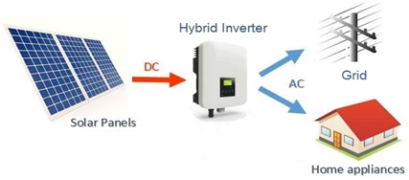
The option of using clean energy (usually solar energy) in Iraq is an excellent option, but it is also fraught with obstacles. The initial cost of purchasing sufficient solar equipment to generate one kilowatt is relatively high in Iraq (about 1,650$), most of which is the cost of batteries. Battery bank is the weakest member in the house solar system due to their high price, maintenance and operation costs, and short life compared to the rest of the system. The system mainly consists of solar panels, a converter, and a storage system, which is the battery bank. The panel’s life is usually 30 years, the converter life is 20 years, and the battery life is 2-4 years. When integrating the house solar system with the reliable microgrid, batteries will dispense, and the storage system will be the microgrid itself (
figure 2). This merger will reduce the electricity bill of the house, reduce the initial price of purchasing solar system to half, and reduce the cost and effort of maintaining system to only cleaning solar panels from dust.
Figure 2. House solar system integrated with the local microgrid.
There is a positive specificity in Iraqi cities in terms of house solar systems, which is the common horizontal construction of them. This privacy makes the impact of the house solar system large and effective due to the large area prepared for installing solar panels in the house. There are several researches on integrating the solar system with a diesel generator to form a hybrid power generation system. The hybrid system reduces the operational cost, the amount of fuel for the generator, and the size of the solar system. There are some researches that dealt with the design of systems that use batteries with the PV-diesel hybrid system
| [10] | M. ASHARI and C. V. NAYAR, An Optimum Dispatch Strategy Using Set Points For A Photovoltaic (Pv)–Diesel–Battery Hybrid POWER SYSTEM, Solar Energy Vol. 66, No. 1, pp. 1–9, 1999. |
| [11] | Vincent Anayochukwu Ani, Design of a Reliable Hybrid (PV/Diesel) Power System with Energy Storage in Batteries for Remote Residential Home, Journal of Energy, 2016. |
| [12] | S. M. Shaahid, M. A. Elhadidy, "Economic analysis of hybrid photovoltaic–diesel–battery power systems for residential loads in hot regions, A step to clean future", Renewable and Sustainable Energy Reviews, 12 (2008) 488–503. |
| [13] | Chong Li, Dequn Zhou, Hui Wang, Huanbo Cheng, Dongdong Li, Feasibility assessment of a hybrid PV/diesel/battery power system for a housing estate in the severe cold zone—A case study of Harbin, China, Energy (2019). |
| [14] | E. M. Nfah, J. M. Ngundam, R. Tchinda, Modelling of solar/diesel/battery hybrid power systems for far-north Cameroon, Renewable Energy 32 (2007) 832–844. |
| [15] | Hai Lan, Shuli Wen, Ying-Yi Hong, David C. Yu, Lijun Zhang, Optimal sizing of hybrid PV/diesel/battery in ship power system, Applied Energy 158 (2015) 26–34. |
| [16] | Shafiqur Rehman, Luai M. Al-Hadhrami, Study of a solar PV-diesel-battery hybrid power system for a remotely located population near Rafha, Saudi Arabia, Energy 35 (2010) 4986-4995. |
| [17] | S. M. Shaahid, M. A. Elhadidy, Technical and economic assessment of grid independent hybrid photovoltaic–diesel–battery power systems for commercial loads in desert environments, Renewable and Sustainable Energy Reviews 11 (2007) 1794–1810. |
| [18] | S. M. Shaahid, I. El-Amin, Techno-economic evaluation of off-grid hybrid photovoltaic–diesel–battery power systems for rural electrification in Saudi Arabia—A way forward for sustainable development, Renewable and Sustainable Energy Reviews 13 (2009) 625–633. |
[10-18]
and others did not use them
| [19] | Manoj Datta, Tomonobu Senjyu, Atsushi Yona, Toshihisa Funabashi, Chul-Hwan Kim, "A Frequency-Control Approach by Photovoltaic Generator in a PV–Diesel Hybrid Power System", IEEE TRANSACTIONS ON ENERGY CONVERSION, VOL. 26, NO. 2, JUNE 2011. |
| [20] | U. Suresh Kumar, P. S. Manoharan, “Economic analysis of hybrid power systems (PV/diesel) in different climatic zones of Tamil Nadu”, Energy Conversion and Management 80 (2014) 469–476. |
| [21] | Muyiwa S. Adaramola, Samuel S. Paul, Olanrewaju M. Oyewola, Assessment of decentralized hybrid PV solar-diesel power system for applications in Northern part of Nigeria, Energy for Sustainable Development (2014). |
| [22] | J. Dekker, M. Nthontho, S. Chowdhury ⇑, S. P. Chowdhury, Economic analysis of PV/diesel hybrid power systems in different climatic zones of South Africa, Electrical Power and Energy Systems 40 (2012) 104–112. |
| [23] | SAID H. EL-HEFNAWI, Photovoltaic Diesel-Generator Hybrid Power System Sizing, Renewable Energy, Vol. 13, No. 1, pp. 33-40, (1998). |
| [24] | Zelalem Girma, Technical and Economic Assessment of solar PV/diesel Hybrid Power System for Rural School Electrification in Ethiopia, INTERNATIONAL JOURNAL of RENEWABLE ENERGY RESEARCH, Vol. 3, No. 3. |
| [25] | Ahmed Belilaa, c, Yassine Amiratb, Mohamed Benbouzidc, e, El Madjid Berkouk, Gang Yao, Virtual Synchronous Generators for Voltage Synchronization of a Hybrid PV-Diesel Power System, Journal of International Journal of Electrical Power and Energy Systems. October 27, 2019. |
| [26] | Aksa Power Generation, AP825, 2023, Available from: https://www.aksa.com.tr/es-ar/urun-detay/224 |
[19-26]
. The use of batteries in solar system is limited by the need for a storage bank that ensures energy recovery when sunset and there is no other power source, which is usually the grid or diesel generator.
The integration of house solar system with the local microgrid requires a smart billing system that determines the costs of electricity consumed by the consumer according to the monthly consumed capacity in watts. The smart billing system in the world uses the net metering or (Bi directional meter) that allows calculating the two-way energy path, drawn from the grid towards the house and exported from the house towards the grid. It was used for the first time in America in 1979, and the first law allowing the export of energy from the consumer to the grid was legislated in Minnesota State in 1983. In Jordan, this law was legislated in 2012. The local microgrid must ensure that electricity is supplied regularly to the consumer, especially during the daytime, which is the time when it generates electrical energy from solar panels. Daytime in Iraq is usually the peak time, especially in the summer, when temperatures reach extreme levels in which most of the country's activities are disrupted and the current national electrical grid usually collapses. Therefore, it was necessary to establish a local microgrid in all cities and villages (one or more big diesel generators, which is the lowest cost option for a small city) that provides reliable smart grid services and supports the integration of house solar systems.
2. Design of a Local Microgrid Suits to Iraq Conditions
In this research, it’s designed a local microgrid that suits the conditions of Iraq. It’s commensurate with the partial failure of the national grid to meet the full electric power needs of Iraqi cities. This local microgrid is an excellent and profitable investment project for producer and consumer alike. On the product side, it is an investment by the local administration of the city or by a private party that coordinates its work with the city administration. This microgrid supports integration with the house solar energy system.
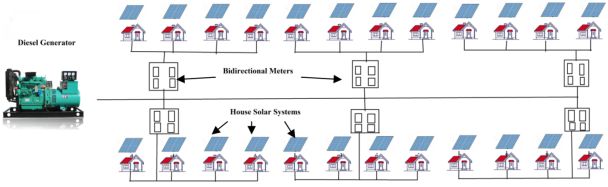
This local microgrid consists of a medium or large diesel generator (200KW - 2000KW) with wire connections that connect power directly to houses via a Bi-directional electricity meter (
Figure 3). This meter calculates the real consumption of electricity, on the contrary of the blind system (amperes - dinars) currently used in private generators. This meter subsidizes clean energy produced by the house and subtracts it from grid energy at a predetermined price. This microgrid is sufficient for 1,000 houses if the diesel generator is of a large size (2000 KW) and the current drawing rate per house is 10 amps. If the city or village contains 3000 houses, we need a local microgrid that contains 3 diesel generators of large size.
Figure 3. A local microgrid that supports house solar energy production with a smart metering system.
This local microgrid operates on low voltage (250VAC) and does not need voltage risers due to the close distance of source-load. Also, it’s preferable that this microgrid be managed in coordination with the local administration of the city to organize its work with the main grid. As in the previous example, if the city has 3000 houses and the main grid programmed cut-off system is 2-4 for the city, the program can be changed so that the main grid energy is allocated to feed one-third of the city for a continuous 12-hour period, and two generators in the local microgrid feed the other two-thirds of the city with the third generator turned off. Thus, coordination continues between sources in order to provide a continuous flow of electrical energy to the consumer. The billing system can be works with prepaid manner (same as in Kurdistan and many countries). Revenues are collected to meet fuel cost, maintenance and employee salaries.
The benefit of the consumer is in obtaining continuous electrical energy and economical payment of bills by virtue of price control by the city administration and by virtue of the consumer's ability to monitor and control his own consumption, in contrast to the blind system, Ampere-Dinar, which is followed by private generators. This also allows the professionals to doing their work easily and efficiently after they get a continuous electrical energy supply that matches their consumption in an economical manner.
Also, the benefit of the consumer will be his ability to install a solar energy system at a lower initial cost because it will be without batteries and with a cost payback from reduce the electricity bill according to the size of his solar system. If his solar system is large enough to exceed his consumption during the day, the excess energy will be transformed into a negative bill that he will recover at night or on days when solar energy is weak in winter. Also, most of the residents are workers, employees, and students who leave their houses during the day to do their work or study, so their houses produce free energy that is added to their balance in the form of a negative bill that they get later. This system will encourage all consumers to install solar systems in their houses. This will result in the disappearance of the problem of peak electricity consumption during the summer day, with low energy costs for consumers and less pollution. In addition, it results in less pressure on the main grid in general and less pressure on transmission and distribution lines in particular, due to the enhancement of local generation in the residential areas of the various cities of Iraq.
3. Calculations and Results
The cost of electric power from private generators in Iraqi cities
In Iraq, They sell electric power as privet business. They usually use middle size diesel generators of (250KVA) or (200KW) and sell power monthly by “blind” prepaid method of (Ampere-Dinar) i.e. a monthly maximum ampere current is limit, and the supply is interrupted if the consumer exceeds this limit.
We well first calculate the price of the ampere against the energy consumed by the private generators:
The average monthly price of an ampere from a private generator in Iraq cities is 15,000D dinars, which is equivalent to 10$ dollars. One ampere generates a power of 0.2 KW, considering the voltage is 250V, so the price of one kilowatt is $0.05.
1A * 250V = 250VA= 200W (PF=0.8)(1)
If the program of power cutoff of the main grid is 2-4, i.e. two hours (on) four hours (off) per day, then the privet generator supplies two-thirds of the full day, i.e. 16 hours per day or 480 hours per month. So the energy generated by a single ampere per month is 96KWh at approximately (0.104) $/KWh according to the equation:
10$/96KWh = 0.104 $/KWh(4)
Which is high price relative to other world grids, and this is acceptable if we know that the private generator grid is limited to diesel generators only and is devoid of clean energy sources that limit fuel consumption (
Table 1).
Table 1. The price and energy consumed from electric current of the private generators currently use in Iraq.
Price of energy $/KWh | Consumed energy per month KWh | Price of power $\W | Price by USdolar ($) | Price by dinar (Di) | Power (W) | Current (A) |
0.104 | 96 | 0.05 | 10 | 15,000 | 200 | 1 |
0.104 | 960 | 0.05 | 100 | 150,000 | 2000 | 10 |
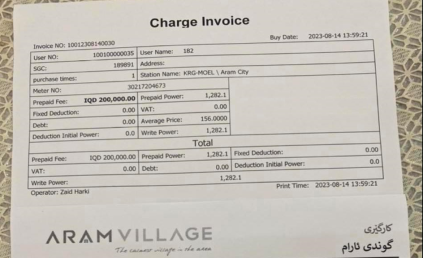
By comparing this result with bill of modern residential complexes in Kurdistan, in which the smart prepaid system for bills is applied (
Figure 4). By applying the price that we extracted above (0.104$/KWh) to the amount of energy consumed in the bill (1,282.1 KWh), we find that the resulting amount is 200,007 dinars, which is exactly equal to the amount of the bill (considering that the dollar equals 1500 Iraqi dinars).
Figure 4. Electricity bill for a consumer in a modern residential complex in Kurdistan.
The cost of local Microgrid components
A local microgrid cost of one large diesel generator can be calculated as follows:
1) The price of a large generator (2MW), brand Perkins, in Iraq market is 50,000 US$.
2) Bidirectional meter cost $100.
3) Normal meter cost $20.
4) Electrical cables, cabins and other accessories cost is $20,000.
So the total cost is $70,000 without considering meters cost.
We can deduct the meters cost from the consumer and consider it as involving in the system, to reduce the initial cost to the investor. It is also can install the normal meters at the beginning for all consumers and replace it later with the Bidirectional meters for those who want to install a solar system in their houses. If the consumers count 1,000 houses, we will need 1,000 bidirectional measures, with a total cost of $100,000 for the meters only, which is a large amount for the project start.
The fuel consumption per hour of the diesel generator can be found from the initial specifications of the engine. If we use a Perkins generator type AP 825
with a power of 600KW and the government price for diesel is 430 dinars / liter, while the commercial price is approximately 620 dinars / liter (we considered the dollar price 1500 Iraqi dinars) the consumption rate will be count according to
table 2:
Table 2. Average fuel consumption for a 600KW Perkins engine and diesel price (at the government price 430 and commercial price 620).
| Fuel consumption at 50% load | Fuel consumption at 75% load | Fuel consumption at 100% load |
L/h | 83 | 122 | 161 |
L/KWh | 0.276 | 0.271 | 0.268 |
Dinar (gov)/KWh | 119 | 117 | 115 |
Dinar (com)/KWh | 172 | 168 | 166 |
$(gov)/KWh | 0.079 | 0.078 | 0.077 |
$(com)/KWh | 0.115 | 0.112 | 0.11 |
From
table 2, approximately 75% of the electricity generation cost is used as fuel consumption and the profits only 25%. The government fuel price is (0.078$/KWh) while the generation fee is (0.104$/KWh). In case of the commercial fuel price ($0.112/KWh) we see it becomes more than the generation fee, and the generation fee must be increased to meet the 25% profits i.e. the generation fee must be ($0.149/kWh) instead of ($0.104/kWh). Then generation of one ampere current must be costs the consumer ($14.3) instead of ($10), i.e. (21,500 dinars) instead of (15,000 dinars).
These results show that our microgrid recovers its initial cost ($70,000) after approximately (112) days (in the case of 75% load) (and uses government fuel price 0.104 $/KWh) according to the following equations:
Net profit of the project owner is equal to:
0.104 $/KWh – 0.078 $/KWh = 0.026 $/KWh(5)
A large generator (2000KW) (at 75% load, i.e. use only 1500KW) recovers net profit within one hour by:
0.026 $/KWh * 1500 KWh = 39 $(6)
The project needs to recover $ 70,000 for operating hours of:
70,000$ / 39$ = 1795 h(7)
And days of:
By considering that it works only 16 hours a day.
In case of the generation cost (0.149$/KWh) at the commercial price of fuel, it takes (79) days to recover its initial cost because the amount of its (25%) profits and commercial fuel is greater than the amount of its profits in government fuel for the same ratio (See
Table 3).
From these results, we see that the investing in a local microgrid is a very profitable in Iraq.
Table 3. 2MW generator profits in case of using government and commercial fuel (75% load).
| operating days to recover the initial cost day | operating hours to recover the initial cost h | Net profit per hour $/h | Net profit rate $/KWh | Power (KW) |
Gov. fuel | 112 | 1795 | 39 | 0.026 | 1500 |
Com. fuel | 79 | 1261 | 55.5 | 0.037 | 1500 |
House solar energy system
Iraq cities has positive feature that makes reliance on the house solar system an influential factor to support the working grid. This feature is the horizontal construction of housing which has a sufficient space to install solar panels on the roofs.
The price of solar panels in Iraq ranges between $0.3 and $0.4 per watt, depending on the type and size. In our design we will use a solar panel with a power of 455 watts and 2m2 area at a price of $175.
If we use four panels with a total power of 1820W and a total price of $700 with a 3.6KW hybrid converter at $400, then the cost of the system with its installation will be approximately $1600. This system is without batteries because it uses the reliable microgrid as a storage system instead of batteries.
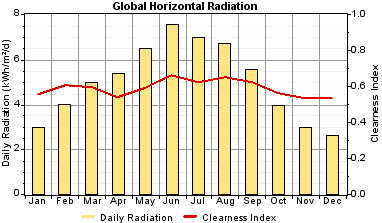
The least amount of solar radiation in central Iraq at (Dec) = 2.62 KWh/m2/d
The highest amount of solar radiation in central Iraq at (Jun) = 7.56 KWh/m2/d
The annual mean of solar radiation in Iraq centre throughout the year = 5.02 KWh/m2/d
Figure 5. The amount of solar radiation over Baghdad city (Iraq centre).
From the equation of electrical energy obtained from solar radiation
:
PPV = the total energy produced by PV array (KWh/d)
fPV = derating factor (%)
YPV = the rated capacity of the PV array (KW)
IT = the global solar radiation (kW/m2/d)
IS = the incident radiation at standard test conditions (1kW/m2)
(fPV) This factor refers to reduce in energy obtained from sun, including dust, wires loss, and overall system efficiency, its about 80%.
Table 4.
Theoretical values of equation (9). Parameter | Value | Unit |
PPV | 7.31 | kWh/d |
fPV | 80 | % |
IT | 5.02 | kWh/m2/d |
YPV | 1.82 | kW |
According to
Table 4, this system consisting of four solar panels with 455W each, generates 7.31 KWh per day, or 219 KWh per month, which is equivalent to the energy generated by a 2.3A from the generator (considering the energy of (1) ampere equal to 96 KWh per month). The generation of two solar panels equivalent to 1.14 amperes, so the installing of 8 panels earns 4.56 amperes and its bill will decrease accordingly (see
Table 5).
Table 5. The cost of the house solar system (panel power is 455 watts), its profits (considering the monthly price of one ampere $10), and the number of years to payback its initial cost for the benefit of the consumer.
Payback for initial cost Year | Earned money per month IqDinar | Earned money per month $ | Electric current gained per month A | Generated energy per month KWh/month | Total power W | System cost $ | Number of panels |
9 | 17,130 | 11.42 | 1.14 | 109,637 | 910 | 1250 | 2 |
5.8 | 34,500 | 23 | 2.3 | 219,300 | 1,820 | 1600 | 4 |
4.7 | 51,392 | 34.26 | 3.43 | 328,910 | 2,730 | 1950 | 6 |
4.2 | 68,550 | 45.7 | 4.57 | 438,547 | 3,640 | 2300 | 8 |
3.8 | 85,650 | 57.1 | 5.71 | 548,184 | 4,550 | 2650 | 10 |
In
table 5, the amount of energy generated by house solar system (one panel 455 watts) and payback time to total initial cost that consumer’s profits by reducing electricity bill. We see that the payback time decreases as the size of the solar system increases. This result encourages the consumer to install the largest size possible. The reputable companies that equip these systems provide a 10-year guarantee. This means that the customer always remains under warranty until the full cost of his system is paid back, no matter how small.
4. Conclusions and Suggestions
In this paper, it’s designed a microgrid consisting of a relatively large diesel generator and a smart billing system that supports the integration of the house solar energy system. This microgrid is applied in Iraq, but in a miniature and primitive way, represented by private generators with a blind (amperes - dinars) prepaid method that does not support the integration of clean energy systems. It’s reached the following conclusions:
1) This microgrid is a very profitable investment in Iraq in light of the stifling energy crisis in Iraq, which there is no hope of being fixed soon.
2) This microgrid represents a radical solution to the city’s energy problem without relying on the national grid and its problems. The city's local administration can manage this investment or monitor its owners and coordinate with them in order to serve the city. Coordination involves directing the national grid’s energy to a part of the city continuously, instead of directing it to the entire city intermittently, as is the case now, and leaving the other parts of the city to the local microgrid to feed.
3) This microgrid supports integration of clean energy system in an efficient manner, which reduces the consumer’s electricity bill and allows for increase the number of consumers benefiting from this microgrid and also reduces the damage of environmental pollution in the region.
Providing regular electricity to Iraqi cities allows small and large projects to work and resume their activities necessary to support the national economy.
It’s proposed three investment scenarios in this project:
1) Individual investment, which is for small investors to start with a microgrid of one large generator and its accessories, which costs, as we mentioned, approximately $70,000, and grows his project to a second and third generator over time with increasing demand.
2) The local administration of the city can use its budget by establishing this microgrid with three or four large generators, depending on the size of the city. This project is within the city’s capabilities and ability to develop their city, in coordination with the city’s Electricity Department.
3) Contracting with a foreign company to establish this microgrid without paying any money and paying back its cost from the microgrid revenues for a period of one year, for example. We saw from the above calculations that the cost is paid back in less than four months, no matter how large it is (and the remaining eight months will be their profits) and delivered after the year to the city administration.
Abbreviations
Gov | Government Fuel |
Com | Commercial Fuel |
Acknowledgments
I extend my thanks and appreciation to Mr. Omar Hussein, representative of Al-Hadbaa Renewable Energy Solutions Company, and Mr. Naseer Karim, Head of the Renewable Energy Department at the Ministry of Electricity, for the useful information.
Author Contributions
Fadhil Yousif Hammadi: Conceptualization, Data curation, Investigation, Methodology
Qais Khalil Shaker: Conceptualization, Data curation, Validation
A. Wesam Al-Mufti: Writing – review & editing
Rashid Hashim Jabbar: Writing – review & editing
Monadhil Al-Chaderchi: Data curation, Investigation, Validation
Data Availability Statements
The data that supports the findings of this study are available within the article.
Conflicts of Interest
The authors declare no conflicts of interest.
References
| [1] |
National Renewable Energy Laboratory (NREL) USA, Micro grids, 2023, available from:
https://www.nrel.gov/grid/microgrids.html#:~:text=A%20microgrid%20is%20a%20group,and%20resilience%20to%20grid%20disturbances
|
| [2] |
Center for Climate and Energy Solutions USA, Microgrids, 2023, available from:
https://www.c2es.org/content/microgrids/
|
| [3] |
International Renewable Energy Agency (IRNA), The Big Impact of Mini-Grids in Mali’s Rural Areas, 11-5-2022 available from:
https://www.irena.org/news/articles/2022/May/The-Big-Impact-of-Mini-Grids-in-Malis-Rural-Areas
|
| [4] |
Xuan Hoa Thi Pham, Toi Thanh Le, Hieu Tran Trong. (2019). Control Power Sharing of Parallel Inverters in Microgrid with Consideration of Line Impedance Effect. American Journal of Electrical Power and Energy Systems, 8(5), 127-144.
https://doi.org/10.11648/j.epes.20190805.15
|
| [5] |
Abiy Mokennen Weldegiyorgis, Ravikumar Hiremath, Derje Shiferaw. (2021). Design and Simulation of Renewable Energy Resources for Micro Grid Based Rural Electrification in Ethiopia. American Journal of Electrical Power and Energy Systems, 10(4), 51-59.
https://doi.org/10.11648/j.epes.20211004.11
|
| [6] |
Unwana Macaulay Ekpe, Vincent Bassey Umoh. (2019). Comparative Analysis of Electrical Power Utilization in Nigeria: From Conventional Grid to Renewable Energy-based Mini-grid Systems. American Journal of Electrical Power and Energy Systems, 8(5), 111-119.
https://doi.org/10.11648/j.epes.20190805.12
|
| [7] |
Noam Raydan, Iraq’s Power Problem (Part 1): Persistent Financial and Technical Challenges, The Washington Institute for near east policy, 17-7-2023.
|
| [8] |
Bilal Wahab, Dennis Ross, Iraq’s Power Problem (Part 2): Implications of The New Oil-Gas-Gas Deal with Iran. The Washington Institute for near east policy, 19-7-2023.
|
| [9] |
Independent Arabia, "كهرباء الامل....الى متى يظل العراق مظلما" [Electricity of Hope... How long will Iraq remain in dark?], 18-2-2023.
|
| [10] |
M. ASHARI and C. V. NAYAR, An Optimum Dispatch Strategy Using Set Points For A Photovoltaic (Pv)–Diesel–Battery Hybrid POWER SYSTEM, Solar Energy Vol. 66, No. 1, pp. 1–9, 1999.
|
| [11] |
Vincent Anayochukwu Ani, Design of a Reliable Hybrid (PV/Diesel) Power System with Energy Storage in Batteries for Remote Residential Home, Journal of Energy, 2016.
|
| [12] |
S. M. Shaahid, M. A. Elhadidy, "Economic analysis of hybrid photovoltaic–diesel–battery power systems for residential loads in hot regions, A step to clean future", Renewable and Sustainable Energy Reviews, 12 (2008) 488–503.
|
| [13] |
Chong Li, Dequn Zhou, Hui Wang, Huanbo Cheng, Dongdong Li, Feasibility assessment of a hybrid PV/diesel/battery power system for a housing estate in the severe cold zone—A case study of Harbin, China, Energy (2019).
|
| [14] |
E. M. Nfah, J. M. Ngundam, R. Tchinda, Modelling of solar/diesel/battery hybrid power systems for far-north Cameroon, Renewable Energy 32 (2007) 832–844.
|
| [15] |
Hai Lan, Shuli Wen, Ying-Yi Hong, David C. Yu, Lijun Zhang, Optimal sizing of hybrid PV/diesel/battery in ship power system, Applied Energy 158 (2015) 26–34.
|
| [16] |
Shafiqur Rehman, Luai M. Al-Hadhrami, Study of a solar PV-diesel-battery hybrid power system for a remotely located population near Rafha, Saudi Arabia, Energy 35 (2010) 4986-4995.
|
| [17] |
S. M. Shaahid, M. A. Elhadidy, Technical and economic assessment of grid independent hybrid photovoltaic–diesel–battery power systems for commercial loads in desert environments, Renewable and Sustainable Energy Reviews 11 (2007) 1794–1810.
|
| [18] |
S. M. Shaahid, I. El-Amin, Techno-economic evaluation of off-grid hybrid photovoltaic–diesel–battery power systems for rural electrification in Saudi Arabia—A way forward for sustainable development, Renewable and Sustainable Energy Reviews 13 (2009) 625–633.
|
| [19] |
Manoj Datta, Tomonobu Senjyu, Atsushi Yona, Toshihisa Funabashi, Chul-Hwan Kim, "A Frequency-Control Approach by Photovoltaic Generator in a PV–Diesel Hybrid Power System", IEEE TRANSACTIONS ON ENERGY CONVERSION, VOL. 26, NO. 2, JUNE 2011.
|
| [20] |
U. Suresh Kumar, P. S. Manoharan, “Economic analysis of hybrid power systems (PV/diesel) in different climatic zones of Tamil Nadu”, Energy Conversion and Management 80 (2014) 469–476.
|
| [21] |
Muyiwa S. Adaramola, Samuel S. Paul, Olanrewaju M. Oyewola, Assessment of decentralized hybrid PV solar-diesel power system for applications in Northern part of Nigeria, Energy for Sustainable Development (2014).
|
| [22] |
J. Dekker, M. Nthontho, S. Chowdhury ⇑, S. P. Chowdhury, Economic analysis of PV/diesel hybrid power systems in different climatic zones of South Africa, Electrical Power and Energy Systems 40 (2012) 104–112.
|
| [23] |
SAID H. EL-HEFNAWI, Photovoltaic Diesel-Generator Hybrid Power System Sizing, Renewable Energy, Vol. 13, No. 1, pp. 33-40, (1998).
|
| [24] |
Zelalem Girma, Technical and Economic Assessment of solar PV/diesel Hybrid Power System for Rural School Electrification in Ethiopia, INTERNATIONAL JOURNAL of RENEWABLE ENERGY RESEARCH, Vol. 3, No. 3.
|
| [25] |
Ahmed Belilaa, c, Yassine Amiratb, Mohamed Benbouzidc, e, El Madjid Berkouk, Gang Yao, Virtual Synchronous Generators for Voltage Synchronization of a Hybrid PV-Diesel Power System, Journal of International Journal of Electrical Power and Energy Systems. October 27, 2019.
|
| [26] |
Aksa Power Generation, AP825, 2023, Available from:
https://www.aksa.com.tr/es-ar/urun-detay/224
|
| [27] |
HOMER software, HOMER268Beta, 2017,
https://www.homerenergy.com/
|
| [28] |
HOMER software, HOMER Pro.3.13, 2020, available from:
https://www.homerenergy.com/products/pro/docs/3.13/how_homer_calculates_the_pv_array_power_output.html
|
Cite This Article
-
APA Style
Hammadi, F. Y., Shaker, Q. K., Al-Mufti, A. W., Jabbar, R. H., Al-Chaderchi, M. (2024). Design of Local Micro-Grids to Solve the Electricity Shortage in Iraq Cities. American Journal of Electrical Power and Energy Systems, 13(3), 49-58. https://doi.org/10.11648/j.epes.20241303.12
 Copy
|
Copy
|
 Download
ACS Style
Hammadi, F. Y.; Shaker, Q. K.; Al-Mufti, A. W.; Jabbar, R. H.; Al-Chaderchi, M. Design of Local Micro-Grids to Solve the Electricity Shortage in Iraq Cities. Am. J. Electr. Power Energy Syst. 2024, 13(3), 49-58. doi: 10.11648/j.epes.20241303.12
Copy
|
Download
AMA Style
Hammadi FY, Shaker QK, Al-Mufti AW, Jabbar RH, Al-Chaderchi M. Design of Local Micro-Grids to Solve the Electricity Shortage in Iraq Cities. Am J Electr Power Energy Syst. 2024;13(3):49-58. doi: 10.11648/j.epes.20241303.12
Copy
|
Download
-
@article{10.11648/j.epes.20241303.12,
  author = {Fadhil Yousif Hammadi and Qais Khalil Shaker and Abdulmohaimen Wesam Al-Mufti and Rashid Hashim Jabbar and Monadhil Al-Chaderchi},
  title = {Design of Local Micro-Grids to Solve the Electricity Shortage in Iraq Cities
},
  journal = {American Journal of Electrical Power and Energy Systems},
  volume = {13},
  number = {3},
  pages = {49-58},
  doi = {10.11648/j.epes.20241303.12},
  url = {https://doi.org/10.11648/j.epes.20241303.12},
  eprint = {https://article.sciencepublishinggroup.com/pdf/10.11648.j.epes.20241303.12},
  abstract = {Iraqi cities suffer from a shortage of electric power due to poor production and deterioration of transmission and distribution lines. There is no prospect currently for improving the grid, despite the government's promises. So it has become necessary to find alternatives, at least at the local level. This research, presented a successful alternative, which applied all over the world, which is the local microgrid. Also, it’s developed a design for this microgrid that suits the conditions of Iraq and supports the integration of clean energy produced by the consumer. The results indicate the success of investing in this microgrid by small investors, foreign companies or local administrations of the cities that want to develop their cities in isolation from the problems of the country's national electrical grid. This solution reduce the pressure on the national grid on one hand and improve the electricity service for the consumer on the other hand, by providing the pivotal key to the solution, which is replacing the blind system of paying wages (for electricity service) currently followed in Iraq with the billing system followed in all developed countries of the world. This solution provides the possibility of deploying the economic solar PV system (without batteries) in Iraqi houses to reduce the bills and also allows personal monitoring of electricity consumption so that the consumer can reduce loads during peak times to reduce bills as well.
},
 year = {2024}
}
Copy
|
Download
-
TY  - JOUR
T1  - Design of Local Micro-Grids to Solve the Electricity Shortage in Iraq Cities

AU  - Fadhil Yousif Hammadi
AU  - Qais Khalil Shaker
AU  - Abdulmohaimen Wesam Al-Mufti
AU  - Rashid Hashim Jabbar
AU  - Monadhil Al-Chaderchi
Y1  - 2024/11/28
PY  - 2024
N1  - https://doi.org/10.11648/j.epes.20241303.12
DO  - 10.11648/j.epes.20241303.12
T2  - American Journal of Electrical Power and Energy Systems
JF  - American Journal of Electrical Power and Energy Systems
JO  - American Journal of Electrical Power and Energy Systems
SP  - 49
EP  - 58
PB  - Science Publishing Group
SN  - 2326-9200
UR  - https://doi.org/10.11648/j.epes.20241303.12
AB  - Iraqi cities suffer from a shortage of electric power due to poor production and deterioration of transmission and distribution lines. There is no prospect currently for improving the grid, despite the government's promises. So it has become necessary to find alternatives, at least at the local level. This research, presented a successful alternative, which applied all over the world, which is the local microgrid. Also, it’s developed a design for this microgrid that suits the conditions of Iraq and supports the integration of clean energy produced by the consumer. The results indicate the success of investing in this microgrid by small investors, foreign companies or local administrations of the cities that want to develop their cities in isolation from the problems of the country's national electrical grid. This solution reduce the pressure on the national grid on one hand and improve the electricity service for the consumer on the other hand, by providing the pivotal key to the solution, which is replacing the blind system of paying wages (for electricity service) currently followed in Iraq with the billing system followed in all developed countries of the world. This solution provides the possibility of deploying the economic solar PV system (without batteries) in Iraqi houses to reduce the bills and also allows personal monitoring of electricity consumption so that the consumer can reduce loads during peak times to reduce bills as well.

VL  - 13
IS  - 3
ER  -
Copy
|
Download

 ,
Qais Khalil Shaker
,
Qais Khalil Shaker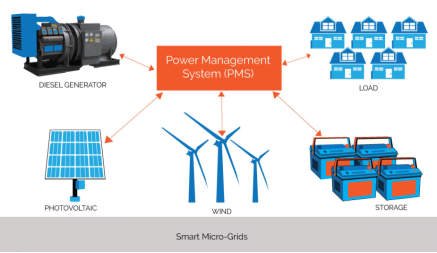



 Share This Article
 Twitter
 Linked In
 Facebook