Research Article | | Peer-Reviewed

Magnitude of Central Obesity and Its Associated Factors among Civil Servants in West Gojjam Zone District Government Offices, Northwest Ethiopia

Received: 7 April 2026     Accepted: 1 June 2026     Published: 11 August 2026
Views:       Downloads:
Abstract

Central obesity is defined as its excessive accumulation of visceral fat around the abdomen. It has become a significant public health concern and a major risk factor for non-communicable diseases (NCDs) in developing countries like Ethiopia. The study fills the knowledge gap and detects central obesity in civil servants in the West Gojjame zone office workers. Objective: To assess the magnitude of central obesity and its associated factors among civil servants in West Gojjam Zonal government office, North West Ethiopia, 2024. Methods: An institutional-based cross-sectional study was conducted among 567 civil servants in the West Gojjam Zone government office from August 7 to September 1, 2024. Study participants were selected using a simple random sampling technique, and data were collected through face-to-face interviews using a pretested structured questionnaire. The collected data were entered into Epi-Data version 3.1 and then exported to Stata version 17 for analysis. Binary logistic regression analysis was performed to identify factors associated with central obesity. Variables with a p-value of ≤ 0.25 in the bivariable binary logistic regression analysis were included in the multivariable binary logistic regression analysis. The odds ratio with a 95% Confidence Interval (CI) was calculated to assess the strength of the association. Results: The prevalence of central obesity among civil servants was 27.8% (95% CI: 24.1, 31.8). Factors positively associated with central obesity included older age (AOR=4.5, 95% CI: 2.3, 8.8), being female (AOR=2.5, 95% CI: 1.5, 4.2), and having an income above the poverty line (AOR=18.4, 95% CI: 7.9, 42.9). In contrast, a borderline food consumption score (AOR=2.2, 95% CI: 1.1, 4.2) and physical inactivity (AOR=2.5, 95% CI: 1.4, 4.5) were negatively associated with central obesity. Conclusion and Recommendations: Central obesity is prevalent in the West Gojjam Zone government office, affecting one in two women and one in five men, with factors like Being a female, older age, richest monthly income, inadequate food consumption score and physical inactivity significantly associated with central obesity among civil servants. Workplace health programs and campaigns targeting women and older adults are crucial, along with government policies promoting physical activity. Office workers should aim for at least 150 minutes of moderate or 75 minutes of vigorous weekly aerobic exercise.

Published in European Journal of Preventive Medicine (Volume 14, Issue 4)
DOI 10.11648/j.ejpm.20261404.13
Page(s) 74-85
Creative Commons

This is an Open Access article, distributed under the terms of the Creative Commons Attribution 4.0 International License (http://creativecommons.org/licenses/by/4.0/), which permits unrestricted use, distribution and reproduction in any medium or format, provided the original work is properly cited.

Copyright

Copyright © The Author(s), 2026. Published by Science Publishing Group

Keywords

Magnitude, Central Obesity, Associated Factors, Civil Servants, West, Gojjam Zone

1. Introduction
Central obesity, defined by excessive accumulation of abdominal fat, is particularly harmful because it is strongly associated with metabolic disorders such as type 2 diabetes mellitus, hypertension, cardiovascular diseases, and certain cancers .
The global prevalence of obesity has increased substantially over recent decades, largely driven by rapid urbanization, economic development, dietary transitions, and declining levels of physical activity . As a result, obesity is now recognized as a leading risk factor for non-communicable diseases (NCDs) and premature mortality worldwide .
Central obesity, defined as excessive fat accumulation in the abdominal region, is considered more detrimental to health than general obesity because of its strong association with visceral fat deposition . Visceral adiposity contributes to metabolic abnormalities such as insulin resistance, dyslipidemia, systemic inflammation, and hypertension, which significantly increase the risk of cardiovascular disease and type 2 diabetes mellitus . Consequently, anthropometric measures such as waist circumference and waist-to-height ratio are widely recommended for assessing cardio metabolic risk in both clinical and population-based settings .
The rising burden of central obesity is closely linked to behavioral and lifestyle changes, including increased consumption of energy-dense foods, reduced physical activity, prolonged sedentary behavior, and exposure to psychosocial stress . Occupational settings play a critical role in shaping these behaviors, particularly for office-based workers who spend prolonged periods sitting with limited opportunities for movement during working hours . As a result, civil servants and other office employees are increasingly recognized as high-risk groups for central obesity and its related health consequences .
Civil servants constitute a substantial proportion of the formal workforce and are primarily engaged in administrative and managerial duties that require minimal physical exertion International Labor Organization . Prolonged sitting, work-related stress, irregular eating patterns, and limited engagement in physical activity have been widely documented among civil servants and are known contributors to abdominal fat accumulation . These factors collectively increase the likelihood of developing central obesity and related NCDs, which may negatively affect productivity and work performance .
Low- and middle-income countries, particularly those in sub-Saharan Africa, are currently experiencing a rapid nutrition and epidemiological transition characterized by shifts toward sedentary lifestyles and increased consumption of processed foods . This transition has resulted in a growing burden of overweight and obesity alongside persistent under nutrition, creating a double burden of malnutrition . Urban and semi-urban populations are disproportionately affected due to changes in transport systems, work environments, and food availability .
Ethiopia, which has historically focused on combating under nutrition and infectious diseases, is now facing a steady rise in overweight and obesity, particularly among adults residing in urban areas . Recent studies conducted in different parts of the country indicate that central obesity is increasingly prevalent, especially among women, older adults, and individuals engaged in sedentary occupations . This emerging trend poses a significant public health concern, as the health system must address both communicable diseases and nutrition-related NCDs simultaneously (Federal Ministry of Health .
Despite the increasing burden of obesity, central obesity remains under-recognized and inadequately addressed in Ethiopia, as routine screening often relies on body mass index alone . Limited awareness, insufficient workplace health promotion programs, and inadequate preventive strategies further contribute to the growing burden of abdominal obesity . Consequently, central obesity continues to contribute silently to the rising prevalence of hypertension, diabetes, and cardiovascular disease among working-age adults .
West Gojjam Zone, located in Northwest Ethiopia, has experienced notable urban expansion and growth of district-level government offices in recent years . These developments have been accompanied by lifestyle changes, including reduced physical activity, increased sedentary work, and shifts in dietary habits . Civil servants working in district government offices in West Gojjam Zone are therefore likely to be exposed to multiple risk factors for central obesity.
However, there is limited evidence regarding the magnitude of central obesity and its associated factors among civil servants in this area. Most available studies in Ethiopia have focused on the general population or urban communities, with limited emphasis on occupational groups, particularly at the district levelv . Therefore, generating context to assess the magnitude of central obesity and identify its associated factors among civil servants in West Gojjam Zone district government offices, Northwest Ethiopia.
Central obesity is a major contributor to the global burden of non-communicable diseases and is associated with increased morbidity, mortality, and health-care expenditure . Individuals with excess abdominal fat are at a significantly higher risk of developing cardiovascular disease, type 2 diabetes mellitus, metabolic syndrome, and other chronic conditions compared to individuals without central obesity . Despite these serious health consequences, central obesity often remains underdiagnosed, particularly in low-income settings .
In Ethiopia, public health priorities have traditionally focused on maternal and child under nutrition, communicable diseases, and emergency health challenges, while obesity and other NCDs have received relatively limited attention .
Civil servants play a critical role in public administration and service delivery, and their health status directly influences institutional efficiency and national development . Sedentary work environments, prolonged sitting, occupational stress, and unhealthy dietary behaviors are common among civil servants and are strongly associated with abdominal fat accumulation . Without effective preventive measures, central obesity among civil servants may lead to increased absenteeism, reduced work performance, and early onset of chronic diseases .
Although several studies in Ethiopia have examined overweight and obesity, many rely solely on body mass index and fail to adequately capture central obesity, which is a stronger predictor of cardio metabolic risk . Moreover, limited research has explored the occupational, behavioral, and socio demographic factors associated with central obesity among civil servants, particularly in district-level government offices . This lack of evidence constrains the development of effective workplace-based interventions and policies. In West Gojjam Zone, district government offices employ a large number of civil servants who may be at increased risk of central obesity due to changing lifestyles and work patterns associated with urbanization . However, there is a clear lack of localized data on the magnitude of central obesity and its associated factors in this population. This evidence gap limits the ability of policymakers and health planners to design targeted prevention and control strategies. Therefore, assessing the magnitude of central obesity and identifying its associated factors among civil servants in West Gojjam Zone district government offices is essential. The findings of this study will provide valuable evidence to inform workplace health promotion programs, guide policy formulation, and support efforts to prevent and control non-communicable diseases in Northwest Ethiopia.
2. Materials and Methods
2.1. Study Area and Period
A facility-based cross-sectional study was conducted in the July 07/08/2024 to September 1/2024 at the west Gojjam Zone Civil service offices, which is located in Finote Selam City administration, capital of west Gojjam zone, Amhara Region, Ethiopia. The town is located about 387 km from Addis Ababa, the capital city of Ethiopia, and 173 km far from Bahir Dar, the Capital city of Amhara National Regional State.
West Gojjam Administration Zone had 32 Zonal and 12 woredas offices and both of 7667 workers.
2.2. Source and Study Population
All West Gojjam zonal government office civil Servants were the source population of the study, and all office workers from the selected seven Zonal departments in the West Gojjam zone is study populations.
2.3. Sample Size Determination and Sampling Procedure
To determine the magnitude of central obesity and the sample size as determined using a single population proportion formula with an assumption of the overall prevalence of outcome variable, central obesity 33.6% . 95%, confidence interval 5% margin of error, and 10% non-response rate.
n = (Zα/2)2× p (1-p /d2)
Here: n=the desired sample size
p=proportion of central obesity among civil servants
CI=Confidence interval with 95%
Z a/2 = Critical value at 95% confidence level of certainty is (1.96)
n =(/2)2p(1-p)d2 =1.962(0.336)(0.664)(0.05)2= 343X1.5+10%
By considering a 10% of non-response rate, n= 567
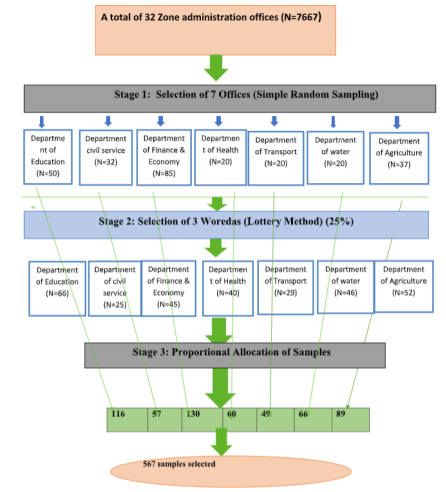
The sampling procedure used in this study is multi-stage random sampling. Initially, seven offices were selected from a total of 32 zonal offices through a simple random sampling method and a total of 12 woredas covering 25% of the total woredas in the west Gojjam Zone selected. Bure, Jabi Thinan, and Sekela were chosen as the sampling units using the lottery method. After that, samples were proportionally allocated to each selected woreda based on the total number of civil servants in those areas (Figure 1).
Figure 1. Schematic Presentation of Sampling Procedure in west Gojjam zone.
2.4. Variable of the Study
2.4.1. Dependent Variable
Central obesity (yes/no)
2.4.2. Independent Variable
Socio-demographic factors
Age, Sex, Marital status, Family size, Religion, Educational level
Behavioral factors
Alcohol use, Dietary diversity, Physical activity
Economic factors: Monthly income level
2.5. Operational Definition
Central obesity: waist circumference >94 cm in men and >80 cm in women .
Adult: a person whose age group is between 18 and 65 years .
Physically inactive: If the total physical activity MET minute/eek is < 600 MET minutes .
Non-drinker: Amen and a woman who has a score of 0 on AUDIT score labeled as a non-drinker .
Alcohol use disorder: Defined as men and women who have a score of 8 or more on AUDIT score considered as AUD .
Monthly income: Based on the World Bank report, those who have an income of < 2.15$ per day (<6450 ETB per month) are below the poverty line, and those who have an income of >2.15$ per day (≥6451 ETB) are above poverty line .
Food Consumption Score (FCS): Food items are grouped into 8 standard food groups with a maximum value of 7 days/eek. Items using the threshold 0 – 21, 21.5 – 35, and > 35 poor, borderline, and Acceptable consumption score, respectively .
2.6. Data Collection Tool
Data were collected using a structured and pretested interviewer-administered questionnaire combined with standard anthropometric measurements. The questionnaire was adapted from the World Health Organization (WHO) STEPwise approach to Surveillance (STEPS) and related literature on central obesity and non-communicable disease risk factors, with contextual modifications to suit the local setting and study population . The questionnaire was structured into four main sections. The first section addressed socio-demographic characteristics, including age, sex, marital status, educational level, job category, monthly income, and years of service. The second section focused on behavioral and lifestyle factors, such as dietary habits, physical activity, alcohol consumption, smoking status, and sedentary behaviors. The third section covered health-related factors, including a history of hypertension and diabetes mellitus, family history of obesity-related conditions, and current medication use. The fourth section consisted of anthropometric measurements, specifically waist circumference, which was used to assess central obesity.
Waist circumference was measured using a non-stretchable measuring tape, following WHO standard procedures. Measurements were taken at the midpoint between the lower margin of the last palpable rib and the top of the iliac crest, at the end of a normal expiration. Central obesity was defined as a waist circumference of ≥94 cm for men and ≥80 cm for women, in accordance with WHO recommendations for adult populations . The questionnaire was first prepared in English, translated into Amharic, and then back-translated into English to ensure consistency and accuracy. A pretest was conducted on 5% of the sample size in a similar population outside the selected offices, and necessary modifications were made to improve clarity and reliability.
2.7. Data Collection Procedure
Data Data were collected from civil servants working in selected district government offices of West Gojjam Zone using a structured interviewer-administered questionnaire and anthropometric measurements. Trained health professionals conducted face-to-face interviews to obtain socio-demographic, behavioral, and health-related information. Prior to data collection, written informed consent was obtained from all participants after explaining the purpose of the study and assuring confidentiality. Waist circumference was measured using a non-stretchable measuring tape following World Health Organization (WHO) standard procedures. Supervisors closely monitored the data collection process and performed daily checks for completeness and consistency to ensure data quality.
2.8. Data Quality Assurance
One day of training was provided to data collectors and supervisors on the objectives of the research, how to collect the data, how to store the collected data, ethical principles, and how to supervise the data collection process. Afterward, a pretest was conducted with 5% of the total sample size, involving civil servants, to assess the clarity of the data collection tools and make any necessary modifications.
2.9. Data Analysis Technique
The completed questionnaire was manually checked for completeness, coded and the data were entered into the Kobo toolbox and exported to STATA 17 for further analysis. Descriptive statistics was used to explain the population concerning the relevant variables. Data were presented using tables, graphs, and descriptive texts. A binary logistic regression technique was employed, and variables with p-values less than 0.25 in the bivariable analysis were included in the multivariable analysis. The odds ratio with a 95% confidence interval (CI) was calculated, and statistical significance was determined at p-values less than 0.05 in the multivariable analysis. Model fitness and multicollinearity were assessed using the Hosmer-Lemeshow goodness-of-fit test.
2.10. Ethical Consideration
Ethical approval was secured from the Institutional Review Board of the College of Medicine and Health Sciences at Debre Markos University. In addition, authorization was granted by public health institutions in West Gojjam Zone. Study participants were clearly informed about the purpose of the research and assured that participation was entirely voluntary. They were told that they could decline to participate or withdraw from the study at any time without any consequences. Data were collected only after obtaining informed consent from the selected individuals. All interviews were conducted in a manner that ensured the confidentiality of the information provided.
3. Results
3.1. Socio-demographic and Economic Characteristics of the Study Participants
Out of 567 study participants, complete information was collected from civil servants, resulting in a 100% response rate. Among the respondents, the mean age was 33.7 years. The majority of the participants (60.3%) were male, and over one-third (37.4%) had more than five family members. More than half (51.7%) had attained a bachelor's degree. In terms of monthly income, the majority (66.5%) of the respondents were above the poverty line (Table 2).
Table 1. Socio-demographic and economic characteristics of west Gojjam zone civil servants North west Ethiopia 2024 (n=567).

Variable

Category

Frequency

percent

Age

Yung Age (18-35)

191

33.7

Middle age adults (36–55)

200

35.3

old age adults (≥60)

176

31.0

Sex

Male

342

60.3

Female

225

39.7

Marital status

Single

124

21.9

Married

234

41.3

Divorced

118

20.8

widowed

91

16.0

Education

Primary (9-12)

19

3.4

Diploma

150

26.5

Degree

293

51.7

Masters

105

18.5

Family size

<5

355

62.6

≥5

212

37.4

Monthly income

below poverty line

190

33.5

Above poverty line

377

66.5

3.2. Behavioral and Dietary Practices of the Respondents
Among the respondents, (44.6%) had borderline food consumption scores, while half (48.2.%), were physically inactive. Most participants (65.6%) primarily consumed home-prepared meals. Tow-third of the civil servants (65.3%) had more than 3 years of work experience (Table 3).
Table 2. Behavioral characteristics of west Gojjame Zone civil servants North West Ethiopia 2024 (n=567).

Variables

Category

Frequency

percent

Alcohol consumption

Non-drinker

391

69.0

Drinker

176

31.0

dietary consumption score

Acceptable

167

29.5

Borderline

253

44.6

Poor

147

25.9

Physical Activity

Active

294

51.9

Inactive

273

48.2

Majorly eat

From- home prepared

372

65.6

From- hotel/cafeteria

195

34.4

Work experience

<3

197

34.7

≥3

370

65.3

Additional work

Yes

260

45.9

No

307

54.1

Source: Own survey, 2024
3.3. Prevalence of Central Obesity
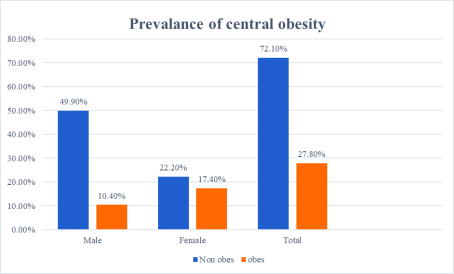
The overall magnitude of central obesity among civil servants was 27.8% (95% CI, (24.2, 31.8) (Figure 2).
Figure 2. Prevalence of central obesity by sex using (WC) among West Gojjame zone civil servants in North West Ethiopia 2024 (n=567).
Factors associated with central obesity
In the bi-variable binary logistic regression analysis, age, sex, family size, monthly income, additional work, food consumption score, majorly eating, and physical activity were identified as significant factors associated with central obesity at a p-value of ≤0.25. Subsequently, in a multivariable binary logistic regression analysis, age, sex, family size, monthly income, food consumption score, majorly eating, and physical activity had statistically significant associations with central obesity at a p-value of <0.05, the odds of central obesity being females were almost 2.5 times higher than in males (AOR=2.5, (95% CI,1.5,4.2), Civil servants with the age of ≥60 were approximately 4.5 times more likely to develop central obesity than those below 18-44 age (AOR=4.5,95% CI: 2.3,8.8), Individuals with monthly income above the poverty line were 18.4 times more likely to develop central obesity compared to below the poverty line (AOR= 18.4,95% CI: 7.9,42.9). Individuals having borderline food consumption scores were 2.2 times more likely to develop central obesity compared to those with acceptable food consumption scores (AOR=2.2, 95% CI: 1.1,4.2), physically inactive participants had 2.5 times more likely to develop central obesity compared to those with physically active (AOR)= 2.5,95% CI: 1.4,4.5). (Table 4).
Table 4. Multivariable logistic regression of factors associated with central obesity by waist Circumference (WC) among west Gojjame zone civil servants in Northwest Ethiopia 2024 (n=567).

Variables

Category

Central obesity

COR 95%CI

AOR, 95%CI

Yes

No

Age

Yang age (18-35)

36

155

1

1

Middle age (36-55)

39

161

1.0 (0.6,1.7)

0.9 (0.5,1.8)

old age (≥65)

83

93

3.8 (2.4,6.1) *

4.5 (2.3,8.8) **

Sex

Male

59

283

1

1

Female

99

126

3.8 (2.6,5.5) *

2.5 (1.5,4.2) **

Family size

<5

51

304

1

1

≥5

107

105

6.1 (4.1,9.1) *

12.2 (6.7,22.2) **

Monthly Income

Poverty line

10

180

1

1

above Poverty line

148

229

11.6 (6.0,22.7) *

18.4 (7.9,42.9) **

Additional work

Yes

26

234

1

1

No

132

175

2.1 (1.5 3.1) *

1.7 (1.0,2.9)

Dietary diversity

Acceptable

43

129

1

1

Borderline

87

121

2.2 (1.4,3.4) *

2.2 (1.1,4.2) **

Poor

28

159

0.5 (0.3,0.9)

0.5 (0.3,1.1)

Majorly eat

From home

75

306

1

1

From hotel/cafeteria

83

103

3.3 (2.2,4.8) *

4.3. (2.4,7.8) **

Physical activity

Active

39

176

1

1

Inactive

119

233

2.3 (1.5,3.5) *

2.5 (1.4,4.5) **

Key: *Significant at p-value < 0.25 in unadjusted logistic regression analysis
**Significant at p < 0.05 in adjusted logistic regression analysis
4. Discussion
This study examined the magnitude of central obesity and its associated factors among civil servants in West Gojjam Zone district government offices, Northwest Ethiopia. The findings demonstrated that age, sex, family size, monthly income, dietary practices, source of food, and physical activity were significant determinants of central obesity. These results reinforce existing evidence that central obesity is influenced by a complex interaction of socio-demographic, economic, and lifestyle factors.
The study suggested the age was significantly associated with central obesity. Civil servants aged 65 years and above were more than four times more likely to develop central obesity compared with young adults aged 18–35 years (AOR = 4.5; 95% CI: 2.3–8.8). This finding is consistent with studies conducted in Ethiopia, including Addis Ababa and Jimma, which reported increased central obesity with advancing age. Similar associations have also been documented in studies from other low- and middle-income countries. The increased risk among older adults may be attributed to age-related metabolic slowdown, hormonal changes, reduced lean body mass, and declining physical activity levels, all of which favor abdominal fat accumulation .
We found that female participants were significantly more likely to have central obesity compared with males (AOR = 2.5; 95% CI: 1.5–4.2). This finding aligns with numerous Ethiopian studies, including those conducted among urban residents and office workers, which consistently report higher central obesity prevalence among women. Biological factors such as pregnancy-related weight retention, hormonal variations, and menopause may partly explain this difference. Additionally, sociocultural norms that limit women’s participation in physical activity and increase sedentary behavior may further contribute to higher abdominal obesity among females .
The study suggested family size showed a strong and independent association with central obesity. Participants from households with five or more members were twelve times more likely to be centrally obese compared with those from smaller families (AOR = 12.2; 95% CI: 6.7–22.2). This finding is consistent with previous studies in Ethiopia, which reported that larger family size influences dietary patterns, portion size, and food quality. In urban and semi-urban settings, large families may depend on affordable, energy-dense foods with low nutritional quality, increasing the risk of central obesity .
We found that monthly income was one of the strongest predictors of central obesity in this study. Civil servants earning above the poverty line had significantly higher odds of central obesity than those earning below the poverty line (AOR = 18.4; 95% CI: 7.9–42.9). This finding is in agreement with studies conducted in urban Ethiopia and other developing countries, where higher income is associated with increased consumption of processed foods, reduced physical labor, and sedentary lifestyles. This pattern reflects the ongoing nutrition transition in Ethiopia, where economic improvement is accompanied by unhealthy dietary shifts .
The study suggested Participants without additional work were more likely to develop central obesity compared with those who had additional work (AOR = 1.7; 95% CI: 1.0–2.9). This may be explained by reduced physical activity and increased sedentary time among individuals who rely solely on office-based employment. Similar findings have been reported in studies among office workers, indicating that engagement in additional income-generating activities may increase energy expenditure and reduce obesity risk .
Dietary diversity was significantly associated with central obesity. Participants with borderline dietary diversity were twice as likely to be centrally obese compared with those with acceptable dietary diversity (AOR = 2.2; 95% CI: 1.1–4.2). This finding is consistent with evidence showing that inadequate dietary diversity reflects poor diet quality, often characterized by high intake of refined carbohydrates and fats. Interestingly, poor dietary diversity showed lower odds of central obesity, although the association was not statistically significant after adjustment. This inverse relationship may be related to lower overall caloric intake among individuals with very limited food access, a finding also reported in similar Ethiopian studies .
We found that Civil servants who mainly consumed meals from hotels or cafeterias were more than four times more likely to have central obesity compared with those who ate predominantly home-prepared foods (AOR = 4.3; 95% CI: 2.4–7.8). This finding is consistent with previous studies showing that foods consumed outside the home tend to be energy-dense, high in fat and salt, and served in large portions. Increased reliance on commercially prepared foods has been identified as a major contributor to obesity in rapidly urbanizing settings like Ethiopia .
The study suggested that Physical inactivity was independently associated with central obesity. Inactive participants were 2.5 times more likely to be centrally obese compared with physically active individuals (AOR = 2.5; 95% CI: 1.4–4.5). This finding is in line with extensive global and national evidence demonstrating that insufficient physical activity is a major risk factor for abdominal obesity. Sedentary office-based work, combined with limited recreational exercise, likely explains the increased risk observed among civil servants .
5. Strengths and Limitations
This study addressed an under-researched public health issue by focusing on central obesity among civil servants in Ethiopia. The use of waist circumference provided a valid and reliable measure of central obesity. Multivariable logistic regression enabled identification of independent predictors while controlling for confounders. Inclusion of diverse socio-demographic, economic, dietary, and lifestyle variables enhanced the comprehensiveness and policy relevance of the findings.
The cross-sectional design limits causal inference between central obesity and associated factors. Some variables were self-reported, which may have introduced recall or social desirability bias. The study population was limited to district civil servants, restricting generalizability to other groups. Additionally, unmeasured factors such as genetics, stress, and detailed dietary intake may have influenced the results.
6. Conclusion And Recommendations
6.1. Conclusion
This study identified central obesity as a significant and emerging public health problem among civil servants in West Gojjam Zone district government offices. Central obesity was independently associated with age, sex, family size, monthly income, dietary diversity, source of food, physical activity, and additional work status. The higher prevalence among older adults, females, and higher-income earners reflects the combined influence of biological factors, urbanization, and lifestyle changes. Unhealthy dietary practices and physical inactivity further indicate that central obesity may increase the future burden of non-communicable diseases and reduce productivity if preventive measures are not implemented.
6.2. Recommendation
Recommendations for addressing central obesity among civil servants include integrating workplace-focused prevention strategies into national non-communicable disease frameworks and strengthening occupational health services with routine screening and counseling. Government institutions and employers should promote regular physical activity, provide healthy and affordable meals, and implement health education programs on balanced diets and active lifestyles. Civil servants are encouraged to increase physical activity, reduce sedentary behavior, choose healthier foods, and understand the risks of central obesity. Policymakers should foster multi sectoral collaboration to create supportive environments for healthy eating and activity in workplaces. Researchers should conduct longitudinal, intervention-based, and qualitative studies to identify causes and evaluate the effectiveness of workplace obesity prevention strategies.
Abbreviations

AMA

American Medical Association

BMI

Body Mass Index

COR

Crude Odd Ratio

CVD

Cardiovascular Disease

DM

Diabetes Mellitus

EDHS

Ethiopian Demographic Health Survey

HCWS

Health Care Workers

HDL

High-Density Lipoprotein

IDF

International Diabetes Federation

Kg/m2

Kilo Gram Per Meter Square

KG

Kilo Gram

KM

Kilo Meter

NCD

Non-Communicable Disease

NGO

Non-Governmental Organization

OR

Odds Ratio

SSR

Simple Random Sampling

STEPS

Stepwise Approach to Surveillance

WC

Waist Circumference

WHO

World Health Organization

Acknowledgments
First; I would like to thank Debre Markos University College of Medicine and Health Sciences. Department of Human Nutrition for allowing me to write this study.
Finally, I would like to say thanks to the west Gojjam Zone civil servants and Studie participants who took part in this study, and the human resources for providing the information needed for this study.
Author Contributions
Haimanot Degu: Conceptualization, Data curation, Formal Analysis, Funding acquisition, Investigation, Methodology, Project administration, Resources, Software, Validation, Visualization & Writing – original draft
Abraham Degu: Conceptualization, Data curation, Formal Analysis, Methodology, Project administration, Supervision, Validation, Visualization & Writing – review & editing
Agumas Degu: Conceptualization, Data curation, Formal Analysis, Methodology, Project administration, Supervision, Validation, Visualization & Writing – review & editing
Data Availability Statement
The data used for this study are available from the corresponding author upon request.
Conflicts of Interest
The authors declare that they have no competing interests.
References
[1] Després J-P: Body fat distribution and risk of cardiovascular disease: an update. Circulation 2012, 126(10): 1301-1313.
[2] Popkin BM, Du S, Green WD, Beck MA, Algaith T, Herbst CH, Alsukait RF, Alluhidan M, Alazemi N, Shekar M: Individuals with obesity and COVID‐19: a global perspective on the epidemiology and biological relationships. Obesity reviews 2020, 21(11): e13128.
[3] Després J-P: Abdominal obesity and cardiovascular disease: is inflammation the missing link? Canadian Journal of Cardiology 2012, 28(6): 642-652.
[4] Ashwell M, Gibson S: Waist-to-height ratio as an indicator of ‘early health risk’: simpler and more predictive than using a ‘matrix’based on BMI and waist circumference. BMJ open 2016, 6(3): e010159.
[5] Organization WH: WHO health workforce support and safeguards list 2023: World Health Organization; 2023.
[6] Hall KD, Ayuketah A, Brychta R, Cai H, Cassimatis T, Chen KY, Chung ST, Costa E, Courville A, Darcey V: Ultra-processed diets cause excess calorie intake and weight gain: an inpatient randomized controlled trial of ad libitum food intake. Cell metabolism 2019, 30(1): 67-77. e63.
[7] Church TS, Thomas DM, Tudor-Locke C, Katzmarzyk PT, Earnest CP, Rodarte RQ, Martin CK, Blair SN, Bouchard C: Trends over 5 decades in US occupation-related physical activity and their associations with obesity. PloS one 2011, 6(5): e19657.
[8] Hagiwara N, Kawada-Watanabe E, Koyanagi R, Arashi H, Yamaguchi J, Nakao K, Tobaru T, Tanaka H, Oka T, Endoh Y: Low-density lipoprotein cholesterol targeting with pitavastatin+ ezetimibe for patients with acute coronary syndrome and dyslipidaemia: the HIJ-PROPER study, a prospective, open-label, randomized trial. European Heart Journal 2017, 38(29): 2264-2276.
[9] Benanav A: The origins of informality: the ILO at the limit of the concept of unemployment. Journal of Global History 2019, 14(1): 107-125.
[10] Kivimäki M, Jokela M, Nyberg ST, Singh-Manoux A, Fransson EI, Alfredsson L, Bjorner JB, Borritz M, Burr H, Casini A: Long working hours and risk of coronary heart disease and stroke: a systematic review and meta-analysis of published and unpublished data for 603 838 individuals. The lancet 2015, 386(10005): 1739-1746.
[11] Filipowska J, Tomaszewski KA, Niedźwiedzki Ł, Walocha JA, Niedźwiedzki T: The role of vasculature in bone development, regeneration and proper systemic functioning. Angiogenesis 2017, 20(3): 291-302.
[12] Popkin BM, Corvalan C, Grummer-Strawn LM: Dynamics of the double burden of malnutrition and the changing nutrition reality. The Lancet 2020, 395(10217): 65-74.
[13] Ford ND, Patel SA, Narayan KV: Obesity in low-and middle-income countries: burden, drivers, and emerging challenges. Annual review of public health 2017, 38(1): 145-164.
[14] Alemayehu D, Bachewe F, Genye T, Gilbert R, Haile H, Headey D, Masters W, Herforth A, Tessema M: Ethiopian Public Health Institute Food Science and Nutrition Research Directorate Scientific Newsletter.
[15] Biccard BM, Gopalan PD, Miller M, Michell WL, Thomson D, Ademuyiwa A, Aniteye E, Calligaro G, Chaibou MS, Dhufera HT: Patient care and clinical outcomes for patients with COVID-19 infection admitted to African high-care or intensive care units (ACCCOS): a multicentre, prospective, observational cohort study. The Lancet 2021, 397(10288): 1885-1894.
[16] Eba K, Gerbaba MJ, Abera Y, Tadessse D, Tsegaye S, Abrar M, Mohammed A, Ibrahim A, Shekabdulahi M, Zeleke S: Mobile health service as an alternative modality for hard-to-reach pastoralist communities of Afar and Somali regions in Ethiopia. Pastoralism 2023, 13(1): 17.
[17] Gizaw W, Assegid D: Trend of cereal crops production area and productivity, in Ethiopia. Journal of Cereals and Oilseeds 2021, 12(1): 9-17.
[18] Mekonnen MM, Gerbens-Leenes W: The water footprint of global food production. Water 2020, 12(10): 2696.
[19] Tesfaye BT, Feyissa TM, Workneh AB, Gudina EK, Yizengaw MA: Chronic Liver Disease in Ethiopia With a Particular Focus on the Etiological Spectrums: A Systematic Review and Meta‐Analysis of Observational Studies. Canadian Journal of Gastroenterology and Hepatology 2021, 2021(1): 8740157.
[20] Nazare J-A, Smith JD, Borel A-L, Haffner SM, Balkau B, Ross R, Massien C, Alméras N, Després J-P: Ethnic influences on the relations between abdominal subcutaneous and visceral adiposity, liver fat, and cardiometabolic risk profile: the International Study of Prediction of Intra-Abdominal Adiposity and Its Relationship With Cardiometabolic Risk/Intra-Abdominal Adiposity. The American journal of clinical nutrition 2012, 96(4): 714-726.
[21] Hoeper MM, Lam CS, Vachiery J-L, Bauersachs J, Gerges C, Lang IM, Bonderman D, Olsson KM, Gibbs JSR, Dorfmuller P: Pulmonary hypertension in heart failure with preserved ejection fraction: a plea for proper phenotyping and further research. European heart journal 2017, 38(38): 2869-2873.
[22] Jellason NP, Conway JS, Baines RN: Understanding impacts and barriers to adoption of climate-smart agriculture (CSA) practices in North-Western Nigerian drylands. The Journal of Agricultural Education and Extension 2021, 27(1): 55-72.
[23] Molla MD, Wolde HF, Atnafu A: Magnitude of central obesity and its associated factors among adults in urban areas of Northwest Ethiopia. Diabetes, Metabolic Syndrome and Obesity: Targets and Therapy 2020, 13: 4169.
[24] WHO:
[25] Petry NM: A comparison of young, middle-aged, and older adult treatment-seeking pathological gamblers. The gerontologist 2002, 42(1): 92-99.
[26] WHO: Physical Activity. WHO 2017.
[27] Babor TF, Higgins-Biddle JC, Saunders JB, Monteiro MG, Organization WH: AUDIT: the alcohol use disorders identification test: guidelines for use in primary health care. In.: World Health Organization; 2001.
[28] Zewdu S, Hanlon C, Fekadu A, Medhin G, Teferra S: Treatment gap, help-seeking, stigma and magnitude of alcohol use disorder in rural Ethiopia. Substance abuse treatment, prevention, and policy 2019, 14: 1-10.
[29] Ferreira IA, Salvucci V, Tarp F: Poverty, inequality, and growth: trends, policies, and controversies. In: Handbook of Labor, Human Resources and Population Economics. edn.: Springer; 2023: 1-45.
[30] WFP F: Food Consumption Score: Construction of the FCS. 2008.
[31] Lopes MBS: The 2017 World Health Organization classification of tumors of the pituitary gland: a summary. Acta neuropathologica 2017, 134(4): 521-535.
[32] Misganaw A, Mariam DH, Ali A, Araya T: Epidemiology of major non-communicable diseases in Ethiopia: a systematic review. Journal of health, population, and nutrition 2014, 32(1): 1.
[33] Falzon D, Jaramillo E, Schünemann H, Arentz M, Bauer M, Bayona J, Blanc L, Caminero J, Daley C, Duncombe C: WHO guidelines for the programmatic management of drug-resistant tuberculosis: 2011 update. In.: European Respiratory Society; 2011.
[34] Louis DN, Perry A, Wesseling P, Brat DJ, Cree IA, Figarella-Branger D, Hawkins C, Ng H, Pfister SM, Reifenberger G: The 2021 WHO classification of tumors of the central nervous system: a summary. Neuro-oncology 2021, 23(8): 1231-1251.
[35] Abebe E, Gugsa G, Ahmed M: Review on major food‐borne zoonotic bacterial pathogens. Journal of tropical medicine 2020, 2020(1): 4674235.
[36] Tesfaye K, Kruseman G, Cairns JE, Zaman-Allah M, Wegary D, Zaidi P, Boote KJ, Erenstein O: Potential benefits of drought and heat tolerance for adapting maize to climate change in tropical environments. Climate risk management 2018, 19: 106-119.
[37] Alemu T, Mengistu A: Impacts of climate change on food security in Ethiopia: adaptation and mitigation options: a review. Climate change-resilient agriculture and agroforestry: Ecosystem services and sustainability 2019: 397-412.
[38] Getachew N, Erkalo B, Garedew MG: Data quality and associated factors in the health management information system at health centers in Shashogo district, Hadiya zone, southern Ethiopia, 2021. BMC Medical Informatics and Decision Making 2022, 22(1): 154.
[39] Darebo T, Mesfin A, Gebremedhin S: Prevalence and factors associated with overweight and obesity among adults in Hawassa city, southern Ethiopia: a community based cross-sectional study. BMC obesity 2019, 6(1): 8.
[40] Leser S: The 2013 FAO report on dietary protein quality evaluation in human nutrition: Recommendations and implications. Nutrition Bulletin 2013, 38(4): 421-428.
[41] Worku E, Fenta DA, Ali MM: Bacterial etiology and risk factors among newborns suspected of sepsis at Hawassa, Ethiopia. Scientific Reports 2022, 12(1): 20187.
[42] Lachat C, Raneri JE, Smith KW, Kolsteren P, Van Damme P, Verzelen K, Penafiel D, Vanhove W, Kennedy G, Hunter D: Dietary species richness as a measure of food biodiversity and nutritional quality of diets. Proceedings of the National Academy of Sciences 2018, 115(1): 127-132.
[43] Bull FC, Al-Ansari SS, Biddle S, Borodulin K, Buman MP, Cardon G, Carty C, Chaput J-P, Chastin S, Chou R: World Health Organization 2020 guidelines on physical activity and sedentary behaviour. British journal of sports medicine 2020, 54(24): 1451-1462.
[44] Guthold R, Stevens GA, Riley LM, Bull FC: Worldwide trends in insufficient physical activity from 2001 to 2016: a pooled analysis of 358 population-based surveys with 1· 9 million participants. The lancet global health 2018, 6(10): e1077-e1086.
Cite This Article
  • APA Style

    Degu, H., Degu, A., Degu, A. (2026). Magnitude of Central Obesity and Its Associated Factors among Civil Servants in West Gojjam Zone District Government Offices, Northwest Ethiopia. European Journal of Preventive Medicine, 14(4), 74-85. https://doi.org/10.11648/j.ejpm.20261404.13

    Copy | Download

    ACS Style

    Degu, H.; Degu, A.; Degu, A. Magnitude of Central Obesity and Its Associated Factors among Civil Servants in West Gojjam Zone District Government Offices, Northwest Ethiopia. Eur. J. Prev. Med. 2026, 14(4), 74-85. doi: 10.11648/j.ejpm.20261404.13

    Copy | Download

    AMA Style

    Degu H, Degu A, Degu A. Magnitude of Central Obesity and Its Associated Factors among Civil Servants in West Gojjam Zone District Government Offices, Northwest Ethiopia. Eur J Prev Med. 2026;14(4):74-85. doi: 10.11648/j.ejpm.20261404.13

    Copy | Download

  • @article{10.11648/j.ejpm.20261404.13,
      author = {Haimanot Degu and Abraham Degu and Agumas Degu},
      title = {Magnitude of Central Obesity and Its Associated Factors among Civil Servants in West Gojjam Zone District Government Offices, Northwest Ethiopia},
      journal = {European Journal of Preventive Medicine},
      volume = {14},
      number = {4},
      pages = {74-85},
      doi = {10.11648/j.ejpm.20261404.13},
      url = {https://doi.org/10.11648/j.ejpm.20261404.13},
      eprint = {https://article.sciencepublishinggroup.com/pdf/10.11648.j.ejpm.20261404.13},
      abstract = {Central obesity is defined as its excessive accumulation of visceral fat around the abdomen. It has become a significant public health concern and a major risk factor for non-communicable diseases (NCDs) in developing countries like Ethiopia. The study fills the knowledge gap and detects central obesity in civil servants in the West Gojjame zone office workers. Objective: To assess the magnitude of central obesity and its associated factors among civil servants in West Gojjam Zonal government office, North West Ethiopia, 2024. Methods: An institutional-based cross-sectional study was conducted among 567 civil servants in the West Gojjam Zone government office from August 7 to September 1, 2024. Study participants were selected using a simple random sampling technique, and data were collected through face-to-face interviews using a pretested structured questionnaire. The collected data were entered into Epi-Data version 3.1 and then exported to Stata version 17 for analysis. Binary logistic regression analysis was performed to identify factors associated with central obesity. Variables with a p-value of ≤ 0.25 in the bivariable binary logistic regression analysis were included in the multivariable binary logistic regression analysis. The odds ratio with a 95% Confidence Interval (CI) was calculated to assess the strength of the association. Results: The prevalence of central obesity among civil servants was 27.8% (95% CI: 24.1, 31.8). Factors positively associated with central obesity included older age (AOR=4.5, 95% CI: 2.3, 8.8), being female (AOR=2.5, 95% CI: 1.5, 4.2), and having an income above the poverty line (AOR=18.4, 95% CI: 7.9, 42.9). In contrast, a borderline food consumption score (AOR=2.2, 95% CI: 1.1, 4.2) and physical inactivity (AOR=2.5, 95% CI: 1.4, 4.5) were negatively associated with central obesity. Conclusion and Recommendations: Central obesity is prevalent in the West Gojjam Zone government office, affecting one in two women and one in five men, with factors like Being a female, older age, richest monthly income, inadequate food consumption score and physical inactivity significantly associated with central obesity among civil servants. Workplace health programs and campaigns targeting women and older adults are crucial, along with government policies promoting physical activity. Office workers should aim for at least 150 minutes of moderate or 75 minutes of vigorous weekly aerobic exercise.},
     year = {2026}
    }
    

    Copy | Download

  • TY  - JOUR
    T1  - Magnitude of Central Obesity and Its Associated Factors among Civil Servants in West Gojjam Zone District Government Offices, Northwest Ethiopia
    AU  - Haimanot Degu
    AU  - Abraham Degu
    AU  - Agumas Degu
    Y1  - 2026/08/11
    PY  - 2026
    N1  - https://doi.org/10.11648/j.ejpm.20261404.13
    DO  - 10.11648/j.ejpm.20261404.13
    T2  - European Journal of Preventive Medicine
    JF  - European Journal of Preventive Medicine
    JO  - European Journal of Preventive Medicine
    SP  - 74
    EP  - 85
    PB  - Science Publishing Group
    SN  - 2330-8230
    UR  - https://doi.org/10.11648/j.ejpm.20261404.13
    AB  - Central obesity is defined as its excessive accumulation of visceral fat around the abdomen. It has become a significant public health concern and a major risk factor for non-communicable diseases (NCDs) in developing countries like Ethiopia. The study fills the knowledge gap and detects central obesity in civil servants in the West Gojjame zone office workers. Objective: To assess the magnitude of central obesity and its associated factors among civil servants in West Gojjam Zonal government office, North West Ethiopia, 2024. Methods: An institutional-based cross-sectional study was conducted among 567 civil servants in the West Gojjam Zone government office from August 7 to September 1, 2024. Study participants were selected using a simple random sampling technique, and data were collected through face-to-face interviews using a pretested structured questionnaire. The collected data were entered into Epi-Data version 3.1 and then exported to Stata version 17 for analysis. Binary logistic regression analysis was performed to identify factors associated with central obesity. Variables with a p-value of ≤ 0.25 in the bivariable binary logistic regression analysis were included in the multivariable binary logistic regression analysis. The odds ratio with a 95% Confidence Interval (CI) was calculated to assess the strength of the association. Results: The prevalence of central obesity among civil servants was 27.8% (95% CI: 24.1, 31.8). Factors positively associated with central obesity included older age (AOR=4.5, 95% CI: 2.3, 8.8), being female (AOR=2.5, 95% CI: 1.5, 4.2), and having an income above the poverty line (AOR=18.4, 95% CI: 7.9, 42.9). In contrast, a borderline food consumption score (AOR=2.2, 95% CI: 1.1, 4.2) and physical inactivity (AOR=2.5, 95% CI: 1.4, 4.5) were negatively associated with central obesity. Conclusion and Recommendations: Central obesity is prevalent in the West Gojjam Zone government office, affecting one in two women and one in five men, with factors like Being a female, older age, richest monthly income, inadequate food consumption score and physical inactivity significantly associated with central obesity among civil servants. Workplace health programs and campaigns targeting women and older adults are crucial, along with government policies promoting physical activity. Office workers should aim for at least 150 minutes of moderate or 75 minutes of vigorous weekly aerobic exercise.
    VL  - 14
    IS  - 4
    ER  - 

    Copy | Download

Author Information
  • Department of Public Health, Debre Markos University, Burie, Ethiopia;Students’ Clinic Burie Campus, Debre Markos University, Burie, Ethiopia

  • Departments of Midwifery, Bahir Dar University, Bahir Dar, Ethiopia

  • Departments of Nursing, Debre Markos University, Debre Markos, Ethiopia

  • Abstract
  • Keywords
  • Document Sections

    1. 1. Introduction
    2. 2. Materials and Methods
    3. 3. Results
    4. 4. Discussion
    5. 5. Strengths and Limitations
    6. 6. Conclusion And Recommendations
    Show Full Outline
  • Abbreviations
  • Acknowledgments
  • Author Contributions
  • Data Availability Statement
  • Conflicts of Interest
  • References
  • Cite This Article
  • Author Information