Abstract
Currently, research on persistent organic pollutants in permafrost soils has primarily focused on distribution surveys, with limited studies investigating migration mechanisms. This paper examines the vertical migration processes and driving mechanisms of polycyclic aromatic hydrocarbons (PAHs) in permafrost soils. Given the diverse sources of pollutants under natural conditions and the complex mixture of contaminants typically found in soils, this study selected 16 priority-controlled PAHs as research targets. Using loess soil from Lanzhou—a seasonally frozen region—as the experimental substrate, we conducted indoor soil column leaching experiments under freeze-thaw cycling conditions. This approach simulates the vertical migration of PAHs in permafrost soils, to quantitatively describe PAHs' vertical migration and distribution within soil profiles, along with permafrost layer barrier mechanisms. Simulated soil column experiments combining freeze-thaw cycles and leaching were designed to analyze the driving mechanisms of PAH vertical migration influenced by these processes. The results indicate that the driving mechanism of freeze-thaw cycles primarily involves water migration toward the freeze front due to soil surface freezing, leading to upward migration of pollutants. The driving mechanism of leaching primarily involves vertical migration of dissolved-phase PAH pollutants in soil through leachate. The primary driving force is leaching, while freeze-thaw cycles drive PAHs to migrate upward over greater distances.
|
Published in
|
Earth Sciences (Volume 15, Issue 3)
|
|
DOI
|
10.11648/j.earth.20261503.11
|
|
Page(s)
|
125-136 |
|
Creative Commons
|

This is an Open Access article, distributed under the terms of the Creative Commons Attribution 4.0 International License (http://creativecommons.org/licenses/by/4.0/), which permits unrestricted use, distribution and reproduction in any medium or format, provided the original work is properly cited.
|
|
Copyright
|
Copyright © The Author(s), 2026. Published by Science Publishing Group
|
Keywords
Polycyclic Aromatic Hydrocarbons, Freeze-thaw Action, Leaching, Vertical Migration, 16 PAHs Mixture, Soil
1. Introduction
Polycyclic aromatic hydrocarbons are widely distributed across various environmental media. Under the influence of external factors such as natural conditions, they undergo long-range transport, causing irreversible damage to the ecological environment and human health.There are reports in the literature
| [1] | Menzie C A, Potocki B B, Santodonato J. Exposure to carcinogenic PAHs in the environment [J]. Environmental Science & Technology, 1992, 26(7): 1278-1284.
https://doi.org/10.1021/es00031a002 |
[1]
. Exposure to PAHs can cause serious diseases such as skin cancer in humans. Therefore, the migration and pollution control of PAHs have long been a global research hotspot.
PAHs accumulated in soil undergo complex environmental geochemical processes.Some of the PAHs accumulated in soil have their concentrations reduced through dilution, diffusion, and migration. Others undergo redox reactions that alter their structure and form. Still others are adsorbed onto soil particle surfaces or degraded and transformed by microorganisms
| [2] | Ukalska-Jaruga A, Smreczak B. The Impact of Organic Matter on Polycyclic Aromatic Hydrocarbon (PAH) Availability and Persistence in Soils. Molecules. 2020; 25(11): 24-70.
https://doi.org/10.3390/molecules25112470 |
[2]
.Due to the hydrophobicity and persistence of PAHs, migration and transformation constitute their primary geochemical processes. The migration behavior of PAHs in soil is closely related to their physicochemical properties, such as molecular weight, hydrophobicity, and octanol-water partition coefficient. Additionally, the physical and chemical properties of the soil, along with the surrounding environment, exert varying degrees of influence. Research indicates that soils with higher organic matter or clay content tend to accumulate greater PAH concentrations. Lower-ring PAHs exhibit stronger migration capabilities than higher-ring PAHs. Polycyclic aromatic hydrocarbons migrate to colder environments at higher latitudes and elevations, where they are captured through condensation processes and ultimately deposited on soil surfaces
| [3] | Syed, J.H., et al., Polycyclic aromatic hydrocarbons (PAHs) in Chinese forest soils: profile composition, spatial variations and source apportionment. Scientific Reports, 2017. 7(1): p. 2692. https://doi.org/10.1038/s41598-017-02999-0 |
[3]
.Secondly, physicochemical properties such as soil organic carbon content, pH, and soil particle size also influence the migration behavior of PAHs within soil. Changes in soil pH affect the migration capacity of PAHs, with varying impacts depending on acidity or alkalinity levels. Zhen Li et al. demonstrated through multi-factor controlled soil column leaching experiments that the migration kinetics of polycyclic aromatic hydrocarbons in soil profiles are significantly influenced by pH. Under acidic with pH 3 and 5, and alkaline with pH 9 and 11 leaching conditions, the residual concentrations of polycyclic aromatic hydrocarbons significantly increased
| [4] | Li Z, Wang X, Luo Q, et al. Microplastics Enhance Soil Residue of Polycyclic Aromatic Hydrocarbons: Roles of pH and Dissolved Organic Matter [J]. Environmental Research, 2025: 122-964. https://doi.org/10.1016/j.envres.2025.122964 |
[4]
.
Freeze-thaw cycles increase soil porosity, thereby reducing the soil's water-holding capacity
| [5] | Liu, B., et al., Linking soil water retention capacity to pore structure characteristics based on X-ray computed tomography: Chinese Mollisol under freeze-thaw effect. Geoderma, 2021. 401: p. 115170.
https://doi.org/10.1016/j.geoderma.2021.115170 |
[5]
. Additionally, soil moisture carries dissolved PAHs during migration. Thaw-freeze cycles redistribute soil moisture, altering PAH distribution within the soil and influencing their environmental processes. Therefore, the impact of thaw-freeze cycles on soil moisture content is critical. When the topsoil freezes, internal water migrates toward the freeze front. During thawing, some water migrates vertically through the soil under gravitational influence, while another portion evaporates from the soil surface. After surface water evaporates, capillary action drives water migration from deeper soil layers with higher water potential toward the drier surface layer. This process intensifies with increased freeze-thaw cycles and higher initial soil moisture content
| [6] | Perfect, E., et al., Influence of ice segregation and solutes on soil structural stability. Canadian journal of soil science, 1990. 70(4): p. 571-581. https://doi.org/10.4141/cjss90-060 |
[6]
. Soil aggregates are formed through a series of natural processes, beginning with the coalescence of mineral and organic matter components into larger clumps, ultimately resulting in porous structural units of varying sizes
. Most research findings indicate that freeze-thaw cycles reduce the stability of soil aggregates. However, a small number of studies suggest that freeze-thaw cycles can enhance soil aggregate stability. These differing outcomes are primarily related to the extent of freeze-thaw exposure experienced by the soil. The number of freeze-thaw cycles and soil moisture content determine the degree of impact freeze-thaw cycles have on soil aggregates.Research findings by Perfect et al
| [8] | PERFECT, E., et al., INFLUENCE OF ICE SEGREGATION AND SOLUTES ON SOIL STRUCTURAL STABILITY. Canadian Journal of Soil Science, 1990. 70(4): p. 571-581.
https://doi.org/10.4141/cjss90-060 |
[8]
indicate that freeze-thaw action promotes the stability of soil aggregates in loamy soils, with the extent of influence being related to the soil's initial moisture content. Some scholars propose that initial moisture content is the dominant factor influencing freeze-thaw action on soil aggregate stability, followed by freeze-thaw frequency, while freezing temperature exerts the least effect
| [9] | Ge, Z., et al., Freeze-thaw characteristics and deformation monitoring of topsoil in highland pastoral areas under the influence of snow accumulation. Heliyon, 2024. 10(13), e33652. https://doi.org/10.1016/j.heliyon.2024.e33652 |
[9]
. Studies by Six et al.
| [10] | Six, J., et al., A history of research on the link between (micro)aggregates, soil biota, and soil organic matter dynamics. Soil and Tillage Research, 2004. 79(1): p. 7-31.
https://doi.org/10.1016/j.still.2004.03.008 |
[10]
indicate that freeze-thaw action causes more significant damage to the structure of large soil aggregates, with large aggregates breaking down into smaller ones that exhibit reduced stability. When soil aggregates exceed 0.25 mm in size and the initial soil moisture content is high, freeze-thaw action inflicts particularly severe damage
| [11] | van Bochove, E., D. Prévost and F. Pelletier, Effects of freeze–thaw and soil structure on nitrous oxide produced in a clay soil. Soil Science Society of America Journal, 2000. 64(5): p. 1638-1643. https://doi.org/10.2136/sssaj2000.6451638x |
[11]
. Meanwhile, Lehrsch et al.
also noted that soil freezing can be categorized into dry and wet states. In wet soil, the expansion of ice crystals disrupts the original cohesive forces between particles, thereby destabilizing soil aggregates. Conversely, in dry soil, particle contraction enhances cohesive forces between particles, consequently improving the stability of soil aggregates.
The IPCC and the UNEP simultaneously called on humanity to pay close attention to environmental pollution issues under climate change. Climate warming affects the migration and transformation of polycyclic aromatic hydrocarbons in the environment by altering meteorological conditions, soil physicochemical properties, and ecological balance, etc
| [13] | Biswas B, Qi F, Biswas J K, et al. The fate of chemical pollutants with soil properties and processes in the climate change paradigm—A review [J]. Soil Systems, 2018, 2(3): 51-71.
https://doi.org/10.3390/soilsystems2030051 |
[13]
. Studies show that the average temperature of the permafrost layers located in the Arctic and high-altitude areas has increased by 0.3 ~1 ℃·(10a)
-1 over the past 20 years.Over the past 50 years, The annual average temperature on China's Qinghai-Tibet Plateau has risen by 0.16–0.67°C per decade. Winter temperatures have increased by 0.45°C per decade, approximately twice the rate of summer temperature increase over the same period
| [15] | Kuang X, Jiao J J. Review on climate change on the Tibetan Plateau during the last half century [J]. Journal of Geophysical Research: Atmospheres, 2016, 121(8): 3979-4007.
https://doi.org/10.1002/2015jd024728 |
[15]
. Moreover, This sustained warming has caused the thickness of the permafrost on the Tibetan Plateau to degrade at a rate of 3.6 cm·a-1. Consequently, the timing of soil freezing and thawing in the active layer has been delayed and advanced at rates of 1.7 d·(10a)
-1 and 4.7 d·(10a)
-1, respectively
| [16] | Ding J, Chen L, Ji C, et al. Decadal soil carbon accumulation across Tibetan permafrost regions [J]. Nature Geoscience, 2017, 10(6): 420-424. https://doi.org/10.1038/ngeo2945 |
| [17] | Guo D, Wang H. Simulated change in the near-surface soil freeze/thaw cycle on the Tibetan Plateau from 1981 to 2010 [J]. Science Bulletin, 2014, 59: 2439-2448. |
[16, 17]
.
At present, Soil PAH contamination is becoming increasingly severe, a large number of related studies focus on the exploration of the adsorption, desorption, migration and transformation behaviors of PAHs in different types of soil.Enell et al.
| [18] | Enell A, Reichenberg F, Warfvinge P, et al. A column method for determination of leaching of polycyclic aromatic hydrocarbons from aged contaminated soil [J]. Chemosphere, 2004, 54(6): 707-715.
https://doi.org/10.1016/j.chemosphere.2003.08.026 |
[18]
conducted a soil column leaching simulation experiment using soil samples from a specific industrial facility. The study revealed that 2-and 3-ring PAHs constituted the primary components in leachate, while PAHs with four or more rings were difficult to leach out with leaching water. In contrast, medium-and high-ring PAHs (4-6 rings) exhibited relatively higher adsorption capacity by soil particles, subsequently migrating through their colloidal-bound particle forms within the soil matrix.Wang Ke et al.
| [19] | Wang Ke, Zhang Zhihuan, Zeng Li et al. Study on the Effect of Leachate Volume on the Vertical Migration of Polycyclic Aromatic Hydrocarbons in Soil Profiles [J]. Environmental Science and Management,2018, 43(1): 32-37. (in Chinese)
https://doi.org//10.3969/j.issn.1673-1212.2018.01.008 |
[19]
conducted leaching experiments with varying water volumes on three soil columns artificially contaminated with PAHs. Results showed that as leaching water volume increased, PAH concentrations in the upper soil layers decreased by 84.28%, 86.80%, and 87.52%, respectively. with low-ring PAHs decreasing from an initial concentration of 16 μg·g-1 to 0.2 μg·g-1, a reduction significantly greater than that of high-ring PAHs, which decreased from 3.3 μg·g-1 to 2.4 μg·g-1. However, studies on the effects of PAHs in soil remain limited. Therefore, this paper uses loess from Lanzhou in a seasonally frozen soil zone as the experimental soil and investigates a mixture of 16 priority PAHs specified by the USEPA. By simulating environmental conditions in permafrost regions, it explores the vertical migration patterns and mechanisms of PAHs in soil under freeze-thaw cycles. This research holds significant implications for assessing and managing soil PAH contamination risks in natural environments of cold regions.
2. Materials and Methods
2.1. Soil Sampling and Basic Physical and Chemical Properties
The soil type selected for this experiment is loess from Lanzhou, China, located in a seasonally frozen zone. It is classified as mineral soil. The sampling site is the National New Area in Lanzhou City, Gansu Province. This area lies at the junction of the Qinghai-Tibet Plateau, the Mongolian Plateau, and the Loess Plateau, exhibiting typical hilly terrain of the Loess Plateau. It features a temperate continental monsoon climate with an annual average temperature of 6.9°C. with strong winds and drought in spring, severe cold and dryness in winter, and an annual average precipitation of 300–350 mm. The maximum frost depth is approximately 1.1 m, and the frost-free period lasts 139 days annually. Soil samples were collected as follows: An 80 m × 80 m plot was delineated, with samples taken from the center and each of the four corners. Sampling depth was 0–20 cm from the soil surface. Collected samples were mixed, impurities such as stones, leaves, and roots were removed, and the mixture was air-dried indoors. After grinding and sieving through a 2 mm mesh, the samples were set aside for later use.
The collected soil samples were pretreated, then subjected to Soxhlet extraction using n-pentane and dichloromethane as solvents to obtain the aromatic fraction. This fraction was diluted to 0.5 mL with dichloromethane before analysis. The baseline values for soil sample content were determined using a GC-MS system. The results are shown in
Table 1. When processing the experimental data, the baseline values of the soil samples were subtracted before analysis.
Table 1. Background Concentrations of 16 PAHs in Soil Samples.
PAHs | Nap | Any | Acp | Flu | Phe | Ant |
content(μg·g-1) | 1.22 | 10.40 | 12.43 | 37.49 | 14.83 | 18.57 |
PAHs | FL | Pyr | BbA | Chry | BbF | BkF |
content(μg·g-1) | 2.08 | 1.35 | 42.71 | 21.31 | 85.83 | 54.14 |
PAHs | BaP | DBA | INcdP | BghiP | — | — |
content(μg·g-1) | 15.67 | 25.64 | 20.66 | 12.78 | — | — |
2.2. Test Instrument
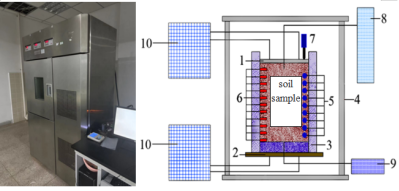
The primary instruments used in this experimental study include: a freeze-thaw cycle test chamber, a freeze-dryer, and a GC-MS system. The freeze-thaw cycle test chamber was independently developed by the State Key Laboratory of Permafrost Engineering at the Northwest Institute of Eco-Environment and Resources, Chinese Academy of Sciences(
Figure 1). This apparatus primarily consists of a temperature control system, a liquid replenishment system, and a data acquisition system. The temperature control system regulates the temperatures of the top plate, bottom plate, and chamber body by controlling the temperature of the circulating cold bath. The liquid replenishment system simulates groundwater recharge or rainfall leaching by regulating the replenishment volume to the top and bottom plates. The apparatus is equipped with temperature and moisture monitoring probes connected to a data acquisition instrument for periodic data collection, while water replenishment volumes are manually recorded at scheduled intervals.
Figure 1. Physical diagram and system schematic diagram of the freeze-thaw cycle test chamber(1- Top plate, 2- Bottom plate, 3- Insulation layer, 4- Freeze-thaw cycle box, 5- Moisture probe, 6- Temperature probe, 7- Deformation sensor, 8- Water replenishment device, 9- Spray solution collection device, 10- Cold bath).
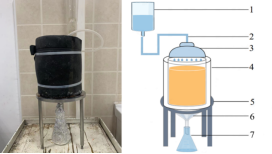
Polycyclic aromatic hydrocarbons in permafrost regions of soil vertical migration process of driving mechanism - the eluviation. Institute with main instruments includes a homemade soil column leaching simulator(
Figure 2), the lyophilizer and gas chromatography - mass spectrometry instrument. The self-made soil column leaching simulation device is mainly composed of the water inlet part, the soil column leaching part, and the water outlet part. The water replenishment volume is collected and recorded manually at regular intervals.
Figure 2. Physical picture and structural diagram of the leaching simulation device(1- Water storage bottle, 2- latex tube, 3- nozzle, 4- acrylic column, 5- rack, 6- funnel, 7- conical flask).
2.3. Experiment Design
2.3.1. Soil Column Preparation
Weigh 1120 g of soil sample, add deionized water to achieve a soil moisture content of 20%, seal with plastic wrap, and place in a dark location to stand for 1 day. For the experiment, a 45 cm tall, 10 cm diameter acrylic cylinder served as the soil sample container (marked with graduations, with the soil filling section being 10 cm) to minimize container adsorption of PAHs. A layer of filter paper and a perforated guard plate were placed at the bottom of the acrylic cylinder to prevent leaching and soil loss. After filling the soil sample, a soil compactor was used to consolidate the soil within the acrylic cylinder. For the PAHs in Permafrost Soil Vertical Migration Process Experiments, the standard mixture of 16 priority-controlled PAHs(A mixture of 16 polycyclic aromatic hydrocarbons was dissolved in high-purity methanol at a concentration of 2000 μg·mL-1 each)was added to the top surface of the soil column. Finally, quartz sand with a diameter of 1 mm was evenly spread over the topmost layer of the soil sample to prevent the deionized water from dispersing the soil during leaching. However, regarding the driving mechanisms of vertical migration processes for polycyclic aromatic hydrocarbons in permafrost soils: freeze-thaw cycle experiments, the standard mixture of 16 PAHs was added to the frozen depth of the soil column. During sample packing, compact the soil from deep to shallow layers to a height of 2 cm. Evenly apply the 16-PAH standard mixture onto the soil surface, then continue packing and compacting the soil to a final height of 10 cm. Driving Mechanisms of Vertical Migration of Polycyclic Aromatic Hydrocarbons in Permafrost Soils: A Leaching Experiment compact the soil sample within the acrylic cylinder using a sample compactor after filling. Apply the 16-PAH standard mixture onto the top surface of the soil column.
2.3.2. Test Process
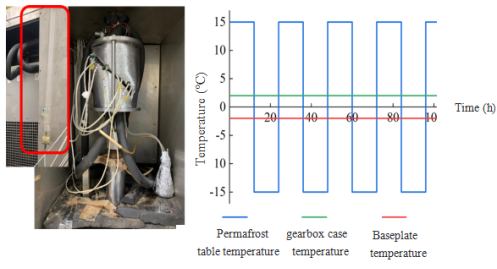
For the PAHs in Permafrost Soil Vertical Migration Process Experiments and mechanisms of vertical migration processes for polycyclic aromatic hydrocarbons in permafrost soils: freeze-thaw cycle experiments Will fill in good soil column in the freeze-thaw cycle test box, box body temperature is set to 2℃, according to the general freeze-thaw test set in minus temperature, and combining with the size and the freeze-thaw cycle test soil column experiment box condition, soil pillars plate temperature is set to -15℃ to 15℃ alternate circulation, to simulate permafrost regions under the natural environment of freeze-thaw cycle, The temperature is switched once every 12 hours. Every 24 hours is a freeze-thaw cycle to simulate a natural year. The temperature of the bottom plate of the soil column is set at -2℃. The temperature change process of the freeze-thaw cycle test chamber is shown in
Figure 3. Top-deionized water leaching was carried out on the soil column to simulate atmospheric precipitation in the natural environment. Based on the annual precipitation of Mohe in the permafrost area (450 mm) and the thickness of the active permafrost layer (3 m), combined with the size of the test soil column (height 10 cm), the daily leaching water volume was determined to be 120 mL after calculation. Insert the temperature probe uniformly from top to bottom along the outer wall of the soil column to monitor the temperature changes inside the soil column. Wrap the outer layer of the soil column with an insulating layer to prevent heat exchange between the soil column and the environment inside the freeze-thaw cycle test chamber. The temperature data is collected by the data acquisition instrument at regular intervals and recorded every 3 minutes. The water replenishment volume is recorded manually, and recorded every 24 hours. The temperature variation process in the freeze-thaw cycling chamber is shown in
Figure 3.
For Mechanisms of Vertical Migration of Polycyclic Aromatic Hydrocarbons in Permafrost Soils: A Leaching Experiment, the filled soil columns were placed on a custom-made leaching apparatus. The leaching nozzle was positioned atop the soil column to apply deionized water at a daily rate of 120 mL. A funnel was placed at the bottom of the soil column to facilitate drainage of leachate flowing down the column. This test was conducted indoors in a shaded area. The outer layer of the soil column was wrapped with a black light-blocking layer to prevent light exposure. Water replenishment volume was recorded manually every 24 hours.
Figure 3. Schematic Diagram of Vertical Migration Process Simulation of Polycyclic Aromatic Hydrocarbons in Permafrost Regions via Soil Column Tests and the Effect of Freeze-Thaw Cycles on Casing Temperature (Circular Section Represents Artificial Water-Filling Device).
2.3.3. Soil Column Treatment
After 12 days of PAH migration under combined freeze-thaw cycling and leaching, the soil column was removed for stratified sampling. Layers were cut every 2 cm from top to bottom, designated as layers 1 to 5. Each layer was weighed before freeze-drying to prevent PAH volatilization. Post-freeze-drying reweighing determined the moisture content of each layer. Subsequently, the five soil layers were subjected to Soxhlet extraction, followed by GC-MS analysis to determine PAH concentrations in each layer. Distribution patterns of PAH mixtures and individual PAHs across layers were then analyzed.
In the freeze-thaw cycle effect and leaching effect experiments, the aforementioned steps were performed after PAHs migrated for 12 days under the individual effects of each process.
3. The Vertical Migration Process of Polycyclic Aromatic Hydrocarbons in the Soil of Permafrost Regions
3.1. Temperature Distribution of Soil Column Sections
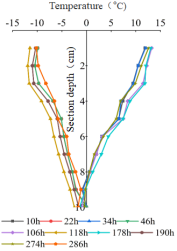
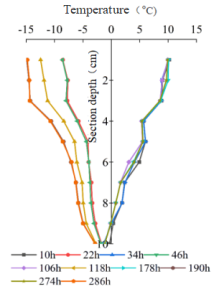
Based on 288 hours of temperature data recorded by the data logger, the temperature distribution within the soil column stabilized after approximately 2.5 to 3 hours of alternating positive and negative temperature regulation at the top plate. The temperature distribution characteristics of the soil column profile (
Figure 4) reveal the leaching conditions within the column at different time points as the internal temperature field stabilized following freeze-thaw cycles and leaching effects. The temperature variation trend within the soil column exhibits an approximately linear relationship with depth. During the freezing period, when the temperatures at the top and bottom plates reached -15°C and -2°C respectively, the temperature distribution within the column gradually increased with depth. During the thawing phase, with temperatures at the top and bottom plates at 15°C and -2°C respectively, the temperature gradient within the column gradually decreases with depth. Once the temperature field stabilizes, the freezing period lasts approximately 9 to 10 hours, while the thawing period also lasts approximately 9 to 10 hours.
The also emperature distribution characteristics of the soil column profile(
Figure 4)also shows that the soil sample at the 5th layer remains in a negative temperature state all the time, while the states of the soil samples above the 5th layer change alternately with the positive and negative temperatures of the top plate.
Figure 4. Temperature distribution characteristics of the soil column profile.
3.1. Moisture distribution in the soil column section
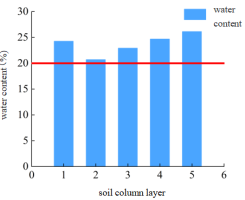
The red horizontal line in
Figure 5 indicated that the initial moisture content of the soil samples was 20%. The moisture distribution characteristics of the soil columns (
Figure 5) revealed that the rehydration levels of all five soil samples increased to varying degrees compared to their initial moisture content. Due to the water replenishment at the top of the soil columns in this experiment, the moisture content of the first soil sample significantly increasing to 24.27% compared to its initial moisture content. The moisture content of the second layer decreased sharply, increasing by only 0.71% compared to the initial moisture content. The moisture content of the third layer and subsequent soil samples gradually increased with depth. The moisture content of the soil sample from Layer 5 reached 26.14%.Based on the temperature distribution data, the fifth layer at the bottom of the soil column remained at sub-zero temperatures throughout. Water replenished from the top flowed downward along the cross-section of the soil column. Part of the water flow exits along the bottom of the soil column, while another portion accumulates and freezes at the frost front at the bottom, forming an ice layer. This process causes the fifth layer to exhibit the highest value of water content. Additionally, when the top of the soil column is at subzero temperatures, moisture within the column also migrates toward the freezing front at the top. This reduces the increase in moisture content in the intermediate soil layers, the reduction in the second layer of soil samples was most pronounced.
Figure 5. Moisture distribution characteristics of the soil column section.
3.3. Total Distribution of 16 Polycyclic Aromatic Hydrocarbon Mixtures in Soil Column Segments
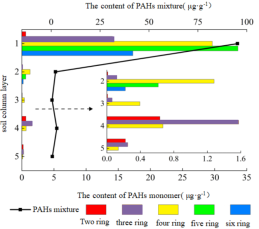
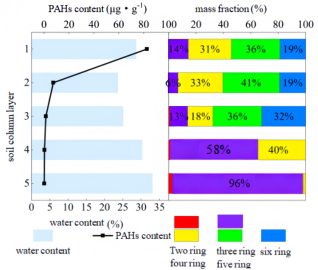
After freeze-thaw cycles and leaching, the total distribution of 16 PAH mixtures and the distribution of individual two to six ring PAHs in the soil column profile are shown in
Figure 6.
Figure 6. Moisture distribution characteristics of the soil column section.
The PAHs were added to the top surface layer of the test soil column (Column No. 1).The concentration distribution range of the 16 PAHs in the soil column profile was 0.46 - 95.26 μg·g
-1. As shown in
Figure 6, after the freeze-thaw cycles and leaching, the residual amount of the first layer soil sample was the highest, accounting for 66.68% of the total added amount. The PAHs underwent vertical migration. With the increase in the depth of the soil column profile, the migration amount of each layer of soil samples gradually decreased except for the fourth layer. The migration amounts of the second to fifth-layer soil samples accounted for 1.57%, 0.33%, 2.01% and 0.43% of the total added amount, respectively. This is related to the adsorption effect of the soil on PAHs. Most of the PAHs added to the surface soil were adsorbed by soil particles, so the PAHs mainly remained in the surface soil, and the PAHs that were not adsorbed were gradually adsorbed by soil particles during the vertical migration process, resulting in a gradual decrease in the concentration of the 16 PAHs along the soil column profile. The migration amount of the fourth layer soil sample suddenly increased, while the content of the bottom soil sample decreased sharply. The migration amount of the fifth layer soil sample was less than 0. 5%, indicating that the PAHs accumulated in the fourth layer soil sample after being hindered by the bottom frozen layer during the vertical migration. It can be seen from the temperature distribution data that the fifth-layer soil sample was always in a frozen state and belonged to the frozen layer, which hindered the vertical migration of PAHs. Nevertheless, trace amounts of PAHs were still detectable in the fifth layer of soil samples. This occurs because trace amounts of unfrozen water within the soil column carry dissolved PAHs to the lower frost line layer as they migrate downward during frost formation.
3.4. Distribution of Polycyclic Aromatic Hydrocarbon Monomers in Soil Columns
The distribution of 16 PAHs in the soil profile (
Figure 6) indicates that after freeze-thaw cycles and leaching, PAHs with different ring numbers exhibit relatively high residual concentrations in the surface layer of soil samples. Furthermore, during vertical migration, these compounds exhibited significant differences in migration to different soil layers. For PAHs with two and three rings, after vertical migration along the soil column profile, they primarily accumulated in the fourth layer of the soil sample, with migration amounts accounting for 7.10% and 3.52% of the total added amount, respectively. After vertical migration of the four ring PAHs, they were mainly enriched in the 2nd layer of soil samples, and the migration amounts accounted for 3.59% of the total addition. After vertical migration of the five and six ring PAHs, they were mainly enriched in the 2nd layer of soil samples. Only 1.72% and 1.23% of the total addition amount were migrated, and the contents of PAHs in rings five and six were not detected in the soil samples of the third layer and below.
The results indicate that for PAH monomers ranging from two ~ six rings, both the vertical migration distance along the soil column profile and the migration amount gradually decrease with increasing molecular weight. After vertical migration, the enrichment ratios of two ring PAHs relative to the total added amount were 2.01 times, 1.98 times, 4.13 times, and 5.76 times higher than those of three ~ six ring PAHs. No five-six ring PAHs were detected in soil samples from the third layer and below.indicating that the migration behavior of high ring PAHs stopped vertically after migrating to the soil samples of the second layer. This is closely related to their physicochemical properties. As molecular weight increases, the octanol-water partition coefficient of polycyclic aromatic hydrocarbon monomers rises, leading to reduced water solubility. Soil moisture content distribution results indicate that soil moisture content increases layer by layer from the third layer downward. Due to the relatively high water solubility of low ring PAHs, they are more likely to migrate vertically within the soil column along with water. In contrast, the octanol-water separation coefficient of high ring PAHs is relatively high, and its hydrophobicity increases relatively. As a result, the content entering the soil from the aqueous phase also increases, making it easier for organic matter in the soil to adsorb them
. Furthermore, compared with low-ring PAHs, the desorption process of high ring PAHs in soil is also more difficult. Therefore, although high ring PAHs also have a certain migration ability, they are significantly weaker than low ring PAHs.
4. The Freeze-Thaw Cycle Effect
The temperature distribution characteristics of the soil column section(
Figure 7) show the temperature distribution of the soil column when the internal temperature field is stable at different times of the test after the freeze-thaw cycle. By regulating the positive and negative temperatures of the top plate of the soil column, positive temperature gradients and negative temperature gradients were formed, respectively, inside the soil column at different times, and obvious linear distributions were shown. When the soil is at a positive temperature state, the temperature gradually decreases along the cross-section of the soil column. When the roof is in a negative temperature state, the temperature gradually increases along the cross-section of the soil column. According to the temperature data monitored by the data acquisition instrument, after regulating the temperature for 1.5 to 2.5 hours, the internal temperature field of the soil column tends to stabilize. The freezing period lasts approximately 10 to 11 hours, and the melting period lasts approximately 10 to 11 hours.
Figure 7. Temperature distribution characteristics of the soil column section.
It can also be observed from the temperature distribution characteristics of the soil column section(
Figure 7) that when the roof is in a negative temperature state, As the number of freeze-thaw cycles increases, the internal temperature field of the soil column becomes progressively lower. The soil samples in the fourth layer and above alternate between positive and negative temperatures with the change of the roof temperature, while the lower part of the soil samples in the fifth layer is always in a negative temperature state. Compared with the frozen layer at the bottom of soil column No. 1, the frozen layer formed at the bottom of the soil column in this test is relatively thin. Since the soil column in this test has not undergone leaching, the internal moisture content is significantly lower than that of the No. 1 soil column. Therefore, the amount of water accumulating at the freezing front at the base of the soil column and subsequently freezing is correspondingly reduced, resulting in a relatively thin layer of frozen soil.
4.1. Moisture Distribution in the Soil Column Section
The initial moisture content of the soil samples was 20%. After moisture content determination, the results are shown in
Figure 8. The moisture content of the middle layer soil samples decreased compared to the initial moisture content, with the moisture content of the second and third layer samples decreasing by 0.83% and 0.25%, respectively. The top and bottom soil samples exhibited increases in moisture content compared to the initial value, reaching 20.24% and 21.58%, respectively. This indicates that after freeze-thaw cycles, moisture redistribution occurred within the soil column.
In this experiment, by regulating the positive and negative temperatures of the roof to simulate the freeze-thaw cycle, the bottom temperature remained stable at -2 ℃ all the time to simulate a certain thickness of permafrost. When the top plate is in a negative temperature state, the top of the earth column freezes, and the internal moisture migrates to the freezing front at the top. When the top plate is in a positive temperature state, the frozen water begins to melt and migrates vertically along the soil column profile under the action of gravity. Furthermore, the bottom of the soil column remained at sub-zero temperatures throughout, causing water to migrate to the freezing front at the fifth soil sample layer where it accumulated. Consequently, moisture content increased at both the top and bottom of the experimental soil column while decreasing in the middle layers.
4.2. Moisture Distribution in the Soil Column Section
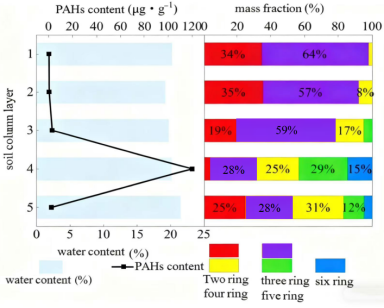
After freeze-thaw action, the distribution and composition characteristics of 16 kinds of PAHs in the soil column profile are shown in Distribution and composition characteristics of 16 types of PAHs in the soil column profile (
Figure 8).The PAH pollutants of the soil column (Soil Column No. 2) in this test were added to the frozen depth of the soil. The concentration distribution range of 16 kinds of PAHs in the soil column profile was 0.49~120.01 μg·g
-1.
Based on the characteristics of 16 polycyclic aromatic hydrocarbons in the soil column profile (
Figure 8), the highest concentration of these 16 PAHs was observed in the fourth layer of residual soil samples after freezing of the subsoil samples and freeze-thaw cycling of the topsoil samples, accounting for 84.01% of the total added amount. Furthermore, different contents of PAHs were detected in the soil samples of the remaining layers, indicating that PAHs underwent upward migration under the action of freeze-thaw cycles. A trace amount of PAHs was also detected in the frozen layer beneath it, indicating that PAHs also migrated downward at the freeze-thaw interface. The migration amounts of soil samples from layers 1 to 3 and layer 5 accounted for 0.34%, 0.50%, 2.31% and 1.79% of the total addition amounts, respectively. The 16 PAHs primarily remained in the added layer soil samples. During upward migration driven by freeze-thaw cycles, they mainly accumulated in the third layer soil samples. Examining PAH composition characteristics at different depths within the soil column profile, the proportion of low ring PAHs rapidly increased from deeper to shallower sections. Between soil sample locations from Layer 4 to Layer 1, the proportion of two ring PAHs rose from less than 5% to 34%, while the proportion of three ring PAHs increased from 28% to 64%. Conversely, the proportions of medium- and high-ring PAHs exhibited the opposite trend, gradually decreasing from deeper to shallower sections of the soil column. Notably, the proportion of high ring PAHs rapidly decreased to zero.
Figure 8. Distribution and composition characteristics of 16 types of PAHs in the soil column profile.
4.3. Eluviation
The initial moisture content of the soil sample was 20%. After leaching, the moisture content of each soil layer is shown in
Figure 9. The moisture content of each layer increased to varying degrees compared to the initial value. The moisture content of the second-layer soil sample showed a smaller increase compared to its initial moisture content. Below the second layer, the moisture content of the soil samples increased progressively through each layer along the soil column profile. The soil sample from the fifth layer showed the most significant increase in water content compared to its initial value, Its moisture content is as high as 33.11%.since this test involved water replenishment at the top of the soil column, the first layer exhibited a relatively high moisture content. The leaching water flowed from top to bottom inside the soil column. The moisture content of the middle layer of the soil sample was relatively low and showed a trend of increasing layer by layer. Some water flowed out along the bottom of the soil column, while some accumulated at the base, resulting in the highest moisture content in Layer 5 of the soil sample. Both the test soil column and Soil Column No. 1 underwent leaching. However, compared to Soil Column No. 1, the test soil column exhibited a more extensive distribution of internal moisture content, while Soil Column No. 1 showed a more limited distribution. This difference arises because Soil Column 1 additionally underwent freeze-thaw cycles. Following leaching, the increased internal water content in Soil Column 1 led to more ice layers or voids. During freezing, the soil was fractured by ice into layered or reticulated structures. Upon thawing, water rapidly drained from these soil voids. After freeze-thaw cycles, both the water release capacity and permeability of the soil increased, resulting in lower internal water content within Soil Column 1 compared to the test soil column.
The distribution and composition characteristics of 16 PAHs in soil column profiles after leaching are shown in the bar chart (
Figure 9). In this experiment, PAH pollutants were added to the top layer of the soil column (Column 3), and the concentration distribution range of 16 PAHs in this column was determined. The concentration profile in the soil column ranged from 0.19 to 82.57 μg·g
-1.
According to the distribution and composition characteristics of 16 types of PAHs in the soil column profile(
Figure 9), after leaching, the residual amounts of 16 kinds of PAHs in the first layer of soil samples were the highest, accounting for 57.80% of the total addition amount. PAHs migrated vertically along the soil column profile, and the migration amounts of the remaining four layers of soil samples accounted for 5.24%, 1.03%, 0.24% and 0.13% of the total addition amount, respectively. The migration amounts of 16 kinds of PAHs along the soil column profile under leaching showed a decreasing trend layer by layer. PAHs still mainly remained in the added layer of soil samples, and after vertical migration, they were mainly enriched in the second layer of soil samples. From the longitudinal distribution characteristics of PAHs components in the soil column profile, in the first to third layers of soil samples, the proportion of PAHs with different ring counts showed little variation, with medium-ring and high ring polycyclic aromatic hydrocarbons predominating. In the fourth to fifth layers of soil samples, the proportion of high ring PAHs rapidly declined to zero, while the proportion of medium ring PAHs first rose to 40% before rapidly falling below 5%. For low ring PAHs, the proportion of three ring PAHs rapidly increased from 13% to 96%, while the proportion of two ring PAHs did not change much along the depth of the soil column profile. This is because Nap has the highest water solubility and is most prone to vertical migration after leaching. Therefore, the variation characteristics in the soil column profile are extremely insignificant.
Consistent with the results reported in previous studies, low ring PAHs are more prone to vertical migration under leaching
| [21] | Hou Y, Liao X, Li Y, et al. Heterogeneity, nonlinearity, and multifactor interactions of polycyclic aromatic hydrocarbons in steelworks soils [J]. Environmental Science and Ecotechnology, 2025: 100607. https://doi.org/10.1016/j.ese.2025.100607 |
[21]
.
Figure 9. Distribution and composition characteristics of 16 types of PAHs in the soil column profile.
Compared with soil column No. 1, the difference of the soil column in this test lies in that it does not undergo freeze-thaw cycles. In this test soil column, the migration amounts of 16 kinds of PAHs were mainly concentrated in the second layer of soil samples, while in the No. 1 soil column, they were mainly concentrated in the fourth layer of soil samples. This was caused by the fact that the bottom of the No. 1 soil column was always in a negative temperature state, and the formed frozen layer hindered the vertical migration of PAHs. By comparing the PAHs content of the fourth layer of soil samples in the two soil columns, the PAHs content retained in the frozen layer of soil column No. 1 accounted for 1.77% of the total addition amount. Secondly, the residual amount of the soil sample in the first layer of the soil column in this test was reduced by 21.04% compared with that of the No. 1 soil column. On the one hand, due to the influence of the freeze-thaw cycle on the No. 1 soil column, the PAHs that migrated vertically to the middle and bottom of the soil column migrated upward again, resulting in a recovery of the PAHs content in the first layer of soil samples after the downward migration under leaching. On the other hand, the soil column in this test only underwent leaching. Water carried more dissolved PAHs and migrated downward together, resulting in a decrease in the PAH content of the soil sample in the first layer.
5. Comparison of Residual Amounts of Pollutant Addition Layers Under Three Driving Mechanisms
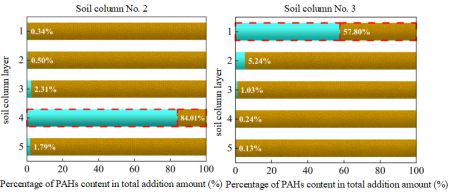
The comparative analysis of PAHs distribution and content in two soil column sections is shown in
Figure 10. The pollutant addition layer for Soil Column No.2 consists of the fourth soil sample, while Soil Column No.3 uses the first soil sample, and Soil Column —all marked with red lines in the diagram.
Figure 10. Comparison of the distribution and content of 16 PAHs in two groups of soil column profiles(The red circled layer is the addition layer for 16 PAHs pollutants).
The residual amount of the pollutant addition layer of soil column No. 2 accounted for 84.01% of the total addition amount, and that of soil column No. 3 accounted for 57.80% of the total addition amount. Among the three groups of soil columns, the residual amount of PAHs in the addition layer of soil column No. 3 was the smallest, indicating that the migration amount of PAHs caused by leaching was the largest. While the residual amount of PAHs in the addition layer of soil column No. 2 was the largest, indicating that the migration amount caused by freeze-thaw was the smallest.
Under the migration-driven mechanisms, the residual amounts of PAH monomers with different ring numbers in the soil column pollutant addition layer are all different. For the two ring PAHs, the residual amount of the No.2 soil column pollutant addition layer accounts for 48.63% of the total addition amount, while the residual amount of the No. 3 soil column pollutant addition layer only accounts for 0.70% of the total addition amount. The residual amounts of PAHs in the addition layer 2 of each group of soil columns were significantly different. Due to the strong water solubility of low-ring PAHs and their easy migration with moisture, in the No. 3 soil column, low-ring PAHs migrate with moisture under the leaching effect, resulting in a relatively small residual amount in the added layer. With the increase in the molecular weight of PAHs, the differences in the residual amounts of the three groups of soil column addition layers gradually decreased. For six ring PAHs, the residual amount of the pollutant addition layer in the No. 2 soil column accounted for 97.80% of the total addition amount, 86.40% In the No. 3 soil column, in the No. 3 soil column, the residual proportion of 6-ring PAHs was less than 90%. Even for the high-ring PAHs that were more difficult to migrate, the reduction in the residual amount of the added layer was more obvious, indicating that the driving force of leaching was the strongest among the three driving mechanisms. In light of the actual situation, in most freeze-thaw regions of our country, the winter precipitation is relatively low, the soil surface is covered with snow, and the soil is frozen due to the influence of low temperatures. Although PAHs in the soil will not undergo vertical migration due to leaching in this case, from the perspective of a natural year or a long-term time dimension of many years, PAHs in the soil are vertical.
6. Conclusions
An indoor soil column experiment was employed to simulate the vertical migration of PAHs in frozen soil. A soil column simulation test incorporating freeze-thaw cycles and leaching effects was designed to investigate the driving mechanisms of PAH vertical migration in permafrost soils. The research findings are as follows:
After PAHs pollutants migrating in the soil of permafrost regions enter the active layer of permafrost, First adsorbed by surface soil particles, unadsorbed PAHs undergo vertical migration into deeper soil layers via leaching. During migration, PAHs are progressively adsorbed by soil, resulting in a decreasing concentration gradient along the soil profile. Migration is impeded at the frozen soil layer, causing accumulation at the freeze-thaw interface. Additionally, due to the presence of small amounts of unfrozen water within the soil, dissolved PAHs migrate toward the freezing front of the frozen layer, resulting in trace PAHs remaining within the frozen layer. Compared to high-ring PAHs, low-ring PAHs migrate farther distances and in greater quantities. As molecular weight increases, the migration capacity of PAHs gradually decreases.
The primary driving mechanism of freeze-thaw cycles involves water migration toward the freezing front due to surface soil freezing, causing pollutants to migrate upward and exhibit a decreasing trend along the soil column profile from bottom to top. The main driving mechanism of leaching involves vertical migration of dissolved-phase PAH pollutants carried by leaching water within the soil, showing a decreasing trend along the soil column profile from top to bottom. Leaching exhibits the strongest driving force.
Abbreviations
PAHs | Polycyclic Aromatic Hydrocarbons |
UNEP | United Nations Environment Programmet |
GC-MS | Gas Chromatography-Mass Spectrometry |
Author Contributions
Qinxuan Bai: Conceptualization, Data curation, Resources, Writing – original draft
Zhiyong Han: Supervision, Validation
Dehua Wang: Methodology, Writing – original draft
Xinpeng Wei: Validation, Supervision
Zixuan Wang: Data Curation, Validation
Shiquan Wang: Validation
Yingying Hu: Supervision
Yanling Zhu: Supervision
Funding
This work is supported by Name the National Natual Science Foundation of China(42001069), Youth Fund Project of Northwest Institute of Ecological Environment and Resources, Chinese Academy of Science(FEYS2019007)
Data Availability Statement
The data is available from the corresponding author upon reasonable request.
Conflicts of Interest
The authors declare no conflicts of interest.
References
| [1] |
Menzie C A, Potocki B B, Santodonato J. Exposure to carcinogenic PAHs in the environment [J]. Environmental Science & Technology, 1992, 26(7): 1278-1284.
https://doi.org/10.1021/es00031a002
|
| [2] |
Ukalska-Jaruga A, Smreczak B. The Impact of Organic Matter on Polycyclic Aromatic Hydrocarbon (PAH) Availability and Persistence in Soils. Molecules. 2020; 25(11): 24-70.
https://doi.org/10.3390/molecules25112470
|
| [3] |
Syed, J.H., et al., Polycyclic aromatic hydrocarbons (PAHs) in Chinese forest soils: profile composition, spatial variations and source apportionment. Scientific Reports, 2017. 7(1): p. 2692.
https://doi.org/10.1038/s41598-017-02999-0
|
| [4] |
Li Z, Wang X, Luo Q, et al. Microplastics Enhance Soil Residue of Polycyclic Aromatic Hydrocarbons: Roles of pH and Dissolved Organic Matter [J]. Environmental Research, 2025: 122-964.
https://doi.org/10.1016/j.envres.2025.122964
|
| [5] |
Liu, B., et al., Linking soil water retention capacity to pore structure characteristics based on X-ray computed tomography: Chinese Mollisol under freeze-thaw effect. Geoderma, 2021. 401: p. 115170.
https://doi.org/10.1016/j.geoderma.2021.115170
|
| [6] |
Perfect, E., et al., Influence of ice segregation and solutes on soil structural stability. Canadian journal of soil science, 1990. 70(4): p. 571-581.
https://doi.org/10.4141/cjss90-060
|
| [7] |
Menon M, Mawodza T, Rabbani A, et al. Pore system characteristics of soil aggregates and their relevance to aggregate stability [J]. Geoderma, 2020, 366: 114259.
https://doi.org/10.1016/j.geoderma.2020.114259
|
| [8] |
PERFECT, E., et al., INFLUENCE OF ICE SEGREGATION AND SOLUTES ON SOIL STRUCTURAL STABILITY. Canadian Journal of Soil Science, 1990. 70(4): p. 571-581.
https://doi.org/10.4141/cjss90-060
|
| [9] |
Ge, Z., et al., Freeze-thaw characteristics and deformation monitoring of topsoil in highland pastoral areas under the influence of snow accumulation. Heliyon, 2024. 10(13), e33652.
https://doi.org/10.1016/j.heliyon.2024.e33652
|
| [10] |
Six, J., et al., A history of research on the link between (micro)aggregates, soil biota, and soil organic matter dynamics. Soil and Tillage Research, 2004. 79(1): p. 7-31.
https://doi.org/10.1016/j.still.2004.03.008
|
| [11] |
van Bochove, E., D. Prévost and F. Pelletier, Effects of freeze–thaw and soil structure on nitrous oxide produced in a clay soil. Soil Science Society of America Journal, 2000. 64(5): p. 1638-1643.
https://doi.org/10.2136/sssaj2000.6451638x
|
| [12] |
Lehrsch, G.A., et al., Freezing effects on aggregate stability affected by texture, mineralogy, and organic matter. Soil Science Society of America Journal, 1991. 55(5): p. 1401-1406.
https://doi.org/10.2136/sssaj1991.03615995005500050033x
|
| [13] |
Biswas B, Qi F, Biswas J K, et al. The fate of chemical pollutants with soil properties and processes in the climate change paradigm—A review [J]. Soil Systems, 2018, 2(3): 51-71.
https://doi.org/10.3390/soilsystems2030051
|
| [14] |
Biskaborn B K, Smith S L, Noetzli J, et al. Permafrost is warming at a global scale [J]. Nature Communications, 2019, 10(1): 264-275.
https://doi.org/10.1038/s41467-018-08240-4
|
| [15] |
Kuang X, Jiao J J. Review on climate change on the Tibetan Plateau during the last half century [J]. Journal of Geophysical Research: Atmospheres, 2016, 121(8): 3979-4007.
https://doi.org/10.1002/2015jd024728
|
| [16] |
Ding J, Chen L, Ji C, et al. Decadal soil carbon accumulation across Tibetan permafrost regions [J]. Nature Geoscience, 2017, 10(6): 420-424.
https://doi.org/10.1038/ngeo2945
|
| [17] |
Guo D, Wang H. Simulated change in the near-surface soil freeze/thaw cycle on the Tibetan Plateau from 1981 to 2010 [J]. Science Bulletin, 2014, 59: 2439-2448.
|
| [18] |
Enell A, Reichenberg F, Warfvinge P, et al. A column method for determination of leaching of polycyclic aromatic hydrocarbons from aged contaminated soil [J]. Chemosphere, 2004, 54(6): 707-715.
https://doi.org/10.1016/j.chemosphere.2003.08.026
|
| [19] |
Wang Ke, Zhang Zhihuan, Zeng Li et al. Study on the Effect of Leachate Volume on the Vertical Migration of Polycyclic Aromatic Hydrocarbons in Soil Profiles [J]. Environmental Science and Management,2018, 43(1): 32-37. (in Chinese)
https://doi.org//10.3969/j.issn.1673-1212.2018.01.008
|
| [20] |
Shi Z, Tao S, Pan B, et al. Contamination of rivers in Tianjin, China by polycyclic aromatic hydrocarbons [J]. Environmental Pollution, 2005, 134(1): 97-111.
https://doi.org/10.1016/j.envpol.2004.07.014
|
| [21] |
Hou Y, Liao X, Li Y, et al. Heterogeneity, nonlinearity, and multifactor interactions of polycyclic aromatic hydrocarbons in steelworks soils [J]. Environmental Science and Ecotechnology, 2025: 100607.
https://doi.org/10.1016/j.ese.2025.100607
|
Cite This Article
-
APA Style
Bai, Q., Han, Z., Wang, D., Wei, X., Wang, Z., et al. (2026). Simulation Study on Vertical Migration Processes and Driving Mechanisms of Polycyclic Aromatic Hydrocarbons in Permafrost Soils. Earth Sciences, 15(3), 125-136. https://doi.org/10.11648/j.earth.20261503.11
 Copy
|
Copy
|
 Download
ACS Style
Bai, Q.; Han, Z.; Wang, D.; Wei, X.; Wang, Z., et al. Simulation Study on Vertical Migration Processes and Driving Mechanisms of Polycyclic Aromatic Hydrocarbons in Permafrost Soils. Earth Sci. 2026, 15(3), 125-136. doi: 10.11648/j.earth.20261503.11
Copy
|
Download
AMA Style
Bai Q, Han Z, Wang D, Wei X, Wang Z, et al. Simulation Study on Vertical Migration Processes and Driving Mechanisms of Polycyclic Aromatic Hydrocarbons in Permafrost Soils. Earth Sci. 2026;15(3):125-136. doi: 10.11648/j.earth.20261503.11
Copy
|
Download
-
@article{10.11648/j.earth.20261503.11,
  author = {Qinxuan Bai and Zhiyong Han and Dehua Wang and Xinpeng Wei and Zixuan Wang and Shiquan Wang and Yingying Hu and Yanling Zhu},
  title = {Simulation Study on Vertical Migration Processes and Driving Mechanisms of Polycyclic Aromatic Hydrocarbons in Permafrost Soils},
  journal = {Earth Sciences},
  volume = {15},
  number = {3},
  pages = {125-136},
  doi = {10.11648/j.earth.20261503.11},
  url = {https://doi.org/10.11648/j.earth.20261503.11},
  eprint = {https://article.sciencepublishinggroup.com/pdf/10.11648.j.earth.20261503.11},
  abstract = {Currently, research on persistent organic pollutants in permafrost soils has primarily focused on distribution surveys, with limited studies investigating migration mechanisms. This paper examines the vertical migration processes and driving mechanisms of polycyclic aromatic hydrocarbons (PAHs) in permafrost soils. Given the diverse sources of pollutants under natural conditions and the complex mixture of contaminants typically found in soils, this study selected 16 priority-controlled PAHs as research targets. Using loess soil from Lanzhou—a seasonally frozen region—as the experimental substrate, we conducted indoor soil column leaching experiments under freeze-thaw cycling conditions. This approach simulates the vertical migration of PAHs in permafrost soils, to quantitatively describe PAHs' vertical migration and distribution within soil profiles, along with permafrost layer barrier mechanisms. Simulated soil column experiments combining freeze-thaw cycles and leaching were designed to analyze the driving mechanisms of PAH vertical migration influenced by these processes. The results indicate that the driving mechanism of freeze-thaw cycles primarily involves water migration toward the freeze front due to soil surface freezing, leading to upward migration of pollutants. The driving mechanism of leaching primarily involves vertical migration of dissolved-phase PAH pollutants in soil through leachate. The primary driving force is leaching, while freeze-thaw cycles drive PAHs to migrate upward over greater distances.},
 year = {2026}
}
Copy
|
Download
-
TY  - JOUR
T1  - Simulation Study on Vertical Migration Processes and Driving Mechanisms of Polycyclic Aromatic Hydrocarbons in Permafrost Soils
AU  - Qinxuan Bai
AU  - Zhiyong Han
AU  - Dehua Wang
AU  - Xinpeng Wei
AU  - Zixuan Wang
AU  - Shiquan Wang
AU  - Yingying Hu
AU  - Yanling Zhu
Y1  - 2026/06/09
PY  - 2026
N1  - https://doi.org/10.11648/j.earth.20261503.11
DO  - 10.11648/j.earth.20261503.11
T2  - Earth Sciences
JF  - Earth Sciences
JO  - Earth Sciences
SP  - 125
EP  - 136
PB  - Science Publishing Group
SN  - 2328-5982
UR  - https://doi.org/10.11648/j.earth.20261503.11
AB  - Currently, research on persistent organic pollutants in permafrost soils has primarily focused on distribution surveys, with limited studies investigating migration mechanisms. This paper examines the vertical migration processes and driving mechanisms of polycyclic aromatic hydrocarbons (PAHs) in permafrost soils. Given the diverse sources of pollutants under natural conditions and the complex mixture of contaminants typically found in soils, this study selected 16 priority-controlled PAHs as research targets. Using loess soil from Lanzhou—a seasonally frozen region—as the experimental substrate, we conducted indoor soil column leaching experiments under freeze-thaw cycling conditions. This approach simulates the vertical migration of PAHs in permafrost soils, to quantitatively describe PAHs' vertical migration and distribution within soil profiles, along with permafrost layer barrier mechanisms. Simulated soil column experiments combining freeze-thaw cycles and leaching were designed to analyze the driving mechanisms of PAH vertical migration influenced by these processes. The results indicate that the driving mechanism of freeze-thaw cycles primarily involves water migration toward the freeze front due to soil surface freezing, leading to upward migration of pollutants. The driving mechanism of leaching primarily involves vertical migration of dissolved-phase PAH pollutants in soil through leachate. The primary driving force is leaching, while freeze-thaw cycles drive PAHs to migrate upward over greater distances.
VL  - 15
IS  - 3
ER  -
Copy
|
Download





 Share This Article
 Twitter
 Linked In
 Facebook