Abstract
The Hybrid Empirical Method (HEM) is widely used to predict ground motions in regions with sparse strong-motion data by transferring empirically derived ground-motion prediction equations (GMPEs) from data-rich host regions. A fundamental requirement for the reliability of this approach is that the stochastic point-source model adopted for the host region be consistent with the empirical GMPEs developed from the same dataset. Despite its importance, this consistency is often assumed or verified only over limited magnitude-distance conditions. This study presents a systematic evaluation of the observation-calibrated stochastic equivalent point-source model of Yenier and Atkinson (2015, YA15) for California. Both the single corner-frequency (SCF) and double corner-frequency (DCF) formulations are assessed over moment magnitudes Mw 3.0-7.5, rupture distances Rrup of 1-300 km, and frequencies from 0.1 to 10 Hz. Model predictions of pseudo-spectral acceleration are compared with the median predictions of four widely used four NGA-West2 GMPEs, and consistency is quantified using normalized residuals that account for inter-model variability. Results show that the YA15 model generally reproduces the empirical predictions well for moderate magnitudes (Mw 4.5-7.0) over most distances and frequencies. However, systematic discrepancies are identified for small-magnitude events at low frequencies in the near and intermediate distance ranges, at high frequencies in the near field, and for large-magnitude events in the near-fault region. Furthermore, the more complex DCF formulation does not demonstrate systematic improvement over the SCF model at higher magnitudes and exhibits increased variability and larger residual amplitudes in certain magnitude–distance–frequency regimes. These findings delineate the effective applicability domain of observation-calibrated equivalent point-source models in HEM applications and clarify the limitations of the point-source approximation when extrapolated beyond its primary calibration range. The results provide practical guidance for selecting host-region stochastic models in hybrid empirical frameworks and indicate conditions under which more physically detailed finite-fault simulations may be required.
|
Published in
|
Earth Sciences (Volume 15, Issue 2)
|
|
DOI
|
10.11648/j.earth.20261502.11
|
|
Page(s)
|
86-94 |
|
Creative Commons
|

This is an Open Access article, distributed under the terms of the Creative Commons Attribution 4.0 International License (http://creativecommons.org/licenses/by/4.0/), which permits unrestricted use, distribution and reproduction in any medium or format, provided the original work is properly cited.
|
|
Copyright
|
Copyright © The Author(s), 2026. Published by Science Publishing Group
|
Keywords
Stochastic Point-source Simulation, Ground-motion Prediction Equations, Hybrid Empirical Method,
Equivalent Point-source Model
1. Introduction
Reliable ground-motion prediction in regions with sparse strong-motion data remains a central challenge in engineering seismology. In such regions, the limited availability of observational data hampers the direct development of region-specific ground-motion prediction equations (GMPEs), particularly across a wide range of magnitudes, distances, and frequencies relevant to engineering applications. To address this limitation, the Hybrid Empirical Method (HEM) has been widely adopted as a pragmatic framework for transferring well-constrained GMPEs from data-rich “host regions” to data-poor “target regions”
| [1] | Campbell, K. W. Prediction of Strong Ground Motion Using the Hybrid Empirical Method and Its Use in the Development of Ground-Motion (Attenuation) Relations in Eastern North America. Bulletin of the Seismological Society of America. 2003, 93(3), 1012-1033.
https://doi.org/10.1785/0120020002 |
| [2] | Douglas, J., H. Bungum., F. Scherbaum. Ground-motion prediction equations for southern Spain and southern Norway obtained using the composite model perspective. Journal of Earthquake Engineering. 2006, 10(1), 33-72
https://doi.org/10.1080/13632460609350587 |
| [3] | Pezeshk, S., A. Zandieh., A. Haji-Soltani. Hybrid empirical ground-motion prediction equations for the Gulf Coast Region. [Technical Report]. U. S. Geological Survey. Available from: https://earthquake.usgs.gov/cfusion/external_grants/reports/G16AP00138.pdf [Accessed April 2023]. |
| [4] | Pezeshk, S., A. Zandieh, K. Campbell., B. Tavakoli. Groundmotion prediction equations for CENA using the hybrid empirical method in conjunction with NGA-West2 empirical ground-motion models. Bulletin of the Seismological Society of America. 2018, 108(4), 2278-2304.
https://doi.org/10.1785/0120170179 |
| [5] | Pezeshk, S., A. Zandieh., A. Haji-Soltani. A Ground-Motion Model for the Gulf Coast Region of the United States. Bulletin of the Seismological Society of America. 2021, 111(6), 3261-3277.
https://doi.org/10.1785/0120210023 |
| [6] | Jiang, W., Tao, X., Tao, Z. Seismology-based hybrid ground motion prediction models of PGA in Sichuan, China. Soil Dynamics and Earthquake Engineering. 2022, 156
https://doi.org/10.1016/j.soildyn.2022.107220 |
[1-6]
.
The core concept of HEM is to decompose regional variations in ground motion into physically interpretable components through stochastic simulations. In practice, stochastic point-source simulations are independently constructed for both the host and target regions, and the resulting spectral differences are interpreted as regional adjustment factors
. These factors are then applied to a reference GMPE developed for the host region, yielding a modified prediction model intended to represent the target region. The reliability of this procedure critically depends on a key underlying assumption: the stochastic point-source model for the host region must be consistent with the empirical GMPEs developed from the same region
| [8] | Campbell, K. W. An Evaluation of Eastern North American Ground-Motion Models Developed Using the Hybrid Empirical MethodAn Evaluation of ENA Ground-Motion Models Developed Using the Hybrid Empirical Method. Bulletin of the Seismological Society of America. 2014, 104(1), 347-359.
https://doi.org/10.1785/0120120256 |
[8]
. If this consistency is not satisfied, the inferred adjustment factors may reflect modeling artifacts rather than genuine regional effects, thereby undermining the validity of the HEM transfer.
Despite the central role of this assumption, systematic evaluations of host-region stochastic source models against empirical GMPEs across the full engineering parameter space remain limited. In many applications, consistency is implicitly assumed or verified only at a small number of discrete magnitude-distance combinations, often focused on moderate magnitudes and intermediate distances. Such partial validation provides limited insight into the robustness of stochastic models when extrapolated to small or large magnitudes, near-fault distances, or frequency ranges outside their original calibration domains—conditions that are frequently encountered in seismic hazard and risk analyses.
A comprehensive example of an observation-calibrated stochastic point-source ground-motion model is the formulation proposed by Yenier and Atkinson (2015)
| [9] | Yenier, E., Atkinson, G. M. An Equivalent Point-Source Model for Stochastic Simulation of Earthquake Ground Motions in California. Bulletin of the Seismological Society of America. 2015, 105(3), 1435-1455.
https://doi.org/10.1785/0120140254 |
[9]
, hereafter referred to as the YA15 model. The model was developed for regional ground-motion prediction in the active crustal region of California and calibrated using the NGA-West2 strong-motion database. By systematically fitting observed spectral shapes over a broad range of magnitudes and distances, YA15 established an internally consistent parameter set describing source characteristics, path attenuation, and near-surface effects within a stochastic point-source framework.
A key feature of the YA15 model is the introduction of an empirical, magnitude-dependent effective source depth, often referred to as a pseudo-depth, which modifies the effective distance metric used in the simulations. This formulation allows near-field saturation effects associated with finite-fault rupture to be approximated while retaining the computational simplicity of a point-source representation. In addition, the model provides two alternative source spectral parameterizations: a conventional single corner-frequency (SCF) model and a more flexible double corner-frequency (DCF) model, the latter intended to better represent spectral complexity at moderate to large magnitudes.
Owing to its empirical grounding and coherent parameterization, the YA15 model has become a widely used and influential reference in stochastic ground-motion simulations for California and related engineering applications. The availability of both SCF and DCF formulations, combined with calibration against a large and high-quality observational database, has contributed to its broad adoption as a representative stochastic point-source model in studies requiring consistency with empirical ground-motion characteristics.
However, the original validation of the YA15 model was primarily based on comparisons at selected magnitude-distance conditions, rather than on a systematic assessment of its performance across the full magnitude-distance-frequency space relevant to engineering practice. Consequently, the extent to which the model remains consistent with empirical ground-motion predictions when extrapolated beyond its primary calibration domain has not been comprehensively quantified.
Previous evaluations of stochastic point-source ground-motion models have largely emphasized their overall agreement with empirical observations, while regions of systematic misfit have received comparatively less attention. As a result, model performance is often demonstrated only under selected magnitude-distance conditions, and potential limitations outside these ranges remain insufficiently documented. Recent studies have shown that comprehensive, full-parameter-space evaluations offer a more robust framework for identifying both the strengths and weaknesses of ground-motion models
| [10] | Zandieh, A., Pezeshk, S., Campbell, K. W. An Equivalent Point-Source Stochastic Simulation of the NGA-West2 Ground-Motion Prediction Equations. Bulletin of the Seismological Society of America. 2018, 108(2), 815-835.
https://doi.org/10.1785/0120170116 |
| [11] | Pezeshk, S., Assadollahi, C., Zandieh, A. An equivalent point-source stochastic model of the NGA-East ground-motion models. Earthquake Spectra. 2024, 40(2), 1452-1478.
https://doi.org/10.1177/87552930231225983 |
[10, 11]
.
Motivated by this perspective, the objective of this study is to provide a comprehensive, quantitative assessment of the observation-calibrated YA15 stochastic point-source model. Both the SCF and DCF formulations are evaluated over a broad parameter space spanning moment magnitudes Mw 3.0-7.5, rupture distances of 1-300 km, and frequencies from 0.1 to 10 Hz, with model predictions systematically compared against the median behavior of NGA-West2 GMPEs
| [12] | Abrahamson, N. A., Silva, W. J., Kamai, R. Summary of the ASK14 Ground Motion Relation for Active Crustal Regions. Earthquake Spectra. 2014, 30(3), 1025-1055.
https://doi.org/10.1193/070913EQS198M |
| [13] | Boore, D. M., Stewart, J. P., Seyhan, E., Atkinson, G. M. NGA-West2 Equations for Predicting PGA, PGV, and 5% Damped PSA for Shallow Crustal Earthquakes. Earthquake Spectra. 2014, 30(3), 1057-1085.
https://doi.org/10.1193/070113EQS184M |
| [14] | Campbell, K. W., Bozorgnia, Y. NGA-West2 Ground Motion Model for the Average Horizontal Components of PGA, PGV, and 5% Damped Linear Acceleration Response Spectra. Earthquake Spectra. 2014, 30(3), 1087-1115.
https://doi.org/10.1193/062913EQS175M |
| [15] | Chiou, B. S. -J., Youngs, R. R. Update of the Chiou and Youngs NGA Model for the Average Horizontal Component of Peak Ground Motion and Response Spectra. Earthquake Spectra. 2014, 30(3), 1117-1153.
https://doi.org/10.1193/072813EQS219M |
[12-15]
.
By mapping residual patterns across the full parameter space, this study explicitly identifies regions where the YA15 model is in good agreement with empirical predictions, as well as regions where significant, systematic discrepancies emerge. These results clarify the reliable applicability domain of observation-calibrated equivalent point-source models in HEM and illuminate the inherent limitations of the point-source approximation when extended beyond its effective range. The findings provide direct guidance for the selection and use of host-region stochastic models in HEM applications and highlight the conditions under which more physically detailed approaches, such as stochastic finite-fault simulations, may be required.
2. Methods
2.1. Stochastic Equivalent Point-source Model
The stochastic ground-motion simulations evaluated in this study are based on the equivalent point-source model proposed by Yenier and Atkinson (2015), hereafter referred to as the YA15 model. The model follows the general stochastic simulation framework of Boore (2003)
and incorporates a set of empirically calibrated source, path, and site parameters representative of the active crustal region of California. A summary of the key YA15 model components and parameter categories adopted in this study is provided in
Table 1.
A central feature of the YA15 formulation is the use of an empirical, magnitude-dependent effective source depth, commonly referred to as a pseudo-depth. This parameter modifies the effective source-to-site distance and allows near-field saturation effects associated with finite-fault rupture to be approximated within a point-source framework. While the source is treated as a point in space, the pseudo-depth increases systematically with magnitude, thereby reducing unrealistically large amplitudes at short distances for moderate-to-large earthquakes.
The YA15 model provides two alternative representations of the source spectrum: a conventional single corner-frequency (SCF) model and a more flexible double corner-frequency (DCF) model
| [17] | Brune, J. N. Tectonic stress and the spectra of seismic shear waves from earthquakes. Jouranl of Geophysical Research. 1970, 75(26), 4997-5009.
https://doi.org/10.1029/JB075i026p04997 |
| [18] | Boore, D. M., Alessandro, C. D., Abrahamson, N. A. A Generalization of the Double-Corner-Frequency Source Spectral Model and Its Use in the SCEC BBP Validation Exercise. Bulletin of the Seismological Society of America. 2014, 104(5), 2387-2398. https://doi.org/10.1785/0120140138 |
[17, 18]
. Both formulations were calibrated using observed spectral amplitudes from the NGA-West2 strong-motion database and are evaluated in this study using the original published parameter sets, without modification.
Table 1. Summary of the published YA15 stochastic point-source model components and parameters adopted in this study.
Model component | Description | Notes |
Effective source depth | Empirical, magnitude-dependent pseudo-depth used to define effective source-to-site distance | Accounts for near-field saturation effects |
Source spectral model | Single corner-frequency (SCF) and double corner-frequency (DCF) formulations | Both variants evaluated using the original YA15 parameter sets |
Stress drop | Constant, observation-calibrated stress-drop model | Adopted directly from YA15 |
Geometrical spreading | Piecewise distance-dependent geometrical attenuation | The recommended YA15 near-distance slope b1=-1.3 is used |
Anelastic attenuation | Frequency-dependent quality factor (Q) model | Region-specific attenuation structure as specified in YA15 |
Site attenuation | Near-surface attenuation parameterized by κ (kappa) | The value of follows YA15 and is based on the findings of Yenier and Atkinson (2014) |
* All model components and parameterizations are implemented as specified in YA15 model, without recalibration or additional tuning in this study. For specific parameters such as κ
0, we follow the approach adopted in Yenier and Atkinson (2014)
| [19] | Yenier, E., Atkinson, G. M. Equivalent Point-Source Modeling of Moderate-to-Large Magnitude Earthquakes and Associated Ground-Motion Saturation Effects. Bulletin of the Seismological Society of America. 2014, 104(3), 1458-1478.
https://doi.org/10.1785/0120130147 |
[19]
, as referenced in the model's original formulation.
2.2. Evaluation Parameter Space
To ensure a comprehensive and engineering-relevant assessment, the YA15 model's performance is evaluated over a broad parameter space encompassing magnitude, distance, and frequency ranges commonly encountered in seismic hazard and engineering applications.
Moment magnitude (Mw) is varied from 3.0 to 7.5, covering small-to-moderate earthquakes as well as large crustal events. Rupture distance (Rrup) ranges from 1 to 300 km, spanning near-fault conditions through distances relevant to regional hazard assessments. Frequency-dependent ground-motion amplitudes are evaluated over the range 0.1-10 Hz, which encompasses the primary frequency band of interest for most engineered structures.
Within this three-dimensional parameter space, simulations are performed on a dense grid of magnitude-distance-frequency combinations in order to capture systematic trends and potential localized deviations in model performance.
2.3. Empirical Reference Models
The empirical benchmark used for comparison consists of four widely adopted ground-motion prediction equations developed within the NGA-West2 project: Abrahamson et al. (2014), Boore et al. (2014), Campbell and Bozorgnia (2014), and Chiou and Youngs (2014). These models represent independent formulations derived from the same underlying strong-motion database and collectively reflect the current empirical consensus for ground-motion prediction in active crustal regions.
For each magnitude-distance-frequency combination, the median pseudo-spectral acceleration (PSA) predicted by each GMPE is computed. The median of the four GMPE predictions is then taken as the reference empirical value. This approach minimizes dependence on any single GMPE and provides a robust representation of central empirical tendency.
2.4. Residual Definition and Consistency Metric
Model consistency is quantified using normalized residuals defined as:
(1)
where denotes the PSA predicted by the YA15 stochastic simulations,is the median of the four GMPE median predictions, and represents the global median of the logarithmic standard deviations reported by the four GMPEs.
This normalized residual metric expresses the deviation of the stochastic simulation from the empirical reference in units of typical GMPE variability. Values of indicate agreement within approximately one standard deviation of the empirical models, while larger absolute values indicate increasing levels of systematic discrepancy.
Residuals are computed for both the SCF and DCF variants of the YA15 model across the full parameter space. The resulting residual fields are analyzed to identify regions of consistent agreement as well as systematic departures from empirical predictions.
2.5. Scope and Interpretation of the Evaluation
The objective of this evaluation is not to recalibrate or optimize the YA15 model but to assess the degree to which the published, observation-calibrated formulation reproduces the empirical behavior captured by NGA-West2 GMPEs across a wide range of conditions. Consequently, all analyses are conducted using the original YA15 parameter sets, and no additional magnitude- or distance-dependent adjustments are introduced.
The results are interpreted in the context of hybrid empirical applications, where stochastic point-source models are commonly used to represent host-region behavior. Particular attention is given to identifying parameter-space regions in which the point-source approximation provides an adequate representation of empirical trends, as well as regions where its limitations become pronounced.
3. Results
3.1. Overall Residual Patterns Across the Parameter Space
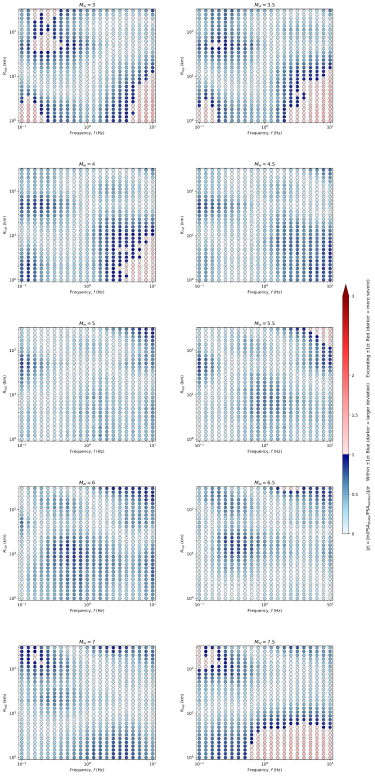
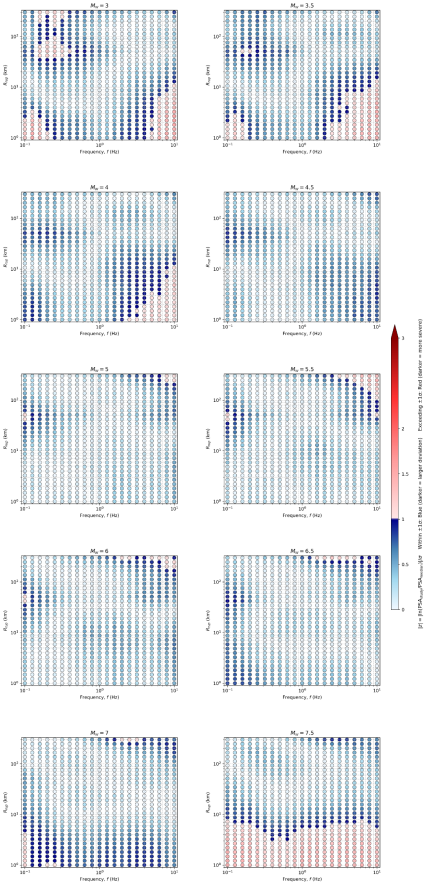
Normalized residuals between pseudo-spectral acceleration (PSA) predicted by the YA15 stochastic simulations and the empirical reference GMPE median were computed over the full magnitude-distance-frequency parameter space defined in Section 2. Residual distributions for the SCF and DCF formulations are summarized in
Figure 1 and
Figure 2, respectively.
Overall, the YA15 model reproduces the central tendency of NGA-West2 GMPE predictions reasonably well over a substantial portion of the parameter space. In particular, for moderate magnitudes (Mw 4.5-7.0), residuals are generally centered near zero across most distances and frequencies, with the majority of values falling within ±1 standard deviation of the empirical reference. This indicates that, within this range, the observation-calibrated equivalent point-source formulation provides a satisfactory representation of empirically derived ground-motion behavior.
However, the residual maps also reveal clear magnitude-, distance-, and frequency-dependent structures, indicating that model performance is not uniform across the full parameter space. Several regions of systematic deviation are consistently observed for both the SCF and DCF variants, suggesting intrinsic limitations of the point-source approximation under specific conditions.
3.2. Performance at Small Magnitudes
For small-magnitude events (Mw < 4.5), both SCF and DCF formulations exhibit similar residual patterns. Significant deviations from the empirical reference (|z| > 1) are observed in three primary regions of the parameter space.
First, at low frequencies (f < 0.2 Hz) in the near-source region (Rrup<4 km), simulated PSA values differ systematically from GMPE predictions. Second, persistent discrepancies are identified at low frequencies (approximately 0.1-0.4 Hz) over intermediate distances (Rrup ≈ 40-100 km), where residuals remain elevated across a broad distance range. Third, at high frequencies (f > 2 Hz) in the near field (Rrup < 10 km), deviations are most pronounced, with residuals frequently exceeding one standard deviation.
These patterns indicate that, for small events, the YA15 equivalent point-source formulation has difficulty simultaneously reproducing low-frequency behavior at short and intermediate distances and high-frequency amplitudes in the near field.
3.3. Magnitude Dependence and SCF-DCF Comparison
As magnitude increases, differences between the SCF and DCF formulations become more apparent. Contrary to expectations based on limited comparisons in the original YA15 study, the present full-space analysis does not indicate a systematic improvement in model performance associated with the DCF formulation at moderate to large magnitudes.
For Mw≥5.0, the SCF model generally maintains residuals within a comparable or narrower range than the DCF model across much of the parameter space. In contrast, the DCF formulation exhibits a higher proportion of large residuals, particularly at higher frequencies (f > 1 Hz) and large distances (Rrup > 200 km), where deviations become increasingly widespread.
At very large magnitudes (Mw > 7.0), both formulations show substantial discrepancies in the near-fault region (Rrup < 10 km). In this regime, residuals for the DCF model are especially large and spatially extensive, indicating a breakdown of consistency with empirical GMPE predictions.
Figure 1. Normalized residuals of pseudo-spectral acceleration (PSA) predicted by the YA15 stochastic point-source model with the single corner-frequency (SCF) formulation relative to the median NGA-West2 GMPE predictions, shown as a function of magnitude, rupture distance, and frequency.
Figure 2. Normalized residuals of pseudo-spectral acceleration (PSA) predicted by the YA15 stochastic point-source model with the double corner-frequency (DCF) formulation relative to the median NGA-West2 GMPE predictions, shown as a function of magnitude, rupture distance, and frequency.
4. Discussion
Although the equivalent source depth (pseudo-depth) introduced in the YA15 model can partially approximate near-field saturation effects associated with finite-fault rupture, the systematic analysis presented here indicates that a single effective depth parameter is insufficient to reconcile ground-motion attenuation behavior across all magnitudes, distances, and frequency bands. The residual patterns observed for large-magnitude events in the very near field, as well as for small-magnitude events at low frequencies over near and intermediate distances, reveal persistent discrepancies that cannot be resolved within the equivalent point-source framework.
These discrepancies reflect inherent physical limitations of the point-source approximation. Key rupture- and wave-propagation-related effects—such as rupture directivity, hanging-wall effects, spatially distributed energy release, and surface-wave excitation—are not explicitly represented. While the pseudo-depth formulation mitigates unrealistically high amplitudes at short distances for moderate events, it cannot capture the full complexity of near-fault ground motions, particularly for large earthquakes.
At small magnitudes, low-frequency discrepancies at intermediate distances further indicate limitations of point-source models when extrapolated beyond their primary calibration range.
From an engineering perspective, these results highlight the importance of clearly identifying the effective applicability domain of stochastic point-source models. Although such models remain efficient and practical tools for regional ground-motion prediction within moderate magnitude ranges, their limitations become pronounced for near-fault conditions of large earthquakes and for low-frequency predictions of small events. In hybrid empirical applications, uncritical use of point-source simulations in these regimes may introduce biases into regional adjustment factors and affect the reliability of transferred GMPEs.
Accordingly, achieving physically consistent ground-motion predictions across the full magnitude-distance-frequency space may require more refined simulation approaches in specific applications. Stochastic finite-fault models, which explicitly represent rupture dimensions and spatial energy release, offer a natural extension for addressing the systematic discrepancies identified in this study and for improving the robustness of engineering-oriented ground-motion estimates.
5. Conclusions
This study presents a systematic assessment of the observation-calibrated stochastic equivalent point-source model proposed by Yenier and Atkinson (2015) by directly comparing its predictions with the median behavior of NGA-West2 ground-motion prediction equations over a broad engineering parameter space. By evaluating both the single corner-frequency (SCF) and double corner-frequency (DCF) formulations across moment magnitudes Mw 3.0-7.5, rupture distances of 1-300 km, and frequencies from 0.1 to 10 Hz, the analysis provides a comprehensive characterization of model consistency and applicability.
The results demonstrate that the YA15 model reproduces the empirical GMPE median reasonably well for moderate magnitudes (Mw 4.5-7.0) over most distances and frequencies. Within this range, the equivalent point-source formulation provides an adequate representation of observed ground-motion behavior, supporting its use in applications that rely on consistency with empirical models, including hybrid empirical frameworks.
Outside this central applicability domain, systematic discrepancies are identified. For small-magnitude events (Mw < 4.5), significant deviations occur at low frequencies in both near-source and intermediate distance ranges, as well as at high frequencies in the near field. For large-magnitude events (Mw > 7.0), pronounced inconsistencies emerge in the near-fault region, indicating limitations of the point-source approximation when attempting to represent finite-fault effects at short distances.
Across the evaluated parameter space, the more complex DCF formulation does not exhibit a systematic improvement over the SCF model in terms of agreement with empirical GMPE predictions. In several magnitude-distance-frequency regimes, particularly at higher magnitudes, the DCF model shows increased variability and larger residuals. These findings indicate that additional spectral flexibility alone does not necessarily lead to improved consistency when applied within an equivalent point-source framework.
Overall, this study delineates the effective applicability domain of an observation-calibrated stochastic point-source model commonly used in engineering practice. The results highlight the importance of explicitly identifying parameter-space regions where such models provide reliable representations of empirical ground-motion behavior, as well as regions where their inherent assumptions break down. These insights provide practical guidance for the selection and use of host-region stochastic models in hybrid empirical applications and underscore the need for more physically detailed simulation approaches, such as stochastic finite-fault models, when extending predictions to conditions beyond the effective range of point-source formulations.
Future research should focus on whether stochastic finite-fault models can compensate for the systematic deficiencies identified in stochastic point-source formulations, particularly in near-fault regions of large-magnitude events and in low-frequency regimes of small earthquakes. A key question is whether finite-fault representations provide improved consistency with empirical GMPEs in those magnitude–distance–frequency domains where point-source models exhibit persistent discrepancies.
Abbreviations
HEM | Hybrid Empirical Method |
GMPEs | Ground Motion Prediction Equations |
SCF | Single Corner-frequency |
DCF | Double Corner-frequency |
PSA | Pseudo Spectral Acceleration |
Acknowledgments
The author sincerely thanks Rui Hu for his constructive suggestions, which significantly improved this paper. The author also acknowledges and extends sincere thanks to all members of the research group for their invaluable assistance and collaborative support throughout this work.
Author Contributions
Chuanxiang Chen: Resources, Data curation, Software, Writing – original draft
Zhinan Xie: Conceptualization, Formal Analysis, Writing – review & editing, Supervision
Funding
This work is supported by the Key Research and Development Program of Xinjiang Production and Construction Corps (Grant No. 2024AB077).
Data Availability Statement
The software used to perform the ground-motion simulations in this study (SMSIM) can be found at: http://www.daveboore.com/software_online.html
Conflicts of Interest
The authors declare no conflicts of interest.
References
| [1] |
Campbell, K. W. Prediction of Strong Ground Motion Using the Hybrid Empirical Method and Its Use in the Development of Ground-Motion (Attenuation) Relations in Eastern North America. Bulletin of the Seismological Society of America. 2003, 93(3), 1012-1033.
https://doi.org/10.1785/0120020002
|
| [2] |
Douglas, J., H. Bungum., F. Scherbaum. Ground-motion prediction equations for southern Spain and southern Norway obtained using the composite model perspective. Journal of Earthquake Engineering. 2006, 10(1), 33-72
https://doi.org/10.1080/13632460609350587
|
| [3] |
Pezeshk, S., A. Zandieh., A. Haji-Soltani. Hybrid empirical ground-motion prediction equations for the Gulf Coast Region. [Technical Report]. U. S. Geological Survey. Available from:
https://earthquake.usgs.gov/cfusion/external_grants/reports/G16AP00138.pdf
[Accessed April 2023].
|
| [4] |
Pezeshk, S., A. Zandieh, K. Campbell., B. Tavakoli. Groundmotion prediction equations for CENA using the hybrid empirical method in conjunction with NGA-West2 empirical ground-motion models. Bulletin of the Seismological Society of America. 2018, 108(4), 2278-2304.
https://doi.org/10.1785/0120170179
|
| [5] |
Pezeshk, S., A. Zandieh., A. Haji-Soltani. A Ground-Motion Model for the Gulf Coast Region of the United States. Bulletin of the Seismological Society of America. 2021, 111(6), 3261-3277.
https://doi.org/10.1785/0120210023
|
| [6] |
Jiang, W., Tao, X., Tao, Z. Seismology-based hybrid ground motion prediction models of PGA in Sichuan, China. Soil Dynamics and Earthquake Engineering. 2022, 156
https://doi.org/10.1016/j.soildyn.2022.107220
|
| [7] |
Davatgari-Tafreshi, M., Pezeshk, S. A ground-motion model for the shallow crustal earthquakes in New Zealand. Earthquake Spectra. 2025, 41(3), 2460-2486.
https://doi.org/10.1177/87552930251337332
|
| [8] |
Campbell, K. W. An Evaluation of Eastern North American Ground-Motion Models Developed Using the Hybrid Empirical MethodAn Evaluation of ENA Ground-Motion Models Developed Using the Hybrid Empirical Method. Bulletin of the Seismological Society of America. 2014, 104(1), 347-359.
https://doi.org/10.1785/0120120256
|
| [9] |
Yenier, E., Atkinson, G. M. An Equivalent Point-Source Model for Stochastic Simulation of Earthquake Ground Motions in California. Bulletin of the Seismological Society of America. 2015, 105(3), 1435-1455.
https://doi.org/10.1785/0120140254
|
| [10] |
Zandieh, A., Pezeshk, S., Campbell, K. W. An Equivalent Point-Source Stochastic Simulation of the NGA-West2 Ground-Motion Prediction Equations. Bulletin of the Seismological Society of America. 2018, 108(2), 815-835.
https://doi.org/10.1785/0120170116
|
| [11] |
Pezeshk, S., Assadollahi, C., Zandieh, A. An equivalent point-source stochastic model of the NGA-East ground-motion models. Earthquake Spectra. 2024, 40(2), 1452-1478.
https://doi.org/10.1177/87552930231225983
|
| [12] |
Abrahamson, N. A., Silva, W. J., Kamai, R. Summary of the ASK14 Ground Motion Relation for Active Crustal Regions. Earthquake Spectra. 2014, 30(3), 1025-1055.
https://doi.org/10.1193/070913EQS198M
|
| [13] |
Boore, D. M., Stewart, J. P., Seyhan, E., Atkinson, G. M. NGA-West2 Equations for Predicting PGA, PGV, and 5% Damped PSA for Shallow Crustal Earthquakes. Earthquake Spectra. 2014, 30(3), 1057-1085.
https://doi.org/10.1193/070113EQS184M
|
| [14] |
Campbell, K. W., Bozorgnia, Y. NGA-West2 Ground Motion Model for the Average Horizontal Components of PGA, PGV, and 5% Damped Linear Acceleration Response Spectra. Earthquake Spectra. 2014, 30(3), 1087-1115.
https://doi.org/10.1193/062913EQS175M
|
| [15] |
Chiou, B. S. -J., Youngs, R. R. Update of the Chiou and Youngs NGA Model for the Average Horizontal Component of Peak Ground Motion and Response Spectra. Earthquake Spectra. 2014, 30(3), 1117-1153.
https://doi.org/10.1193/072813EQS219M
|
| [16] |
Boore, D. M. Simulation of Ground Motion Using the Stochastic Method. Pure and Applied Geophysics. 2003, 160, 635-676.
https://doi.org/10.1007/PL00012553
|
| [17] |
Brune, J. N. Tectonic stress and the spectra of seismic shear waves from earthquakes. Jouranl of Geophysical Research. 1970, 75(26), 4997-5009.
https://doi.org/10.1029/JB075i026p04997
|
| [18] |
Boore, D. M., Alessandro, C. D., Abrahamson, N. A. A Generalization of the Double-Corner-Frequency Source Spectral Model and Its Use in the SCEC BBP Validation Exercise. Bulletin of the Seismological Society of America. 2014, 104(5), 2387-2398.
https://doi.org/10.1785/0120140138
|
| [19] |
Yenier, E., Atkinson, G. M. Equivalent Point-Source Modeling of Moderate-to-Large Magnitude Earthquakes and Associated Ground-Motion Saturation Effects. Bulletin of the Seismological Society of America. 2014, 104(3), 1458-1478.
https://doi.org/10.1785/0120130147
|
Cite This Article
-
APA Style
Chen, C., Xie, Z. (2026). Assessment of a Regional Stochastic Point-source Model for Hybrid Empirical Applications. Earth Sciences, 15(2), 86-94. https://doi.org/10.11648/j.earth.20261502.11
 Copy
|
Copy
|
 Download
ACS Style
Chen, C.; Xie, Z. Assessment of a Regional Stochastic Point-source Model for Hybrid Empirical Applications. Earth Sci. 2026, 15(2), 86-94. doi: 10.11648/j.earth.20261502.11
Copy
|
Download
AMA Style
Chen C, Xie Z. Assessment of a Regional Stochastic Point-source Model for Hybrid Empirical Applications. Earth Sci. 2026;15(2):86-94. doi: 10.11648/j.earth.20261502.11
Copy
|
Download
-
@article{10.11648/j.earth.20261502.11,
  author = {Chuanxiang Chen and Zhinan Xie},
  title = {Assessment of a Regional Stochastic Point-source Model for Hybrid Empirical Applications},
  journal = {Earth Sciences},
  volume = {15},
  number = {2},
  pages = {86-94},
  doi = {10.11648/j.earth.20261502.11},
  url = {https://doi.org/10.11648/j.earth.20261502.11},
  eprint = {https://article.sciencepublishinggroup.com/pdf/10.11648.j.earth.20261502.11},
  abstract = {The Hybrid Empirical Method (HEM) is widely used to predict ground motions in regions with sparse strong-motion data by transferring empirically derived ground-motion prediction equations (GMPEs) from data-rich host regions. A fundamental requirement for the reliability of this approach is that the stochastic point-source model adopted for the host region be consistent with the empirical GMPEs developed from the same dataset. Despite its importance, this consistency is often assumed or verified only over limited magnitude-distance conditions. This study presents a systematic evaluation of the observation-calibrated stochastic equivalent point-source model of Yenier and Atkinson (2015, YA15) for California. Both the single corner-frequency (SCF) and double corner-frequency (DCF) formulations are assessed over moment magnitudes Mw 3.0-7.5, rupture distances Rrup of 1-300 km, and frequencies from 0.1 to 10 Hz. Model predictions of pseudo-spectral acceleration are compared with the median predictions of four widely used four NGA-West2 GMPEs, and consistency is quantified using normalized residuals that account for inter-model variability. Results show that the YA15 model generally reproduces the empirical predictions well for moderate magnitudes (Mw 4.5-7.0) over most distances and frequencies. However, systematic discrepancies are identified for small-magnitude events at low frequencies in the near and intermediate distance ranges, at high frequencies in the near field, and for large-magnitude events in the near-fault region. Furthermore, the more complex DCF formulation does not demonstrate systematic improvement over the SCF model at higher magnitudes and exhibits increased variability and larger residual amplitudes in certain magnitude–distance–frequency regimes. These findings delineate the effective applicability domain of observation-calibrated equivalent point-source models in HEM applications and clarify the limitations of the point-source approximation when extrapolated beyond its primary calibration range. The results provide practical guidance for selecting host-region stochastic models in hybrid empirical frameworks and indicate conditions under which more physically detailed finite-fault simulations may be required.},
 year = {2026}
}
Copy
|
Download
-
TY  - JOUR
T1  - Assessment of a Regional Stochastic Point-source Model for Hybrid Empirical Applications
AU  - Chuanxiang Chen
AU  - Zhinan Xie
Y1  - 2026/03/31
PY  - 2026
N1  - https://doi.org/10.11648/j.earth.20261502.11
DO  - 10.11648/j.earth.20261502.11
T2  - Earth Sciences
JF  - Earth Sciences
JO  - Earth Sciences
SP  - 86
EP  - 94
PB  - Science Publishing Group
SN  - 2328-5982
UR  - https://doi.org/10.11648/j.earth.20261502.11
AB  - The Hybrid Empirical Method (HEM) is widely used to predict ground motions in regions with sparse strong-motion data by transferring empirically derived ground-motion prediction equations (GMPEs) from data-rich host regions. A fundamental requirement for the reliability of this approach is that the stochastic point-source model adopted for the host region be consistent with the empirical GMPEs developed from the same dataset. Despite its importance, this consistency is often assumed or verified only over limited magnitude-distance conditions. This study presents a systematic evaluation of the observation-calibrated stochastic equivalent point-source model of Yenier and Atkinson (2015, YA15) for California. Both the single corner-frequency (SCF) and double corner-frequency (DCF) formulations are assessed over moment magnitudes Mw 3.0-7.5, rupture distances Rrup of 1-300 km, and frequencies from 0.1 to 10 Hz. Model predictions of pseudo-spectral acceleration are compared with the median predictions of four widely used four NGA-West2 GMPEs, and consistency is quantified using normalized residuals that account for inter-model variability. Results show that the YA15 model generally reproduces the empirical predictions well for moderate magnitudes (Mw 4.5-7.0) over most distances and frequencies. However, systematic discrepancies are identified for small-magnitude events at low frequencies in the near and intermediate distance ranges, at high frequencies in the near field, and for large-magnitude events in the near-fault region. Furthermore, the more complex DCF formulation does not demonstrate systematic improvement over the SCF model at higher magnitudes and exhibits increased variability and larger residual amplitudes in certain magnitude–distance–frequency regimes. These findings delineate the effective applicability domain of observation-calibrated equivalent point-source models in HEM applications and clarify the limitations of the point-source approximation when extrapolated beyond its primary calibration range. The results provide practical guidance for selecting host-region stochastic models in hybrid empirical frameworks and indicate conditions under which more physically detailed finite-fault simulations may be required.
VL  - 15
IS  - 2
ER  -
Copy
|
Download





 Share This Article
 Twitter
 Linked In
 Facebook