2. Interview: Visual Anthropology, Memory and Criolla Music
2.1. Between Sound and Image
Why study criollismo from the perspective of visual anthropology? Why did criolla music have such an impact on you? I know you have a very interesting relationship with your grandfather, and that he has a strong connection to criollismo; he has contributed to it through his art. But what does visual anthropology contribute to the understanding of criolla music that more traditional approaches—such as historiography or musicology—do not?
Visual anthropology helped me understand that performance is the main component of how people live and reproduce cultural identities. In this specific case, I am speaking of performance in a broader sense: that everyday performance through which one reaffirms oneself as criollo, beyond the specific ritual of the jarana, which would already represent the culmination of criollo expression.
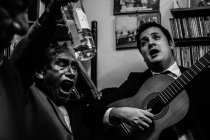
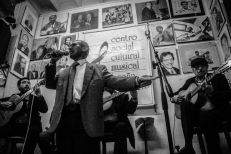
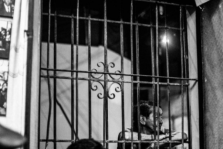
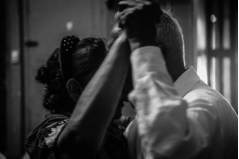
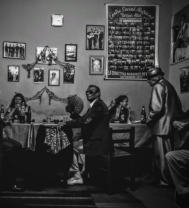
Figure 1. Caceres Alvarez, L. (2018). Lalo Llanos and Bruno Lara at La Catedral del Criollismo. Breña, Lima, Peru.
In that sense, photography and video—which incorporate an important auditory element—can convey aspects in ways that escape the approaches you refer to as more traditional. No matter how postmodern one may be, no matter how aware one is of one’s own bias, it seems to me that video, the audiovisual medium, is a very particular mode of transmission for criollismo, understood not only as a musical expression but also as a social and cultural one. It revolves around music, gathering, conversations, and states of mind. By watching a scene from a jarana or a recorded gathering, one can observe dynamics among the participants: one can see someone singing louder than another and notice details that, while open to subjectivity, are present and escape what is strictly musical.
If you say, “on such-and-such a day, at such-and-such a time, these songs were played”, or even if you are very specific and say that Chiclayo or Piura coplas were included, everything ends up feeling somewhat cold, somewhat schematic in relation to the real atmosphere in which these events took place. And while it is true that video is not a solution to everything—because there is always mediation, especially when someone is editing—it does allow one to open a window onto expressions that are not easily quantifiable or classifiable.
I think that is where the idea lies: the audiovisual functions as a tool that reveals these processes and, at the same time, fulfills another very particular function, namely that of the archive, something inherent to documentary practice. The archive becomes something that can be revisited. In the case of criollismo, this is even more evident. For example, as people pass away, as performers are lost, a record can remain—an archive that, over time, becomes invaluable. Imagine finding a video of the last time Óscar Avilés played the guitar at a gathering: that would have an enormous value as a historical archive. And one never knows who the next Óscar Avilés might be, or whether that man who has not sung all night long turns out, when seen in the recording, to be a popular composer from a particular neighborhood. The mere fact of his presence there, without doing much, already represents a value—a kind of important document, a document that transcends, as you say, the textual and the musicological.
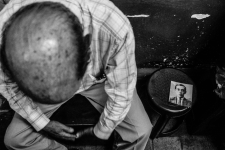
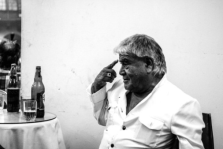
Figure 2. Caceres Alvarez, L. (2017). Gonzalo Graña and Felipe Pinglo at 20 years old. Breña, Lima, Peru.
In Idyllic Landscapes, you emphasize that the “live” experience is a priority for understanding, and that’s where the archival aspect comes in. But what kind of ethics or care does filming “from within” this popular world demand?
I think that’s a question anthropology has always asked, right? This idea of participant observation. To what extent is one an observer, and to what extent is one participating? Is it easy to participate in a jarana while holding a camera in your hand? Do the dynamics within the gathering change because someone is recording? Who is doing the recording is another very important point.
I explain this a bit in the text accompanying the audiovisual thesis. The criollo world of the so-called “older generation”—not the commercial or vocational criollo world, but this one that explores an entire network of affections and also conflicts—is very difficult to access. People like [Fred] Rohner, who manage to make a space for themselves
| [1] | Rohner, F. The Old Guard. The criollo vals and the Formation of Citizenship in the Popular Classes (1885–1930). Lima, Peru: Institute of Ethnomusicology, Pontifical Catholic University of Peru (PUCP); 2018, 463 pp. |
[1]
, researchers like [Rodrigo] Chocano, people who really get in
| [2] | Chocano, R. Will there be a Jarana in heaven? Tradition and Change in the Lima Marinera. Lima, Peru: Ministry of Culture; 2012. |
[2]
; it’s because they earn that space over time. And, like any other closed cultural group, it has its codes and barriers that must be crossed. No matter how much you want to, many times you never end up being an organic part of it.
It happened to me, for example, with an important person like a very well-known singer—he was at my grandfather’s house, invited to a birthday gathering, and he got very upset because I was recording. Of course, he had never seen me in his life and had no reason to know I was the grandson of the honoree. Even knowing it, I think at one point he chose to be aggressive toward me. They are understandably very protective, like any artist; they obviously value what they do. And many times, for them, someone with a camera is a journalist, a kind of “bird of prey” scavenging a moment that is very significant for them.
It’s something I never fully got over, even with people with whom I managed to build some trust. It’s very complex. It’s more complex than just saying, “Ah, this person is not criollo”. But why is he not criollo? And why don’t they consider him part of it if he has been coming for six months, a year, a year and a half, or three years? It’s part of the broader social conflict we have: class differences, differences in thinking, and intergenerational differences.
It’s very complicated for me. I even imagine a scene where someone who hasn’t attended a gathering in ten years suddenly appears and sees an anthropologist who has been there for three months, and says, “Who is this guy? Where did they get him from?” Then starts this kind of validation process, ways of being and identity specific to the group, in this case, criollismo. And that also involves knowing to what extent one must perform as a researcher: knowing when to dry a beer glass, when to be quiet, when to laugh, etc.
I found it to be a very complex group, a super rich and little-studied field from my point of view. There is also a kind of brotherhood—not exactly silence, but also not freely giving away details to anyone. In my thesis, I had a couple of incidents…
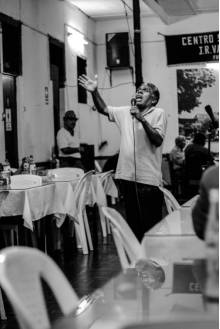
For example, with someone at the Centro Social Cultural Musical Breña…
I must be very grateful for the access I was given at Breña, thanks to being my grandfather’s grandson. Now, my grandfather is not a figure free of controversy. On the contrary, he has a strong and very straightforward character that can generate some antipathy. And he doesn’t care! But if your access depends on someone opening the door for you, indirectly doing a favor for your grandfather, you end up inheriting those same antipathies as well.
That’s why you must be very careful, very resilient, and know how to navigate between the personal and the collective.
2.2. Affective Tensions: Between Ethnography and Family
How did you manage the tension between ethnographic documentation and your familial or affective involvement?
Well, that is a topic I am still working on. Beyond considering myself someone with a lot of interest and a strong desire to research and learn more, I cannot for a single moment lose sight of the fact that, first and foremost, I am a grandson digging into what I have familiarly absorbed all my life, only in a more serious way and relying on a certain methodology.
I do not intend to divide myself between ethnographer and family member. And I think that is something I develop in my approach to documentary filmmaking. Recognizing myself in front of the audience as directly implicated, on an affective and intimate level, allows me to be consistent with my principles and feel that what I do has a certain authenticity.
Has your grandfather already passed away?
No, no. He turned 103 years old on September 19. For his age, he’s doing quite well.
Is he still painting?
No, he has lost his sight. He stopped painting several years ago. In fact, he continued painting well into his nineties. The recording for my audiovisual thesis began when he was 92 and lasted at least until he was 95. We even traveled together to Chiclayo when he was already over 94. So, he’s made of good stock.
Óscar Allaín is a key figure in Peruvian painting. Regarding these criollo moments, moments of jarana, how did his work and personality influence your perspective on the criollo?
In everything. Both his work and his personality. Since I was a child, I knew he was a painter, and I’ve seen his work at different stages—sketches, works in progress, and finished pieces—from a very young age. I recognize that I have a kind of duality there: I never quite feel completely part of that criollo tradition that my maternal family cultivates almost religiously.
On the other hand, my paternal family is not criollo at all. So, I always saw that bohemian world as something mysterious and attractive. A different way of being. I’m not even talking about “being criollo,” but about being a person; even when we start talking about gender values, about being a man. My paternal grandfather has a different way of understanding masculinity than my father, for example.
So, I think there is something very particular in my personal drive to research. I want to understand this part of my family much more, because it is also part of me, ultimately. My parents instilled in me a work ethic based on responsibility, which contrasts clearly with the festive spirit of, for example, how birthdays were celebrated back in the day: the serenade, the santo, the joroba, the recorcova, the respinguete, and the andavete.
I remember asking my grandfather how those people managed if they had to work the next day, and he would tell me: “No, most criollos were workers with trades where they controlled their own time. If someone was a mason or a painter, or made keys, well, they simply didn’t open their business that day, period”. It looks very nice in a book about others or a research thesis, but if you live through those long nights with alcohol, it becomes clear that if you don’t have the discipline to balance it out, you couldn’t live a somewhat productive life. Uncontrolled bohemianism can end up in a carousel of excesses that benefits no one.
But in Idyllic Landscapes that tension is also noticeable. What you say about admiration and distance is very strong. How did you manage that affective tension during the four years of research?
At the end of 2010, I began recording my first visits to the Centro Social Cultural Musical Breña. That tension is part of the entire process. It is also extrapolatable to the tension between the establishment and a cultural expression that, in many ways, belongs to another era, and is sometimes decontextualized.
Of course, this tension is not limited to me alone. That’s why it was important to include it in the research: because it is a real tension. Sure, the criollo can be very beautiful, but it also has a part that is not so much. There is a part that is difficult to access and that is surrounded by prejudices, by ideas inherent to it that no one can escape.
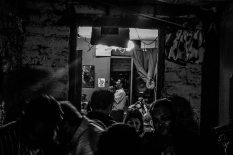
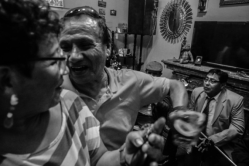
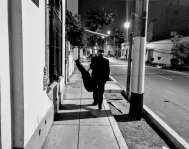
Figure 3. Caceres Alvarez, L. (2015). A Night in Las López. Lince, Lima, Peru.
So, could you tell me what you learned from your grandfather about this representation of the “people,” the “neighborhood,” the “criollo body,” and the “performance”? Your grandfather painted in oil, and you have documented it from a documentary perspective.
This research was marked by the distance with the figure of my grandfather. But also, by pleasure: it was the way I found to connect with my grandfather in a more intimate way than routine allowed. It was an opportunity to get to know each other, not only me getting to know him, but him getting to know me as well.
And I really think that is the beauty of documentary work, and of research, in this case from the anthropology of the family: you don’t leave your role as a grandson at the door. All the time, it was about getting to know an older criollo, who happened to be my grandfather. Understanding that entire cultural background. Of course, he paints, but he is not only a painter: he also sings and participates in the gatherings. I think that on his 93rd birthday, he indulged himself by singing at a peña in Miraflores. He has also had that desire or curiosity to transcend his role as a painter, as an observer. That need to express himself musically is part of who he is.
And he didn’t just sing: he also wrote poetry. He has always had a strong desire to express himself artistically, and I think in that way I connect a lot with him. Ultimately, I had the pleasure of getting to know him better in terms of his abilities, and of allowing him to get to know me, establishing with him a relationship different from the one we had before the research. We established a kind of complicity.
Were you more criollo than your grandfather? (Laughs).
No! Never. Never. I think, in any case, this experience helped me get closer to him, and that is something very significant for the researcher as a person.
Is there anything you haven’t been able to film from your grandfather’s heritage, from the legacy he leaves you, from the criollismo that is part of him?
Unfortunately, it will no longer be possible to record him. What I could probably record now would be other people talking about him, although that was not the intention of this research. I did not want to make a kind of tribute video, so I limited it as much as possible to the relationship between the two parties.
In any case, I could speak of him as that multifaceted presence that people remember positively, but also with its nuances. And that is not strange to me, because I always knew his character, how he also liked to perform his criollo identity as an artist. That is also interesting: how he understands what it means to be an artist, what freedoms artistic life allows, and the obligations it entails.
Because, of course, yes, very bohemian, all you want, but every day at eight in the morning he was in front of a canvas. And not necessarily because art was boiling in his veins and needed to be expressed, but also because it was an economic activity that allowed him to live. Which, for me, is a real achievement.
Now, in these times, when the relationship between image and its distribution circuits is more “transparent,” and there are new ways of understanding artistic practice, it seems to me that that generation and that type of artist deserve recognition. My grandfather is not considered a great master like José Tola, [José] Sabogal, or Tilsa Tsuchiya, who fulfill that mandate of the artistic understood as a unique, irreproducible work with market value as a singular object.
He, on the other hand, basically reinvented himself. It was as if a musician composed a song and did not record a single version, but played the same song over and over again, in different eras, in different places. And you could even observe—from such a year to such a year—how his voice changed, what type of guitar he used, what equipment he recorded with… but applied to a pictorial motif.
He reinvented himself a million times. Why? Because that serial production, but without a machine, was what allowed him to live. He lived from it. He had no family inheritance or property. He was the beginning of his own tradition and allowed himself to live by his own rules. I think that is very commendable.
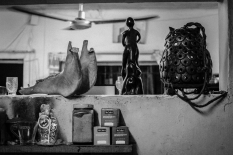
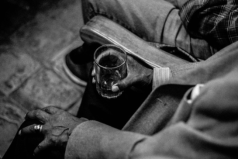
Figure 4. Caceres Alvarez, L. (2018). A cup, a donkey jaw, Chulucanas pottery, and an owl. Breña, Lima, Peru.
2.3. The Visual Study of Criollismo
What potential do you see in documentary photography for studying criollismo and its spaces?
At first, it seems to me that any type of documentation is valuable. But it also depends on the mindset with which it is done. It’s not that one type is better than another; rather, each record responds to a different intention: documenting the spaces? The occurrences? The events? The Día de la Canción Criolla? Or perhaps conducting a visual research project like La Catedral by Wendor Salgado? Other interests may also converge, such as the desire to create artistic photography.
These are very significant spaces and events. That’s why I consider that any type of documentation can serve many purposes: it can have aesthetic-artistic value, or it can be used to gather visual information. For example, someone might ask—and it wouldn’t be a crazy question: is there a particular aesthetic in the homes of criollos? In the spaces where people jaranea? Are they living rooms, gardens? Closed or open spaces?
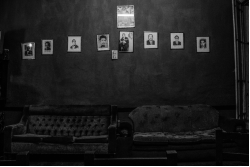
Figure 5. Caceres Alvarez, L. (2016). Main hall of the Barrios Altos Musical Social Center. Barrios Altos, Lima, Peru.
These are also private spaces. No one opens their home for just anyone to enter, but we still must ask: who is the audience? Is it a family event, as is most often the case? Many of these family gatherings leave no record, and for that reason, they could be forgotten. That is why photographic documentation is so valuable: it rescues the everyday, the ephemeral.
So, there are many factors to consider: first, the mindset with which the photos are taken; second, the nature of what is being photographed. And, of course, all of this is important for ethnographic research.
.
For example, beyond public-private spaces or musical clubs, we could focus on family jaranas, and the result would be completely different. One could even ask seemingly trivial questions, such as: what color do criollos paint their walls? It might sound trivial, but if you take photographs in color, you could discover patterns, aesthetic details that say a lot about material culture.
In my case, I focused more on ways of being criollo, because I had a particular, and I admit perhaps even selfish, interest in understanding who this person, my grandfather, really was.
So, of course, I think about all the people I met—not just the singers, but also the people who worked at the Musical Center. For example, Elsa. That person was incredible to me; I established a very affective connection with her. When the time came, I told her that the research was focused on my grandfather, and she had many interesting things to say about him, not all necessarily flattering.
Seeing my grandfather through the eyes of an Afro-descendant woman from the working class was revealing. There is no way to know him in that dimension except through her eyes. And that made me think about the enormous potential of video, photography, and even sound recording. All these media allow one to capture nuances, resonances, gestures, and silences, which are hardly conveyed through words alone.
Talking with you, new ideas occur to me, like creating a kind of sound map of the places where Musical Centers exist: how the street in front of each one sounds, how that corner sounds. I am sure the sound is not the same in Breña as it is in Callao, Rímac, or La Victoria, and that is how it resonates.
Figure 6. Caceres Alvarez, L. (2015). 11th anniversary of La Catedral del Criollismo. Breña, Lima, Peru.
How can one visually translate the rhythm, improvisation, and humor?
I think there are untranslatable. One can approach them, but as with the most deeply rooted identities, you cannot simply put on a criollo outfit and take it off at will. If someone is seen doing that, they will quickly be identified as an outsider. Being criollo, as cliché as it may sound, is living as a criollo. It’s like being an artist: almost everything is a performance.
There is something interesting that, now that I mention it, was left out of my research: politics. In political terms, what kind of political life did these people have? Because in our time, political participation basically boils down to voting and marching at specific moments. However, these people come from a completely different generation, which experienced very different political moments throughout their lives. And that internal tension, almost inherent to criollismo, about what constitutes the music of Peruvian identity… How did criolla music come to be considered the music of Peruvian identity? Is the tension with Andean culture limited only to music? When you go deeper, you realize it is a real tension, one that is part of the society we live in and that is unavoidable.
It is a theme that is present, and I think that, just like humor—which can sometimes be easier for us as Limeños to approach—there are also aspects that involve much deeper tensions, going beyond what is strictly musical.
2.4. Peruvian Anthropology, the Study of the Criollo and the Problem of Exotification
In Idyllic Landscapes, you mention that criollismo, despite being a popular expression, can reproduce certain discriminatory patterns toward Indigenous people. Could you elaborate on that?
The one who has worked on this topic from a theoretical perspective is one of your interviewees, José A. Lloréns
. He has a book specifically dedicated to it:
Musica popular en Lima: criollos y andinos (1983). There is an evident polarization around this issue, and it is enough to visit any criollo center or any
jarana and ask the older gentlemen what they think of Grupo 5, or of musical forms of mestizaje like chicha or Amazonian cumbia, to realize that discrimination still exists, shaped by the historical and social context we live in. We are children of our reality, and
criollismo does not escape any of this.
The fact that Prado institutionalized
criolla music is also interesting, because it shows that it is an interclass expression. It is not unique nor entirely popular. It is like a curve: it begins and develops as a popular expression in the early decades—as Steve Stein shows in
Lima obrera: 1900-1930 | [5] | Stein, S. Lima obrera 1900-1930. Lima, Peru: El Virrey; 1986. |
[5]
—then reaches a peak of popularity driven by a whole musical and recording industry, a real boom, and afterward enters a decline that, in some way, we are still experiencing.
But it was popular enough to cross all social strata. Just think of a composer like Chabuca Granda and a performer like Lucha Reyes. They are very different figures, one a singer-songwriter and the other a performer, but both are fundamental.
| [6] | Lloréns, J. A., & Chocano, R. Celajes, florestas y secretos: A history of the popular limeñan vals. Lima, Perú: National Institute of Culture; 2009. |
[6]
.
And then these ghostly images appear, completely fabricated, of a viceregal Lima, a “pure” Lima without contaminants, a Lima criolla in its purest state. So, what is criollo? Where does the word “criollo” come from? Which group was considered “criollo” at the beginning of the Republic?
It is fascinating because criollismo is popular and, at the same time, it is not. It can be elitist, but it is also not accurate to say it is essentially elitist.
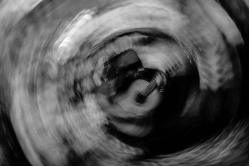
Figure 7. Caceres Alvarez, L. (2018). Mi guitarra palpita como un loco corazón. Breña, Lima, Peru.
Is it a mix?
It is a polyhedron that keeps turning, and depending on where you grasp it, you will find three, four, five, or six different dimensions
. That is precisely what makes it so distinct and rich to study, especially in times when every research project seems colored by a specific ideology. Each point of view approaches from a particular place, and there is also a politics behind studying the great retablo makers, for example. It is not something limited only to
criollo. I think that these kinds of cultural and artistic manifestations, so complex, are very valuable for understanding who we are as a society: who we were, who we are now, how we have changed, and how we continue to transform.
Ten years after the publication of your thesis, how has your perspective on criollismo and visual anthropology changed?
Visual anthropology is incorporated into my way of seeing and making film. It is present, above all, in its critical dimension in self-critique, which for me is one of the most valuable things I gained from studying it. I stopped being a person who records thoughtlessly and, above all, who edits thoughtlessly, without that meaning becoming paralyzed.
It is a continuous process that has a lot to do with postmodern thinking. I remember in an ethnographic film course we watched a film by the Vietnamese filmmaker Trinh T. Minh-ha, which begins with the phrase: “I am recording, but why am I recording?” That question stays with me to this day. I have never stopped following that logic, constantly questioning myself. Additionally, I try to move away from clichés, to contribute something different, because clichés tend to reproduce hegemonic thoughts, hierarchies, and factual social relationships within the society we live in and for which we also produce.
Let’s talk about the documentary Lima Bruja , because it presents a tension you mention in your thesis: the commercial, the exotic, the folkloric, and the underground. How does your critique of that documentary relate to your approach to criollismo? My critique wasn’t so much about what should or shouldn’t be done. I think everyone approaches the topic from their own position, but of course, one doesn’t approach it only as a producer, but also as a viewer and, in my case, as a critic of a cultural artifact that is a film. Something that caught my attention—and I think I do mention it—was the issue of food. For example, when in the film they eat “gato” or “cabrito de techo”. There is that need to maintain a critical perspective toward oneself. That goes beyond ethnographic research and the academic realm. It’s not about censoring or dictating how to make a film; for Rafael Polar it was necessary because it is part of his experience, and he has every right to do it, but I also consider it legitimate to offer a critique in that regard.
You have mentioned exotification as one of the most persistent flaws in cultural production. Why do you consider that this perspective improves the understanding of criollismo?
Exotification seems to me to be one of the most recurring flaws, and unfortunately it does not seem to end in cultural production in general. I understand that it may be more attractive or more “marketable” to show a scene where they eat gato, but while does a disservice to the complexity of the criollo polyhedron we were talking about. I don’t think Lima Bruja is a bad film; on the contrary, over time it has gained strength and today functions as an invaluable testimony, in every sense of the word.
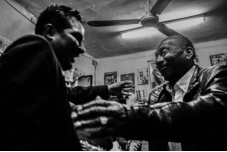
Figure 8. Caceres Alvarez, L. (2016). Carlos Hidalgo and Enrique Molina in The Cathedral. Breña, Lima, Peru.
In your thesis, you point out that Peruvian anthropology has been historically marked by an indigenist perspective. How does this affect the study of criollo and criolla music?
This is a topic that even goes against the historiography of the Social Sciences in Peru. Peruvian anthropology is founded by an indigenist school, and all the major schools are tinged with that influence. I find it interesting when that perspective becomes more complex, when it enters more personal terrains: family ethnography, autoethnography, in a country where the tension between the Andean and the criollo—or between the Andean world and the Western world—is foundational to our identities.
As Plato said, we reproduce the State within ourselves. We are the State. Education is designed so that the State reproduces itself in us. And, of course, the State in which we live has its flaws, just as it also has its great achievements.
I find this very interesting when it is applied to academic research, to a very particular way of doing anthropology. That is why some of my professors, who have done work in visual ethnography and visual anthropology with great masters of Andean art, had no idea who my father was. And that’s fine; it is completely valid. The recovery of those traditions is necessary, but it is also interesting that they don’t know, for example, the Centro Social Cultural Musical Breña or the figure of my grandfather.
And it’s not that they should know it just because he is my grandfather, but because his work is quite particular: it moves in those interstices that the broom of Limeño or Peruvian anthropology usually doesn’t reach.
What narrative or visual strategies do you employ to create tension with or subvert hegemonic views of “the Limeño” or “authentic criollo”?
It’s very complex. What may seem subversive to us can be exactly the opposite for other people. They might say: “No, you’re playing the game of the upper-class Limeño, criollo, white, Chabuca Granda, and the balconies with ornamental ironwork”. So, am I doing something subversive, or am I reinforcing an outdated and colonial system? (Laughs).
Figure 9. Caceres Alvarez, L. (2015). A person watches the members of The Cathedral singing. Breña, Lima, Peru.
Neither chicha nor limonada…
Neither maracuya nor tamarindo (Laughs). In that sense, I value research on criollo very much because it allows us to tell a story that doesn’t necessarily make us feel comfortable or proud. I am interested in the mirror reflecting that multiple images, that polyhedron that sometimes appears perfectly faceted and structured, but at other times can be amorphous, unstable, and changing.
Returning a bit to the topic of Lima Bruja, I think that the deeper research, the more involved one becomes in it. And yes, I believe it is now time to take that another step: looking toward the familiar, the intimate. If the State is reproduced within us—as we said before—and if that tension between the West and the Andes is present in every thought we have, then autoethnography and subjective research can offer a very powerful perspective. They are often underestimated, but I think they can provide profound and necessary insights into who we really are.
Figure 10. Caceres Alvarez, L. (2015). Y que importa mañana la condena. Si estuvo un rato, el corazón contento. Lince, Lima, Peru.
2.5. Research on Criolla Music Today
You have pointed out that we should value research on criollo more because it is important not to always tell ourselves a pleasant story, but a complex one. I find it striking that there are so few researchers dedicated to studying criolla music and its transformations in different regions of Peru. Some argue that criolla music develops primarily in the main urban centers. How do you see this?
I’m not approaching the topic from an academic mindset, nor am I up to date with all the recent publications, but I do remember that when I was more active in research, around 2015, there was already a lot of discussion about this. Everything revolves around music. If there is a fundamental element of criollismo that cannot be overlooked, it is this: the music.
It is not visual production that sustains it, but the musical aspect, and there is something interesting here because it shares a lot with food. Criollo music and food are very close categories; both are an essential part of gatherings and celebrations. But I’m no longer sure if all of this can still be considered “criollo” in the strict sense.
What I am clear about is that there is much more research and interest—and especially market—around gastronomy than around music. In music, there is no money at stake, or at least not in the same way. In countries like Spain or Argentina, for example, traditional music has become a cultural industry, whereas here it hasn’t to the same extent. People who make music do it out of passion, out of love for the art, but they can hardly sustain themselves solely from it.
This inevitably discourages the emergence of new bands or innovative projects within criollismo. And as you say, there aren’t enough creators or researchers generating new circuits or new audiences.
I don’t consider myself a specialist by any means, but it does strike me that there isn’t really any truly innovative production. It’s as if postmodernity has never arrived in criollismo (Laughs). It remains in a state where everyone seems to be playing a role, pretending something, but without looking inward. That intimate conflict, that reflection on being, is missing—something we do find in other musical traditions.
In your thesis, you acknowledge that, at the beginning, your approach to criollismo was conditioned by a “conflict of interests” and by a certain unconscious defense of the idea of an “authentic” criollismo. How do you now engage with that critical reflection on the very notion of “criollo” and its multiple meanings?
I reaffirm what has been called “authentic criollo”. Perhaps there are more recognizable traits—as several authors have pointed out—but I have the impression that between two people who belong to the same music center, who have shared most of their lives as members and have known each other for forty or fifty years, there will surely be substantial differences in what it means to be criollo. That is not written down.
To some extent, this situation is shared with other types of identifications after the twentieth century that are also quite “amorphous.” For example, I think of the case of Antifa: what is Antifa? Are you Antifa? Who is more Antifa? That’s the point. Trump designates it as a criminal organization, but if you look more closely, no one can encompass everything that someone identifying as antifascist might signify, nor the full range of positions that emerge from it.
Figure 11. Caceres Alvarez, L. (2021). En el ron de la jarana. Barrios Altos, Lima, Peru.
When we think about criollo, there is usually a prevalence of the Western—because otherwise, it wouldn’t be criollo—and that could be one of the safest grounds from which to start defining it. From there, other perspectives can be explored and specific authors cited.
In my case, one of the authors who influenced me the most was someone who, in a way, aligned with what I was observing in my grandfather and how he himself defined criollo. My grandfather also tried to define it, but his definition varied depending on the context, the stimulus, or the people he was with. For example, you might ask: Is Chabuca Granda criolla? Common sense would say yes, but in a specific circumstance, in a specific context, and with specific people, she might not really be, at least not with the conviction or clarity we usually assume.
In my case, the criollo practitioner I encountered was Wendor Salgado, and I believe he breaks with many of the most widespread stereotypes about the figure of the criollo. He states that the old criollo was respectful, honorable, humble, and above all, well-loved for his good deeds. How does that vision engage with the idea of criollismo as an open category or “empty container” that you propose?
That’s the Robin Hood criollo. That’s what I mean by the idea of the empty container. Personally, I’m not going to associate my identity with that part of what is understood as “criollo,” but there are many people who still relate it to something negative; it’s a reality, and in a way, it comes naturally to people.
For me, obviously, as for you, it’s striking, and one says: “Hey, that’s not being criollo”, and then I turn into my grandfather (Laughs): “Be more careful with the words you use.” But at the same time, I can understand it if it’s a more general allusion.
You would never say at a family gathering: “I just went and did a couple of criolladas”. What do you mean by that? Yet, that sense exists in language, and if it exists in language, it also exists in people’s minds.
In your thesis, you point out that the category “criollo” acquires positive or negative meanings depending on the context, the speaker’s intention, and the standpoint from which it is expressed. Even “positive” criollismo varies according to the area or district. How do you interpret this variability today, and what does it imply for studying criollismo?
It is consistent with what I found during my research and with what I read; I don’t see any contradiction. It seems to me that everything depends on the assumptions people hold and how they interpret the concept. For me, it reaffirms that there are indeed many criollismos.
For example, there is a middle-class criollismo, an upper-middle-class criollismo, another of the upper class, and all have very different characteristics. They are distinct sets: there are people who play castanets, people who dance marinera, and a million other things.
You could also be referring to the shift in musical production toward Afro influences in the 1970s; that could be your frame of reference for what criollo is, and it doesn’t necessarily coincide with what the person next to you, waiting their turn at EsSalud, thinks criollo is. It can vary greatly.
In your thesis, you point out that by giving up the definition of a fixed “criollo identity”, you were able to explore different ways of understanding and performing criollismo, where memory appears as a central axis. This is also reflected in your approach to visual anthropology and in the documentary constructed from your grandfather’s memories. Additionally, you assert that criollismo will continue to exist if someone remembers and practices it. Could you elaborate on that relationship between memory and the continuity of criollismo?
I believe that, as a phenomenon, criollismo is part of the history of Peru and of its cities. It seems to me that these identities exist as long as they are performed, as long as actions are taken; it is not simply “I am criollo in my mind.” Even reproducing certain ritual characteristics, which are still maintained today, is part of this. And you, having conducted research with Mr. Salgado, obviously know this better than anyone: it is one of the places that preserves this traditional outlook.
I hope this does not offend those who consider that there is a “pure” way of being criollo, a tangible or “monolithic” criollismo—I’m not sure if monolithic is the exact word; I believe it is much more fluid than that. While musical production has not fully reached postmodernity, this has indeed arrived through fluidity.
I take advantage of what I mentioned earlier about freeing myself from attempting to define it in a positivist way: I began to see the ghost of the criollo that surrounds us, present and permeating, at times, events and relationships far more than we might like to think.
Figure 12. Caceres Alvarez, L. (2016). Short Drink. Day of Canción Criolla. Breña, Lima, Peru.
So, could we speak of an emotional geography of criollismo?
That Limeño world prior to Leguía’s works, with the natural connection between neighborhoods, allowed for a highly differentiated cultural and identity development. Among almost contiguous neighbors, such as Rímac and La Victoria, there were specific characteristics; each block, each alley had its own idiosyncrasy, and it was there that popular music developed. That is the criollismo my grandfather knew. It was neither academic nor institutionalized. It did not depend on a music club where everyone would gather every Friday; it was his way of living. It was everywhere. It was not something that a group needed to guard, safeguard, or preserve; it was not in danger of extinction.
In that formative stage, it seems to me that all these particularities were sown. Of course, some things might sound anachronistic, but it is no longer necessary to explain them. Look at the very interesting contrast between Manuel Acosta Ojeda and Wendor Salgado.
I believe they are archetypes within the history and culture of criolla music…
Sometimes I have heard various rankings from my grandfather regarding a specific figure. For example: “Criollismo is macho.” But that cannot be understood without a bit of context. What the hell is “el tren macho”? This has to do with our cultural society, our criollo society. If we want to trace back to the origins of the country that began to take shape in the 19th century, it could not have been otherwise.
Figure 13. Caceres Alvarez, L. (2021). I press against your chest. Barrios Altos, Lima, Peru.
Regarding the criollismo of Chiclayo, how did you experience it? What elements did you take from that environment, and what would you say is the “mystique” of that city in relation to criolla music?
Honestly, I would be at fault if I tried to define something I don’t know in depth. I haven’t spent enough time to claim that I fully know the criollismo of Chiclayo in all its dimensions. What I can say is only what I experienced, because what I was doing was not research on Chiclayo’s criollismo per se.
We went to a place called “La esquina del movimiento”. It is a corner where the musicians of Chiclayo gather. In the past, even at times when there was no radio, people would meet there, sing, and perform songs in their own way. It was a meeting point: if you were throwing a party, you would go to that corner, gather a band, and take them with you. That’s where musicians found work, and around that, a kind of musical scene developed.
My grandfather knew several people from that environment, so what we did was a very spontaneous recreation. There was no overly structured production: I was the director of photography, handled the live sound, the audio, everything. And it was a very pleasant experience. For me, it was a way to get to know my grandfather in another context, to spend more time with him than I had in my entire life.
There is a very funny part in the documentary, towards the end, where my grandfather says: “Ah, yes, before I used to see you and think: there he is, my grandson” (Laughs), just one among many. And of course, there is something deeply emotional there. It wasn’t a conscious attempt to gain his appreciation, but rather a genuine interest. I have always been fascinated by my grandfather as an artist: his vocation, his passion.
In that transition, criollismo appears as a constitutive space, encompassing all his interests and permeating his entire identity discourse. In the end, we are all complex people, full of archetypes, projections, idealizations, but also contradictions. And that is what I find most interesting: how that mixture of projected identity and real person is ultimately revealed through the relationship and the time shared.
During your experience at the Centro Social Cultural Musical Breña, was there any prejudice that transformed or unraveled in the process? And, based on what you experienced, do you think it is possible to speak of a new criollismo among young people or in popular spaces?
Everything I have mentioned is based on what I experienced between the end of 2010 and 2015. It is important to specify this time frame, because perhaps in the following years a new movement emerged that I am unaware of or that simply did not reach my ears. I do not intend, therefore, to represent anyone else or speak on behalf of a general panorama, but only to refer to the specific experience of that research.
What I saw then did not surprise me, but it did catch my attention that young people were involved in criollismo. However, I also noticed a certain distance: a kind of reverence, like that shown in a temple toward images or monks, toward the “initiated,” the regulars, the elders over seventy who embody the tradition. That respect, I believe, also functions as a barrier that prevents renewal or generational dialogue.
I am not a specialist on the subject, but I cannot help comparing this situation to other contexts, such as Argentina, where tango presents an infinity of variations and where there is an industry that allows many to make a living from the practice. In the Peruvian case, that circuit still seems fragmented or lacking a sustained dynamic to keep it alive and evolving.
2.6. Audiovisual References, Influences, First-person Documentary and Aesthetics
Could you tell me about your experience working with documentary filmmaking and how this medium influenced your research?
I have been involved with documentary filmmaking for several years. In 2013, for example, I visited Buenos Aires to participate in a festival: one of my short films was selected at the Mar del Plata Festival to compete in the Best Latin American Short Film category. At that time, I was also in the midst of the research stage for my thesis. That short film is called La mirada de un extraño (The Gaze of a Stranger).
My academic background has also been a guiding thread. I completed my undergraduate studies at the University of Lima and then pursued a master's degree in Visual Anthropology at the Pontifical Catholic University of Peru, which is when everything we have already discussed regarding documentary filmmaking and research took place.
Later, in 2017—after having completed my thesis—I pursued another master's degree at the Escuela Internacional de Cine y TV (EICTV) in San Antonio de los Baños, Cuba. It is a school with a particular history, founded by Fidel Castro, Gabriel Garcia Marquez, and the Argentine filmmaker Fernando Birri.
How was that experience?
I think that when I entered the master's program in Visual Anthropology, I was still closer to journalism and academic research. For me, it was a whole process to find an authorial voice. La mirada de un extraño was the first step, as I mentioned, but Visual Anthropology also gave me a particular perspective on the kind of documentary or cinematic production I would like to create.
Personally, I feel more like a filmmaker than a visual anthropologist. In that journey, the experience in Cuba was fundamental. Being at a school like EICTV is unique: I stayed for six months, while the regular program—which would be equivalent to an undergraduate degree—lasts three years, with the possibility of returning to your country for one or two months between cycles.
What impressed me the most was that academic excellence was never neglected: the level of the professors, classmates, and the creative environment was outstanding. Having access to a program like this, in such a specific discipline, was truly a privilege.
In the references for your documentary, you mention Lima Bruja. Portraits of criolla music, by Rafael Polar, and Lucha Reyes, Letter to heaven, by Javier Ponce Gambirazio. Would you say that these two works are your main audiovisual references within the criollo universe?
Yes, because there isn’t much material available. Beyond television programs—which we could consider part of a broader audiovisual record—there aren’t many cinematic works on criolla music. I imagine there must be more; for example, I know there is a documentary about Chabuca Granda that will soon be screened at the Pontificia Universidad Católica, and I’m interested in seeing it precisely because works like these are scarce.
This is striking when we consider that Peru had, for almost twenty years, a Film Law that required the screening of short films, mostly documentaries. There must be thousands of works that, due to cultural policy issues, are not properly archived or accessible. We should have a national film library, a preservation system, and a clear state commitment to safeguard the enormous amount of material that has been produced and that forms part of our culture, our country, and our society.
Today, this responsibility falls almost exclusively on academia and universities, because there is no sustained policy from the State in this regard. In fact, in recent years, cultural policies have been weakened, disorganized, or even openly undermined, to the detriment of creative development and the consumption of Peruvian cinema. I believe we are witnessing a very evident regression in terms of cultural institutionalization; deeper and more specific than other legislative changes we have experienced previously.
You have mentioned that documentaries like Time Indefinite, by Ross McElwee, acted as a catalyst for your work. What did you find in that kind of cinema that allowed you to say: “this is the way”?
It’s a small observation, but Time Indefinite is a very well-made documentary. It’s curious because I don’t always have such clarity about my own processes, but in this case, I did. I changed my thesis advisor because I wanted to work with Wilton Martínez, a professor who had made a very good impression on me during my master’s at the Católica. When he saw some preliminary sequences, I had already put together, one of his first recommendations was to watch Time Indefinite.
For me, few documentaries have influenced what I do to this day as much as that one. Ross McElwee has several films, but in my view, there are two that are pillars of his work. One is the better-known Sherman’s March, which is crafted more as a comedy. It’s an interesting documentary in which he himself appears as a character, almost as if created by Woody Allen: he reflects on his relationships, digresses, exposes himself, always from what in documentary cinema is called the device, that is, the narrative axis that supports the film.
In my documentary about my grandfather, that device was precisely the act of getting to know him: traveling with him, spending time together, approaching him in a more holistic, more complete way. That experience became the narrative framework that moves the film forward and allowed me to build a more intimate perspective of him as a person.
With its lights and shadows…
What McElwee does in Sherman’s March is fundamental. He follows General Sherman’s route from north to south, and what’s interesting is the standpoint from which he speaks. McElwee is a young man from the southern United States who goes to study film in New England, the northeast of the country—a much older region, with a liberal and progressive society, but also with a very marked social elite. He arrives already with an identity fracture: he is the son of a doctor, from a wealthy southern family, and he decides to study film, something his family sees as a total frivolity.
From there, he uses the historical figure of General Sherman—a northern soldier who ravaged the South during the Civil War—as a major narrative device. Sherman practiced what would later be called “total war”: not only winning on the battlefield but also destroying production means to destabilize the enemy economically. McElwee takes that historical wound, that north-south trauma, to tell something seemingly very different: his amorous misadventures. It is a funny and entertaining film, where humor coexists with a deep reflection on identity and belonging.
The counterpart, on the other side of the coin, is Time Indefinite. It is like Sherman’s March, but serious. Here he begins to look inward. A family event—the arrival of his nephew—leads him to reflect on his relationship with his father, on life, death, and time. There is something fascinating in this transition: scenes that are repeated between both films. For example, when he visits an older friend who invites him to film and, at the same time, tries to introduce him to a girl. It is the same person but filmed differently; the emotional tone is completely distinct. In Time Indefinite he is no longer the wandering young man, but a man searching for himself, revisiting his own personal icons from another perspective.
First-person narration and unvarnished subjectivity are perhaps what McElwee masters best. He offers a very powerful dissection of the paternal figure, always from affection and sensitive observation. He films these encounters with diverse characters that together construct an intimate but also cultural portrait. Even the title Time Indefinite comes from a casual encounter: some Mormon missionaries knock on his door, he talks with them, and one utters that phrase. McElwee turns it into the key to the film, a glorification of the eventual, of that cinematic dimension that resides in everyday.
Time Indefinite ends up being, moreover, a farewell to his father. What I am recounting may sound like a spoiler, but it does not ruin the experience. It is a deeply felt testimony, and, above all, it served as a compass for me: it showed a possible path, a way of making documentary in which the intimate, the emotional, and the self-reflective are not obstacles, but a source of power.
Based on your experience with Time Indefinite, your research leads to a documentary built from your relationship with your grandfather. Why did you choose to work from the first-person perspective?
To approach my grandfather, I had no other option but to do so from the most genuine place possible: myself. It wasn’t about finding an “authorial voice” as a cliché, but about understanding what I was interested in telling and why. The device was to get to know him, to travel with him, to spend time together. That experience allowed me to construct a more intimate perspective, with its lights and shadows, and to embrace subjectivity as a strength, not a weakness.
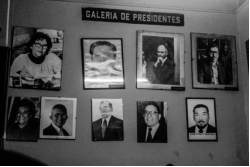
Figure 14. Caceres Alvarez, L. (2015). Presidents of the Breña Social Cultural Musical Center. Breña, Lima, Peru.
In relation to the documentary’s aesthetics, what other audiovisual influences were important to you, and what aspects of them attracted you the most?
There’s a film called Viaje en sol mayor (Voyage in G Major), a French production from 2006. It’s very beautiful because it focuses precisely on grandfather and grandson traveling together. I’d say that what I mainly took from that film was the “travel” device. In Viaje en sol mayor, the journey forms almost the entire structure; in my documentary, however, the journey is just one part, because the project extends beyond that physical movement. Still, it was a reference that helped me imagine how a documentary with my grandfather could work.
In your creative process, it’s not so much about citing references literally, but rather reinterpreting them. How do you understand this gesture of symbolic appropriation?
I’d say that what one “takes” is not always literal. Sometimes what we do is pick symbolic elements, atmospheres, questions, and reinterpret them for our own creative process. And I think that’s inevitable: not everything can be a direct citation. Each person develops their own ideas, and you can’t avoid interpreting; in a way, it’s our only resource.
Would you say that these references are key to understanding your visual interpretation?
I suppose so. And I think, in visual and formal terms, there were very concrete influences. For example, the use of intertitles or on-screen text. This device appears in several documentaries; one I specifically remember is La casa Emak Bakia (2012), about a house that belonged to Man Ray. It’s a Basque film that plays a lot with text over image, and I feel that something of that style made its way into La mirada de un extraño.
When I reviewed the film years later, I realized that influence had been stronger than I initially thought. In La mirada de un extraño, the text functions as part of the narrative device; it’s one of the engines of the short film. And although over time I became less interested in using text this way, at that moment it was important.
Text—whether in voice-over or visually—always offers expressive possibilities: playing with typography, spacing, placement within the frame, deciding whether it appears via cut or dissolve. All of that has a very appealing design component. But, as I said, it’s something I gradually moved away from.
The same happened with the use of black screens. Later, I reflected on why I was using them, whether I was using them effectively, and what they meant within the structure. Looking back, these resources mark a particular stage in my aesthetic exploration.
Over time, how do you evaluate the use of resources like black screens or intertitles, and what did you learn from that process?
Part of my experience in Cuba was learning something that, although it sounds obvious, isn’t when you’re in the middle of creating: understanding the other half of the process, which is receiving feedback. What I learned there was that creating also involves receiving criticism and learning to live with it. Even in the harshest critiques, there’s always, even if minimal, a kernel of truth.
In La mirada de un extraño, the black screens work because the image is based on photography. It’s literally a soundtrack accompanied by a body of photos, almost like a multimedia slideshow. There, the black functions because the images can appear or disappear; it’s part of the format’s language. But when you work with moving images, that logic doesn’t work the same way. So that device, which was part of my style at the time, no longer identifies me as strongly.
Black is a very strong marker: “end of chapter one”, “complete cut,” a shift in mental space. Every device has its own grammar, of course, and this one is valid. But I feel that in that film I overused it a bit. I also think the fact that it was an audiovisual thesis worked against me. Perhaps I tried to satisfy my own idea of what the academy expected. And that, more than helping me, felt like putting on a straitjacket myself.
For example, you reference an author like Elisenda Ardèvol. To what extent do you consider audiovisual media to be a form of autonomous knowledge, capable of thinking for itself, beyond merely serving as a tool to illustrate or show?
I think it’s great that you make that connection, because my interpretation is precisely that audiovisual work is a distinct exercise. Even if we consider Margaret Mead and her famous ethnographic short film with her husband, where they compare how babies are bathed in two different cultures, we see that—even when the intention is to show cultural differences—there is inevitably a creative gesture. Mead chooses shots, decides how to edit the scene, how long each fragment lasts, and narrates in a very engaging way. That material ceases to be just an academic document: an authorial operation is already shaping reality.
And this is where I think ethnographic cinema often falls into a certain kind of fundamentalism. In the aspiration to be an “objective” document, the subjective, expressive, and emotional dimensions of the audiovisual act are downplayed. That’s why figures like Trinh T. Minh-ha are so important: her work introduces a critical view of the process of representation itself. She problematizes the idea that we can show the “other” without questioning the position from which we observe.
Even when one thinks about making fiction cinema, an anthropological background leaves a very clear mark: a constant awareness of not reproducing clichés, of avoiding exoticization, of identifying the commonplace points where power operates. I think part of that training is precisely this: knowing where the pitfalls lie along the path, the places you can fall without realizing it.
Being conscious of the discourses we reproduce—both as individuals and as agents within structures of power—allows us to avoid reductive or conservative perspectives. Because, in the end, if you don’t introduce a critical perspective, you are not dismantling power: you are reproducing it. And that, for me, is serious. Repeating a discourse that contributes nothing, that neither questions nor complicates, is missing the opportunity to construct a more honest view of the spaces from which we speak.
And regarding your documentary influences, what did you think of Buena Vista Social Club (1999) by Wim Wenders? In relation to the so-called “old guard” of Cuban music, did you draw any parallels with criolla music, especially in the relationship between the filmmaker and the subjects being filmed, as you point out in your thesis?
While it’s an enjoyable film, Buena Vista Social Club is interesting because, in principle, it could make sense within that logic. However, in my case, the theme of criollismo appears only in relation to my grandfather, as part of family ethnography, and it wasn’t something I was interested in addressing from a broader perspective. In that sense, Lima Bruja leans more in that direction: it focuses on collective documentation. They are, in any case, distinct approaches.
The first thing I think of when I mention Buena Vista Social Club is Ry Cooder and how he engages with the musicians. There’s something slightly off—a string that isn’t fully in tune on that harp. It’s not that the film is bad overall, but there’s a detail that doesn’t quite fit. And perhaps that’s also where my interest in telling my own perspective arises, which is partly autobiographical.
That first-person perspective, aware that it is being articulated from one’s own experience and reading, seems almost indispensable to me. “Vampiric” narratives always create distance; they don’t feel authentic or genuine, and I think first-person narration can prevent that. I might be quite committed to that idea, but it’s the type of cinema that interests me.
For example, I think of Stories We Tell (2013) by Sarah Polley. There, the story ultimately becomes the stories, in the plural: it depends on who tells it and how they tell it. There’s no closed statement like “this is how it was”; instead, there’s a spectrum of perceptions about the same person—the child, the friend, the lover, the ex-husband. The entire film itself is part of that spectrum. And that, for me, is one of the great strengths of audiovisual work: making visible the point of view from which the filmic text is articulated.
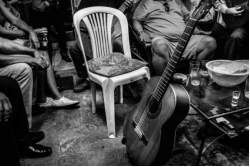
Figure 15. Caceres Alvarez, L. (2018). Chair and guitar by Wendor Salgado Bedoya. Breña, Lima, Peru.
I also think of Viejo Calavera (2016) by Kiro Russo. Bolivian cinema is going through a very interesting moment. His later film, El gran movimiento (2021), produced an ambiguous reaction in me. Although my main concern is exoticization, there were moments when I found myself wishing that the director had some indigenous connection, as if that would grant greater legitimacy in his articulation.
And here a clear limit appears for me: if you decide to tell a story from a place of ignorance, with little research, projecting your own ideas and prejudices onto what you are narrating—even in fiction—I lose interest. When someone tells me a story that doesn’t feel authentic, that isn’t supported by a real relationship with what’s being filmed, it becomes very difficult for me to connect.
2.7. The “Aura” of Criollismo
Returning to Christopher Small’s concept of
musicking | [9] | Small, C. Musicking: The meanings of performing and listening. Middletown, CT: Wesleyan University Press; 1998. |
[9]
, which understands music as a collective practice that includes everyone involved, how does that idea resonate with your concrete experience in the field, especially regarding the boundaries of belonging and estrangement?
I would have loved to explain all that theory, for example, to that character who tried to hit me and practically throw me out of my own grandfather’s house. Situations like that make you question yourself profoundly. I never really knew which side of the polyhedron I was exposed to, and honestly, I never fully overcame that feeling.
Figure 16. Caceres Alvarez, L. (2015). El criollismo tiene quien le cante. Lince, Lima, Peru.
Even though I was going there every weekend for nine months, to the Centro Musical Breña, there was always something that didn’t quite fit. I was there, but at the same time, I wasn’t. There was always a sense of being an outsider, of foreignness. I would be lying if I said otherwise.
From my experience, I may have seen another side of the Centro Social Cultural Musical Breña, one closely shaped by the figure of Wendor Salgado and the space of his home. But the Breña is much broader and more diverse
| [10] | Rohner, F. Musical Centers of Lima and Callao. “Criollas” Social and Musical Practices in Contemporary Lima: The Case of La Catedral del Criollismo in the Context of Lima’s Musical Centers and Peñas. In C. Aguirre & A. Panfichi (Eds.), Lima, 20th Century: Culture, Socialization and Change (pp. 267–297). Lima, Peru: Editorial Fund of the Pontifical Catholic University of Peru; 2013. |
[10]
. How did you experience it?
Yes, perhaps so. And it’s okay that it is, right? In the end, we are what our experiences have made of us, and our research is also the result of those experiences. It’s interesting because Breña also has its own codes; it’s not like it’s anyone’s land. Besides, it’s about as far from underground as you can get.
Could we then think of the Breña as a kind of hinge between the commercial and the underground?
Of course. It’s not the Peña del Carajo, but you’re not entering some hidden underworld of criollismo either, not at all. I only uncovered certain more complex layers after a long time and in very specific situations. And I tell you this because, in the end, we are all experiences and emotions. I think that’s also why I decided to focus my thesis and research on my grandfather.
In the long run, we don’t really know all the codes of these spaces, because they’re men who are now seventy or older, but they haven’t always been that age. For us, they’re just “so-and-so,” but for others, they represent an entire history, from A to Z.
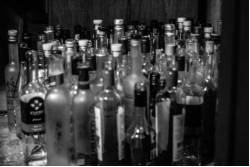
Figure 17. Caceres Alvarez, L. (2018). Bottles of pisco. Breña, Lima, Peru.
We are all people with different, diverse motivations. In my case, one of the motivations for working at Breña was that feeling of having the doors opened to me, of beginning to feel part of a community. I was understanding something new about myself, about my grandfather, and about the culture. But not everything is positive. Over time, I learned so much that I also began to see the other side. I reached a point where I crossed over to the other side, and from there everything became more honest.
I emerged from the process perhaps a little more confused than when I started, with fewer clear conclusions and a bit more skeptical. That was my experience, at least. And I understand that some people might not like that outcome, or researchers who feel they have a very clear mission to fulfill.
The question is: who dares to look at that sordid, dark, dense side that also exists in criollismo and in criollo music, where strong conflicts arise? Because, of course, El puente and la alameda are not that. The image of “the Lima that was,” the scent of leading man at six-thirty in the evening, that’s not it. But it exists and is there, and it’s also part of it.
You could even talk about an anthropology of excess, or an anthropology of sordidness. That exists, but you must dig deep to find it. And when it appears, you realize it was always there.
Figure 18. Caceres Alvarez, L. (2017). Y que me sirvan mas noche en mi copa de mañana. Barrios Altos, Lima, Peru.
You have mentioned that criollismo possesses an “aura” that includes bohemianism, excess, and conflict. Why do you think these dimensions often remain outside academic records?
Exactly, because these traits are also part of criollismo. What does it mean to be trompeador? To be a dancer? To be a womanizer? What does that really entail, and in which spaces does it occur? In what contexts, at what moments of the night does it emerge? All of this relates to ways of relating—to others, to family, to the community. I think it’s a field that deserves much deeper exploration and far more study.
Figure 19. Caceres Alvarez, L. (2018). Retorno a la casa donde suenan los recuerdos. Breña, Lima, Peru.
To conclude: would you say that images “sound”? How do you understand the relationship between sound, image, and emotion in documentary cinema?
Absolutely. Images definitely “resonate” or “sound.” Films appeal to our senses, and image and sound are never truly separate. If images evoke emotions, how could they not also evoke a sense of sound?





 Share This Article
 Twitter
 Linked In
 Facebook
 Copy
Copy Download