The Thermohaline Convection-Enhanced Solar Membrane Distillation (TSMD) system is introduced as an innovative and sustainable solution to global water scarcity, designed to operate entirely off-grid using renewable energy sources, primarily solar thermal power, for an optimal eight-hour daily cycle. Unlike conventional desalination systems dependent on grid electricity or fossil fuels, the TSMD incorporates a 12 V DC submersible pump powered by a 15 W solar panel, a 12V-7Ah battery ensuring semi-autonomous operation in remote or resource-limited regions. The design integrates thermohaline convection and a pump to enhance heat and mass transfer, improving evaporation and condensation efficiency. Experimental results from hardware testing indicate a freshwater production rate of approximately 5.4 L of freshwater from 10 L of feedwater (54% water recovery), with brine discharge maintained at about 4.6 L. Total Dissolved Solids (TDS) levels were significantly reduced, reaching as low as 109 ppm, far below the WHO drinking water threshold of 300 ppm. Under peak sunlight conditions, the system achieved a thermal efficiency of approximately 62%. These findings demonstrate that the TSMD system is environmentally friendly, and its energy-independent design makes it a strong potential for solving the freshwater shortages in arid, semi-arid, and off-grid communities around the globe.
This is an Open Access article, distributed under the terms of the Creative Commons Attribution 4.0 International License (http://creativecommons.org/licenses/by/4.0/), which permits unrestricted use, distribution and reproduction in any medium or format, provided the original work is properly cited.
Solar Desalination, Thermohaline Convection, Freshwater, Membrane Distillation, Saltwater
1. Introduction
In recent times, water scarcity has become a global challenge and has increased rapidly due to several factors such as rapid urbanization, dramatic climate change over centuries, and immense industrialization. Resources of clean drinking water are becoming limited in pure-water-scarce regions. Traditional desalination technologies, such as reverse osmosis (RO) and multi-stage flash (MSF) distillation, have been utilized to address these problems; however, they often consume too much energy and leave a carbon footprint
[1]
S. M. Shalaby et al., “Membrane distillation driven by solar energy: A review,” Journal of Cleaner Production, vol. 366, p. 132949, Jun. 2022,
. These technologies consume substantial energy, which leads to carbon emissions, and produce highly concentrated brine as well, which requires safe disposal
[2]
I. Eziyi et al., “Effects of salinity and feed temperature on permeate flux of an air gap membrane distillation unit for seawater desalination,” in Proc. IEEE Conf. Technologies for Sustainability (SusTech), Portland, OR, USA, 2013, pp. 142–145.
. There are such drawbacks that lead to the pressing need for desalination processes that are energy-efficient, eco-friendly, and sustainable as well.
Thermohaline Convection-Enhanced Solar Membrane Distillation (TSMD) is a relatively new technique that shows promise in addressing these significant concerns. TSMD combines the concept of using solar energy and membrane distillation (MD) and takes advantage of thermohaline convection to increase efficiency. As opposed to traditional MD systems, which use temperature gradients as their main driving factor, TSMD uses salinity gradients to induce natural convection currents within the water, which improves heat and mass transfer phenomena more effectively
[3]
J. Gao et al., “Extreme salt-resisting multistage solar distillation with thermohaline convection,” Joule, Sep. 2023,
. The main goal of this system is to improve the water evaporation and condensation process, which enhances freshwater production and reduces energy expenditure. The system’s use of solar energy makes it sustainable, greatly decreasing the carbon emissions associated with the desalination process and making water management more eco-friendly
[4]
S. Kuravi, J. Trahan, D. Y. Goswami, M. M. Rahman, and E. K. Stefanakos, “Thermal energy storage technologies and systems for concentrating solar power plants,” Progress in Energy and Combustion Science, vol. 39, no. 4, pp. 285–319, Aug. 2013,
W. Wang et al., “Integrated solar-driven PV cooling and seawater desalination with zero liquid discharge,” Joule, vol. 5, no. 7, pp. 1873–1887, Jul. 2021,
M. Elimelech and W. A. Phillip, “The Future of Seawater Desalination: Energy, Technology, and the Environment,” Science, vol. 333, no. 6043, pp. 712–717, Aug. 2011,
The key concept behind TSMD involves heating saline water using solar thermal collectors, which creates a temperature difference across a hydrophobic membrane. This temperature difference drives water vapor across the membrane, salt and other impurities stay behind
[7]
A. S. Nafey, M. F. Abdelkader, A. Abdelmotalip, and A. Mabrouk, “Solar still productivity enhancement,” Energy Conversion and Management, vol. 42, no. 11, pp. 1401–1408, Jul. 2001,
. TSMD can harness thermohaline convection, a process that is driven by gradients in temperature and salinity. If these gradients are carefully managed, then the TSMD can achieve more efficient circulation of water, and it will enhance heat transfer coefficients, and lead to an improved overall performance of the system
[3]
J. Gao et al., “Extreme salt-resisting multistage solar distillation with thermohaline convection,” Joule, Sep. 2023,
. This new technology does not only increase the volume of freshwater generated, but it also ensures high water quality, which can eliminate the dissolved solids, heavy metals, and pathogens
[1]
S. M. Shalaby et al., “Membrane distillation driven by solar energy: A review,” Journal of Cleaner Production, vol. 366, p. 132949, Jun. 2022,
I. Eziyi et al., “Effects of salinity and feed temperature on permeate flux of an air gap membrane distillation unit for seawater desalination,” in Proc. IEEE Conf. Technologies for Sustainability (SusTech), Portland, OR, USA, 2013, pp. 142–145.
The major benefit of TSMD is that it has the potential for decentralized use and thus is especially appropriate in remote and off-grid communities with no access to centralized water treatment facilities or reliable power grids. As the design is modular, it allows it to be installed in various settings from small household units to larger community-based systems. The system operates entirely on renewable solar energy, TSMD offers energy independence and reduces operational costs, and makes clean water more accessible and affordable in underserved areas
[8]
S. A. El-Agouz, G. B. Abd El-Aziz, and A. M. Awad, “Solar desalination system using spray evaporation,” Energy, vol. 76, pp. 276–283, Nov. 2014,
As it is an emerging technology, TSMD faces some challenges that need ongoing research and development. These include optimizing system design to maximize efficiency under varying solar irradiance conditions, developing advanced membrane materials with improved fouling resistance and longevity, and effectively managing the concentrated brine byproduct
[9]
G. L. Amy et al., “Membrane-based seawater desalination: Present and future prospects,” Desalination, vol. 401, pp. 16–21, Jan. 2017,
. The variability of solar energy also requires integrating efficient thermal energy storage solutions or hybrid power systems to ensure continuous operation, especially during periods of low sunlight or at night
[11]
O. Mahian, A. Kianifar, C. Jumpholkul, P. Thiangtham, S. Wongwises, and R. Srisomba, “Solar Distillation Practice For Water Desalination Systems,” Journal of Thermal Engineering, vol. 1, no. 4, pp. 287–288, Apr. 2015,
A. Mathioulakis, V. Belessiotis, and E. Delyannis, “Desalination by using alternative energy: Review and state-of-the-art,” Desalination, vol. 203, pp. 346–365, 2007.
. To achieve long-term success from TSMD, innovative approaches are required to address these challenges and enable widespread adoption. The proposed solar energy-based TSMD method, integrated with a rechargeable Li-ion battery, can be a promising solution for mitigating the intermittency of solar energy, enabling stable, continuous desalination while enhancing overall system efficiency and reliability.
2. Literature Study
The field of membrane distillation (MD) has emerged as a promising thermal desalination technology that operates at relatively low temperatures and pressures, making it well-suited for integration with solar energy systems. MD relies on a vapor pressure gradient across a hydrophobic membrane to facilitate the transport of water vapor from saline or impure feed to the permeate side
[1]
S. M. Shalaby et al., “Membrane distillation driven by solar energy: A review,” Journal of Cleaner Production, vol. 366, p. 132949, Jun. 2022,
. Several configurations have been investigated, including direct contact MD (DCMD), air gap MD (AGMD), vacuum MD (VMD), and sweeping gas MD. Among these, DCMD is the simplest configuration and typically provides higher permeate flux
[2]
I. Eziyi et al., “Effects of salinity and feed temperature on permeate flux of an air gap membrane distillation unit for seawater desalination,” in Proc. IEEE Conf. Technologies for Sustainability (SusTech), Portland, OR, USA, 2013, pp. 142–145.
demonstrated a multi-stage solar distillation system augmented by thermohaline convection, achieving solar-to-water efficiencies of 322%–121% along with excellent salt resistance. This approach utilizes salinity gradients to induce natural convective currents, thereby improving heat transfer and freshwater productivity. The study highlights the potential of thermohaline convection-enhanced systems in overcoming the limitations of conventional single-stage solar stills.
S. M. Shalaby et al.
[1]
S. M. Shalaby et al., “Membrane distillation driven by solar energy: A review,” Journal of Cleaner Production, vol. 366, p. 132949, Jun. 2022,
presented a comprehensive review of solar-powered MD systems, emphasizing their advantages, including the ability to treat high-salinity brines, operate at low temperatures, and integrate with renewable energy sources. The combination of solar thermal energy with MD is particularly suitable for arid and semi-arid regions. Furthermore, the inclusion of thermohaline effects can enhance convection and reduce overall energy consumption. The importance of renewable integration was further demonstrated by W. Wang et al.
[5]
W. Wang et al., “Integrated solar-driven PV cooling and seawater desalination with zero liquid discharge,” Joule, vol. 5, no. 7, pp. 1873–1887, Jul. 2021,
, where a hybrid solar PV-cooling-desalination system with zero liquid discharge was proposed. This study highlighted the environmental benefits and sustainability of decentralized desalination systems for off-grid applications. In addition, intelligent energy management strategies for renewable-based microgrids using machine learning techniques such as Random Forest have been shown to enhance energy efficiency, optimize storage utilization, and improve system stability in solar–wind integrated systems
[13]
H. Z. Anonto et al., “Intelligent Energy Management of Microgrids Using Machine Learning: Leveraging Random Forest Models for Solar and Wind Power,” Results in engineering, p. 106539, Aug. 2025,
I. Eziyi et al., “Effects of salinity and feed temperature on permeate flux of an air gap membrane distillation unit for seawater desalination,” in Proc. IEEE Conf. Technologies for Sustainability (SusTech), Portland, OR, USA, 2013, pp. 142–145.
analyzed the effects of feed temperature and salinity on MD performance, confirming that higher temperatures and salinity gradients increase permeate flux, an important mechanism underlying thermohaline convection-enhanced system.
From a materials perspective, membrane properties play a crucial role in determining MD performance. The development of hydrophobic membranes with high porosity, thermal stability, and fouling resistance significantly influences system efficiency and operational lifespan
[7]
A. S. Nafey, M. F. Abdelkader, A. Abdelmotalip, and A. Mabrouk, “Solar still productivity enhancement,” Energy Conversion and Management, vol. 42, no. 11, pp. 1401–1408, Jul. 2001,
. In addition, several studies have explored advanced system configurations and integration strategies to further improve productivity and energy efficiency
[14]
Z. Ding, L. Liu, M. S. El-Bourawi, and R. Ma, “Analysis of a solar-powered membrane distillation system,” Desalination, vol. 172, no. 1, pp. 27–40, Feb. 2005,
. Brine management remains another critical challenge in desalination processes, as the disposal of highly concentrated brine poses environmental risks. T. Tong et al. and A. Subramani et al.
[16]
T. Tong et al., “Brine management with zero and minimal liquid discharge,” Mar. 2025,
A. Subramani and J. G. Jacangelo, “Treatment technologies for reverse osmosis concentrate volume minimization: A review,” Separation and Purification Technology, vol. 122, pp. 472–489, Feb. 2014,
investigated emerging solutions such as mineral recovery and hybrid systems for brine reduction, which could be effectively integrated with thermohaline convection-enhanced MD systems to improve overall sustainability.
Both modeling and experimental studies in remote communities have supported the applicability of thermohaline solar MD systems for decentralized water production
[8]
S. A. El-Agouz, G. B. Abd El-Aziz, and A. M. Awad, “Solar desalination system using spray evaporation,” Energy, vol. 76, pp. 276–283, Nov. 2014,
A. Mathioulakis, V. Belessiotis, and E. Delyannis, “Desalination by using alternative energy: Review and state-of-the-art,” Desalination, vol. 203, pp. 346–365, 2007.
. These studies demonstrate the scalability and adaptability of solar-driven MD technologies across different environmental and operational conditions, making them suitable for low-income and off-grid regions.
Despite significant progress in solar-powered MD systems, several challenges remain. Most existing studies focus either on thermal enhancement or salinity-driven effects, with limited research addressing their combined influence through thermohaline convection to simultaneously optimize heat and mass transfer. Additionally, many systems are restricted to laboratory-scale investigations and lack validation under real-world solar conditions. Persistent issues such as membrane fouling, uneven heat distribution, and inefficient brine management continue to hinder large-scale deployment. Moreover, comprehensive analyses that simultaneously evaluate thermal efficiency, freshwater productivity, and water quality in fully autonomous solar-driven systems are still scarce.
Therefore, the primary objective of this study is to design, develop, and experimentally evaluate a soler powered TSMD. This work aims to investigate the coupled effects of temperature and salinity gradients on thermohaline convection, assess freshwater yield and salt rejection performance, and evaluate the overall water quality. The feasibility of a self-sustaining, off-grid desalination system suitable for arid and remote regions will be evaluated in this study.
3. Methodology
3.1. Overview of the TSMD Desalination System
This study utilizes a TSMD system to desalinate seawater in a sustainable and off-grid manner. Solar energy is utilized in two forms: (i) photovoltaic (PV) energy to power the DC pump, and (ii) solar thermal energy to heat the saline water for the membrane distillation process. The Solar thermal collector, membrane distillation unit, and a closed-loop saline circulation system are the three large parts of the system that are to sustain thermal and salinity gradients. The first stage of energy conversion is a solar thermal collector that captures solar energy and transmits the thermal energy to the heating of saline water. The thermal power attained by the saline water can be termed as,
(1)
Here, Q is the heat energy in Joules, m is the mass of water (kg), cp is the specific heat capacity of water (4186 J/kg⋅°C), and ΔT is the temperature rise across the collector.
Heated saline water enters the TSMD unit and membrane distillation, which separates the brine and the water vapor because of the overlapping of the temperature gradient and salinity gradient. The calculated heat energy (Q) represents the total thermal energy gained over the heating period. For consistency with power-based efficiency calculations, the corresponding thermal power is obtained by dividing Q by the heating duration (t).
3.2. System Architecture and Operational Flow
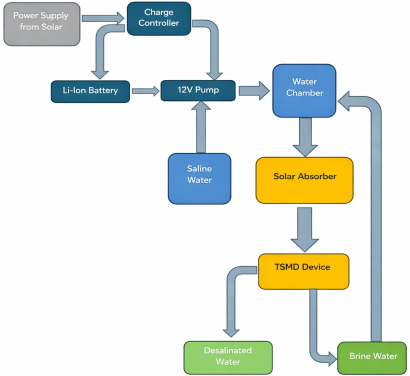
Figure 1 displays the general system architecture of the TSMD system, which shows the workflow of the system. This is initiated through solar panels, which use solar energy and transform it into electricity. The PV panel supplies electrical energy to operate the pump and control system, while the solar thermal collector provides the required heat for evaporation. A charge controller is necessary to control this electrical energy and to regulate the flow of power and prevent the lithium-ion (Li-ion) battery from being overcharged. The battery energy allows operation of the system even when there is limited sunlight. The TSMD device is at the center of the system, as it combines thermohaline convection and membrane distillation. The salty water inside the TSMD unit is exposed to a hydrophobic membrane, through which only water is allowed to pass and leave the salts and impurities. Such a vapor is then cooled to clean water through a cooling system, and the rest of the brine is discharged or recirculated into the system to make the most of it. A 12V DC pump pumps saline water from a reservoir and circulates it through the solar thermal absorber. As the saline water passes through this absorber, it gains thermal energy, which is enough for evaporation. The daily yield over 9 days ranged between 3.27 L (minimum) and 4.15 L (maximum) per cycle.
3.3. Particularization of Structural Design and Components of the TSMD Device
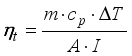
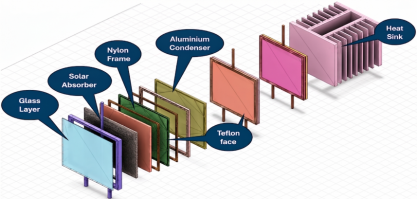
Figure 2 shows the 3D design model of the TSMD device, which has been designed using materials that maximize both structural integrity and thermal efficiency. The thermohaline convection is supported by a glass aquarium, which contains the saline feedwater of the system. A clear sheet of glass on the top allows sunlight to pass through, and it is absorbed by a black-coated layer on the bottom that then turns the solar radiation into heat. Frames made of nylon are structural components which give the device mechanical stability. Joints are covered with Teflon tape, which makes sure that the joints are watertight and do not leak thermal energy. A heat sink and an aluminum condenser are used to increase the efficiency of condensation and control the temperature of the system. This compact size not only allows easy desalination but also allows the device to be used in a portable or decentralized operation. The thermal efficiency of the absorber (ηₜ) is evaluated on a power basis
[19]
V. Karanikola, A. F. Corral, H. Jiang, A. E. Sáez, W. P. Ela, and R. G. Arnold, “Effects of membrane structure and operational variables on membrane distillation performance,” Journal of Membrane Science, vol. 524, pp. 87–96, Feb. 2017,
, where the useful thermal power (Q =m ⋅Cp ⋅ΔT) is compared with the incident solar power (A⋅I). Here, m is the mass flow rate (kg/s), Cp is the specific heat capacity of water (4186 J/kg·°C), A is the absorber area (0.3624 m²), and I is the solar irradiance (800 W/m²). For the proposed model, measured midday irradiance of 800 W/m2 with 3.35 kg heated in 1 hour, the efficiency is approximately 62%. In this calculation, the useful thermal energy is evaluated based on the sensible heat gained by the saline water (m·Cp·ΔT), assuming negligible heat storage within the system components. Heat losses due to convection and radiation are minimized using an enclosed glass structure, insulated sidewalls, and limited air exchange within the system. However, residual thermal losses to the surrounding environment are not explicitly quantified, which may result in a slight overestimation of the calculated efficiency.
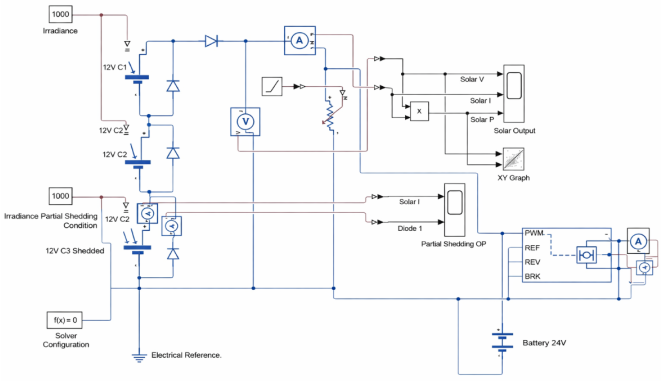
Figure 3 illustrates the MATLAB Simulink-based simulation of the TSMD system. This virtual model allows for an understanding of the system’s behavior under different environmental conditions. The simulation starts with solar panels, labeled C1, C2, and C3, which generate electricity. One of the panels (C3) is simulated under partial shading to mimic real-world scenarios. To protect the system from reverse current flow, diodes are used. The generated power, voltage, current, and energy are measured and displayed using virtual instruments in the model. This modeling approach validates the real-time operational viability of the TSMD system and helps refining the design before its physical implementation. The simulated PV system (185 W) represents a higher-capacity configuration and is used for performance analysis, while the experimental setup uses a 15 W panel.
Figure 3. Schematic view of the electronic components.
3.5. Hardware Implementation of the TSMD System
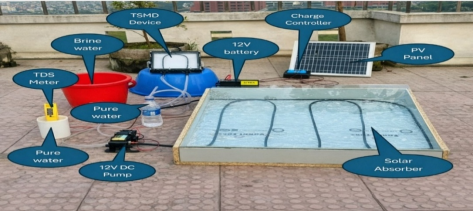
Brine water, stored in a red container labeled "brine water," is pumped using a 12V DC pump into the TSMD device as shown in Figure 4. A hydrophobic PVDF membrane with a pore size of 0.22 µm facilitates the passage of water vapor while preventing the transmission of dissolved salts and impurities. The resulting condensate is collected in separate containers marked as Pure water. The entire setup is powered by a 12V battery, which is continuously charged by a PV panel. A charge controller is integrated between the panel and the battery to regulate power flow and prevent overcharging. The use of solar power ensures the system can operate independently in off-grid or resource-constrained environments. A TDS meter is used for assuring that the system is effective in removing contaminants.
3.6. Mechanical Modeling and Simulation of Flow Dynamics
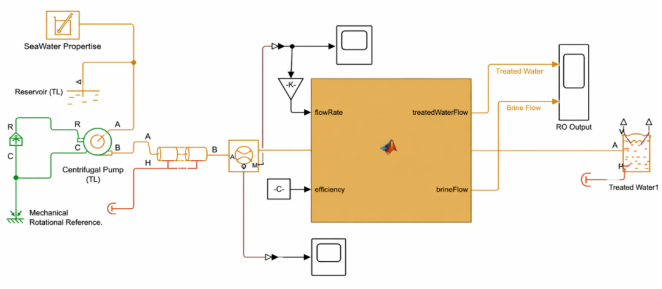
Figure 5 illustrates the mechanical simulation of the TSMD system. In this model, a high-pressure pump draws saline water from a reservoir and delivers it to the membrane distillation device. The MD unit separates the water into two parts: clean freshwater and concentrated brine. The flow rates and thermal performance of the treated water and rejected brine are continuously monitored in the simulation to evaluate efficiency. The simulation helps optimize the TSMD system for field deployment, ensuring reliable freshwater production in off-grid or remote settings. The mechanical simulation validated the measured results, with flow rates ranging from 0.5 L/h to 0.62 L/h. The rejection rate of brine (Rb) is computed by,
(3)
Here, Vb is the brine volume and Vf is the total feedwater volume. The average brine rejection rate during testing was 15–18%. The calculated recovery ratio does not account for minor thermal and hydraulic losses, which may slightly affect the actual system performance.
Figure 5. Schematic model of the mechanical components of the TSMD device.
4. Result Analysis
4.1. Simulation Results
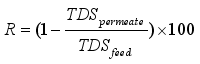
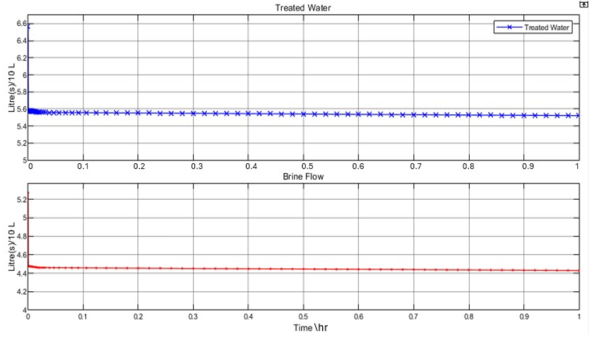
Figure 6 illustrates the performance of a water treatment system over one hour for two parameters: treated water and brine flow. In the top subplot, the treated water flow rate remains nearly constant at about 5.4 L per 10 L, indicating consistent water recovery performance. In the lower subplot, the brine flow rate stays steady at around 4.6 L per 10 L, showing that the separation process between treated water and brine is stable and well-controlled. The consistent values in both plots confirm the system’s reliable performance. The system was in a stable condition and showed optimal performance in terms of solar energy usage and desalination output. From an input of 10 liters of saline water, 5.4 liters of freshwater were recovered, and 4.6 liters remained as saline water. The water recovery ratio was calculated as,
(4)
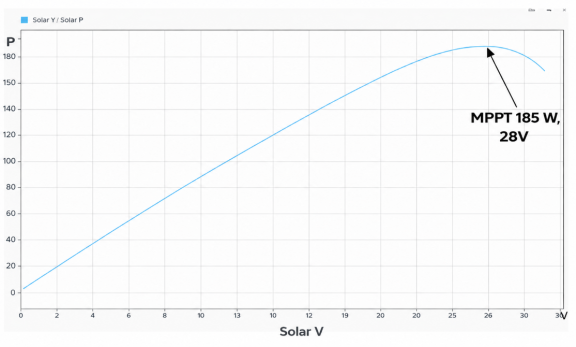
The graph in Figure 7 illustrates the power–voltage (P–V) characteristics of a simulated solar panel. Starting at zero volts, the power output is initially zero and increases steadily as voltage rises, reaching a maximum of 185 W at 28 V, the Maximum Power Point (MPP). After this point, power decreases despite further voltage increases, which highlights the non-linear nature of solar panel performance. This behavior confirms that optimal energy extraction occurs at the MPP, and operating outside this point results in reduced efficiency. This curve corresponds to the simulated high-power PV module. The simulation demonstrates that increasing PV capacity significantly enhances water production, indicating the scalability potential of the TSMD system.
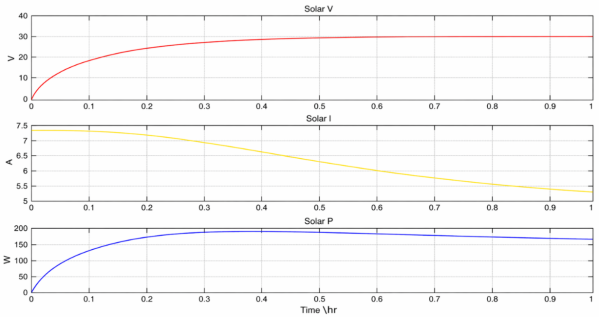
Figure 8. Variation of solar panel voltage, current, and power over time.
Figure 8 illustrates the time-dependent performance of a solar panel in three plots: voltage, current, and power. The first plot shows the solar voltage, which rises rapidly from zero and gradually stabilizes at around 30 V over time. The second plot illustrates the solar current, starting at approximately 7.5 A and steadily decreasing, because of the changes in solar irradiance or the system’s operating conditions. The third plot presents the power output, which initially increases as voltage rises and current remains relatively high, reaching a peak near 200 W, before slightly declining as the drop in current outweighs the stable Voltage.
4.2. Performance Measurement of the TSMD Device
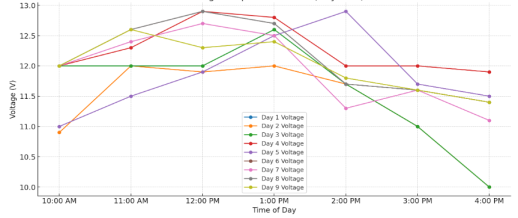
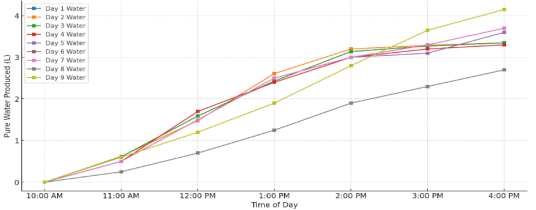
The measured data from the TSMD device across nine consecutive days shows a clear correlation between solar-powered system voltage output and the cumulative production of desalinated water throughout each day in Figures 9 and 10. The system performance is evaluated using three key metrics: thermal efficiency, water recovery ratio, and water quality (TDS and pH). The initial readings at 10: 00 AM for all days consistently indicate zero pure water output, which is expected since the system requires some warm-up time for the solar absorber to heat the saline water to an optimal temperature for membrane distillation. By 11: 00 AM, the pure water yield begins to rise, with production rates varying slightly depending on the day’s solar intensity and voltage stability. During peak solar conditions, the system heated approximately 3.35 L of saline water (≈3.35 kg) from an average inlet temperature of 27.5°C to 46.2°C, demonstrating effective solar thermal energy absorption.
(5)
The PV panel output generally starts between 11 V and 12.9 V in the late morning, peaking between noon, when solar irradiance is highest. The highest recorded voltage was 12.9 V, coinciding with midday hours on multiple days (e.g., Day 4 at 12: 00 PM and Day 8 at 12: 00 PM). After 2: 00 PM, voltage declines gradually, showing a reduction in sunlight intensity. Water production follows a nearly linear growth pattern across most days, reaching peak values between 3.2 L and 4.15 L by 4: 00 PM. The maximum observed desalinated water yield occurred on Day 9 with 4.15 L, suggesting optimal operational conditions—likely due to consistent sunlight and stable system voltage. In contrast, days with lower midday voltage (e.g., Day 8) show slower water production growth, indicating the sensitivity of the TSMD process to power availability. The cumulative water output can be linked to the average operating voltage via the water production rate formula,
(6)
Here, ηw is the water production rate (L/hr), Vw is the volume of desalinated water, and t is the total operational time in hours Applying this to the highest performing day (Day 9), with 4.15 L over approximately 6 hours of operation, gives ηw=0.692 L/hr. Comparing this to a lower production day, such as Day 8, with 2.7 L over the same time gives ηw=0.45 L/hr. Overall, the dataset demonstrates that the TSMD system maintains a stable desalination rate when operating near its optimal voltage range (12–12.9 V), and that both sunlight availability and PV output directly influence daily water yield. The trends suggest that under consistent high solar irradiance, the system can reliably produce between 3.5 – 4 L of potable water per day, making it a viable small-scale sustainable desalination solution.
Figure 10. Variation of Cumulative Desalinated Water with Time (Day 1-9).
4.3. Water Quality Measurement
The water quality parameters were evaluated using TDS and pH meters. TDS value of the desalinated samples ranged from 109 to 275 ppm, as listed in Table 1. The initial feedwater TDS was measured in the range of 700–900 ppm, representing moderately saline water. Since the World Health Organization (WHO) recommends TDS levels under 300 ppm for drinking water, the treated water clearly qualifies the standard
[19]
V. Karanikola, A. F. Corral, H. Jiang, A. E. Sáez, W. P. Ela, and R. G. Arnold, “Effects of membrane structure and operational variables on membrane distillation performance,” Journal of Membrane Science, vol. 524, pp. 87–96, Feb. 2017,
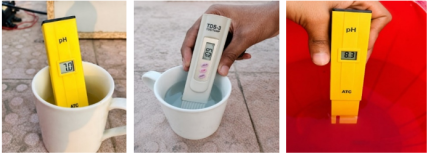
Figure 11. The figure shows three measurements: a pH of 7.0 and a TDS of 109 ppm for desalinated water, and a pH of 8.3 for brine water.
Based on the measured values, the salt rejection efficiency of the TSMD system was approximately 70–88%, depending on operating conditions. The collected brine water samples contain high TDS of 862, 752, and 752 ppm, representing salt and mineral concentrations. The pH values of desalinated water fell within 6.8–7.3, matching the recommended range of 6.5 to 7.5
[18]
Cotruvo Jr, Joseph. (2017). 2017 WHO Guidelines for Drinking Water Quality: First Addendum to the Fourth Edition. Journal - American Water Works Association. 109. 44-51.
. This confirms the TSMD system’s reliability in producing safe, potable water. Figures 11(a) and 11(b) show the measured pH and TDS level of desalinated water, respectively, where 11(c) represents the pH level of brine water contained in the red bucket, which is slightly basic.
Table 1. TDS and pH level comparison of treated and brine water.
Different water Sample no.
TDS [ppm]
pH Level
Desalinated
Brine
Desalinated
Brine
1
109
717
7.0
6.5
2
197
752
7.3
8.3
3
275
862
6.8
8.7
Table 2. Comparison of TSMD with conventional desalination technologies.
Method Criteria
Reverse Osmosis (RO)
[5]
W. Wang et al., “Integrated solar-driven PV cooling and seawater desalination with zero liquid discharge,” Joule, vol. 5, no. 7, pp. 1873–1887, Jul. 2021,
E. R. Jones et al., “The state of desalination and brine production: A global outlook.,” Science of The Total Environment, vol. 657, pp. 1343–1356, Mar. 2019,
E. R. Jones et al., “The state of desalination and brine production: A global outlook.,” Science of The Total Environment, vol. 657, pp. 1343–1356, Mar. 2019,
R. Orsini, P. G. Brodrick, A. R. Brandt, and L. J. Durlofsky, “Computational optimization of solar thermal generation with energy storage,” Sustainable Energy Technologies and Assessments, vol. 47, p. 101342, Oct. 2021,
Z. Y. Xu et al., “Ultrahigh-efficiency desalination via a thermally-localized multistage solar still,” Energy and Environmental Science, vol. 13, no. 3, pp. 830–839, Mar. 2020,
E. Chiavazzo, M. Morciano, F. Viglino, M. Fasano, and P. Asinari, “Passive high-yield seawater desalination at below one sun by modular and low-cost distillation,” arXiv: Other Condensed Matter, Feb. 2017,
H. Z. Anonto et al., “Intelligent Energy Management of Microgrids Using Machine Learning: Leveraging Random Forest Models for Solar and Wind Power,” Results in engineering, p. 106539, Aug. 2025,
E. K. Summers and J. H. Lienhard, “Experimental study of thermal performance in air gap membrane distillation systems, including the direct solar heating of membranes,” Desalination, vol. 330, pp. 100–111, Dec. 2013,
Relies on grid electricity with significant exergy losses in pumps and valves
Uses thermal energy (often fossil or waste heat)
Uses thermal heat in multiple effects
Solar-thermal driven
Uses passive solar thermal with thermohaline convection
Scale and Deployment
Large, centralized plants; not ideal for decentralized use
Requires large-scale thermal infrastructure
Prototypes vary from compact to containerized modular systems
Medium to large scale
Modular, scalable for off-grid/rural use
Throughput per Unit Area
High (but with large energy cost)
High but energy intensive
~0.5–1.25 L/day per 0.25 m²
Moderate throughput balanced by multiple stages
Higher yield per area than MD due to enhanced heat transfer
Maintenance & Fouling
High fouling, requires pre-treatment & chemicals
Scaling/corrosion in heat exchangers
Membrane fouling & wetting
Scaling and corrosion
Low pressure, reduced fouling, easy maintenance
Environmental Impact
Large brine discharge, high energy footprint
Large brine discharge, high CO₂ footprint
Minimal brine but low efficiency
Large brine discharge
Low brine volume, low-carbon, eco-friendly
Operational Complexity
Skilled operators needed
Highly skilled operators & complex systems
Simple but low output
Skilled operation & multi-effect control
Simple operation, minimal training needed
Table 2 presents a comparison between TSMD and other desalination methods. Unlike Reverse Osmosis (RO), Multi-Stage Flash (MSF), and Multi-Effect Distillation (MED), which require large-scale infrastructure, high-pressure pumps, or fossil-fuel-based heat, TSMD is modular, low-pressure, and suitable for off-grid deployment. In addition, its performance decreases the need to use electricity, results in the minimization of the environmental impact due to the restriction of the amount of brine discharged, as well as providing an inexpensive method of decentralized freshwater generation, which is both cost-effective and sustainable.
5. Conclusions
This study demonstrates the feasibility of a TSMD system for small-scale, off-grid desalination, where the integration of thermohaline convection with solar thermal energy enhances heat and mass transfer, resulting in improved water production performance and a reported thermal efficiency of 62%. However, this efficiency is based on controlled experimental conditions, and further detailed analysis is required to quantify convective and radiative heat losses and to validate the efficiency under real operating environments. Experimental validation was conducted using feed water with a TDS range of 700–900 ppm, which is significantly lower than real seawater (~35,000 ppm); therefore, system performance under actual seawater conditions may differ, particularly in terms of reduced permeate flux, increased fouling, and accelerated membrane wetting due to scaling and pore intrusion. Additionally, the present study was limited to a 9-day experimental period, which is insufficient to conclusively establish long-term operational stability or low maintenance requirements, especially with respect to membrane durability and fouling resistance. Despite these limitations, the system demonstrates reliable operation using renewable solar energy, making it a promising solution for decentralized and resource-constrained regions. Future work will focus on evaluating performance with real seawater, investigating long-term membrane wetting behavior and lifespan, providing a comprehensive thermal loss analysis, and optimizing system efficiency and scalability for practical deployment.
Abbreviations
TSMD
Thermohaline Convection-Enhanced Solar Membrane Distillation
TDS
Total Dissolved Solids
RO
Reverse Osmosis
MSF
Multi-Stage Flash
MED
Multi-Effect Distillation
MD
Membrane Distillation
Li-ion
Lithium-ion
PV
Photovoltaic
PPM
Particles per Million
WHO
World Health Organization
Author Contributions
Md. Mahim Rahman: Conceptualization, Data curation, Formal analysis, Investigation, Writing – original draft
I. Eziyi et al., “Effects of salinity and feed temperature on permeate flux of an air gap membrane distillation unit for seawater desalination,” in Proc. IEEE Conf. Technologies for Sustainability (SusTech), Portland, OR, USA, 2013, pp. 142–145.
S. Kuravi, J. Trahan, D. Y. Goswami, M. M. Rahman, and E. K. Stefanakos, “Thermal energy storage technologies and systems for concentrating solar power plants,” Progress in Energy and Combustion Science, vol. 39, no. 4, pp. 285–319, Aug. 2013,
W. Wang et al., “Integrated solar-driven PV cooling and seawater desalination with zero liquid discharge,” Joule, vol. 5, no. 7, pp. 1873–1887, Jul. 2021,
M. Elimelech and W. A. Phillip, “The Future of Seawater Desalination: Energy, Technology, and the Environment,” Science, vol. 333, no. 6043, pp. 712–717, Aug. 2011,
A. S. Nafey, M. F. Abdelkader, A. Abdelmotalip, and A. Mabrouk, “Solar still productivity enhancement,” Energy Conversion and Management, vol. 42, no. 11, pp. 1401–1408, Jul. 2001,
O. Mahian, A. Kianifar, C. Jumpholkul, P. Thiangtham, S. Wongwises, and R. Srisomba, “Solar Distillation Practice For Water Desalination Systems,” Journal of Thermal Engineering, vol. 1, no. 4, pp. 287–288, Apr. 2015,
A. Mathioulakis, V. Belessiotis, and E. Delyannis, “Desalination by using alternative energy: Review and state-of-the-art,” Desalination, vol. 203, pp. 346–365, 2007.
H. Z. Anonto et al., “Intelligent Energy Management of Microgrids Using Machine Learning: Leveraging Random Forest Models for Solar and Wind Power,” Results in engineering, p. 106539, Aug. 2025,
Z. Ding, L. Liu, M. S. El-Bourawi, and R. Ma, “Analysis of a solar-powered membrane distillation system,” Desalination, vol. 172, no. 1, pp. 27–40, Feb. 2005,
A. Subramani and J. G. Jacangelo, “Treatment technologies for reverse osmosis concentrate volume minimization: A review,” Separation and Purification Technology, vol. 122, pp. 472–489, Feb. 2014,
Cotruvo Jr, Joseph. (2017). 2017 WHO Guidelines for Drinking Water Quality: First Addendum to the Fourth Edition. Journal - American Water Works Association. 109. 44-51.
V. Karanikola, A. F. Corral, H. Jiang, A. E. Sáez, W. P. Ela, and R. G. Arnold, “Effects of membrane structure and operational variables on membrane distillation performance,” Journal of Membrane Science, vol. 524, pp. 87–96, Feb. 2017,
E. R. Jones et al., “The state of desalination and brine production: A global outlook.,” Science of The Total Environment, vol. 657, pp. 1343–1356, Mar. 2019,
R. Orsini, P. G. Brodrick, A. R. Brandt, and L. J. Durlofsky, “Computational optimization of solar thermal generation with energy storage,” Sustainable Energy Technologies and Assessments, vol. 47, p. 101342, Oct. 2021,
Z. Y. Xu et al., “Ultrahigh-efficiency desalination via a thermally-localized multistage solar still,” Energy and Environmental Science, vol. 13, no. 3, pp. 830–839, Mar. 2020,
E. Chiavazzo, M. Morciano, F. Viglino, M. Fasano, and P. Asinari, “Passive high-yield seawater desalination at below one sun by modular and low-cost distillation,” arXiv: Other Condensed Matter, Feb. 2017,
E. K. Summers and J. H. Lienhard, “Experimental study of thermal performance in air gap membrane distillation systems, including the direct solar heating of membranes,” Desalination, vol. 330, pp. 100–111, Dec. 2013,
Rahman, M. M., Alam, S. S., Mahi, M. A., Ahmed, A., Dipta, F. N., et al. (2026). Thermohaline Convection-enhanced Solar Membrane Distillation: A Sustainable Approach to Global Water Security. American Journal of Water Science and Engineering, 12(2), 27-38. https://doi.org/10.11648/j.ajwse.20261202.11
Rahman, M. M.; Alam, S. S.; Mahi, M. A.; Ahmed, A.; Dipta, F. N., et al. Thermohaline Convection-enhanced Solar Membrane Distillation: A Sustainable Approach to Global Water Security. Am. J. Water Sci. Eng.2026, 12(2), 27-38. doi: 10.11648/j.ajwse.20261202.11
Rahman MM, Alam SS, Mahi MA, Ahmed A, Dipta FN, et al. Thermohaline Convection-enhanced Solar Membrane Distillation: A Sustainable Approach to Global Water Security. Am J Water Sci Eng. 2026;12(2):27-38. doi: 10.11648/j.ajwse.20261202.11
@article{10.11648/j.ajwse.20261202.11,
  author = {Md. Mahim Rahman and Sadman Shahriar Alam and Minhaz Ahmed Mahi and Abir Ahmed and Fatin Nehal Dipta and Md. Mehedi Hasan Tanim and Md. Ashiquzzaman},
  title = {Thermohaline Convection-enhanced Solar Membrane Distillation: A Sustainable Approach to Global Water Security},
  journal = {American Journal of Water Science and Engineering},
  volume = {12},
  number = {2},
  pages = {27-38},
  doi = {10.11648/j.ajwse.20261202.11},
  url = {https://doi.org/10.11648/j.ajwse.20261202.11},
  eprint = {https://article.sciencepublishinggroup.com/pdf/10.11648.j.ajwse.20261202.11},
  abstract = {The Thermohaline Convection-Enhanced Solar Membrane Distillation (TSMD) system is introduced as an innovative and sustainable solution to global water scarcity, designed to operate entirely off-grid using renewable energy sources, primarily solar thermal power, for an optimal eight-hour daily cycle. Unlike conventional desalination systems dependent on grid electricity or fossil fuels, the TSMD incorporates a 12 V DC submersible pump powered by a 15 W solar panel, a 12V-7Ah battery ensuring semi-autonomous operation in remote or resource-limited regions. The design integrates thermohaline convection and a pump to enhance heat and mass transfer, improving evaporation and condensation efficiency. Experimental results from hardware testing indicate a freshwater production rate of approximately 5.4 L of freshwater from 10 L of feedwater (54% water recovery), with brine discharge maintained at about 4.6 L. Total Dissolved Solids (TDS) levels were significantly reduced, reaching as low as 109 ppm, far below the WHO drinking water threshold of 300 ppm. Under peak sunlight conditions, the system achieved a thermal efficiency of approximately 62%. These findings demonstrate that the TSMD system is environmentally friendly, and its energy-independent design makes it a strong potential for solving the freshwater shortages in arid, semi-arid, and off-grid communities around the globe.},
 year = {2026}
}
TY  - JOUR
T1  - Thermohaline Convection-enhanced Solar Membrane Distillation: A Sustainable Approach to Global Water Security
AU  - Md. Mahim Rahman
AU  - Sadman Shahriar Alam
AU  - Minhaz Ahmed Mahi
AU  - Abir Ahmed
AU  - Fatin Nehal Dipta
AU  - Md. Mehedi Hasan Tanim
AU  - Md. Ashiquzzaman
Y1  - 2026/05/18
PY  - 2026
N1  - https://doi.org/10.11648/j.ajwse.20261202.11
DO  - 10.11648/j.ajwse.20261202.11
T2  - American Journal of Water Science and Engineering
JF  - American Journal of Water Science and Engineering
JO  - American Journal of Water Science and Engineering
SP  - 27
EP  - 38
PB  - Science Publishing Group
SN  - 2575-1875
UR  - https://doi.org/10.11648/j.ajwse.20261202.11
AB  - The Thermohaline Convection-Enhanced Solar Membrane Distillation (TSMD) system is introduced as an innovative and sustainable solution to global water scarcity, designed to operate entirely off-grid using renewable energy sources, primarily solar thermal power, for an optimal eight-hour daily cycle. Unlike conventional desalination systems dependent on grid electricity or fossil fuels, the TSMD incorporates a 12 V DC submersible pump powered by a 15 W solar panel, a 12V-7Ah battery ensuring semi-autonomous operation in remote or resource-limited regions. The design integrates thermohaline convection and a pump to enhance heat and mass transfer, improving evaporation and condensation efficiency. Experimental results from hardware testing indicate a freshwater production rate of approximately 5.4 L of freshwater from 10 L of feedwater (54% water recovery), with brine discharge maintained at about 4.6 L. Total Dissolved Solids (TDS) levels were significantly reduced, reaching as low as 109 ppm, far below the WHO drinking water threshold of 300 ppm. Under peak sunlight conditions, the system achieved a thermal efficiency of approximately 62%. These findings demonstrate that the TSMD system is environmentally friendly, and its energy-independent design makes it a strong potential for solving the freshwater shortages in arid, semi-arid, and off-grid communities around the globe.
VL  - 12
IS  - 2
ER  -
Rahman, M. M., Alam, S. S., Mahi, M. A., Ahmed, A., Dipta, F. N., et al. (2026). Thermohaline Convection-enhanced Solar Membrane Distillation: A Sustainable Approach to Global Water Security. American Journal of Water Science and Engineering, 12(2), 27-38. https://doi.org/10.11648/j.ajwse.20261202.11
Rahman, M. M.; Alam, S. S.; Mahi, M. A.; Ahmed, A.; Dipta, F. N., et al. Thermohaline Convection-enhanced Solar Membrane Distillation: A Sustainable Approach to Global Water Security. Am. J. Water Sci. Eng.2026, 12(2), 27-38. doi: 10.11648/j.ajwse.20261202.11
Rahman MM, Alam SS, Mahi MA, Ahmed A, Dipta FN, et al. Thermohaline Convection-enhanced Solar Membrane Distillation: A Sustainable Approach to Global Water Security. Am J Water Sci Eng. 2026;12(2):27-38. doi: 10.11648/j.ajwse.20261202.11
@article{10.11648/j.ajwse.20261202.11,
  author = {Md. Mahim Rahman and Sadman Shahriar Alam and Minhaz Ahmed Mahi and Abir Ahmed and Fatin Nehal Dipta and Md. Mehedi Hasan Tanim and Md. Ashiquzzaman},
  title = {Thermohaline Convection-enhanced Solar Membrane Distillation: A Sustainable Approach to Global Water Security},
  journal = {American Journal of Water Science and Engineering},
  volume = {12},
  number = {2},
  pages = {27-38},
  doi = {10.11648/j.ajwse.20261202.11},
  url = {https://doi.org/10.11648/j.ajwse.20261202.11},
  eprint = {https://article.sciencepublishinggroup.com/pdf/10.11648.j.ajwse.20261202.11},
  abstract = {The Thermohaline Convection-Enhanced Solar Membrane Distillation (TSMD) system is introduced as an innovative and sustainable solution to global water scarcity, designed to operate entirely off-grid using renewable energy sources, primarily solar thermal power, for an optimal eight-hour daily cycle. Unlike conventional desalination systems dependent on grid electricity or fossil fuels, the TSMD incorporates a 12 V DC submersible pump powered by a 15 W solar panel, a 12V-7Ah battery ensuring semi-autonomous operation in remote or resource-limited regions. The design integrates thermohaline convection and a pump to enhance heat and mass transfer, improving evaporation and condensation efficiency. Experimental results from hardware testing indicate a freshwater production rate of approximately 5.4 L of freshwater from 10 L of feedwater (54% water recovery), with brine discharge maintained at about 4.6 L. Total Dissolved Solids (TDS) levels were significantly reduced, reaching as low as 109 ppm, far below the WHO drinking water threshold of 300 ppm. Under peak sunlight conditions, the system achieved a thermal efficiency of approximately 62%. These findings demonstrate that the TSMD system is environmentally friendly, and its energy-independent design makes it a strong potential for solving the freshwater shortages in arid, semi-arid, and off-grid communities around the globe.},
 year = {2026}
}
TY  - JOUR
T1  - Thermohaline Convection-enhanced Solar Membrane Distillation: A Sustainable Approach to Global Water Security
AU  - Md. Mahim Rahman
AU  - Sadman Shahriar Alam
AU  - Minhaz Ahmed Mahi
AU  - Abir Ahmed
AU  - Fatin Nehal Dipta
AU  - Md. Mehedi Hasan Tanim
AU  - Md. Ashiquzzaman
Y1  - 2026/05/18
PY  - 2026
N1  - https://doi.org/10.11648/j.ajwse.20261202.11
DO  - 10.11648/j.ajwse.20261202.11
T2  - American Journal of Water Science and Engineering
JF  - American Journal of Water Science and Engineering
JO  - American Journal of Water Science and Engineering
SP  - 27
EP  - 38
PB  - Science Publishing Group
SN  - 2575-1875
UR  - https://doi.org/10.11648/j.ajwse.20261202.11
AB  - The Thermohaline Convection-Enhanced Solar Membrane Distillation (TSMD) system is introduced as an innovative and sustainable solution to global water scarcity, designed to operate entirely off-grid using renewable energy sources, primarily solar thermal power, for an optimal eight-hour daily cycle. Unlike conventional desalination systems dependent on grid electricity or fossil fuels, the TSMD incorporates a 12 V DC submersible pump powered by a 15 W solar panel, a 12V-7Ah battery ensuring semi-autonomous operation in remote or resource-limited regions. The design integrates thermohaline convection and a pump to enhance heat and mass transfer, improving evaporation and condensation efficiency. Experimental results from hardware testing indicate a freshwater production rate of approximately 5.4 L of freshwater from 10 L of feedwater (54% water recovery), with brine discharge maintained at about 4.6 L. Total Dissolved Solids (TDS) levels were significantly reduced, reaching as low as 109 ppm, far below the WHO drinking water threshold of 300 ppm. Under peak sunlight conditions, the system achieved a thermal efficiency of approximately 62%. These findings demonstrate that the TSMD system is environmentally friendly, and its energy-independent design makes it a strong potential for solving the freshwater shortages in arid, semi-arid, and off-grid communities around the globe.
VL  - 12
IS  - 2
ER  -

 ,
Sadman Shahriar Alam*
,
Sadman Shahriar Alam*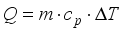 (1)
(1)  (2)
(2)  (3)
(3)  (4)
(4)  (5)
(5)  (6)
(6)  (7)
(7) 



 Share This Article
 Twitter
 Linked In
 Facebook
 Copy
Copy Download