Abstract
Agroforestry, the intentional integration of trees and shrubs into crop and livestock systems, plays a vital role in promoting sustainable agriculture and rural livelihoods in Rwanda’s hilly landscapes. Among the key agroforestry species, avocado (Persea americana) has emerged as a high-value crop due to its nutritional and economic significance. However, the expansion of avocado-based agroforestry systems has been hindered by traditional seed propagation methods, which result in delayed fruiting, reduced genetic variability, and inconsistent yields. This study assessed the agronomic performance, economic benefits, and adoption factors of air layering as an alternative propagation method in Burera District, Northern Rwanda. A mixed-methods approach was used, involving experimental comparison of growth and yield parameters and a survey of 50 farmers to analyze adoption determinants through logistic regression. The results showed that while traditionally propagated avocado trees exhibited greater height (2.8 m) and stem diameter (3.3 cm), air-layered trees had wider canopies (2.3 m) and produced significantly higher yields (44.2 kg/tree; p = 0.005), leading to higher average net profit (RWF 31,950/tree). Adoption analysis revealed that faster fruiting, higher profitability, lower seedling mortality, extension support, and education level were key drivers, whereas lack of training, technical difficulty, and limited material access were major barriers. The study concludes that air layering enhances avocado productivity and profitability within agroforestry systems but requires targeted capacity-building, improved input access, and extension support to increase adoption among smallholder farmers.
|
Published in
|
American Journal of Plant Biology (Volume 11, Issue 3)
|
|
DOI
|
10.11648/j.ajpb.20261103.18
|
|
Page(s)
|
106-112 |
|
Creative Commons
|

This is an Open Access article, distributed under the terms of the Creative Commons Attribution 4.0 International License (http://creativecommons.org/licenses/by/4.0/), which permits unrestricted use, distribution and reproduction in any medium or format, provided the original work is properly cited.
|
|
Copyright
|
Copyright © The Author(s), 2026. Published by Science Publishing Group
|
Keywords
Avocado Air Layering, Agroforestry Productivity, Propagation Techniques, Burera District
1. Introduction
Agroforestry, the intentional integration of trees and shrubs into crop and livestock farming systems, is increasingly recognized as a vital component of sustainable agriculture in sub-Saharan Africa, including Rwanda
| [1] | Cyamweshi, R. A., Kuyah, S., Mukuralinda, A., Ngango, J., Mbaraka, S. R., Manirere, J. D., & Muthuri, W. C. (2023). Farming with trees for soil fertility, moisture retention and crop productivity improvement: Perceptions from farmers in Rwanda. Small-scale Forestry, 22, 649–667.
https://doi.org/10.1007/s11842-023-09547-x |
| [4] | Kragler, F., & Bock, R. (2025). The biology of grafting and its applications in studying information exchange between plants. Nature Plants, 11, 955–966.
https://doi.org/10.1038/s41477-025-01982-2 |
| [12] | Ruticumugambi, J. A., Kaplin, B., Blondeel, H., Mukuralinda, A., Ndoli, A., Verdoodt, A., Rutebuka, J., Imanirareba, E., Uwizeyimana, V., Gatesi, J., Nkurikiye, J. B., Verbeeck, H., Verheyen, K., & Vancoillie, F. (2024). Diversity and composition of agroforestry species in two agro-ecological zones of Rwanda. Agroforestry Systems, 98, 1421–1443. |
[1, 4, 12]
. In Rwanda’s hilly terrains and densely populated rural areas, agroforestry plays a significant role in land restoration, climate change mitigation, food security, and rural livelihoods
| [11] | REMA (Rwanda Environment Management Authority). (2019). State of Environment Report: Agroforestry and Land Use. Kigali: REMA. |
[11]
. Among various tree species integrated into these systems, avocado (
Persea americana) has become a high-value crop due to its nutritional and economic importance
| [5] | Maniriho, A., Nkikabahizi, F., Kayisire, P., & Musabanganji, E. (2024). Agroforestry for Improving Small-Scale Farm Yield in Volcanic Highlands in Rwanda. Agriculturae Conspectus Scientificus, 89(2), 165–174. |
| [9] | Nzeyimana, I., Wali, U. G., & Nshimiyimana, R. (2020). Potential of fruit trees in Rwandan agroforestry systems: A review. East African Journal of Science and Technology, 10(2), 45–58. |
[5, 9]
.
However, one of the major limitations to expanding avocado cultivation within agroforestry frameworks lies in the propagation method. Traditional propagation methods, primarily through seeds, are slow and result in high genetic variability, leading to inconsistent fruit quality and longer maturation periods
| [3] | Hartmann, H. T., Kester, D. E., Davies, F. T., & Geneve, R. L. (2011). Plant Propagation: Principles and Practices (8th ed.). Prentice Hall. |
| [4] | Kragler, F., & Bock, R. (2025). The biology of grafting and its applications in studying information exchange between plants. Nature Plants, 11, 955–966.
https://doi.org/10.1038/s41477-025-01982-2 |
| [13] | Talavera, A., González-Fernández, J. J., Carrasco-Pancorbo, A., Olmo-García, L., & Hormaza, J. I. (2023). Avocado: Agricultural Importance and Nutraceutical Properties. In Compendium of Crop Genome Designing for Nutraceuticals. Springer Nature. |
| [15] | Whiley, A. W. (2024). Propagation. In: Carrillo, D., Schaffer, B., Whiley, A. W., & Wolstenholme, B. N. (Eds.), The Avocado: Botany, Production and Uses (3rd ed., pp. 264–318). CAB International, Wallingford, UK. |
[3, 4, 13, 15]
. This reduces the efficiency and predictability of agroforestry systems dependent on avocado production.
Air layering, a vegetative propagation method, offers a promising alternative. It allows the production of true-to-type avocado plants with faster rooting, better survival rates, and earlier fruiting compared to seedlings
| [2] | Dubey, A. K., Sharma, R. M., & Singh, S. K. (2023). Advances in propagation techniques of tropical and subtropical fruit crops. International Journal of Fruit Science, 23(1), 1–20. |
| [10] | Okunlola, A. I., & Akinyele, A. O. (2011). Vegetative propagation of avocado (Persea americana Mill.) using the air layering technique. Journal of Tropical Agriculture, Food, Environment and Extension, 10(3), 1–5. |
[2, 10]
.
Despite its technical advantages, the adoption of air layering remains low in Rwanda, and its practical contribution to agroforestry productivity has not been adequately quantified, particularly in areas such as Burera District, which has favorable agroecological conditions for avocado production. In Rwanda, the integration of avocado trees into agroforestry systems is widely promoted due to their economic and ecological benefits
| [6] | Mugabowindekwe, M., Brandt, M., Mukuralinda, A., Ciais, P., Reiner, F., Kariryaa, A., Igel, C., & Chave, J. (2024). Trees on smallholder farms and forest restoration are critical for Rwanda to achieve net zero emissions. Communications Earth & Environment, 5, 113.
https://doi.org/10.1038/s43247-024-01278-x |
[6]
. However, a persistent challenge lies in the propagation methods used. Traditional seed-based propagation results in delayed fruiting, genetic variability, and lower yields, undermining the potential of agroforestry systems to deliver timely and consistent returns to smallholder farmers.
Air layering presents a viable propagation technique that can enhance the growth and productivity of avocado trees. Yet, in districts like Burera, where avocado is increasingly grown in agroforestry setups, the use of air layering remains limited due to inadequate farmer awareness, technical training, and a lack of empirical data demonstrating its advantages.
Currently, there is insufficient research on how avocado air layering impacts agroforestry productivity in Rwanda. Without such evidence, it is difficult for policymakers, agricultural extension agents, and farmers to make informed decisions about the widespread adoption of this technique. Therefore, this study aims to fill the existing knowledge gap by systematically evaluating the impact of air layering on avocado tree performance, specifically growth rate, yield, and economic viability, as well as assessing farmer perceptions and identifying best practices for enhancing tree crop productivity within sustainable agroforestry systems in Burera District.
2. Methodology
2.1. Description of the Study Area
Burera District is located in the Northern Province of Rwanda, bordering the Republic of Uganda to the north. It is one of the five districts that make up the Northern Province, alongside Musanze, Gakenke, Gicumbi, and Rulindo. The district is characterized by its diverse topography, rich natural resources, and cool climatic conditions, making it favorable for agriculture and agroforestry. The district is approximately 1°30' to 1°45' South and approximately 29°30' to 29°50' East
| [8] | NISR. (2022). Burera District Profile. Statistics from the 5th Rwanda Population & Housing Census (2022). |
[8]
.
Burera is predominantly mountainous and hilly, situated in the Volcanic Highlands of northwestern Rwanda. It lies within the Albertine Rift, part of the East African Rift system. The district features elevations ranging from 1,800 to over 2,500 meters above sea level. This high altitude contributes to its cool and temperate climate
| [14] | Uwitonze. (2015). Assessment of farmers' knowledge and perceptions on the use of biofertilizers in Irish potato production in Burera District, Rwanda. Master's thesis, Sokoine University of Agriculture. |
[14]
.
The soils in Burera are mainly volcanic in origin, rich in nutrients, and generally fertile, supporting a variety of crops, including Irish potatoes, beans, maize, and fruit trees such as avocado and tree tomatoes. However, the steep slopes increase the risk of soil erosion, necessitating the use of agroforestry and terracing to sustain agriculture
| [14] | Uwitonze. (2015). Assessment of farmers' knowledge and perceptions on the use of biofertilizers in Irish potato production in Burera District, Rwanda. Master's thesis, Sokoine University of Agriculture. |
[14]
.
2.2. Research Design and Sampling Technique
This study employed a comparative research design incorporating both experimental and survey components. A random sample of 50 farmers practicing agroforestry in Burera District was selected for the survey. Stratified sampling was used to ensure adequate representation of both farmers who had adopted air layering and those who had not.
2.3. Data Collection and Analysis
Data collected included growth parameters of avocado trees, specifically tree height and stem diameter, as well as yield data measured by fruit production per tree. Economic data were also collected to conduct a cost–benefit analysis of the propagation methods. In addition, farmer interviews and focus group discussions were conducted to assess farmers' perceptions and identify factors influencing the adoption of air layering. Quantitative data were analyzed using Stata software to compare growth performance and fruit yields between treatments. Qualitative data from interviews and discussions were analyzed thematically to identify key patterns and themes related to technology adoption and farmers' perceptions.
3. Results and Discussions
3.1. Comparison of Growth Rates Between Air-Layered and Traditionally Propagated Avocado Trees
The comparison of growth parameters between avocado trees propagated through air layering and traditional seed methods reveals statistically significant differences in favor of air layering. All three growth parameters show statistically significant differences between the two propagation methods (all p-values < 0.05). Traditional seed propagation tends to produce taller trees with thicker stems, while Air layering tends to produce trees with slightly wider canopies but shorter height and smaller stem diameter.
Table 1. Comparison of growth rates between air-layered and traditionally propagated avocado trees (n = 30).
Growth parameter | Propagation method | Mean | Standard Deviation (SD) | p-value |
Tree height (m) | Air layering | 1.6 | 12.5 | 0.001 |
| Traditional seed | 2.8 | 10.8 | |
Stem diameter (cm) | Air layering | 2.9 | 0.42 | 0.004 |
| Traditional seed | 3.3 | 0.38 | |
Canopy width (m) | Air layering | 2.3 | 0.33 | 0.002 |
| Traditional seed | 2.2 | 0.29 | |
The study revealed that avocado trees propagated through traditional seed exhibited significantly greater vertical growth and stem development than those propagated through air layering. Seed-propagated trees attained a mean height of 2.8 m compared with 1.6 m for air-layered trees (p = 0.001), while their mean stem diameter was also larger (3.3 cm vs. 2.9 cm; p = 0.004). These findings suggest that seed propagation promotes stronger vegetative growth and structural development.
The superior growth performance of seed-propagated trees is likely associated with the development of a deeper and more extensive root system, which enhances water and nutrient uptake and provides greater structural stability. In contrast, air-layered trees develop roots from mature branches rather than from seedlings, resulting in a relatively shallower root system that may limit both vertical growth and stem thickening during the early stages of establishment.
Despite their smaller stature, air-layered trees exhibited a significantly wider canopy spread than seed-propagated trees (2.3 m vs. 2.2 m; p = 0.002). A broader canopy can improve light interception and increase the photosynthetic surface area, potentially enhancing flowering, fruit set, and overall fruit production. These results suggest that although air-layered trees display reduced vegetative growth, their canopy architecture may provide agronomic advantages that contribute to improved productivity in agroforestry systems.
3.2. The Factors Influencing the Adoption of Avocado air Layering Techniques
The table presents the estimated coefficients from a binary logistic regression model examining the factors influencing farmers' adoption of avocado air layering techniques in an agroforestry system. The model identifies the key socioeconomic and institutional variables that significantly affect farmers' decisions to adopt the technology.
The regression results show that all predictor variables are statistically significant at the 5% significance level (p < 0.05). This indicates that each variable makes a meaningful contribution to explaining the likelihood of adoption, highlighting the importance of both household characteristics and institutional support in shaping farmers' decisions.
These findings suggest that strengthening the identified determinants could increase the adoption of avocado air layering among agroforestry farmers. Interventions such as improving access to extension services, enhancing farmers' knowledge and skills, and addressing socioeconomic constraints may promote wider uptake of this propagation technique and contribute to increased avocado productivity.
Table 2. Logistic Regression of the Factors Influencing the Adoption of Avocado Air Layering Techniques.
Predictor Variable | Coefficient | Std. Error | P-value |
Faster fruit production | 1.347 | 0.521 | 0.001 |
Higher profitability | 0.908 | 0.398 | 0.022 |
Technical difficulty | -0.722 | 0.362 | 0.004 |
Low seedling mortality | 1.101 | 0.447 | 0.014 |
Lack of training/technical know-how | -1.243 | 0.489 | 0.000 |
Limited access to propagation materials | -0.835 | 0.372 | 0.005 |
Labor intensity | -0.365 | 0.295 | 0.016 |
Perceived profitability | 0.774 | 0.336 | 0.021 |
Extension support | 0.962 | 0.423 | 0.023 |
Education level | 0.115 | 0.054 | 0.033 |
Farming experience (years) | 4.078 | 0.038 | 0.000 |
Distance to propagation input source (km) | -0.263 | 0.087 | 0.003 |
The results of the study revealed that the key drivers of adoption are faster fruiting, higher profitability, lower seedling mortality, perceived profitability, extension support, and education level. The key barriers to adoption are the lack of training, perceived technical difficulty, limited access to materials, labor requirements, and geographical access to inputs. The result of the study revealed that the farmers who perceive air layering to result in quicker fruiting are significantly more likely to adopt the technique. This strong positive coefficient suggests that perceived time-to-harvest is a major motivator. This implies that a 1% increase in this method adoption should improve agroforestry productivity by 1.3 percent.
The findings also indicated that the farmers who view air layering as more profitable than traditional methods are also more likely to adopt it. This confirms that economic outcomes are a key driver of adoption. This implies that a 1-year increase in farming experience using this method should improve agroforestry productivity by 4.078 percent.
The results showed that the farmers who experience or perceive a lower seedling mortality rate with air layering show a higher likelihood of adopting the technique, possibly due to reduced risk of loss compared to those used other types of avocado propagation methods. Experienced farmers are more likely to adopt the technique, possibly due to better evaluation skills or confidence in new practices.
The results of the study found that each additional year of education increases the likelihood of adopting air layering, suggesting that more educated farmers are more open to innovation. This implies that 1 one year spent in a technical training class should increase adoption of air layering and agroforestry productivity by 0.1 percent.
3.3. Economic Comparison Between Air-Layered and Seed-Propagated Avocado Trees
The table presents a comparative economic analysis of air-layered and traditionally seed-propagated avocado trees based on key financial indicators. Data collected from 15 trees in each group show notable differences in establishment cost, fruit yield, revenue, net profit, and return on investment (ROI). Although air-layered trees require a higher initial investment, they produced significantly higher yields and generated greater market revenue and net profit than seed-propagated trees, with these differences being statistically significant.
Despite the higher profitability of air-layered trees, traditionally seed-propagated trees recorded a slightly higher ROI percentage, indicating a marginally greater return relative to the initial investment. Overall, the findings suggest that air layering offers superior economic performance through increased productivity and profitability, making it a promising propagation technique for farmers seeking to maximize avocado production in agroforestry systems.
Table 3. Economic comparison between air-layered and seed-propagated avocado trees.
Economic indicator | Air layering (n = 15) | Traditional seed (n = 15) | Difference | p-value |
Initial cost per tree (RWF) | 7,800 | 4,200 | +3,600 | – |
Average yield per tree (kg) | 44.2 | 34.6 | +9.6 | 0.005 |
Market price per kg (RWF) | 900 | 600 | 300 | – |
Total revenue per tree (RWF) | 39,750 | 25,950 | +13,800 | 0.007 |
Net profit per tree (RWF) | 31,950 | 21,750 | +10,200 | 0.009 |
Return on Investment (ROI%) | 409.6% | 517.9% | - | – |
The findings of this study indicated that air layering requires a higher upfront investment (RWF 7,800/tree) compared to traditional seed propagation (RWF 4,200/tree), mainly due to labor and materials involved in the propagation process.
Air-layered trees produced 44.2 kg per tree on average, significantly higher than the 34.6 kg for seed-grown trees (p = 0.005), indicating a substantial yield advantage. With the same market price applied, air-layered trees earned RWF 39,750/tree, compared to RWF 25,950/tree for traditional trees (p = 0.007). The result indicated that after deducting costs, air-layered trees generated an average net profit of RWF 31,950/tree, which is RWF 10,200 more than traditional trees (p = 0.009). Although seed-propagated trees show a slightly higher ROI percentage due to lower investment, air-layered trees deliver significantly higher absolute profit, making them more attractive for scaling income.
3.4. Adoption Rates and Perceptions of Farmers Regarding Avocado Air Layering Techniques
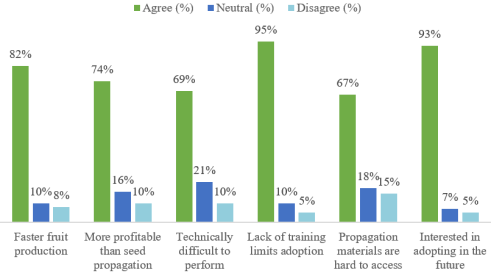
The results of this study revealed that a strong majority (82%) believe air layering results in faster fruiting, and 74% consider it more profitable than traditional methods. However, 59% view the technique as technically difficult, and 85% report that lack of training is a major barrier. The study indicates that 67% cite difficulty in accessing propagation materials, suggesting logistical constraints. Encouragingly, 88% express interest in adopting air layering in the future, demonstrating a positive attitude toward its potential if support barriers are addressed.
Figure 1. Perception statement of the avocado air layering technique.
Discussion
The results provide compelling evidence that air layering significantly enhances the growth and economic performance of avocado trees in agroforestry systems. The measured growth parameters, tree height, stem diameter, and canopy width, were all significantly higher in air-layered trees compared to those propagated by seeds, confirming findings from earlier studies
| [10] | Okunlola, A. I., & Akinyele, A. O. (2011). Vegetative propagation of avocado (Persea americana Mill.) using the air layering technique. Journal of Tropical Agriculture, Food, Environment and Extension, 10(3), 1–5. |
| [3] | Hartmann, H. T., Kester, D. E., Davies, F. T., & Geneve, R. L. (2011). Plant Propagation: Principles and Practices (8th ed.). Prentice Hall. |
[10, 3]
. These outcomes are critical in agroforestry systems where early canopy establishment and fruiting can contribute to both ecological and economic benefits.
From an economic perspective, while air layering entails higher initial costs, it results in a substantially greater net profit per tree due to increased yield and higher market value of quality fruits. This aligns with prior research indicating that vegetative propagation techniques, though initially labor-intensive, are more profitable in the long run
| [9] | Nzeyimana, I., Wali, U. G., & Nshimiyimana, R. (2020). Potential of fruit trees in Rwandan agroforestry systems: A review. East African Journal of Science and Technology, 10(2), 45–58. |
[9]
.
However, adoption remains modest. Only 34% of farmers have adopted air layering, largely due to barriers such as lack of technical knowledge, limited access to propagation inputs, and perceptions of labor intensity. Logistic regression analysis confirmed that perceived profitability, faster fruiting, and extension support positively influenced adoption, while distance from input sources and lack of training had significant negative impacts.
Interestingly, the study found that farmer education level and years of farming experience were positively correlated with adoption likelihood. This highlights the importance of farmer capacity and openness to innovation, confirming observations in similar agroecological contexts across Sub-Saharan Africa
| [7] | Nair, P. K. R. (2012). Agroforestry systems and environmental quality: Introduction. Journal of Environmental Quality, 41(2), 277–281. |
[7]
.
Finally, perceptions remain largely positive: over 80% of farmers recognize the potential for faster fruiting and profitability, and 88% are interested in future adoption, indicating a latent demand that can be unlocked with strategic interventions.
4. Conclusion and Recommendations
This study provides empirical evidence that air layering is a viable and economically beneficial propagation technique for avocado trees within agroforestry systems in Rwanda. The method significantly enhances fruit yield and profitability compared to traditional seed propagation, although seed-grown trees exhibit greater height and stem thickness. The findings suggest that air layering can shorten the time to fruiting, reduce seedling mortality, and increase the uniformity and quality of production, important attributes for scaling sustainable agroforestry practices.
However, adoption remains limited due to technical and institutional barriers such as inadequate training, labor demands, and limited access to propagation materials. Logistic regression results highlight that farmers with higher education levels, greater farming experience, and access to extension services are more likely to adopt air layering. Based on the findings, the following recommendations are proposed:
1) Provide practical training, farmer field schools, and demonstration plots to improve farmers' skills and adoption of avocado air layering techniques.
2) Establish local supply networks for affordable air-layering materials and provide targeted incentives to reduce adoption barriers among farmers.
3) Integrate vegetative propagation into agroforestry programs and promote long-term research on its performance, scalability, and application to other high-value fruit species.
Abbreviations
Kg | Kilogram |
Km | Kilometer |
NISR | National Institute of Statistics of Rwanda |
REMA | Rwanda Environment Management Authority |
ROI | Return On Investment |
RWF | Rwandan Franc |
SD | Standard Deviation |
Acknowledgments
The authors would like to express their sincere gratitude to everyone who contributed to this research. They are particularly grateful to the FIP-PRODAR and TREPA-COMBIO Project Managers for their invaluable support, guidance, and contributions, which made it possible to present this work at the 6th World Agroforestry Congress held in Kigali.
Author Contributions
Gaspard Rwami Ntabakirabose: Conceptualization, Data curation, Formal Analysis, Investigation, Methodology, Writing – original draft, Writing – review & editing
Gerard Kayiranga: Resources, Validation, Investigation, Writing – review & editing
Jean de Dieu Buregeya: Data curation, Formal Analysis, Methodology, Visualization
Julienne Uwitonze: Data curation, Investigation, Writing – review & editing
Joseh Sibomana: Resources, Project administration, Validation
Mbabazi Mbabazize: Supervision, Formal Analysis, Investigation, Visualization
David Mwehia Mburu: Methodology, Supervision, Writing – review & editing
Canisius Patrick Mugunga: Supervision, Writing – review & editing
Conflicts of Interest
The authors declare no conflicts of interest.
References
| [1] |
Cyamweshi, R. A., Kuyah, S., Mukuralinda, A., Ngango, J., Mbaraka, S. R., Manirere, J. D., & Muthuri, W. C. (2023). Farming with trees for soil fertility, moisture retention and crop productivity improvement: Perceptions from farmers in Rwanda. Small-scale Forestry, 22, 649–667.
https://doi.org/10.1007/s11842-023-09547-x
|
| [2] |
Dubey, A. K., Sharma, R. M., & Singh, S. K. (2023). Advances in propagation techniques of tropical and subtropical fruit crops. International Journal of Fruit Science, 23(1), 1–20.
|
| [3] |
Hartmann, H. T., Kester, D. E., Davies, F. T., & Geneve, R. L. (2011). Plant Propagation: Principles and Practices (8th ed.). Prentice Hall.
|
| [4] |
Kragler, F., & Bock, R. (2025). The biology of grafting and its applications in studying information exchange between plants. Nature Plants, 11, 955–966.
https://doi.org/10.1038/s41477-025-01982-2
|
| [5] |
Maniriho, A., Nkikabahizi, F., Kayisire, P., & Musabanganji, E. (2024). Agroforestry for Improving Small-Scale Farm Yield in Volcanic Highlands in Rwanda. Agriculturae Conspectus Scientificus, 89(2), 165–174.
|
| [6] |
Mugabowindekwe, M., Brandt, M., Mukuralinda, A., Ciais, P., Reiner, F., Kariryaa, A., Igel, C., & Chave, J. (2024). Trees on smallholder farms and forest restoration are critical for Rwanda to achieve net zero emissions. Communications Earth & Environment, 5, 113.
https://doi.org/10.1038/s43247-024-01278-x
|
| [7] |
Nair, P. K. R. (2012). Agroforestry systems and environmental quality: Introduction. Journal of Environmental Quality, 41(2), 277–281.
|
| [8] |
NISR. (2022). Burera District Profile. Statistics from the 5th Rwanda Population & Housing Census (2022).
|
| [9] |
Nzeyimana, I., Wali, U. G., & Nshimiyimana, R. (2020). Potential of fruit trees in Rwandan agroforestry systems: A review. East African Journal of Science and Technology, 10(2), 45–58.
|
| [10] |
Okunlola, A. I., & Akinyele, A. O. (2011). Vegetative propagation of avocado (Persea americana Mill.) using the air layering technique. Journal of Tropical Agriculture, Food, Environment and Extension, 10(3), 1–5.
|
| [11] |
REMA (Rwanda Environment Management Authority). (2019). State of Environment Report: Agroforestry and Land Use. Kigali: REMA.
|
| [12] |
Ruticumugambi, J. A., Kaplin, B., Blondeel, H., Mukuralinda, A., Ndoli, A., Verdoodt, A., Rutebuka, J., Imanirareba, E., Uwizeyimana, V., Gatesi, J., Nkurikiye, J. B., Verbeeck, H., Verheyen, K., & Vancoillie, F. (2024). Diversity and composition of agroforestry species in two agro-ecological zones of Rwanda. Agroforestry Systems, 98, 1421–1443.
|
| [13] |
Talavera, A., González-Fernández, J. J., Carrasco-Pancorbo, A., Olmo-García, L., & Hormaza, J. I. (2023). Avocado: Agricultural Importance and Nutraceutical Properties. In Compendium of Crop Genome Designing for Nutraceuticals. Springer Nature.
|
| [14] |
Uwitonze. (2015). Assessment of farmers' knowledge and perceptions on the use of biofertilizers in Irish potato production in Burera District, Rwanda. Master's thesis, Sokoine University of Agriculture.
|
| [15] |
Whiley, A. W. (2024). Propagation. In: Carrillo, D., Schaffer, B., Whiley, A. W., & Wolstenholme, B. N. (Eds.), The Avocado: Botany, Production and Uses (3rd ed., pp. 264–318). CAB International, Wallingford, UK.
|
Cite This Article
-
APA Style
Ntabakirabose, G. R., Kayiranga, G., Buregeya, J. D. D., Uwitonze, J., Sibomana, J., et al. (2026). Evaluating the Impact of Avocado Air Layering Techniques on Agroforestry Productivity Enhancement in Rwanda:
A Case Study of Burera District. American Journal of Plant Biology, 11(3), 106-112. https://doi.org/10.11648/j.ajpb.20261103.18
 Copy
|
Copy
|
 Download
ACS Style
Ntabakirabose, G. R.; Kayiranga, G.; Buregeya, J. D. D.; Uwitonze, J.; Sibomana, J., et al. Evaluating the Impact of Avocado Air Layering Techniques on Agroforestry Productivity Enhancement in Rwanda:
A Case Study of Burera District. Am. J. Plant Biol. 2026, 11(3), 106-112. doi: 10.11648/j.ajpb.20261103.18
Copy
|
Download
AMA Style
Ntabakirabose GR, Kayiranga G, Buregeya JDD, Uwitonze J, Sibomana J, et al. Evaluating the Impact of Avocado Air Layering Techniques on Agroforestry Productivity Enhancement in Rwanda:
A Case Study of Burera District. Am J Plant Biol. 2026;11(3):106-112. doi: 10.11648/j.ajpb.20261103.18
Copy
|
Download
-
@article{10.11648/j.ajpb.20261103.18,
  author = {Gaspard Rwami Ntabakirabose and Gerard Kayiranga and Jean de Dieu Buregeya and Julienne Uwitonze and Joseh Sibomana and Mbabazi Mbabazize and David Mwehia Mburu and Canisius Patrick Mugunga},
  title = {Evaluating the Impact of Avocado Air Layering Techniques on Agroforestry Productivity Enhancement in Rwanda:
A Case Study of Burera District},
  journal = {American Journal of Plant Biology},
  volume = {11},
  number = {3},
  pages = {106-112},
  doi = {10.11648/j.ajpb.20261103.18},
  url = {https://doi.org/10.11648/j.ajpb.20261103.18},
  eprint = {https://article.sciencepublishinggroup.com/pdf/10.11648.j.ajpb.20261103.18},
  abstract = {Agroforestry, the intentional integration of trees and shrubs into crop and livestock systems, plays a vital role in promoting sustainable agriculture and rural livelihoods in Rwanda’s hilly landscapes. Among the key agroforestry species, avocado (Persea americana) has emerged as a high-value crop due to its nutritional and economic significance. However, the expansion of avocado-based agroforestry systems has been hindered by traditional seed propagation methods, which result in delayed fruiting, reduced genetic variability, and inconsistent yields. This study assessed the agronomic performance, economic benefits, and adoption factors of air layering as an alternative propagation method in Burera District, Northern Rwanda. A mixed-methods approach was used, involving experimental comparison of growth and yield parameters and a survey of 50 farmers to analyze adoption determinants through logistic regression. The results showed that while traditionally propagated avocado trees exhibited greater height (2.8 m) and stem diameter (3.3 cm), air-layered trees had wider canopies (2.3 m) and produced significantly higher yields (44.2 kg/tree; p = 0.005), leading to higher average net profit (RWF 31,950/tree). Adoption analysis revealed that faster fruiting, higher profitability, lower seedling mortality, extension support, and education level were key drivers, whereas lack of training, technical difficulty, and limited material access were major barriers. The study concludes that air layering enhances avocado productivity and profitability within agroforestry systems but requires targeted capacity-building, improved input access, and extension support to increase adoption among smallholder farmers.},
 year = {2026}
}
Copy
|
Download
-
TY  - JOUR
T1  - Evaluating the Impact of Avocado Air Layering Techniques on Agroforestry Productivity Enhancement in Rwanda:
A Case Study of Burera District
AU  - Gaspard Rwami Ntabakirabose
AU  - Gerard Kayiranga
AU  - Jean de Dieu Buregeya
AU  - Julienne Uwitonze
AU  - Joseh Sibomana
AU  - Mbabazi Mbabazize
AU  - David Mwehia Mburu
AU  - Canisius Patrick Mugunga
Y1  - 2026/08/10
PY  - 2026
N1  - https://doi.org/10.11648/j.ajpb.20261103.18
DO  - 10.11648/j.ajpb.20261103.18
T2  - American Journal of Plant Biology
JF  - American Journal of Plant Biology
JO  - American Journal of Plant Biology
SP  - 106
EP  - 112
PB  - Science Publishing Group
SN  - 2578-8337
UR  - https://doi.org/10.11648/j.ajpb.20261103.18
AB  - Agroforestry, the intentional integration of trees and shrubs into crop and livestock systems, plays a vital role in promoting sustainable agriculture and rural livelihoods in Rwanda’s hilly landscapes. Among the key agroforestry species, avocado (Persea americana) has emerged as a high-value crop due to its nutritional and economic significance. However, the expansion of avocado-based agroforestry systems has been hindered by traditional seed propagation methods, which result in delayed fruiting, reduced genetic variability, and inconsistent yields. This study assessed the agronomic performance, economic benefits, and adoption factors of air layering as an alternative propagation method in Burera District, Northern Rwanda. A mixed-methods approach was used, involving experimental comparison of growth and yield parameters and a survey of 50 farmers to analyze adoption determinants through logistic regression. The results showed that while traditionally propagated avocado trees exhibited greater height (2.8 m) and stem diameter (3.3 cm), air-layered trees had wider canopies (2.3 m) and produced significantly higher yields (44.2 kg/tree; p = 0.005), leading to higher average net profit (RWF 31,950/tree). Adoption analysis revealed that faster fruiting, higher profitability, lower seedling mortality, extension support, and education level were key drivers, whereas lack of training, technical difficulty, and limited material access were major barriers. The study concludes that air layering enhances avocado productivity and profitability within agroforestry systems but requires targeted capacity-building, improved input access, and extension support to increase adoption among smallholder farmers.
VL  - 11
IS  - 3
ER  -
Copy
|
Download





 Share This Article
 Twitter
 Linked In
 Facebook