
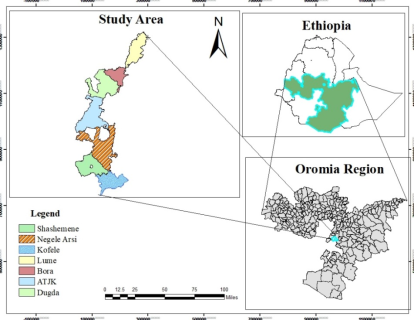
Major cereals globally include wheat, maize, and rice, contributing 80% of production. In Ethiopia, key cereals are tef, maize, wheat, barley, sorghum, rice, and finger millet. Maize accounts for 27.02% of annual grain production, followed by tef at 17.29%. Maize yields the highest per unit area at 3.7 t/ha, followed by rice and wheat. Ethiopia's mean national wheat yield is 2600.75 kg/ha, below African and global averages. Yield-reducing factors include soil fertility decline, weeds, diseases, and insects. Weeds significantly constrain cereal crop production and are crucial for yield increase. Weeds compete for resources, negatively impacting crop yield and increasing production costs. Weeds contribute to 45% of annual agricultural product losses globally. Crop yield losses due to weeds in Africa range from 50% to 100% for various crops. Limited studies exist on common weeds affecting Maize at the West Arsi and East shewa. The weed survey was conducted in East Shewa and West Arsi zones, Oromia. Assessment took place during the main cropping seasons of 2021-2023. The survey covered seven districts: ATJK, Dugda, Bora, Lume, Negelle Arsi, Shashemanne, and Kofele. Maize fields in 37 kebeles and 107 fields were included in the survey. Key parameters such as density, frequency, relative frequency and similarity index have been analyzed for each crop. Generally, for most crops and districts, annual broad leaf weeds dominated over grass and sedge type of weeds. The most dominant family that contained the highest number of weed species for all crops and fields assessed was Asteracae followed by Poaceace and Amaranthaceae families. In most cases weeds of a crop were similar across the various districts as indicated by similarity index. The frequency of individual weed species in maize fields ranged from 1% up to 91% while the dominance value ranged from 0.71% up to 21.92%. The most frequent and dominant weeds were Galensoga palviflora and Argemone mexicana L., Maize crop.
| Published in | American Journal of Plant Biology (Volume 11, Issue 1) |
| DOI | 10.11648/j.ajpb.20261101.11 |
| Page(s) | 1-7 |
| Creative Commons |
This is an Open Access article, distributed under the terms of the Creative Commons Attribution 4.0 International License (http://creativecommons.org/licenses/by/4.0/), which permits unrestricted use, distribution and reproduction in any medium or format, provided the original work is properly cited. |
| Copyright |
Copyright © The Author(s), 2026. Published by Science Publishing Group |
Maize, Assessment, Major Weeds, Galensoga Palviflora
ZONE | Districs | Altitude (ab.ms.l) | no of field assesed |
|---|---|---|---|
East Shewa | ATJK | 1626-1841 | 13 |
Dudga | 1633-1670 | 16 | |
Bora | 1590-1680 | 15 | |
Lume | 1586-1920 | 14 | |
West Arsi | Negelle Arsi | 1604-1967 | 21 |
Shashemanne | 2168-2455 | 14 | |
Kofele | 2398-2646 | 14 | |
Over all mean | 1586-2646 | 107 | |
no of kebele | 37 | ||
No. | Family | No. of species | No. | Family | No. of species |
|---|---|---|---|---|---|
1 | Asteraceae | 9 | 11 | Commelinaceae | 1 |
2 | Poaceae | 7 | 12 | Compositae | 1 |
3 | Amaranthaceae | 4 | 13 | Eragrostidae | 1 |
4 | Lamiaceae | 3 | 14 | Malvaceae | 1 |
5 | Solanaceae | 3 | 15 | Oxalidaceae | 1 |
6 | Brassicaceae | 2 | 16 | Panicae | 1 |
7 | Convolvulaceae | 2 | 17 | Papaveraceae | 1 |
8 | Cyperaceae | 2 | 18 | Primulaceae | 1 |
9 | Euphorbiaceae | 2 | 19 | Protulaceae | 1 |
10 | Polygonaceae | 2 | 20 | Rubiaceae | 1 |
Total | 46 |
Botaical Name | family | Catagories | Life cycle | Density | Frequ ency | RD | FR | SD |
|---|---|---|---|---|---|---|---|---|
Agerantum conyoides | Asteraceae | Broad Leaf | Annual | 2.18 | 0.11 | 1.38 | 1.24 | 111.50 |
Amaranthus hybridus | Amaranthaceae | Broad Leaf | Annual | 1.53 | 0.05 | 0.97 | 0.56 | 172.39 |
Amaranthus retroflexus | Amaranthaceae | Broad Leaf | Biennial | 1.33 | 0.01 | 0.84 | 0.11 | 747.65 |
Amaranthus spinosus | Amaranthaceae | Broad Leaf | Annual | 2.07 | 0.56 | 1.31 | 6.19 | 21.12 |
Anagallis arvensis | Primulaceae | Broad Leaf | Annual | 1.90 | 0.13 | 1.20 | 1.46 | 82.05 |
Argemone mexicana L | Papaveraceae | Broad Leaf | Annual | 4.20 | 0.52 | 2.65 | 5.74 | 46.25 |
Avena fatua | Poaceae | Grassy | Annual | 2.76 | 0.15 | 1.74 | 1.69 | 103.27 |
Bidense pilosa | Asteraceae | Broad Leaf | Annual | 2.07 | 0.38 | 1.31 | 4.16 | 31.48 |
Brassica juncea | Brassicaceae | Broad Leaf | Annual | 0.95 | 0.14 | 0.60 | 1.58 | 38.24 |
Chenopodium album | Amaranthaceae | Broad Leaf | Annual | 2.36 | 0.23 | 1.49 | 2.59 | 57.74 |
Commelina benghalensis | Commelinaceae | Broad Leaf | Annual | 2.29 | 0.58 | 1.45 | 6.41 | 22.55 |
Convolvulus | Convolvulaceae | Broad Leaf | Pennerial | 0.78 | 0.06 | 0.49 | 0.68 | 72.87 |
Cyanthillium cinereum | Brassicaceae | Broad Leaf | Biennial | 4.00 | 0.01 | 2.53 | 0.11 | 2248.57 |
Cynodon dactlyon | Poaceae | Grassy | Pennerial | 3.57 | 0.35 | 2.26 | 3.83 | 59.00 |
Cyprus esculentus | Cyperaceae | Sedge | Pennerial | 7.10 | 0.37 | 4.49 | 4.05 | 110.90 |
Cyprus rotundus | Cyperaceae | Sedge | Pennerial | 4.52 | 0.07 | 2.86 | 0.79 | 363.29 |
Datura stramonium | Solanaceae | Broad Leaf | Annual | 1.17 | 0.18 | 0.74 | 2.03 | 36.44 |
Digitaria diagonalis | Poaceae | Grassy | Pennerial | 4.30 | 0.36 | 2.72 | 3.94 | 69.14 |
Echinochloa esculenta | Poaceae | Grassy | Pennerial | 3.87 | 0.05 | 2.45 | 0.56 | 434.72 |
Eleusine indica | Poaceae | Grassy | Pennerial | 2.70 | 0.18 | 1.71 | 2.03 | 84.44 |
Eragrostis cilianen | Eragrostidae | Grassy | Annual | 3.28 | 0.20 | 2.08 | 2.25 | 92.29 |
Euphorbia esula | Euphorbiaceae | Broad Leaf | Pennerial | 1.20 | 0.10 | 0.76 | 1.13 | 67.46 |
Euphorbia hirta | Euphorbiaceae | Broad Leaf | Annual | 21.92 | 0.04 | 13.86 | 0.45 | 3080.07 |
Galensoga palviflora | Asteraceae | Broad Leaf | Annual | 8.63 | 0.91 | 5.46 | 10.01 | 54.48 |
Galium spurium | Rubiaceae | Broad Leaf | Annual | 2.73 | 0.05 | 1.73 | 0.56 | 307.30 |
Gozotia abisinica | Asteraceae | Broad Leaf | Annual | 2.37 | 0.39 | 1.50 | 4.28 | 35.04 |
Ipomoea indica | Convolvulaceae | Broad Leaf | Annual | 0.71 | 0.07 | 0.45 | 0.79 | 57.36 |
Leucas aspera | Lamiaceae | Broad Leaf | Annual | 1.74 | 0.09 | 1.10 | 1.01 | 108.73 |
Malva parviflora | Malvaceae | Broad Leaf | Annual | 2.80 | 0.05 | 1.77 | 0.56 | 314.80 |
Nicandra physlodes | Solanaceae | Broad Leaf | Annual | 2.88 | 0.62 | 1.82 | 6.86 | 26.54 |
Ocimum lamiifolium | Lamiaceae | Broad Leaf | Annual | 1.11 | 0.03 | 0.70 | 0.34 | 208.20 |
Oxalis acetosella | Oxalidaceae | Broad Leaf | Pennerial | 4.29 | 0.07 | 2.71 | 0.79 | 344.17 |
Oxygonum sinuatum Meisn. | Polygonaceae | Broad Leaf | Annual | 1.53 | 0.19 | 0.97 | 2.14 | 45.16 |
Parthiunium Hysterophoros | Asteraceae | Broad Leaf | Annual | 1.88 | 0.20 | 1.19 | 2.25 | 52.94 |
Pennisetum setaceum | Poaceae | Grassy | Pennerial | 3.95 | 0.21 | 2.50 | 2.36 | 105.80 |
Polygonum arenastrum | Polygonaceae | Broad Leaf | Annual | 8.42 | 0.08 | 5.32 | 0.90 | 591.42 |
Portulaca oleraceus | Protulaceae | Broad Leaf | Annual | 1.33 | 0.06 | 0.84 | 0.68 | 124.92 |
salvia officinalis | Lamiaceae | Broad Leaf | Pennerial | 2.53 | 0.15 | 1.60 | 1.69 | 94.94 |
Setaria pumila | Poaceae | Broad Leaf | Annual | 3.22 | 0.09 | 2.04 | 1.01 | 201.26 |
Setria verticelata | Panicae | Grassy | Annual | 3.06 | 0.27 | 1.94 | 2.93 | 66.25 |
Silybum marianum | Asteraceae | Broad Leaf | Biennial | 2.78 | 0.03 | 1.76 | 0.34 | 520.29 |
Solanum nigrum | Solanaceae | Broad Leaf | Annual | 2.13 | 0.05 | 1.35 | 0.56 | 239.92 |
Sonchus oleraceus | Compositae | Broad Leaf | Annual | 0.83 | 0.02 | 0.53 | 0.23 | 234.23 |
Tagetes minuta | Asteraceae | Broad Leaf | Annual | 8.60 | 0.05 | 5.44 | 0.56 | 966.89 |
Xanthium spinosum | Asteraceae | Broad Leaf | Annual | 0.88 | 0.08 | 0.55 | 0.90 | 61.48 |
Xanthium strumarium | Asteraceae | Broad Leaf | Annual | 1.61 | 0.29 | 1.02 | 3.15 | 32.27 |
District | ATJK | Dugda | Bora | Lume | Negelle A | Shashe | Kofele |
|---|---|---|---|---|---|---|---|
ATJK | 100.00% | 69.23% | 58.13% | 70.20% | 61.90% | 38.09% | 50.00% |
Dugda | 100.00% | 63.41% | 70.20% | 53.49% | 41.46% | 46.20% | |
Bora | 100.00% | 69.23% | 54.54% | 29.89% | 46.15% | ||
Lume | 100.00% | 64.90% | 50.00% | 47.30% | |||
Negelle A | 100.00% | 45.24% | 60.00% | ||||
Shashe | 100.00% | 39.39% | |||||
Kofele | 100.00% |
ATJK | Adami Tulu Jido Combolcha |
MSL | Above Sea Level |
| [1] | Dessie A. Cereal crops research achievements and challenges in Ethiopia. International Journal of Research and Review. 2018; 5(9): 116-122. |
| [2] | CSA. 2017. Central Statistical Agency. The Federal Democratic Republic of Ethiopia, Central Statistical Agency, AgriculturalSample Survey 2016/7 (2009 E. C.), Volume I, Report on Area and Production of Major Crops (Private Peasant Holdings, Meher Season), Statistical Bulletin 532, May 2017, Addis Ababa, Ethiopia. |
| [3] | Central Statistical Authority of Ethiopia (CSA).2016/17. Report on area and production of major crops, private peasant holdings, meher season, Addis Ababa. |
| [4] | Lopez-Granados F. 2011. Weed detection for site-specific weed management: mapping and real-time approaches. Weed Research, 51: 1- 11. M. |
| [5] | Shahzhad F, N Lixiao, R Amjadur, C Chang, W Chao, S Shah, H Jianliang. 2012. Weed control and yield attributes against postemergence herbicides application in wheat crop, Punjab, Pakistan. |
| [6] | Reddy TY and Reddi GHS. 2011. Principles of Agronomy. Kalyani Publishers, Noida, India. P. 527. |
| [7] | Javaid, Arshad & Shafique, Sobiya & Bajwa, Rukhsana & Shafique, Shazia. (2010). Parthenium management through aqueous extracts of Alstonia scholaris. Pak. J. Bot. 42. 3651-3657. |
| [8] | Takele, Negewo., Nagassa, Dechassa., Amare, Fufa., Tigist, Bidira. (2023). Weed science research achievements on maize in Ethiopia: a review. F1000Research, 12: 880-880. |
| [9] | Upadhyay RK, Baksh H, Patra DD (2011). Integrated weed management of medicinal plants In India. International Journal of Medinal and Aromatic Plants 1(2): 51-56. |
| [10] | Uddin MK, Juraimi AS, Ismail MR and Brosnan JT. 2010. Characterizing weed populations in different turfgrass sites throughout the Klang Valley of Western Peninsular Malaysia. Weed Technology, 24(2), pp. 173-181. |
| [11] | Parker C and Fryer JD. 1975. Weed control problems causing major reductions in world food supplies (No. 76-120049. CIMMYT.). |
| [12] | Jibat M, Getachew W, Getu A, Kifelew H (2019). Survey and Identification of Major Weeds of Seeds Spice in Ethiopia. Plant Pathol Microbiol; 10: 477. |
| [13] | Akobundu IO. 1987 Sugarcane. Weed Science in the Tropics: Principles and Practices (IO Akobundu, ed.). John Wiley and Sons, New York, pp. 414-416. |
| [14] | R v Thomas – 1985. Retrieved from |
| [15] | E., O., Abusteit., Ragab, Absy., Amir, Ismail., Amr, Hassan. (2024). Evaluation of the efficiency of some weed control treatments on maize growth, and yield under high infestation by Ipomea eriocarpa and Setaria virdis soil seed banks. |
| [16] | Cordeau, Stéphane. 2022. "Conservation Agriculture and Agroecological Weed Management" Agronomy 12, no. 4: 867. |
APA Style
Tesfaye, G., Begna, F., Longle, A. (2026). Assessment and Identification of Major Weeds on Maize (Zea mays) in East Shewa and West Arsi, Zones, Oromia. American Journal of Plant Biology, 11(1), 1-7. https://doi.org/10.11648/j.ajpb.20261101.11
ACS Style
Tesfaye, G.; Begna, F.; Longle, A. Assessment and Identification of Major Weeds on Maize (Zea mays) in East Shewa and West Arsi, Zones, Oromia. Am. J. Plant Biol. 2026, 11(1), 1-7. doi: 10.11648/j.ajpb.20261101.11
AMA Style
Tesfaye G, Begna F, Longle A. Assessment and Identification of Major Weeds on Maize (Zea mays) in East Shewa and West Arsi, Zones, Oromia. Am J Plant Biol. 2026;11(1):1-7. doi: 10.11648/j.ajpb.20261101.11
@article{10.11648/j.ajpb.20261101.11,
  author = {Gobena Tesfaye and Feyisa Begna and Adisu Longle},
  title = {Assessment and Identification of Major Weeds on Maize (Zea mays) in East Shewa and West Arsi, Zones, Oromia},
  journal = {American Journal of Plant Biology},
  volume = {11},
  number = {1},
  pages = {1-7},
  doi = {10.11648/j.ajpb.20261101.11},
  url = {https://doi.org/10.11648/j.ajpb.20261101.11},
  eprint = {https://article.sciencepublishinggroup.com/pdf/10.11648.j.ajpb.20261101.11},
  abstract = {Major cereals globally include wheat, maize, and rice, contributing 80% of production. In Ethiopia, key cereals are tef, maize, wheat, barley, sorghum, rice, and finger millet. Maize accounts for 27.02% of annual grain production, followed by tef at 17.29%. Maize yields the highest per unit area at 3.7 t/ha, followed by rice and wheat. Ethiopia's mean national wheat yield is 2600.75 kg/ha, below African and global averages. Yield-reducing factors include soil fertility decline, weeds, diseases, and insects. Weeds significantly constrain cereal crop production and are crucial for yield increase. Weeds compete for resources, negatively impacting crop yield and increasing production costs. Weeds contribute to 45% of annual agricultural product losses globally. Crop yield losses due to weeds in Africa range from 50% to 100% for various crops. Limited studies exist on common weeds affecting Maize at the West Arsi and East shewa. The weed survey was conducted in East Shewa and West Arsi zones, Oromia. Assessment took place during the main cropping seasons of 2021-2023. The survey covered seven districts: ATJK, Dugda, Bora, Lume, Negelle Arsi, Shashemanne, and Kofele. Maize fields in 37 kebeles and 107 fields were included in the survey. Key parameters such as density, frequency, relative frequency and similarity index have been analyzed for each crop. Generally, for most crops and districts, annual broad leaf weeds dominated over grass and sedge type of weeds. The most dominant family that contained the highest number of weed species for all crops and fields assessed was Asteracae followed by Poaceace and Amaranthaceae families. In most cases weeds of a crop were similar across the various districts as indicated by similarity index. The frequency of individual weed species in maize fields ranged from 1% up to 91% while the dominance value ranged from 0.71% up to 21.92%. The most frequent and dominant weeds were Galensoga palviflora and Argemone mexicana L., Maize crop.},
 year = {2026}
}
TY  - JOUR
T1  - Assessment and Identification of Major Weeds on Maize (Zea mays) in East Shewa and West Arsi, Zones, Oromia
AU  - Gobena Tesfaye
AU  - Feyisa Begna
AU  - Adisu Longle
Y1  - 2026/01/07
PY  - 2026
N1  - https://doi.org/10.11648/j.ajpb.20261101.11
DO  - 10.11648/j.ajpb.20261101.11
T2  - American Journal of Plant Biology
JF  - American Journal of Plant Biology
JO  - American Journal of Plant Biology
SP  - 1
EP  - 7
PB  - Science Publishing Group
SN  - 2578-8337
UR  - https://doi.org/10.11648/j.ajpb.20261101.11
AB  - Major cereals globally include wheat, maize, and rice, contributing 80% of production. In Ethiopia, key cereals are tef, maize, wheat, barley, sorghum, rice, and finger millet. Maize accounts for 27.02% of annual grain production, followed by tef at 17.29%. Maize yields the highest per unit area at 3.7 t/ha, followed by rice and wheat. Ethiopia's mean national wheat yield is 2600.75 kg/ha, below African and global averages. Yield-reducing factors include soil fertility decline, weeds, diseases, and insects. Weeds significantly constrain cereal crop production and are crucial for yield increase. Weeds compete for resources, negatively impacting crop yield and increasing production costs. Weeds contribute to 45% of annual agricultural product losses globally. Crop yield losses due to weeds in Africa range from 50% to 100% for various crops. Limited studies exist on common weeds affecting Maize at the West Arsi and East shewa. The weed survey was conducted in East Shewa and West Arsi zones, Oromia. Assessment took place during the main cropping seasons of 2021-2023. The survey covered seven districts: ATJK, Dugda, Bora, Lume, Negelle Arsi, Shashemanne, and Kofele. Maize fields in 37 kebeles and 107 fields were included in the survey. Key parameters such as density, frequency, relative frequency and similarity index have been analyzed for each crop. Generally, for most crops and districts, annual broad leaf weeds dominated over grass and sedge type of weeds. The most dominant family that contained the highest number of weed species for all crops and fields assessed was Asteracae followed by Poaceace and Amaranthaceae families. In most cases weeds of a crop were similar across the various districts as indicated by similarity index. The frequency of individual weed species in maize fields ranged from 1% up to 91% while the dominance value ranged from 0.71% up to 21.92%. The most frequent and dominant weeds were Galensoga palviflora and Argemone mexicana L., Maize crop.
VL  - 11
IS  - 1
ER  -
Oromia Agricultural Research Institute, Adami Tullu Agricultural Research Center, Ziway, Ethiopia

Information



 Share This Article
 Twitter
 Linked In
 Facebook
 Copy
Copy Download