Coffee remains Ethiopia's top export commodity and is the most significant crop in the country's economy. The crop's production and quality are extremely low, despite its economic significance. The decline in Ethiopian coffee quality is mostly caused by improper postharvest processing methods, such as harvesting immature cherries, not sorting during grading and processing, improper drying without considering drying time, drying place, layer thickness, and drying material, transportation, storage, over-fermentation, etc. The processing of coffee beans is a critical step that influences the quality of the final product. Effective demucilaging is essential to remove mucilage while preserving the integrity of the beans. This study focuses on the development and performance evaluation of a manually operated coffee bean demucileger, aimed at improving the efficiency of coffee processing while minimizing operational costs. The objective was to design a user-friendly, effective demucilaging device for small-scale coffee production settings. The demucileger was constructed using locally sourced materials, and its performance was evaluated based on parameters such as efficiency, ease of operation, and quality of demucilaged beans. Results indicated that the device successfully removed mucilage with an efficiency rate and washing capacity of 86% and 86.86 kg/hr. while maintaining the integrity of the beans. This manual operated demucileger presents a viable solution for smallholder coffee farmers, potentially enhancing their productivity and product quality in an economically sustainable manner.
This is an Open Access article, distributed under the terms of the Creative Commons Attribution 4.0 International License (http://creativecommons.org/licenses/by/4.0/), which permits unrestricted use, distribution and reproduction in any medium or format, provided the original work is properly cited.
. As a result, it serves as a pillar of the nation's export economy and directly or indirectly provides for the livelihood of about 15 million people
[2]
“REPORT ON THE ETHIOPIAN ECONOMY 2016 Agricultural Transformation in Ethiopia: Prospects and Challenges Ethiopian Economics Association (EEA),” 2016, Accessed: Nov. 05, 2025. [Online]. Available:
. The Jimma Zone, which spans 1,093,268 hectares of land, is one of the coffee-growing regions in the Oromia Regional State
[4]
R. Cerda, J. Avelino, C. Gary, P. Tixier, E. Lechevallier, and C. Allinne, “Primary and secondary yield losses caused by pests and diseases: Assessment and modeling in coffee,” PLoSOne, vol. 12, no. 1, Jan. 2017,
. Approximately 105,140 hectares of land are currently covered by coffee in the region, including plantations owned by the state and corporate entities, as well as small-scale farmers' holdings. Approximately 28–35 thousand tons of the 40–55 thousand tons of coffee produced in the Zone each year are exported to the central market, with the remainder being consumed locally
[5]
“(PDF) Review on Coffee Production and Quality in Ethiopia.” Accessed: Nov. 05, 2025. [Online]. Available:
. Jimma Zone currently accounts for 43% of the Oromia Region's export share and 21% of the nation's total export share
[2]
“REPORT ON THE ETHIOPIAN ECONOMY 2016 Agricultural Transformation in Ethiopia: Prospects and Challenges Ethiopian Economics Association (EEA),” 2016, Accessed: Nov. 05, 2025. [Online]. Available:
Produced in the eight districts of Gomma, Manna, Gera, Limmu Kossa, Limmu Seka, Seka Chokorsa, Kersa, and Dedo, coffee is the Zone's main cash crop and a significant source of income for coffee-growing families
[2]
“REPORT ON THE ETHIOPIAN ECONOMY 2016 Agricultural Transformation in Ethiopia: Prospects and Challenges Ethiopian Economics Association (EEA),” 2016, Accessed: Nov. 05, 2025. [Online]. Available:
. In Jimma Zone, the coffee industry directly or indirectly benefits 30 to 45 percent of the population, according to the same source's assessment.
Coffee quality is occasionally dropping as a result of a number of poor pre- and post-harvest management techniques, even though the Jimma Zone has a long history of producing coffee, a diversity of native coffee varieties for quality enhancement, and a good climate
[6]
T. Kidist, G. Zerihun, and E. Biniam, “Assessment of pre and post-harvest management practices on coffee (Coffea arabica L.) quality determining factors in Gedeo zone, Southern Ethiopia,” AfricanJ.Agric.Res., vol. 14, no. 28, pp. 1216-1228, Jul. 2019,
. Furthermore, natural obstacles like extended periods of precipitation, especially during the harvest and drying seasons, can also result in lower-quality coffee
[6]
T. Kidist, G. Zerihun, and E. Biniam, “Assessment of pre and post-harvest management practices on coffee (Coffea arabica L.) quality determining factors in Gedeo zone, Southern Ethiopia,” AfricanJ.Agric.Res., vol. 14, no. 28, pp. 1216-1228, Jul. 2019,
, for example, of the Jimma coffee delivered to the coffee quality inspection center laboratory between 2003 and 2007, over 60% of the dry processed coffee was categorized as grade, while 80% of the wet processed coffee was classed as grade 2 and grade 3. According to the author, the primary contributing factor to the area's poor quality was the post-harvest processing and handling issues. Coffee growers in woredas like Gomma, Limmu Kossa, and Manna, where coffee accounts for a greater percentage of their yearly revenue, have been negatively impacted by the subpar quality and the ensuing decline in earnings. However, Jimma Zone is renowned for producing high-quality coffee varieties, including Limmu Enaria (Limmu) coffee, which is regarded as the world's best.
Processing is a critical step in the creation of coffee and is essential to determining its quality
[7]
G. Bizimungu, R. H. Ahouansou, and G. C. Semassou, “Design, fabrication and evaluation of small-scale disc and drum pulpers for Arabica (Coffea arabica L.) and Robusta (Coffea canephora L.) coffee,” J.SaudiSoc.Agric.Sci., vol. 23, no. 6, pp. 404-414, Sep. 2024,
. Wet and dry processes are used to process coffee, and the complexity and quality of the final product differ
[8]
K. Teshome, Z. Girma, and B. Eshetu, “African Journal of Agricultural Research Assessment of pre and post-harvest management practices on coffee (Coffea arabica L.) quality determining factors in Gedeo zone, Southern Ethiopia,” vol. 14, no. 28, pp. 1216-1228, 2019,
. In Ethiopia, coffee is produced using both sun-drying and wet-processing techniques, representing 70% and 30% of total production, respectively.
Notwithstanding the long history of coffee production, the variety of local coffee varieties for quality improvement, and the favorable climate, there are still certain gaps, such as the lack of an improved small-scale wet coffee pulpier and washer to improve the wet coffee process and reduce coffee quality issues in the Jimma zone, and the dearth of sufficient information regarding the impact of post-harvest handling and processing methods on coffee quality. In order to increase coffee production by reducing the aforementioned issues that coffee growers and processors face in obtaining high-quality coffee products in the study areas, a small-scale wet coffee pulpier has been introduced.
Wet coffee washing, which involves soaking pulped coffee to allow it to ferment naturally in concrete storage tanks for 12 to 40 hours, is one of the post-harvest processing and handling issues that is being implemented in the research region to aid in the removal of mucilage
[9]
B. Ollika Fufa, M. Bekele Etana, and M. Chewaka Aga, “Review on Post-Harvest and Green Bean Coffee Processing in Ethiopia,” ActaSci.Agric., vol. 3, no. 7, pp. 157-162, Jun. 2019,
. After fermentation, the soaked beans are hand scrubbed against the concrete floor channel, needing three to four rinses of clean water to remove all traces and breakdown products of the mucilage. This is a hard and time-consuming process. In contrast to the natural fermentation process, the mechanical demucilage method offers numerous benefits and enables the rapid removal of the mucilage
[10]
“A Detailed Review on Common Causes of Postharvest Loss and Quality Deterioration of Fruits and Vegetables in Ethiopia,” J.Biol.Agric.Healthc., Apr. 2019,
According to the Ethiopian Science and Technology Agency, some benefits include a major decrease in the amount of human labor needed for operation, preservation of coffee quality, saving money that would otherwise be spent on the purchase of mechanical demucilager’s, and a significant decrease in water consumption
[11]
“(PDF) Factors Affecting the Quality of Ethiopian Coffee (Coffea Arabica L.).” Accessed: Nov. 05, 2025. [Online]. Available:
The natural fermentation process is the primary method of removing coffee mucilage that is now used in the research region. The soaked beans are next washed by scrubbing them against the concrete floor, which requires expensive beginning equipment and is primarily used by high-level investors. Considering these issues, we created a manually operated wet coffee bean washer with the intention of creating and assessing the device
[12]
M. Regassa, “Factors Affecting the Quality of Ethiopian Coffee (Coffea Arabica L.),” Agric.ForFish, vol. 13, no. 5, pp. 175-181, Sep. 2024,
The Jimma Agricultural Engineering Research Center (JAERC) used locally accessible materials to create the washing machine. The Jimma zone, Goma district, which is situated at 7° 59'N & 36°42'E, was the site of the experiment. The area is 1500 meters above sea level, with average annual rainfall of 1143 mm and maximum and minimum temperatures of 31°C and 18°C, respectively.
Machine description
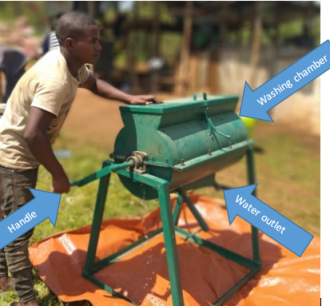
Hopper: Located at the upper left corner of the washer, this broad chute, composed of a galvanized sheet, serves as the material's inlet.
Washing Chamber: Made of thick galvanized sheet, this is the washer's major component. It has a sieve and a washing drum
[13]
C. Marsh, S. Taylor, P. Milliken, and G. Senaratne, “DEVELOPING AN UNDERSTANDING OF WASHING MACHINE DYNAMICS”.
[13]
.
Volume of the wash drum = A*L
Where, l = length of drum
r = radius of the drum
Discharge Outlets: The washer has two outlets: the first is located underneath the cylinder and is used for the waste material (slurry) exit, and the second is located at the top of the cylinder and is used for the coffee bean's input and outlet
[14]
“(PDF) Calculation and selection of machine components.” Accessed: Nov. 05, 2025. [Online]. Available:
Figure 1. Photo taken during an on-farm test of Coffee Bean Demucilager.
Bearing selection
The ball bearings were pillow-block (single row, deep groove radial bearing). As suggested by Khurmi and Gupta, radial bearing number 205 with internal bore diameter, outer diameter, and width of 25 mm, 52 mm, and 15 mm, respectively, was chosen (2005)
[15]
“Applied Tribology: Bearing Design and Lubrication, 3rd Edition”.
[15]
.
Principle of operation
The manual coffee demucilager's primary purpose was to extract the seeds from the softened or fermented DE mucilage. The pulpy and fermented material entered the machine through the hopper, and it traveled along the diameter and length of the washing chamber while the shaft and brushes rotated.
As the materials travel throughout the length of the washing chamber, the shaft and brushes rub the materials against the drum wall, separating the seeds from the DE mucilage. While the coffee bean discharges to the outlet by rotating the cylinder and subsequently into a collector, the pulpy slurry and water first pass through the perforated holes (sieve) of the drum in the washing chamber.
Assessment of performance
The following performance metrics of the machine were determined using the collected data:
1) Washing Efficiency (EC)% - this determines how efficiently the machine is at cleaning, it is expressed
[16]
A. Lee, M. H. Seo, S. Yang, J. Koh, and H. Kim, “The effects of mechanical actions on washing efficiency,” FibersPolym., vol. 9, no. 1, pp. 101-106, Feb. 2008,
W1 = Original weight of pulp containing the coffees fed into the washer, kg. T1 = time taken to feed in the material, hr
4) Machine Capacity, (Mc) kg/hr: - This determines the quantity of coffee washed by a machine per unit time
[18]
C. M. Villanueva etal., “Total and specific fluid consumption as determinants of bladder cancer risk,” Int.J.Cancer, vol. 118, no. 8, pp. 2040-2047, Apr. 2006,
Mc(kg/hr) = weight of washed coffee/time taken to wash the coffee
3. Result and Discussion
Efficiency of the machine
Effect of fermentation time, feed rate, and weight of operator
Table 1 illustrates how operator weight, feed rate, and fermentation time affect the machine's cleaning effectiveness. The analysis of variance (ANOVA) revealed that the fermentation and feed rate had a significant effect (p<0.05) on the cleaning efficiency of a machine. Also, the combination of feed rate and fermentation, feed rate and weight of operator, feed rate, fermentation time, and weight of operator had a significant effect (p<0.05) on the cleaning efficiency of the machine. Whereas, the weight of the operator and other combinations of other parameters had no significant effect (p<0.05) on the cleaning efficiency of a machine.
Table 1. Effect of feed rate and fermentation time on the efficiency of a machine.
Feed rate *fermentation time
Feed rate (kg)
Fermentation time (hr)
Feed rate
Mean
Fermentation time
Mean
0
12
24
5
75.93b
91.08a
89.67a
5
85.56b
0
84.12b
6
88.02a
91.10a
85.96a
6
88.36a
12
90.92a
7
88.40a
90.58a
85.95a
7
88.31a
24
87.19ab
Mean
87.41
CV
6.74
Table 2. Effect of the weight of the operator and feed rate on the capacity of a machine.
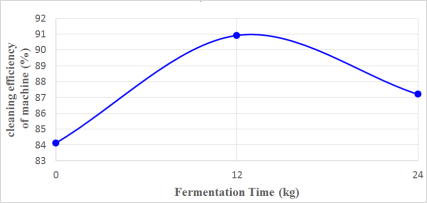
Figure 2. Effect of Fermentation Time on the Cleaning Efficiency of the Machine.
The graph shows that fermentation time affects the cleaning efficiency of the machine. The highest cleaning efficiency was recorded at 12-hour fermentation time, and the lowest cleaning efficiency was at 0-hour fermentation time.
Capacity of the machine
Effect of fermentation time, feed rate, and weight of operator on the capacity of the machine
Table 3 shows how the machine's capacity was affected by the operator's weight, feed rate, and fermentation duration. Analysis of variance (ANOVA) reveals that feed rate, operator weight, and fermentation time all significantly (P<0.05) impacted machine capacity. Additionally, there was a substantial (p<0.05) impact on the machine's capacity from the combination of feed rate and fermentation time, feed rate and operator weight, and feed rate and fermentation time.
Table 3. Effect of feed rate and fermentation time on the capacity of the machine.
Feed rate *fermentation time
Feed rate (kg)
Fermentation time (hr)
Feed rate
Mean
Fermentation time
Mean
0
12
24
5
70.78bcd
100.49b
137.94a
5
103.07a
0
61.53c
6
55.21d
96.62bc
136.87a
6
96.24b
12
86.12b
7
58.59d
61.25d
64.02cd
7
61.29c
24
112.95a
Mean
86.86
CV
13.35
Table 4. Effect of feed rate and weight of operator on the capacity of the machine.
Feed rate * weight of operator
Feed rate (kg)
Weight of operator (kg)
Weight of operator
mean
55
65
75
5
73.38c
98.76b
137.07a
55
66.82b
6
68.25cd
89.78b
130.68a
65
81.18b
7
58.83d
61.56d
64.44cd
75
116.52a
Mean
87.41
CV
4.90
Effect of fermentation time
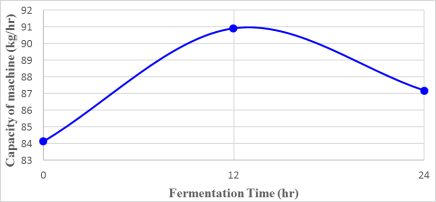
Figure 3 shows that fermentation time and the capacity of the machine have a positive relationship, i.e., when fermentation time increases, the capacity of the machine increases and vice versa.
Figure 3. Effect of fermentation Time on the capacity of the machine.
Effect of the weight of the operator
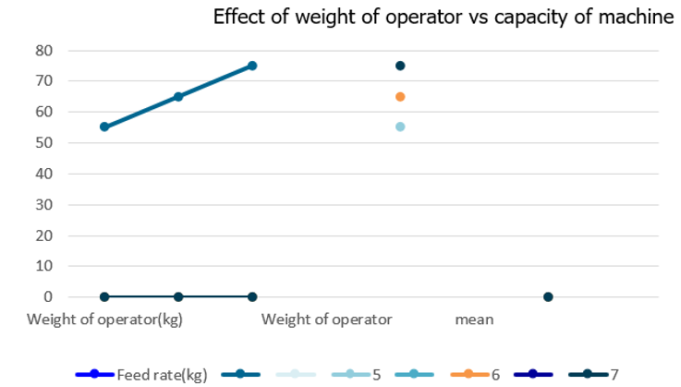
Figure 4 shows that the weight of the operator and the capacity of the machine have a direct relationship, i.e., when the weight of the operator increases, the capacity of the machine also increases and vice versa.
Figure 4. Effect of the weight of the operator on the capacity of the machine.
Effect of feed rate
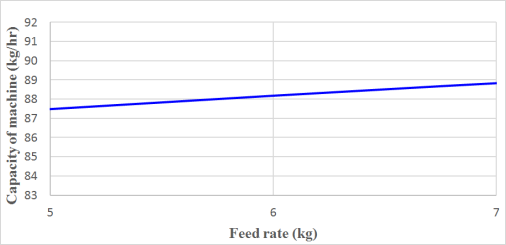
Figure 5 shows that the feed rate and capacity of the machine have an inverse relationship, i.e., when the feed rate increases, the capacity of the machine decreases, and vice versa.
Figure 5. Effect of Feed Rate on the Capacity of the Machine.

4. Conclusion and Recommendation
Conclusion
Coffee is a crop nationally used to improve the economy of the country. Ethiopia is the home of coffee Arabica and is well known for exporting quality coffee to foreign countries. Based on the result obtained, regarding cleaning capacity (kg/hr),- cleaning efficiency (%), it can be concluded that the machine performance is acceptable with prospects for extending the technology. But the machine need addition part which separate coffee float on the water during operation, which affects the quality of coffee.
Recommendation
We recommend that the machine be ready for more demonstration in case of solve the problem of the coffee washing quality at house hold for increasing the coffee producer's income.
We recommended that the fermentation after pulping is 12 hr fermentation time is the best time to achieve good efficiency and capacity for the machine, than that of operating the machine for 0 and 24 hr coffee fermentation time.
We recommend that the machine be operated by a person with a weight of more than 60kg to achieve high capacity and efficiency.
Abbreviations
JAERC
Jimma Agricultural Engineering Research Center
CV
Coefficient of Variance
DE
Demucilager’s Efficiency
ANOVA
Analysis of Variance
Conflicts of Interest
The authors have not declared any conflicts of interest.
References
[1]
S. T. Argaie, “The Impact of Exchange Rate on Ethiopia’s Coffee Export,” Eur.Sci.J.ESJ, vol. 17, no. 23, Jul. 2021,
“REPORT ON THE ETHIOPIAN ECONOMY 2016 Agricultural Transformation in Ethiopia: Prospects and Challenges Ethiopian Economics Association (EEA),” 2016, Accessed: Nov. 05, 2025. [Online]. Available:
R. Cerda, J. Avelino, C. Gary, P. Tixier, E. Lechevallier, and C. Allinne, “Primary and secondary yield losses caused by pests and diseases: Assessment and modeling in coffee,” PLoSOne, vol. 12, no. 1, Jan. 2017,
T. Kidist, G. Zerihun, and E. Biniam, “Assessment of pre and post-harvest management practices on coffee (Coffea arabica L.) quality determining factors in Gedeo zone, Southern Ethiopia,” AfricanJ.Agric.Res., vol. 14, no. 28, pp. 1216-1228, Jul. 2019,
G. Bizimungu, R. H. Ahouansou, and G. C. Semassou, “Design, fabrication and evaluation of small-scale disc and drum pulpers for Arabica (Coffea arabica L.) and Robusta (Coffea canephora L.) coffee,” J.SaudiSoc.Agric.Sci., vol. 23, no. 6, pp. 404-414, Sep. 2024,
K. Teshome, Z. Girma, and B. Eshetu, “African Journal of Agricultural Research Assessment of pre and post-harvest management practices on coffee (Coffea arabica L.) quality determining factors in Gedeo zone, Southern Ethiopia,” vol. 14, no. 28, pp. 1216-1228, 2019,
B. Ollika Fufa, M. Bekele Etana, and M. Chewaka Aga, “Review on Post-Harvest and Green Bean Coffee Processing in Ethiopia,” ActaSci.Agric., vol. 3, no. 7, pp. 157-162, Jun. 2019,
“A Detailed Review on Common Causes of Postharvest Loss and Quality Deterioration of Fruits and Vegetables in Ethiopia,” J.Biol.Agric.Healthc., Apr. 2019,
“Applied Tribology: Bearing Design and Lubrication, 3rd Edition”.
[16]
A. Lee, M. H. Seo, S. Yang, J. Koh, and H. Kim, “The effects of mechanical actions on washing efficiency,” FibersPolym., vol. 9, no. 1, pp. 101-106, Feb. 2008,
C. M. Villanueva etal., “Total and specific fluid consumption as determinants of bladder cancer risk,” Int.J.Cancer, vol. 118, no. 8, pp. 2040-2047, Apr. 2006,
Wirtu, R., Berhanu, T. (2026). Development and Performance Evaluation of Manual Operated Coffee Bean Demucilager. American Journal of Mechanical and Industrial Engineering, 11(1), 1-7. https://doi.org/10.11648/j.ajmie.20261101.11
Wirtu, R.; Berhanu, T. Development and Performance Evaluation of Manual Operated Coffee Bean Demucilager. Am. J. Mech. Ind. Eng.2026, 11(1), 1-7. doi: 10.11648/j.ajmie.20261101.11
Wirtu R, Berhanu T. Development and Performance Evaluation of Manual Operated Coffee Bean Demucilager. Am J Mech Ind Eng. 2026;11(1):1-7. doi: 10.11648/j.ajmie.20261101.11
@article{10.11648/j.ajmie.20261101.11,
author = {Rebira Wirtu and Tolasa Berhanu},
title = {Development and Performance Evaluation of Manual Operated Coffee Bean Demucilager},
journal = {American Journal of Mechanical and Industrial Engineering},
volume = {11},
number = {1},
pages = {1-7},
doi = {10.11648/j.ajmie.20261101.11},
url = {https://doi.org/10.11648/j.ajmie.20261101.11},
eprint = {https://article.sciencepublishinggroup.com/pdf/10.11648.j.ajmie.20261101.11},
abstract = {Coffee remains Ethiopia's top export commodity and is the most significant crop in the country's economy. The crop's production and quality are extremely low, despite its economic significance. The decline in Ethiopian coffee quality is mostly caused by improper postharvest processing methods, such as harvesting immature cherries, not sorting during grading and processing, improper drying without considering drying time, drying place, layer thickness, and drying material, transportation, storage, over-fermentation, etc. The processing of coffee beans is a critical step that influences the quality of the final product. Effective demucilaging is essential to remove mucilage while preserving the integrity of the beans. This study focuses on the development and performance evaluation of a manually operated coffee bean demucileger, aimed at improving the efficiency of coffee processing while minimizing operational costs. The objective was to design a user-friendly, effective demucilaging device for small-scale coffee production settings. The demucileger was constructed using locally sourced materials, and its performance was evaluated based on parameters such as efficiency, ease of operation, and quality of demucilaged beans. Results indicated that the device successfully removed mucilage with an efficiency rate and washing capacity of 86% and 86.86 kg/hr. while maintaining the integrity of the beans. This manual operated demucileger presents a viable solution for smallholder coffee farmers, potentially enhancing their productivity and product quality in an economically sustainable manner.},
year = {2026}
}
TY - JOUR
T1 - Development and Performance Evaluation of Manual Operated Coffee Bean Demucilager
AU - Rebira Wirtu
AU - Tolasa Berhanu
Y1 - 2026/04/13
PY - 2026
N1 - https://doi.org/10.11648/j.ajmie.20261101.11
DO - 10.11648/j.ajmie.20261101.11
T2 - American Journal of Mechanical and Industrial Engineering
JF - American Journal of Mechanical and Industrial Engineering
JO - American Journal of Mechanical and Industrial Engineering
SP - 1
EP - 7
PB - Science Publishing Group
SN - 2575-6060
UR - https://doi.org/10.11648/j.ajmie.20261101.11
AB - Coffee remains Ethiopia's top export commodity and is the most significant crop in the country's economy. The crop's production and quality are extremely low, despite its economic significance. The decline in Ethiopian coffee quality is mostly caused by improper postharvest processing methods, such as harvesting immature cherries, not sorting during grading and processing, improper drying without considering drying time, drying place, layer thickness, and drying material, transportation, storage, over-fermentation, etc. The processing of coffee beans is a critical step that influences the quality of the final product. Effective demucilaging is essential to remove mucilage while preserving the integrity of the beans. This study focuses on the development and performance evaluation of a manually operated coffee bean demucileger, aimed at improving the efficiency of coffee processing while minimizing operational costs. The objective was to design a user-friendly, effective demucilaging device for small-scale coffee production settings. The demucileger was constructed using locally sourced materials, and its performance was evaluated based on parameters such as efficiency, ease of operation, and quality of demucilaged beans. Results indicated that the device successfully removed mucilage with an efficiency rate and washing capacity of 86% and 86.86 kg/hr. while maintaining the integrity of the beans. This manual operated demucileger presents a viable solution for smallholder coffee farmers, potentially enhancing their productivity and product quality in an economically sustainable manner.
VL - 11
IS - 1
ER -
Wirtu, R., Berhanu, T. (2026). Development and Performance Evaluation of Manual Operated Coffee Bean Demucilager. American Journal of Mechanical and Industrial Engineering, 11(1), 1-7. https://doi.org/10.11648/j.ajmie.20261101.11
Wirtu, R.; Berhanu, T. Development and Performance Evaluation of Manual Operated Coffee Bean Demucilager. Am. J. Mech. Ind. Eng.2026, 11(1), 1-7. doi: 10.11648/j.ajmie.20261101.11
Wirtu R, Berhanu T. Development and Performance Evaluation of Manual Operated Coffee Bean Demucilager. Am J Mech Ind Eng. 2026;11(1):1-7. doi: 10.11648/j.ajmie.20261101.11
@article{10.11648/j.ajmie.20261101.11,
author = {Rebira Wirtu and Tolasa Berhanu},
title = {Development and Performance Evaluation of Manual Operated Coffee Bean Demucilager},
journal = {American Journal of Mechanical and Industrial Engineering},
volume = {11},
number = {1},
pages = {1-7},
doi = {10.11648/j.ajmie.20261101.11},
url = {https://doi.org/10.11648/j.ajmie.20261101.11},
eprint = {https://article.sciencepublishinggroup.com/pdf/10.11648.j.ajmie.20261101.11},
abstract = {Coffee remains Ethiopia's top export commodity and is the most significant crop in the country's economy. The crop's production and quality are extremely low, despite its economic significance. The decline in Ethiopian coffee quality is mostly caused by improper postharvest processing methods, such as harvesting immature cherries, not sorting during grading and processing, improper drying without considering drying time, drying place, layer thickness, and drying material, transportation, storage, over-fermentation, etc. The processing of coffee beans is a critical step that influences the quality of the final product. Effective demucilaging is essential to remove mucilage while preserving the integrity of the beans. This study focuses on the development and performance evaluation of a manually operated coffee bean demucileger, aimed at improving the efficiency of coffee processing while minimizing operational costs. The objective was to design a user-friendly, effective demucilaging device for small-scale coffee production settings. The demucileger was constructed using locally sourced materials, and its performance was evaluated based on parameters such as efficiency, ease of operation, and quality of demucilaged beans. Results indicated that the device successfully removed mucilage with an efficiency rate and washing capacity of 86% and 86.86 kg/hr. while maintaining the integrity of the beans. This manual operated demucileger presents a viable solution for smallholder coffee farmers, potentially enhancing their productivity and product quality in an economically sustainable manner.},
year = {2026}
}
TY - JOUR
T1 - Development and Performance Evaluation of Manual Operated Coffee Bean Demucilager
AU - Rebira Wirtu
AU - Tolasa Berhanu
Y1 - 2026/04/13
PY - 2026
N1 - https://doi.org/10.11648/j.ajmie.20261101.11
DO - 10.11648/j.ajmie.20261101.11
T2 - American Journal of Mechanical and Industrial Engineering
JF - American Journal of Mechanical and Industrial Engineering
JO - American Journal of Mechanical and Industrial Engineering
SP - 1
EP - 7
PB - Science Publishing Group
SN - 2575-6060
UR - https://doi.org/10.11648/j.ajmie.20261101.11
AB - Coffee remains Ethiopia's top export commodity and is the most significant crop in the country's economy. The crop's production and quality are extremely low, despite its economic significance. The decline in Ethiopian coffee quality is mostly caused by improper postharvest processing methods, such as harvesting immature cherries, not sorting during grading and processing, improper drying without considering drying time, drying place, layer thickness, and drying material, transportation, storage, over-fermentation, etc. The processing of coffee beans is a critical step that influences the quality of the final product. Effective demucilaging is essential to remove mucilage while preserving the integrity of the beans. This study focuses on the development and performance evaluation of a manually operated coffee bean demucileger, aimed at improving the efficiency of coffee processing while minimizing operational costs. The objective was to design a user-friendly, effective demucilaging device for small-scale coffee production settings. The demucileger was constructed using locally sourced materials, and its performance was evaluated based on parameters such as efficiency, ease of operation, and quality of demucilaged beans. Results indicated that the device successfully removed mucilage with an efficiency rate and washing capacity of 86% and 86.86 kg/hr. while maintaining the integrity of the beans. This manual operated demucileger presents a viable solution for smallholder coffee farmers, potentially enhancing their productivity and product quality in an economically sustainable manner.
VL - 11
IS - 1
ER -