Abstract
Although most enterprises have adopted Artificial Intelligence (AI), a significant maturity gap hinders many from realising its full potential, with many AI projects failing after the pilot phase. This gap is not due to technology but stems from strategic leadership failures, often driven by overconfidence at the executive level and an overemphasis on using AI to immediately reduce workforce numbers. This analysis offers a strategic plan to advance in AI, emphasising a shift from mechanisation to workforce enhancement, supported by robust ethical governance. It argues that deploying ethical AI is now a legal and fiduciary obligation, requiring comprehensive governance structures to ensure accountability, reduce bias, and meet regulatory standards. The operational focus highlights the importance of differentiating between deterministic automation and probabilistic AI to avoid misusing complex models for simple tasks. It questions the cost-effectiveness of enterprise-wide AI licensing and shows that targeted, role-specific deployment delivers much better results, especially when integrating AI into complex workflows prone to resistance. Lastly, to assess value accurately, the paper recommends moving beyond traditional financial ROI to a three-level Key Performance Indicator (KPI) system that measures success from basic adoption and efficiency improvements (Return on Efficiency) to clear strategic business outcomes across functions. By combining ethical oversight, precise deployment, and detailed measurement, organisations can turn AI from a risky experiment into a sustainable source of long-term competitive advantage.
Keywords
Strategic AI Adoption, Ethical AI Governance, AI Maturity Gap, AI Value Realisation, Targeted AI Deployment
1. Introduction: The Artificial Intelligence Maturity Paradox
The integration of Artificial Intelligence (AI) into corporate operations represents a fundamental restructuring of enterprise value creation. Business leaders and economic analysts alike view the advent of advanced AI capabilities as an industrial shift comparable to the transition from steam power to electricity. The quantitative evidence supporting the rapid adoption of these technologies is overwhelming. According to the 2025 Stanford Artificial Intelligence Index Report, AI adoption has reached a near-universal threshold, with 78% of organisations actively integrating the technology into their core operations, a significant increase from 55% the previous year. The economic momentum driving this shift is equally staggering, with the global AI market projected to surge from $233.46 billion in 2024 to an estimated $1.77 trillion by 2032.
| [1] | Agbaakin, O. (2025, September 18). Leveraging artificial intelligence as a strategic growth catalyst for small and medium-sized enterprises. arXiv. Retrieved March 3, 2026, from
https://arxiv.org/html/2509.14532v1 |
[1]
.
However, beneath the surface of this rapid technological acquisition lies a stark and pervasive maturity gap. While nearly all surveyed organisations are investing capital in AI initiatives, only 1% of corporate leaders classify their organisations as truly "mature" in their deployment capabilities. True maturity implies that the technology is fully embedded in workflows, governed by robust ethical frameworks, and driving substantial, measurable business outcomes rather than existing as a siloed experiment. This disconnect highlights a critical reality for modern executives: the primary barrier to realising sustained value from AI is no longer access to compute power or foundational models, but rather strategic leadership and ethical governance.
A pervasive "overconfidence trap" currently afflicts the executive suite. Many corporate leaders claim deep AI expertise but lack the conceptual understanding required to manage the nuanced shift from deterministic software deployments to probabilistic AI ecosystems. Consequently, an estimated 95% of generative AI projects fail to deliver measurable return on investment (ROI) post-pilot. This high failure rate is rarely a technological shortcoming; rather, it is rooted in a fundamental misalignment of objectives. When top leadership approaches AI primarily as an instrument for immediate capital expenditure reduction or sweeping workforce elimination, they apply an outdated, industrial-era metric to a cognitive-era transformation.
.
This comprehensive research report addresses the critical intersection of ethical governance, operational deployment, and value measurement in enterprise AI. It provides a strategic blueprint for corporate leadership, challenging the traditional "budget reduction" paradigm and rigorously examining the ethical imperatives underpinning AI adoption. Furthermore, it delivers the heuristic frameworks frontline managers require to differentiate between simple automation and genuine AI, outlines criteria for prioritising high-value use cases, and establishes a multi-tiered system of Key Performance Indicators (KPIs) to track true efficiency gains in an era characterised by ubiquitous, enterprise-wide AI licensing.
2. Re-evaluating the Traditional AI Adoption Pipeline
For a corporate leader tasked with designing an AI adoption strategy, the standard, instinctive approach often follows a linear progression: clean the organisational data, identify high-ROI use cases, pilot the technology, and scale it across the enterprise. While this progression is technically logical and aligns with established frameworks such as the Analytics Value Stack and the Data-to-Decision framework, it is strategically incomplete if executed in a vacuum.
| [14] | Shrestha, Y. R., Ben-Menahem, S. M., & Von Krogh, G. (2019, July 13). Organizational decision-making structures in the age of artificial intelligence. California Management Review. Retrieved March 3, 2026, from
https://doi.org/10.1177/0008125619862257 |
[14]
.
2.1. The Illusion of Data Readiness and the Pilot Trap
The premise that an organisation must first "get the data cleaned up" is accurate in theory, but frequently derailed in practice by fragmented systems and siloed platforms. Organisations often attempt to bypass this difficulty by running AI Proof of Concepts (PoCs) on sanitised, unrealistic dummy data. This practice creates false optimism regarding the model's efficacy, leading to severe tracking and performance issues when the AI is exposed to the chaotic reality of real-world enterprise data.
Furthermore, the transition from "pilot" to "scale" is where the vast majority of AI initiatives collapse. Organisations frequently treat pilots as isolated technology experiments rather than foundational preparations for enterprise-wide implementation. Market leaders differentiate themselves by using exploratory pilots to build organisational readiness alongside technical capability, testing not only the algorithm but also the human workflows that will interact with it. If an AI model provides perfect predictive insights but the organisation lacks the operational agility to act on them, the pilot is merely an expensive dashboard.
.
2.2. The Flawed Starting Point: Workforce Reduction as a Primary Outcome
The most critical strategic error in the traditional AI adoption pipeline is defining success primarily through the lens of utilising a set budget to achieve a targeted workforce reduction. While 32% of executives expect AI to reduce overall workforce size, treating AI as a pure labour-replacement tool poses profound systemic risks and ethical dilemmas.
Historically, waves of industrialisation have automated physical labour, leading economists such as Frey and Osborne to predict massive job displacement through mechanisation. However, modern analyses reveal that while specific tasks are highly susceptible to automation, entire complex jobs are rarely suitable for complete elimination.
| [6] | Dégallier-Rochat, S., Kurpicz-Briki, M., Endrissat, N., & Yatsenko, O. (2022, October 4). Human augmentation, not replacement: A research agenda for AI and robotics in the industry. National Library of Medicine. Retrieved March 3, 2026, from https://pmc.ncbi.nlm.nih.gov/articles/PMC9578547/ |
[6]
AI excels at logic, massive data processing, and tactical drudgery, but human workers retain a distinct 9-to-1 dominance in high-stakes strategic planning, contextual judgment, and ethical oversight.
When leadership aggressively pursues workforce reduction, they inevitably target routine, entry-level tasks—such as data entry, basic coding, document review, and preliminary customer service—which are the traditional training grounds for junior employees.
This creates a dangerous "double whammy" effect. The organisation eliminates junior roles while simultaneously creating an urgent demand for highly experienced personnel capable of orchestrating, prompting, and governing complex AI systems. Without junior employees learning the foundational mechanics of the business, the organisation effectively offcuts its long-term talent pipeline, leading to a severe structural skills gap.
| [11] | Morandini, S., Fraboni, F., De Angelis, M., Puzzo, G., Giusino, D., & Pietrantoni, L. (2023). The impact of artificial intelligence on workers’ skills: Upskilling and reskilling in organisations. Informing Science: The International Journal of an Emerging Transdiscipline. Retrieved March 3, 2026, from
https://cris.unibo.it/bitstream/11585/917132/1/InfoSciV26p039-068Morandini8895.pdf |
[11]
.
Moreover, aggressive workforce reduction strategies driven by algorithms can lead to catastrophic financial and operational failures if human oversight is entirely removed. The case of Zillow Offers serves as a profound cautionary tale. By relying entirely on AI algorithms to forecast home prices without sufficient human moderation, the company mistakenly overpaid for thousands of properties. This algorithmic failure cost the organisation millions of dollars and, ironically, led to a forced 25% workforce reduction, destroying both shareholder value and employee trust.
| [12] | Rane, U., & Bhosale, V. (2023, January). Smart technology, artificial intelligence, robotics, and algorithms (STARA): Employees’ perceptions of our future workplace. International Journal of Advanced Research in Science Communication and Technology. Retrieved March 3, 2026, from
https://doi.org/10.48175/IJARSCT-8167 |
[12]
.
3. The Ethical Underpinning of Enterprise AI Adoption
Ethical AI adoption demands a paradigm shift from "mechanisation" to "worker empowerment".
| [6] | Dégallier-Rochat, S., Kurpicz-Briki, M., Endrissat, N., & Yatsenko, O. (2022, October 4). Human augmentation, not replacement: A research agenda for AI and robotics in the industry. National Library of Medicine. Retrieved March 3, 2026, from https://pmc.ncbi.nlm.nih.gov/articles/PMC9578547/ |
[6]
As AI assumes responsibility for baseline logic and tactical execution, the intrinsic value of human leadership shifts toward Emotional Intelligence (EQ). Leaders must evolve into "Chief Trust Officers," actively bridging the widening gap between executives' enthusiasm for technological disruption and employees' legitimate anxiety about workplace surveillance and job displacement.
3.1. The Legal and Board-level Mandates for AI Ethics
The ethical deployment of AI is no longer merely a public relations exercise or an abstract corporate social responsibility initiative; it has solidified into a strict legal and fiduciary mandate. Corporate boards and senior business leaders are uniquely positioned to shape the ethical frameworks within which AI operates, ensuring that these complex systems align with both societal norms and regulatory requirements.
.
At a minimum, enterprise AI frameworks must help companies comply with established legal obligations, most notably satisfying a corporate board’s oversight responsibilities under the 1996 Caremark standard, as enunciated by the Delaware Chancery Court. Originally, the Caremark standard afforded directors broad discretion in designing compliance systems. However, as corporate capabilities have evolved, so too have judicial expectations. Boards face heightened Caremark standards, particularly regarding "mission-critical business functions". If an organisation deploys an AI system that violates data privacy laws, discriminates against protected demographic classes in hiring or lending, or executes biased financial decisions, leadership cannot feign ignorance. Ignorance of an algorithm's inner workings or its training data bias does not absolve the board of its oversight liabilities.
Furthermore, ethical AI strategies must aspire to align with broader theories of stakeholder capitalism and natural law, pushing corporate responsibility beyond mere compliance with positive law. To achieve this level of responsible implementation, organisations are moving away from ad-hoc ethical reviews and adopting highly structured, multi-tiered governance frameworks.
3.2. Architecting a Comprehensive AI Governance Framework
To move beyond theoretical ethics and embed responsibility into daily operations, leading organisations deploy rigorous AI governance structures that distribute accountability across multiple operational layers. Drawing on best practices from institutions such as IBM and Scotiabank, a robust ethical framework requires the explicit assignment of roles and continuous assessment of risk.
.
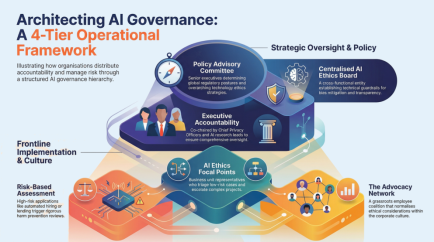
A standard, enterprise-grade AI ethics board structure typically encompasses four core operational roles, designed to ensure comprehensive oversight without stifling innovation:
1) The Policy Advisory Committee: Comprising senior executives and board members, this group operates at the macroeconomic and strategic level. They are responsible for determining global regulatory frameworks, public policy objectives, and overarching strategies for data privacy and technology ethics. This committee ensures that the company's AI trajectory aligns with its core corporate values and international legal standards.
2) The Centralised AI Ethics Board: A cross-functional, dedicated entity, often co-chaired by a Chief Privacy Officer and a global AI research lead. The Board is responsible for defining, maintaining, and advising on the company's specific AI ethics policies. They review escalated, high-risk AI deployments and establish the technical guardrails for bias mitigation, transparency, and explainability.
3) AI Ethics Focal Points: Embedded directly within individual business units, these frontline representatives act as the crucial first line of defence. They proactively assess technology concerns at the ideation phase, utilising standardised questionnaires to evaluate risk. Focal Points possess the authority to triage and approve low-risk use cases—thereby accelerating deployment—while seamlessly escalating complex or high-risk projects to the centralised Ethics Board for rigorous review.
4) The Advocacy Network: Recognising that policy must be supported by culture, successful organisations cultivate a grassroots coalition of employees who promote ethical AI practices. This network fosters a culture of trustworthy technology at the ground level, ensuring that ethical considerations are normalised rather than viewed as bureaucratic hurdles.
When an AI use case is proposed, the Focal Points initiate a risk-based assessment. This involves scrutinising the system's associated properties and intended use. For instance, consumer packaged goods company Unilever utilises an AI assurance function that examines each new application to assess its risk level with respect to both operational effectiveness and ethical alignment. If an algorithm is designed to dictate consumer lending rates, automate hiring screening, or influence medical triage, it triggers a high-risk assessment focused on regulatory compliance, fairness, and harm prevention.
.
Figure 1. A structured four-tier AI governance framework illustrating how organisations align strategic oversight, ethical policy, executive accountability, and frontline implementation to ensure responsible, transparent, and risk-aware deployment of artificial intelligence.
3.3. A Practical Blueprint for Responsible AI Implementation
To rectify the flaws in the traditional "clean data, pilot, scale" pipeline, leadership must integrate ethical checkpoints directly into the implementation roadmap. A comprehensive, responsible AI implementation strategy in the current landscape incorporates the following actionable phases
| [15] | Wieringa, M. (2020, January 27). What to account for when accounting for algorithms: A systematic literature review on algorithmic accountability. Proceedings of the 2020 Conference on Fairness, Accountability, and Transparency (FAccT). Retrieved March 3, 2026, from
https://doi.org/10.1145/3351095.3372833 |
[15]
:
Table 1. Implementation roadmap for operationalising AI governance, outlining key phases, strategic actions with ethical imperatives, and corresponding measurement and documentation practices.
Implementation Phase | Strategic Action and Ethical Imperative | Measurement and Documentation |
1. Comprehensive System Inventory and Risk Evaluation | Catalog every AI system currently in use or under development across the enterprise. Identify the specific demographic groups affected by the AI's decisions and evaluate the potential for algorithmic harm. Conduct thorough reviews against incoming regulatory frameworks, such as the EU AI Act. | Maintain an updated AI asset registry. Document all third-party data sources to ensure diverse representation and prevent the ingestion of biased training data. |
2. Establish Governance and Accountability Structures | Formalise the AI Ethics Board and delegate clear accountability mechanisms to prevent the diffusion of responsibility. Ensure diverse representation on the board to challenge assumptions and recognise systemic biases that homogeneous teams might overlook. | Publish an internal AI Governance Charter detailing exact decision-making authority and escalation protocols. |
3. Standardise Ethical Policies via Data Architecture | Translate high-level ethical principles into practical, enforceable guidelines. Implement a semantic layer within the enterprise data architecture so that AI models automatically inherit the organisation's governance rules, access constraints, and privacy parameters directly at the source. | Utilise standardised deployment checklists covering transparency, human-in-the-loop requirements, and data minimisation. |
4. Implement Continuous Real-Time Monitoring | AI models are not static; they degrade and experience algorithmic drift over time. Organisations must utilise interactive dashboards and explainability tools (e.g., SHAP, LIME) to continuously monitor algorithmic performance and track responsible AI KPIs. | Track compliance flag rates, demographic parity scores, and audit pass rates. Ensure models remain interpretable to non-technical stakeholders and external regulators. |
5. Build Iterative Feedback Loops | Responsible AI is an ongoing commitment. Create frictionless mechanisms for employees and customers to report anomalous AI behaviour. Schedule periodic policy reviews and use the findings to update the overall AI strategy in response to shifting societal norms and technological capabilities. | Measure trust indicators, such as user confidence scores and the closure rates of internal audit findings regarding AI incidents. |
By embedding these rigorous ethical guardrails directly into the core implementation strategy, leadership transitions AI from a high-risk operational gamble into a sustainable, trustworthy driver of long-term enterprise value.
4. The Frontline Challenge: Differentiating Automation from Artificial Intelligence
While strategic governance is established at the executive level, the practical identification of AI opportunities occurs at the frontline. IT teams, departmental managers, and ground-level employees are constantly identifying workflow bottlenecks and proposing technological solutions. However, a pervasive and costly issue in organisational strategy is the conflation of traditional automation with Artificial Intelligence.
There is a growing misconception among managers that any technology capable of operating without human intervention is automatically classified as AI. This misunderstanding is exacerbated by the fact that "AI" is a highly lucrative buzzword, frequently applied to legacy software systems that merely execute simple algorithms without the capacity for original thought or pattern inference.
| [7] | Fügener, A., Walzner, D. D., & Gupta, A. (2025, October 15). Roles of artificial intelligence in collaboration with humans: Automation, augmentation, and the future of work. Management Science. Retrieved March 3, 2026, from
https://pubsonline.informs.org/doi/10.1287/mnsc.2024.05684 |
[7]
Distinguishing between the two concepts is not merely an exercise in semantics; it is a critical operational necessity. Automation and AI require entirely different deployment strategies, data infrastructures, hiring profiles, and risk management protocols.
4.1. The Deterministic Versus Probabilistic Framework
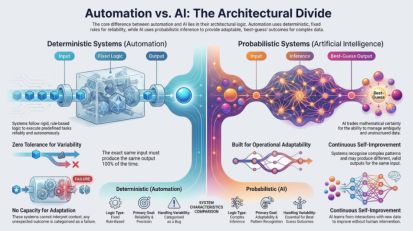
The core difference between automation and AI lies in the architectural distinction between deterministic and probabilistic systems. Understanding this dichotomy is essential for managers evaluating IT proposals.
Deterministic Systems (Automation) follow rigid, rule-based logic characterised by the equation:
Input → Fixed Logic → Output. Automation executes predefined, highly specific tasks reliably and autonomously. However, these systems possess no capacity for independent decision-making, contextual interpretation, or adaptation. In a deterministic system, the exact same input must produce the exact same output 100% of the time. Any variability or unexpected outcome in a deterministic system is categorised as a bug, a defect, or a system failure.
.
Probabilistic Systems (Artificial Intelligence) operate on complex inference characterised by the equation:
Input → Inference → Best-Guess Output. AI systems trade absolute mathematical certainty for operational adaptability. They are specifically designed to manage ambiguity, recognise complex behavioural patterns, and interpret vast quantities of unstructured data. Because AI relies on probabilistic reasoning rather than fixed logic, the model might produce slightly different yet equally valid outputs for the same input, depending on subtle contextual factors. AI can self-improve over time without human intervention by learning from interactions with new data.
.
Figure 2. Architectural comparison between deterministic rule-based automation and probabilistic artificial intelligence, highlighting how automation relies on fixed logic while AI uses adaptive inference to manage complexity and uncertainty.
4.2. A Practical Decision Matrix for Managers
To effectively differentiate between automation and AI opportunities, managers should avoid getting bogged down in technical jargon and instead evaluate proposed workflow enhancements against a practical, five-step decision framework.
.
Table 2. Comparative evaluation framework distinguishing rule-based automation (deterministic systems) from artificial intelligence (probabilistic systems) across predictability, rule stability, input data characteristics, failure risk, and system learning capabilities.
Evaluation Criterion | Indicators for Rule-Based Automation (Deterministic) | Indicators for Artificial Intelligence (Probabilistic) |
1. Predictability and Consistency | Users expect absolute, unwavering consistency. The process requires exact precision (e.g., calculating quarterly tax liabilities or processing payroll). Any variation is viewed as a critical system defect. | Users can accept reasonable variation and adaptability. There is no single "correct" mathematical answer (e.g., drafting a marketing email, suggesting product recommendations, or summarising a meeting). |
2. Rule Stability and Scope | The logic governing the process is clearly defined, easy to document, and rarely changes. Exceptions are finite and well-understood (e.g., "If shopping cart value > $100, apply free shipping tag"). | Exceptions to the rules outnumber the rules themselves. Context matters significantly more than rigid thresholds. Writing static code to cover every scenario is impossible due to the fluidity of the environment. |
3. Nature of the Input Data | Inputs are highly structured and standardised. The system processes numerical data, fixed database fields, drop-down menu selections, and clear Boolean values. | Inputs are inherently unstructured and messy. The system must process natural human speech, free-form text documents, visual images, audio files, or complex, unpredictable behavioural patterns. |
4. Risk and Cost of Failure | Errors lead to severe, immediate consequences, such as financial loss, regulatory breaches, or safety hazards. Strict, unambiguous traceability and explainability are legally required to audit exactly why a decision was made. | Errors are manageable, low-impact, or easily recoverable by a "human-in-the-loop." Absolute precision is secondary to the system's ability to handle massive scale and ambiguity. |
5. System Learning and Evolution | The system remains entirely static. It executes instructions perfectly but never improves its own performance. Outcomes only change if a human developer manually rewrites the underlying code or updates the rules. | The system learns continuously. Performance improves over time through deep learning frameworks (e.g., TensorFlow, PyTorch) as it processes more data, refines its algorithms, and adapts to user feedback. |
Applying this matrix clarifies operational decisions. If an IT team proposes a system to streamline the approval of employee expense reports based on fixed spending limits, the demand for 100% accuracy, strict compliance, and reviewable logic mandates deploying simple Automation. Conversely, if the team wishes to analyse millions of incoming customer support tickets to detect underlying emotional sentiment, prioritise urgency, and draft bespoke responses, the presence of unstructured text and linguistic ambiguity absolutely necessitates Artificial Intelligence.
.
By rigorously applying this framework, managers prevent the highly costly mistake of deploying complex, expensive, and unpredictable AI models to solve simple, deterministic problems. Equally, they ensure that brittle, rigid automation isn't forced into fluid, context-heavy workflows, where it will inevitably break.
5. Architecting and Prioritising the AI Use Case Portfolio
Once an organisation successfully filters genuine AI opportunities from simple automation tasks, the challenge shifts to prioritisation. Frontline IT teams will invariably generate a massive backlog of potential AI applications. The traditional managerial assumption that an organisation should simply "choose the ones with high ROI, pilot, and scale" is mathematically logical but practically flawed if traditional definitions of Return on Investment are strictly applied.
5.1. Moving Beyond Narrow Financial ROI to Return on Efficiency
For decades, organisations have evaluated capital investments through a highly narrow financial lens, demanding immediate cost reductions, labour savings, or direct, quantifiable revenue gains. Consequently, savings, cost reduction, and throughput gains tend to dominate nearly every AI business case placed in front of a Chief Financial Officer. However, as evidenced in highly complex, high-stakes sectors like healthcare, overreliance on short-term operational ROI blinds organisations to deeper, transformative strategic opportunities.
| [3] | Brown, P., De Koning, M., Thomas, K., & Van der Werf, A. (2024, November). Leveraging generative AI for job augmentation and workforce productivity: Scenarios, case studies and a framework for action. PwC. Retrieved March 3, 2026, from https://www.pwc.com/gx/en/issues/artificial-intelligence/wef-leveraging-generative-ai-for-job-augmentation-and-workforce-productivity-2024.pdf |
[3]
.
A traditional ROI model easily quantifies the value of an AI tool that reduces administrative documentation time by 20%, since calculating labour hours saved is straightforward. However, traditional financial models struggle to quantify the value of an AI system that fundamentally reshapes care delivery, reduces the risk of adverse clinical events, or identifies entirely new business models.
Similarly, in standard enterprise environments, evaluating AI solely on immediate, hard cost savings ignores the critical metric of "Return on Efficiency" (ROE). An AI pilot that saves a software engineering team 10 hours a week provides zero traditional financial ROI if those 10 hours are simply absorbed into unstructured downtime. The true value is unlocked only when those saved hours are deliberately repurposed into strategic innovation, accelerated product development, or deeper client engagement.
Therefore, leaders must architect an AI portfolio that balances immediate financial returns with strategic, long-term capability building.
5.2. The AI Use Case Prioritisation Framework
To build a balanced, sequenced portfolio of AI initiatives, organisations should systematically evaluate frontline ideas against a multi-dimensional matrix. A practical AI Use-Case Prioritisation Framework assesses potential projects against the following core criteria
| [14] | Shrestha, Y. R., Ben-Menahem, S. M., & Von Krogh, G. (2019, July 13). Organizational decision-making structures in the age of artificial intelligence. California Management Review. Retrieved March 3, 2026, from
https://doi.org/10.1177/0008125619862257 |
[14]
:
Table 3. Strategic prioritisation framework for evaluating AI initiatives based on business value, technical feasibility, time-to-value, and organisational risk and adoption considerations.
Prioritisation Criterion | Strategic Evaluation Focus | Example Application |
1. Business Value and Strategic Fit | Does the initiative align seamlessly with the company's broader strategic goals (e.g., service differentiation, cost leadership, ESG priorities)? Does it fundamentally improve service resilience or output quality, beyond mere cash savings? | An AI tool that reduces supply chain carbon emissions aligns with corporate sustainability goals, offering high strategic fit despite moderate direct ROI. |
2. Technical and Operational Feasibility | Does the organisation currently possess the necessary data infrastructure, computational capacity, and technical talent to execute the pilot? Crucially, is the required foundational data clean, accessible, and governed? | Rejecting a complex generative AI marketing tool because the underlying customer CRM data is fragmented and unstructured across legacy platforms. |
3. Time-to-Value and Sequencing | How rapidly can measurable benefits be realised? Initiatives should be deliberately categorised into quick wins (deliverable in 8–12 weeks) to build internal momentum, and long-term strategic bets that may require years to mature. | Prioritising an AI scheduling assistant (quick win) to build organisational trust before attempting a massive AI-driven overhaul of core production planning. |
4. Risk Management and Adoption Effort | What is the regulatory compliance risk? More importantly, what is the organisational change management required? A mathematically perfect AI model will fail completely if end-users refuse to adopt it due to workflow friction, lack of training, or a lack of trust. | Factoring in the extensive training budget required to upskill a sales team to effectively use a new predictive lead-scoring algorithm. |
Organisations must ruthlessly balance their portfolio. Selecting only "quick win" administrative AI tools will yield short-term operational savings but fail to secure any long-term competitive advantage. Conversely, pursuing only massive, enterprise-wide AI transformations without proving the technology locally will likely exhaust the budget, erode executive patience, and result in the project's cancellation before value is realised.
6. The Economics of Scaling: Broad Licensing vs Targeted Deployment
In the current technological paradigm, enterprise software vendors are aggressively pushing for broad, ubiquitous AI integration. The most prominent example of this strategy is the deployment of standard AI assistant licenses—such as Microsoft 365 Copilot—to every single employee within an organisation. For leadership navigating the hype of the AI era, the pressing financial question is critical: Does distributing standard AI licenses to everyone in the organisation actually drive measurable efficiency, or is a highly targeted deployment strategy economically superior?
6.1. The Paradox of Enterprise-wide AI Licensing
The appeal of universal access to AI is rooted in the theoretical democratisation of productivity. The logic assumes that if every employee utilises an AI assistant to save just one hour per day on routine tasks, the aggregate efficiency gains across a massive enterprise will be astronomical. However, empirical data and extensive CIO surveys reveal a significantly more complicated, and often disappointing, reality.
The IBM Institute for Business Value found that enterprise-wide AI initiatives frequently achieve an anaemic ROI of just 5.9%, despite consuming roughly 10% of total organisational capital investment. Furthermore, research from McKinsey indicates that nearly 80% of companies report no significant bottom-line impact despite adopting Generative AI on an enterprise scale.
| [16] | Ye, Z., Chen, X., Mai, Y., & Duan, C. (2025, June 17). The effectiveness and boundary conditions of AI adoption in enterprise: A meta-analysis study. Academy of Management. Retrieved March 3, 2026, from
https://journals.aom.org/doi/10.5465/AMPROC.2025.19698abstract |
[16]
.
This systemic failure stems from what industry analysts term the "Copilot Conundrum." At an enterprise licensing cost of $30 per user per month, the financial burden scales linearly with headcount, but the productivity gains absolutely do not. Providing advanced generative AI capabilities to employees whose daily roles do not heavily involve complex document generation, deep data analysis, or extensive cross-functional communication results in vastly underutilised licenses. The enterprise incurs a massive, recurring operational expenditure (OpEx) without capturing the corresponding Return on Efficiency. The reality is that broad embedding across all apps (Word, Excel, PowerPoint) increases the number of potential touchpoints, but without strategic alignment, those touchpoints go ignored.
6.2. The Superiority of Targeted, Role-specific Deployment
In contrast to the poor performance of broad, untargeted rollouts, highly targeted, role-specific AI deployments boast dramatically higher success rates. Successful targeted implementations deliver returns averaging 3.7 times the investment per dollar spent, with top-performing organisations seeing payback periods of less than a single year. Only about 6% of organisations report achieving payback in under a year, and these are invariably the organisations that deployed AI surgically rather than broadly.
| [16] | Ye, Z., Chen, X., Mai, Y., & Duan, C. (2025, June 17). The effectiveness and boundary conditions of AI adoption in enterprise: A meta-analysis study. Academy of Management. Retrieved March 3, 2026, from
https://journals.aom.org/doi/10.5465/AMPROC.2025.19698abstract |
[16]
.
The reality of tools like Copilot is that the ROI scales not with the sheer number of licenses distributed, but with how deeply the AI is embedded into specific, high-friction, complex workflows. The licensing math works most effectively when applied strategically to roles plagued by bottlenecks in information synthesis.
Table 4. Comparison of enterprise-wide versus targeted AI deployment strategies, highlighting differences in ROI impact, capital requirements, risk exposure, and optimal organisational use cases.
Deployment Strategy | Typical ROI Impact | Capital Requirement and Financial Risk | Optimal Use Case Profile |
Enterprise-Wide (Broad Access) | ~5.9% (Average). High risk of stagnant adoption. | Very High (e.g., $30/user/month multiplied across all staff creates massive, immediate OpEx). | General productivity, basic email drafting, meeting summarisation. Prone to user abandonment after initial novelty wears off. |
Targeted (Role-Specific Rollout) | Up to 3.7x multiplier per dollar spent. | Lower initial outlay. Avoids massive budget shocks. Allows for iterative funding based on proven success. | Legal: Cutting contract drafts from 7 days to 7 hours. Finance: Running complex data variance reports. Customer Service: Real-time sentiment analysis. |
To maximise returns, Chief Information Officers (CIOs) and business leaders must employ selective licensing. Instead of a blanket deployment, organisations should identify the high-impact functional areas—such as Legal, Finance, Customer Service, and IT Development—where AI can demonstrably compress complex, time-consuming tasks.
For example, extending Copilot functionality to integrate with Microsoft Teams Phone to capture external PSTN calls (such as complex customer negotiations or supplier dispute discussions) extends the AI's context into the most critical business interactions. This specific, targeted deployment saves an average of 23 minutes per call for sales and service agents, allowing them to reclaim the equivalent of over 50 working days per year.
The strategic roadmap for enterprise AI licensing should follow a distinct path: verify technical readiness, begin with a small group of early adopters in high-impact roles, rigorously measure the Copilot-assisted hours saved, ensure that time is actively reallocated to high-value tasks, and only expand licenses to other departments as the ROI is undeniably proven and documented.
7. Measuring Success: Establishing KPIs for the Cognitive Era
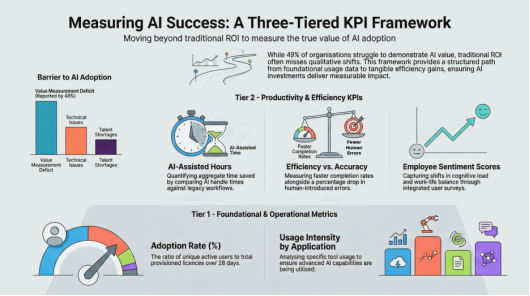
In the AI era, tracking efficiency gains and cost savings is notoriously difficult because AI rarely delivers value in total isolation. It is typically introduced alongside broader digital transformation efforts, data architecture upgrades, and workflow redesigns, making it challenging for leadership to isolate the AI model's specific financial contribution. Consequently, 49% of organisations report struggling to estimate and demonstrate the value of their AI projects, viewing this measurement deficit as a greater roadblock to adoption than technical issues or talent shortages.
| [13] | Shi, Y., Wu, T., Qin, C., & Liu, B. (2025, October 16). The value-creating potential of AI: A multi-dimensional analysis of effects and mechanisms. International Review of Financial Analysis. Retrieved March 3, 2026, from
https://www.sciencedirect.com/science/article/abs/pii/S1057521925007811 |
[13]
.
Furthermore, traditional ROI metrics fail to capture the qualitative shifts enabled by AI, such as improvements in employee satisfaction, innovation speed, and the customer experience. To track whether an organisation is truly on the right path with AI adoption, leadership must implement a comprehensive, three-tiered measurement framework that aligns seamlessly with the organisation's evolving AI maturity level.
| [16] | Ye, Z., Chen, X., Mai, Y., & Duan, C. (2025, June 17). The effectiveness and boundary conditions of AI adoption in enterprise: A meta-analysis study. Academy of Management. Retrieved March 3, 2026, from
https://journals.aom.org/doi/10.5465/AMPROC.2025.19698abstract |
[16]
This framework transitions from basic operational telemetry to deep strategic business impact.
7.1. Tier 1: Foundational and Operational Metrics
Before an organisation can claim strategic ROI, it must first prove that the technology is actually being utilised. Many AI implementations fail simply because employees quietly revert to their legacy workflows. Foundational metrics provide the "hard facts" regarding deployment health, generally sourced directly from admin centres:
1) Enabled Users vs. Active Users: Tracking the total number of provisioned licenses against the number of unique users who have actually engaged with the AI at least once in the last 28 days. This serves as the primary baseline for adoption health.
2) Adoption Rate (%): The ratio of active users to enabled users. A high, sustained adoption rate indicates successful change management, whereas a declining rate suggests the tool is causing friction rather than alleviating it.
3) Usage Intensity by Application: Analysing specifically where the AI is delivering value. If users are only utilising AI for basic email replies in Outlook but ignoring its advanced analytical capabilities in Excel, the organisation is failing to capture the tool's true value.
7.2. Tier 2: Productivity and Efficiency KPIs
Once foundational adoption is secured and normalised, leadership must track the Return on Efficiency (ROE). These metrics quantify the friction removed from daily workflows, serving as the bridge between software usage and business value:
1) AI-Assisted Hours (Time Saved): Quantifying the aggregate time saved through AI assistance. For example, if an AI diagnostic tool cuts the average handle time (AHT) in a customer support centre by 3 minutes per interaction, multiplying that saving by the total call volume yields a concrete, undeniable metric of hours reclaimed.
2)
Workflow Completion Rates & Error Reduction: Measuring the speed at which highly standardised processes (like software code generation, data entry, or financial reconciliation) are completed, strictly alongside the percentage drop in human-introduced errors.
Efficiency without accuracy is merely accelerated failure.
3) Employee Sentiment Scores: Productivity is not purely a mathematical equation. Capturing user perceptions of reduced cognitive load, improved work-life balance, and tool frustration through integrated surveys is critical to ensuring long-term adoption and preventing workforce burnout.
7.3. Tier 3: Strategic and Business Value KPIs
Ultimately, the operational time saved in Tier 2 must be actively translated into tangible financial and strategic gains. If time is saved but not utilised, the AI investment is wasted. This is where organisations link AI usage to core, department-specific business outcomes:
Table 5. Business–function–specific AI key performance indicators (KPIs) and value measurement approaches to assess the organisational impact of AI adoption.
Business Function | Strategic AI Key Performance Indicators (KPIs) | Value Measurement Focus |
Sales and Marketing | Win/lose rates, deal size ($ value), sales cycle length, and revenue per seller. | Translating time saved on administrative data entry into more outbound client interactions and faster deal closures. |
Customer Service | First-call resolution (FCR) rates, average handle time reductions, Customer Satisfaction (CSAT), and call/chat containment rates (percentage of issues resolved entirely by AI without human intervention). | Enhancing the customer experience while simultaneously lowering the operational cost of the contact centre infrastructure. |
Human Resources | Employee engagement scores, retention/attrition rates, time-to-onboard new hires, and HR issue resolution time. | Measuring if AI adoption improves overall workplace satisfaction and prevents the "double whammy" loss of talent. |
Compliance and Risk | Percentage of AI systems correctly inventoried, compliance flag rates, reduction in manual fraud review costs, and audit finding closure rates. | Demonstrating responsible governance to regulators and minimising the financial impact of fraudulent activities. |
Executive Leadership | Business Model Reimagination, speed of pivoting into new markets, and the creation of entirely new revenue streams previously impossible without massive data processing capabilities. | Shifting AI from a cost-centre optimisation tool to a primary driver of enterprise growth and competitive agility. |
Figure 3. A three-tier KPI framework for measuring AI success, integrating adoption metrics, productivity gains, efficiency improvements, and employee sentiment to capture the full organisational value of AI deployment.
By utilising this comprehensive, three-tiered framework, leadership can move beyond the ambiguous promise of "AI-driven transformation." Instead, they build a quantifiable, data-backed narrative of exact value realisation, proving to stakeholders that the organisation is not merely participating in the AI hype cycle, but actively commanding it.
8. Conclusion
The integration of Artificial Intelligence into the modern enterprise is an undeniable mandate of the cognitive era, yet success is by no means guaranteed by technological acquisition alone. The vast maturity gap between ubiquitous AI experimentation and scaled, profitable deployment is fundamentally a gap in strategic leadership, ethical governance, and precise value measurement.
Designing a robust AI strategy requires abandoning the deeply ingrained, industrial-era instinct to utilise transformative technology purely for immediate headcount reduction. Instead, leadership must embrace the paradigm of "AI-First Leadership," acting as Chief Trust Officers who prioritise workforce augmentation, rigorous ethical oversight, and strategic upskilling. By implementing highly structured governance frameworks—complete with centralised Ethics Boards, localised Focal Points, and data architecture guardrails—organisations fulfil their strict fiduciary duties under standards such as Caremark while ensuring their algorithms align with societal values and mitigate severe regulatory risk.
At the operational level, success hinges on the precise differentiation between deterministic automation and probabilistic AI. Managers must apply rigorous frameworks to identify use cases that require contextual reasoning and unstructured data processing, rather than fixed, brittle rules, ensuring the right technological tool is applied to the right problem. Furthermore, when scaling these solutions, the allure of the enterprise-wide, ubiquitous AI license must be met with analytical scepticism. Targeted, role-specific deployments demonstrably yield vastly superior ROI by embedding AI directly into high-friction workflows where it is needed most, avoiding the massive capital drain of underutilised licenses.
Ultimately, tracking efficiency in the AI era demands a complete departure from isolated, short-term financial metrics. By embracing the concept of Return on Efficiency (ROE) and deploying a multi-tiered KPI framework, organisations can clearly monitor foundational adoption, productive time-savings, and strategic revenue generation across every department. By intertwining deep ethical governance with targeted deployment and nuanced performance metrics, corporate leadership can successfully navigate the complexities of the AI frontier, transforming disruptive potential into sustainable, long-term enterprise dominance.
Abbreviations
$ | The United States of America Dollar |
AHT | Average Handle Time |
AI | Artificial Intelligence |
CIO | Chief Information Officer |
CRM | Customer Relationship Management |
CSAT | Customer Satisfaction |
EQ | Emotional Intelligence Quotient |
ESG | Environmental, Social, and Governance |
EU | European Union |
FCR | First Call Resolution |
HR | Human Resources |
IT | Information Technology |
KPI | Key Performance Indicator |
LIME | Local Interpretable Model-agnostic Explanations |
OpEx | Operational Expenses |
PSTN | Public Switched Telephone Network |
ROE | Return on Efficiency |
ROI | Return on Investment |
SHAP | SHapley Additive exPlanations |
Author Contributions
Partha Majumdar: Conceptualization, Formal Analysis, Investigation, Methodology, Project administration, Writing –original draft, Writing – review & editing
Conflicts of Interest
The author declares no conflicts of interest.
References
| [1] |
Agbaakin, O. (2025, September 18). Leveraging artificial intelligence as a strategic growth catalyst for small and medium-sized enterprises. arXiv. Retrieved March 3, 2026, from
https://arxiv.org/html/2509.14532v1
|
| [2] |
Bhuvaneswari, L. (2024, November). The future of work: Automation, artificial intelligence (AI) and job displacement. ResearchGate. Retrieved March 3, 2026, from
https://doi.org/10.13140/RG.2.2.32205.04325
|
| [3] |
Brown, P., De Koning, M., Thomas, K., & Van der Werf, A. (2024, November). Leveraging generative AI for job augmentation and workforce productivity: Scenarios, case studies and a framework for action. PwC. Retrieved March 3, 2026, from
https://www.pwc.com/gx/en/issues/artificial-intelligence/wef-leveraging-generative-ai-for-job-augmentation-and-workforce-productivity-2024.pdf
|
| [4] |
Brynjolfsson, E., Rock, D., & Syverson, C. (2021, January 1). The productivity J-curve: How intangibles complement general purpose technologies. American Economic Journal: Macroeconomics. Retrieved March 3, 2026, from
https://www.aeaweb.org/articles?id=10.1257%2Fmac.20180386
|
| [5] |
Chen, J., & Tajdini, S. (2024, April 17). A moderated model of artificial intelligence adoption in firms and its effects on their performance. Information Technology and Management. Retrieved March 3, 2026, from
https://link.springer.com/article/10.1007/s10799-024-00422-5
|
| [6] |
Dégallier-Rochat, S., Kurpicz-Briki, M., Endrissat, N., & Yatsenko, O. (2022, October 4). Human augmentation, not replacement: A research agenda for AI and robotics in the industry. National Library of Medicine. Retrieved March 3, 2026, from
https://pmc.ncbi.nlm.nih.gov/articles/PMC9578547/
|
| [7] |
Fügener, A., Walzner, D. D., & Gupta, A. (2025, October 15). Roles of artificial intelligence in collaboration with humans: Automation, augmentation, and the future of work. Management Science. Retrieved March 3, 2026, from
https://pubsonline.informs.org/doi/10.1287/mnsc.2024.05684
|
| [8] |
Gallacher, D. (n.d.). Beyond ROI: Are we using the wrong metric in measuring AI success? UC Berkeley Engineering. Retrieved March 3, 2026, from
https://exec-ed.berkeley.edu/2025/09/beyond-roi-are-we-using-the-wrong-metric-in-measuring-ai-success/
|
| [9] |
Jordan, M. I., & Mitchell, T. M. (2015, July 17). Machine learning: Trends, perspectives, and prospects. Science. Retrieved March 3, 2026, from
https://www.science.org/doi/10.1126/science.aaa8415
|
| [10] |
Mittelstadt, B. (2019, November 4). Principles alone cannot guarantee ethical AI. Nature Machine Intelligence. Retrieved March 3, 2026, from
https://doi.org/10.1038/s42256-019-0114-4
|
| [11] |
Morandini, S., Fraboni, F., De Angelis, M., Puzzo, G., Giusino, D., & Pietrantoni, L. (2023). The impact of artificial intelligence on workers’ skills: Upskilling and reskilling in organisations. Informing Science: The International Journal of an Emerging Transdiscipline. Retrieved March 3, 2026, from
https://cris.unibo.it/bitstream/11585/917132/1/InfoSciV26p039-068Morandini8895.pdf
|
| [12] |
Rane, U., & Bhosale, V. (2023, January). Smart technology, artificial intelligence, robotics, and algorithms (STARA): Employees’ perceptions of our future workplace. International Journal of Advanced Research in Science Communication and Technology. Retrieved March 3, 2026, from
https://doi.org/10.48175/IJARSCT-8167
|
| [13] |
Shi, Y., Wu, T., Qin, C., & Liu, B. (2025, October 16). The value-creating potential of AI: A multi-dimensional analysis of effects and mechanisms. International Review of Financial Analysis. Retrieved March 3, 2026, from
https://www.sciencedirect.com/science/article/abs/pii/S1057521925007811
|
| [14] |
Shrestha, Y. R., Ben-Menahem, S. M., & Von Krogh, G. (2019, July 13). Organizational decision-making structures in the age of artificial intelligence. California Management Review. Retrieved March 3, 2026, from
https://doi.org/10.1177/0008125619862257
|
| [15] |
Wieringa, M. (2020, January 27). What to account for when accounting for algorithms: A systematic literature review on algorithmic accountability. Proceedings of the 2020 Conference on Fairness, Accountability, and Transparency (FAccT). Retrieved March 3, 2026, from
https://doi.org/10.1145/3351095.3372833
|
| [16] |
Ye, Z., Chen, X., Mai, Y., & Duan, C. (2025, June 17). The effectiveness and boundary conditions of AI adoption in enterprise: A meta-analysis study. Academy of Management. Retrieved March 3, 2026, from
https://journals.aom.org/doi/10.5465/AMPROC.2025.19698abstract
|
Cite This Article
-
APA Style
Majumdar, P. (2026). Navigating the AI Frontier: Strategic Adoption, Ethical Governance, and Value Realisation in the Enterprise. American Journal of Information Science and Technology, 10(1), 54-65. https://doi.org/10.11648/j.ajist.20261001.17
 Copy
|
Copy
|
 Download
ACS Style
Majumdar, P. Navigating the AI Frontier: Strategic Adoption, Ethical Governance, and Value Realisation in the Enterprise. Am. J. Inf. Sci. Technol. 2026, 10(1), 54-65. doi: 10.11648/j.ajist.20261001.17
Copy
|
Download
AMA Style
Majumdar P. Navigating the AI Frontier: Strategic Adoption, Ethical Governance, and Value Realisation in the Enterprise. Am J Inf Sci Technol. 2026;10(1):54-65. doi: 10.11648/j.ajist.20261001.17
Copy
|
Download
-
@article{10.11648/j.ajist.20261001.17,
  author = {Partha Majumdar},
  title = {Navigating the AI Frontier: Strategic Adoption, Ethical Governance, and Value Realisation in the Enterprise},
  journal = {American Journal of Information Science and Technology},
  volume = {10},
  number = {1},
  pages = {54-65},
  doi = {10.11648/j.ajist.20261001.17},
  url = {https://doi.org/10.11648/j.ajist.20261001.17},
  eprint = {https://article.sciencepublishinggroup.com/pdf/10.11648.j.ajist.20261001.17},
  abstract = {Although most enterprises have adopted Artificial Intelligence (AI), a significant maturity gap hinders many from realising its full potential, with many AI projects failing after the pilot phase. This gap is not due to technology but stems from strategic leadership failures, often driven by overconfidence at the executive level and an overemphasis on using AI to immediately reduce workforce numbers. This analysis offers a strategic plan to advance in AI, emphasising a shift from mechanisation to workforce enhancement, supported by robust ethical governance. It argues that deploying ethical AI is now a legal and fiduciary obligation, requiring comprehensive governance structures to ensure accountability, reduce bias, and meet regulatory standards. The operational focus highlights the importance of differentiating between deterministic automation and probabilistic AI to avoid misusing complex models for simple tasks. It questions the cost-effectiveness of enterprise-wide AI licensing and shows that targeted, role-specific deployment delivers much better results, especially when integrating AI into complex workflows prone to resistance. Lastly, to assess value accurately, the paper recommends moving beyond traditional financial ROI to a three-level Key Performance Indicator (KPI) system that measures success from basic adoption and efficiency improvements (Return on Efficiency) to clear strategic business outcomes across functions. By combining ethical oversight, precise deployment, and detailed measurement, organisations can turn AI from a risky experiment into a sustainable source of long-term competitive advantage.},
 year = {2026}
}
Copy
|
Download
-
TY  - JOUR
T1  - Navigating the AI Frontier: Strategic Adoption, Ethical Governance, and Value Realisation in the Enterprise
AU  - Partha Majumdar
Y1  - 2026/03/23
PY  - 2026
N1  - https://doi.org/10.11648/j.ajist.20261001.17
DO  - 10.11648/j.ajist.20261001.17
T2  - American Journal of Information Science and Technology
JF  - American Journal of Information Science and Technology
JO  - American Journal of Information Science and Technology
SP  - 54
EP  - 65
PB  - Science Publishing Group
SN  - 2640-0588
UR  - https://doi.org/10.11648/j.ajist.20261001.17
AB  - Although most enterprises have adopted Artificial Intelligence (AI), a significant maturity gap hinders many from realising its full potential, with many AI projects failing after the pilot phase. This gap is not due to technology but stems from strategic leadership failures, often driven by overconfidence at the executive level and an overemphasis on using AI to immediately reduce workforce numbers. This analysis offers a strategic plan to advance in AI, emphasising a shift from mechanisation to workforce enhancement, supported by robust ethical governance. It argues that deploying ethical AI is now a legal and fiduciary obligation, requiring comprehensive governance structures to ensure accountability, reduce bias, and meet regulatory standards. The operational focus highlights the importance of differentiating between deterministic automation and probabilistic AI to avoid misusing complex models for simple tasks. It questions the cost-effectiveness of enterprise-wide AI licensing and shows that targeted, role-specific deployment delivers much better results, especially when integrating AI into complex workflows prone to resistance. Lastly, to assess value accurately, the paper recommends moving beyond traditional financial ROI to a three-level Key Performance Indicator (KPI) system that measures success from basic adoption and efficiency improvements (Return on Efficiency) to clear strategic business outcomes across functions. By combining ethical oversight, precise deployment, and detailed measurement, organisations can turn AI from a risky experiment into a sustainable source of long-term competitive advantage.
VL  - 10
IS  - 1
ER  -
Copy
|
Download





 Share This Article
 Twitter
 Linked In
 Facebook