Research Article | | Peer-Reviewed

Algorithm and Implementation of MACBEV Method for Solving Large-data Problems

Received: 2 December 2025     Accepted: 23 December 2025     Published: 26 January 2026
Views:       Downloads:
Abstract

Group decision-making is now an essential approach in our daily lives. It plays a crucial role in the decision-making process. This compels certain human structures or decision-makers to seek external assistance in order to reach a consensus that is accepted by all stakeholders. This is why many multi-criteria decision-making methods have been developed and are widely used to clarify complex decision-making situations where intuition alone is insufficient. Among these existing methods, a new one has recently been developed, the scientific validity of which has been proven: the MACBEV method. It is obtained by hybridizing the EVAMIX method and the VMAVA+ voting method. The collective aggregation method based on the EVAMIX method and the VMAVA+ voting method (MACBEV) is one of these very recent methods that generates good properties but is unfortunately used to solve problems with small datasets where calculations are performed manually. Given the importance of the MACBEV method, it is essential to develop a computer program to broaden its scope. This will facilitate its application to concrete cases. In this work, we propose an algorithm and a computer program for this method that efficiently solves group decision problems, particularly large-scale problems whose manual processing is impractical. We then conduct a theoretical and graphical complexity study to demonstrate the efficiency of our program. Our computer model has been applied to large-scale data problems, and this has produced satisfactory results.

Published in American Journal of Applied Mathematics (Volume 14, Issue 1)
DOI 10.11648/j.ajam.20261401.14
Page(s) 27-38
Creative Commons

This is an Open Access article, distributed under the terms of the Creative Commons Attribution 4.0 International License (http://creativecommons.org/licenses/by/4.0/), which permits unrestricted use, distribution and reproduction in any medium or format, provided the original work is properly cited.

Copyright

Copyright © The Author(s), 2026. Published by Science Publishing Group

Keywords

Collective Decision, Algorithm, Implementation, EVAMIX Method, VAMAV+

1. Introduction
Collective decision-making methods play a significant role in the decision-making process. Consequently, several methods have been developed to enable choice among alternatives or ranking of these alternatives arising from multi-criteria, multi-decision-maker problems, but these methods are not without their shortcomings . While the current direction of decision support is much more oriented towards group decision-making, which is perceived as a process tending towards reality . The MACBEV method (Collective Aggregation Method based on the EVAMIX method and the VMAVA+ voting method) is a recent group decision-making method with good properties and is highly recommended for solving certain choice problems . Like all other methods, this one has shortcomings, especially in numerical applications, particularly when the data is large.
Other computer programs and decision-support methods exist in the literature, but they are not universal. They cannot solve certain types of problems. They are primarily effective only with problems involving entirely quantitative data or when the actions of decision-makers are identical (as is the case in elections) . However, our new computer program not only solves these types of problems but also handles problems with mixed data. This is a significant advantage for our program.
The objective of our work is to propose an effective algorithm and computer model of the MACBEV method capable of overcoming its limitations. To do this, we used the Python programming software to develop the program. Subsequently, we applied it to problems whose calculations are impossible to perform manually, and then concluded with a study of its theoretical and graphical complexity in order to validate the effectiveness of our computer program. These satisfactory results have reassured us of the accuracy and validity of our work.
2. Preliminary
2.1. Basic Concepts
Drawing inspiration from , a group decision problem can be modeled as follows:
1) K: The number of decision makers and D the set; D = {d1, d2,..., dK};
2) n: The number of actions and A the set; A = {a1, a2,... aM}.
3) m: The number of criteria and C the set; C ={1, 2,..., m}.
4) X = xijk denotes the evaluation of the action ai with respect to the criterion cj by the decision maker dk.
5) Pjk is the weight assigned to the criterion cj by the decision maker dk.
Thus the matrix of decision makers is as follows:
dk=g1ka1 g2ka1. gmka1g1ka2 g2ka2. gmka2 . . .. g1kan g2kan. gmkan
And pjk with i=1,.,., m; j=1,…, m; k=1,…, K
2.2. Presentation of the MACBEV Method
This section is inspired by Zoïnabo Savadogo and Z. Savadogo et al.
The MACBEV method essentially comprises three steps:
Step 1: Calculating the Action Score using the EVAMIX method.
Table 1. Global Matrix of Decision-Maker Preferences.

a1

a2

….

an

d1

S1(a1)

S1(a2)

….

S1(an)

d2

S2(a1)

S2(a2)

….

S2(an)

dk

Sk(a1)

Sk(a2)

….

Sk(an)

This Table 1 contains all the action scores obtained for each decision-maker.
Step 2: Aggregation of the overall share score matrix by VMAVA+.
This is obtained by rigorously following the steps of the VMAVA+ voting method.
1) We calculate:
Md [k]= i=1NSk(ai)N; Decision-maker performance dby geometric mean
Ma [ai]= k=1KSk(ai)K: Action performance aby geometric mean
2) According to each decision-maker dk, actions are classified into three groups such as Gsup (superior group), Gmed (medium group) and Glow (lower group).
a) -If Sk(ai) > Md [k] then ai ∈ Gsup (dk)
b) If Sk(ai)= Md [k] then ai∈ Gmed (dk)
c) If Sk(ai)< Md [k] then ai ∈ Glow (dk)
Step 3: Selection of the best action.
It is identified by carefully following the VMAVA+ winner determination processes.
The main steps of the VMAVA+ voting method and the EVAMIX method are described in the literature, see and .
3. Main Results
We proposed two major activities: The development of the algorithm and the implementation of the computer program.
3.1. MACBEV Method Algorithm
MAVBEV algorithm
Entrates
1) {a1,..., an} the set of n actions
2) {c1,..., cm} the set of m criteria
3) {d1,..., dk} the set of K decision-makers
4) {P11,, Pjk} the weights of the criteria given by the decision-makers k
5) { xijk} The set of decision-makers' assessments of actions according to criteria cj
Output:
Ranking of action from best to worst
START
Declaration of variables
1) αk n,n': Array of reals
2) q n,n': Array of reals
3) βk n,n': Array of reals
4) qk n,n': Array of reals
% Aggregation of each decision-maker judgment matrix dk
For i from 1 to n do
For i’ from 1 to n do
For k from 1 to K do
q i,i'0
For j from 1 to m’ do (% m' is the number of ordinal criteria)
q i,i'   xijk   xi'jk 
End for
End for
End for
End for
Function sgn qk n,n'
If qk n,n'>0 then
return 1
Else if qk n,n'<0 then
return -1
Else return 0
end if
for i from 1 to n do
for i' from 1 to n do
for k from 1 to K do
 αk i,i'← 0
for j from 1 to m' do
 αk i,i' αk i,i'+ Pjk× sgn qk i,i'
end for
end for
end for
end for
For i from 1 to n do
For i' from 1 to n do
For k from 1 to K do
 βk i,i'← 0
For j from 1 to m'’ do
 βk i,i' βk i,i'+ Pjk× (xijk   xi'jk )
End for
End for
End for
End for
For k from 1 to K do
αmink← minαk i,i'
αmaxk← maxαk i,i'
βmink← minβk i,i'
βmaxk← maxβk i,i'
Ec(αk) αmaxk αmink
   Ec(βk )← βmaxk  βmink
End for
For k from 1 to K do
For i from 1 to n do
For i’ from 1 to n do
 δk i,i'αk i,i'-αmink/  Ec(αk)
 dk i,i'βk i,i'-βmink/Ec(βk )
End for
End for
End for
PO← 0
For j from 1 to m’ do (m' is the number of ordinal criteria)
WO  PO  + PJ   (sum of the weights of the ordinal criteria)
End for
 PC← 0
For j from 1 to m’’ do (m’’ is the number of cardinal criteria)
 WC  PC  + Pj      
End for
For i from 1 to n do
For i’ from 1 to n do
for k from 1 to K do
Dki,i'WO× δk i,i'+WC× dk i,i'
End for
End for
End for
For i from 1 to n do
for k from 1 to K do
     Ski← 0
For i’ from 1 to n do
SkiSki+   Dki',i/   Dki,i'-1
End for
End for
End for
Sort  Sk1, Sk2,,Skn
% Aggregation now with VMAVA+
for k from 1 to K do
Md [k] ←  i=1nSk(ai)n
End for
for k from 1 to K do
Ma [ai] ←  k=1KSk(ai)K
End for
for k from 1 to K do
for i from 1 to n do
if  Skai> Md [k]
Gsupk [k]← ai
Else if  Skai< Md [k]
Gmoyk [k]← ai
Else
Ginfk [k]← ai
End for
End for
END
3.2. Computer Program Proposal: Python Code
In this section, we present the computer model implemented using the Python programming language. This code takes as input the judgment matrices of each decision-maker and outputs the scores and ranking of actions from best to worst.
Figures 1, 2, 3, 4, 5 and 6 present the proposed Python code which allows solving any group decision problem.
Figure 1. Implementation of the MACBEV Method (Beginning).
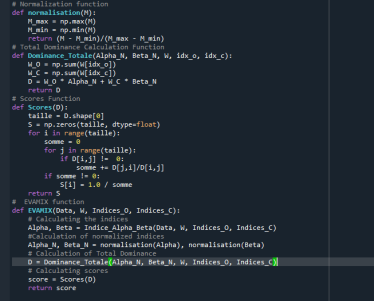
Figure 1 represents the beginning of the program and is the function calculating the dominance rate of any two actions.
Figure 2. Implementation of the MACBEV Method (Following).
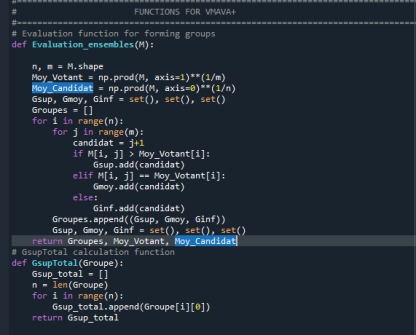
Figure 2 is a continuation of Figure 1 which simultaneously groups four different role functions: The normalization function, the total dominance function, the scoring function and the EVAMIX function.
Figure 3. Implementation of the MACBEV Method (Following).
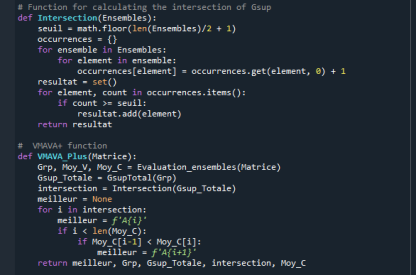
Figure 3 is a continuation of Figure 2 which mainly groups two functions: The function allowing the construction of the different subsets (Gsup, Ginf and Gmoy) and the function which calculates the sets of the higher group (Gsup).
Figure 4. Implementation of the MACBEV Method (Following).
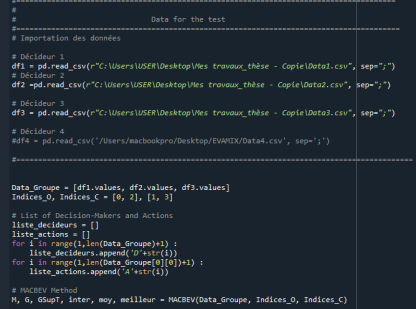
Figure 4 is a continuation of Figure 3 which consists of two functions: the function which facilitates the calculation of the intersection of the sets Gsup and the other the function VMAVA+ to select the winner.
Figure 5. Implementation of the MACBEV Method (Following).
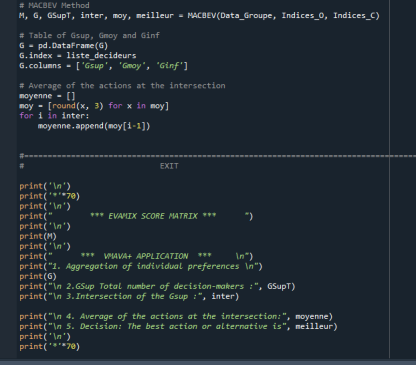
Figure 5 is also a continuation of Figure 4, which allowed the import of data from the EXCEL software.
Figure 6. Implementation of the MACBEV Method (End).
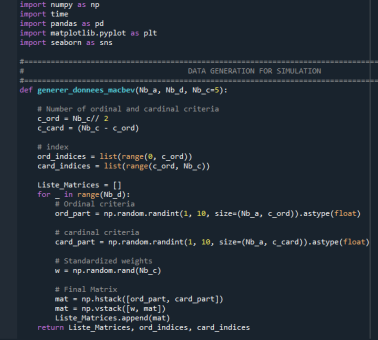
Figure 6 corresponds to the end of our computer program, which is designed to display all the results after the program has been executed.
3.3. Computational Study on the MACBEV Method
Time complexity analysis is an important process in evaluating an algorithmic model.
It allows us to understand and track how the method's execution time changes with data size, and, most importantly, to compare it with other methods.
Step 1: Calculating the Action Score using the EVAMIX method.
1) Element-wise operation:
a) Calculation of αk i,i' αk i,i'+ Pjk× sgn qk i,i': Dominance index of two actions (for each pair of actions, all m criteria are examined) on k decision-makers → O(n² × m × k)
b) Standardization
δk i,i'αk i,i'-αmink/ Ec(αk): For the m' qualitative criteria of n actions and k decision-makers → O(n × k × m′)
dk i,i'βk i,i'-βmink/Ec(βk ): For the m quantitative criteria of n actions and k decision-makers → O(n × k × m′′)
c) Dominance of two actions
d) Dki,i'WO× δk i,i'+WC× dk i,i': For each pair of actions on k decision- makers →O(n2 × k)
e) Overall score for each action
SkiSki+ Dki',i/ Dki,i'-1: Each action by n other actions on k decision-makers →O(n2 × k)
2) Total complexity. By combining, we will have: O(n2 ×m×k) + O(n2 ×m′ ×k) + O(n2 ×m′′ ×k) + O(n2 × k) = O(n2 × m × k) in the worst case.
Step 2: Aggregation using the VMAVA+ voting method.
3) Element-wise operation:
a) Md [k] ← i=1NSk(ai)N: Calculating the performance of decision-makers dk using the geometric mean → O(n × k)
b) Ma [ai] ← k=1pSk(ai)p: Calculating the performance of action ai using the geometric mean → O(n × k)
c) Formation of the subsets gsup, gmoy, and ginf: Each decision-maker produces these subsets of actions → O(n × k)
d) Sorting of actions → O(nlogn)
4) Worst-case total complexity: O(n × k) + O(n × k) + O(n × k) + O(n log n) = O(n × k) with k >> log n
Step 3: Final time complexity of the MACBEV algorithm O(max(n × k, n2 × m × k)) = O(n2 × m × k) therefore the time complexity of our algorithm after this analysis is quadratic in the worst case.
3.4. Graphic Complexity
In this section, we study graphical complexity by fixing the number of criteria and varying the number of decision-makers, along with a corresponding variation in the number of actions. For example, let's fix the number of criteria at 4. For 3 decision-makers, we now vary the number of actions from 10 to 40 in steps of 5. With each resolution, we recover execution time. Then, for 5 decision-makers, we also vary the number of actions from 10 to 40 in steps of 5, and so on up to 15 decision-makers. The number of decision-makers changes in steps of 2. This allowed us to obtain the following curve, see Figure 7.
Presentation of the Python code for the complexity study.
Figure 7. Beginning of the Complexity Code.
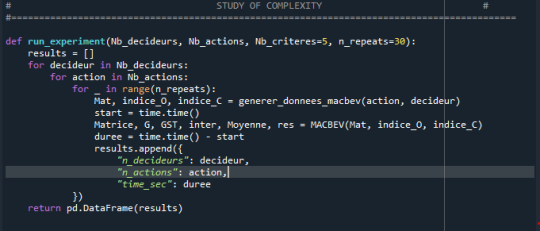
Figure 7 shows a beginning of the Python code for the study of the complexity of the MACBEV method.
Figure 8. Continuation of the Complexity Code.
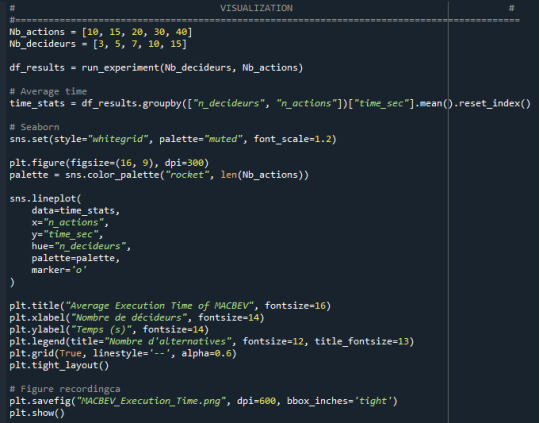
Figure 8 is a continuation of Figure 7, which is a key function in the process of studying complexity.
Figure 9. End of the Complexity Code.
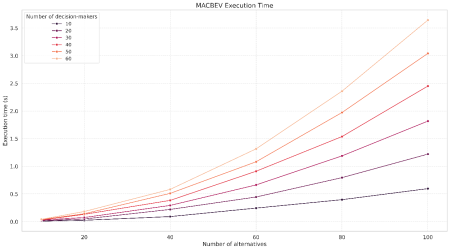
Figure 9 presents the end of the complexity study and displays the different elements with legends.
Complexity curve.
Figure 10. Study of Graphic Complexity.
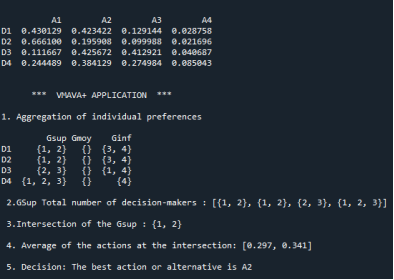
Figure 10 is a graphical representation of the complexity of the MACBEV method. It clearly shows a progression of time as a function of data size.
4. Digital Application
This example is inspired by Zoïnabo Savadogo et al.
4.1. Statement
We have four cowpea varieties suitable for production and four selection criteria. Four experts—a farmer, a technician, a seed producer, and an engineer—each have their own, sometimes conflicting, opinions. The goal is to find a good, consensus-based cowpea variety to boost production. The set of varieties is: A = {Tiligre(a2), Komcalle(a2), Na(a3), Gorom(a4)}, and the set of criteria is: C = {c1, c2, c3, c4} where: C1: Pest resistance; C2: Maturity period; C3: Drought tolerance; C4: Yield potential. Each expert constructs their judgment matrix using a scale of values from 0 to 10, and some evaluations are presented as strings, as shown in Tables 2, 3, 4 and 5.
Table 2. Decision-Maker 1 (Farmer).

C1

C2

C3

C4

weight

6

5

4

7

Tiligre (a1)

good

5

not very important

7

Komcalle (a2)

quite good

6

important

7

Nafi (a3)

fair

7

very important

1

Gorom local (a4)

fair

4

Less important

2

Table 3. Decision-Maker 2 (Technician).

C1

C2

C3

C4

weight

4

5

7

5

Tiligre (a1)

Fairly good

8

very important

4

Komcalle (a2)

fair

4

Very important

3

Nafi (a3)

good

1

Not very important

1

Gorom local (a4)

Fairly good

1

Not very important

2

Table 4. Decision-Maker 3 (Seeds).

C1

C2

C3

C4

weight

1

5

2

4

Tiligre (a1)

good

2

Not very important

6

Komcalle (a2)

Very good

8

Less important

3

Nafi (a3)

fair

4

very important

7

Gorom local (a4)

good

3

Less important

4

Table 5. Decision-Maker 4 (engineer).

C1

C2

C3

C4

weight

2

6

3

5

Tiligre (a1)

Very good

3

Not very important

7

Komcalle (a2)

good

7

very important

4

Nafi (a3)

fair

6

Not very important

8

Gorom local (a4)

good

1

Less important

1

4.2. Resolution with the Program
By importing these 4 judgment matrices into the program and after execution, we obtain the following results:
Figure 11. Presentation of the Result Using the Computer Program.
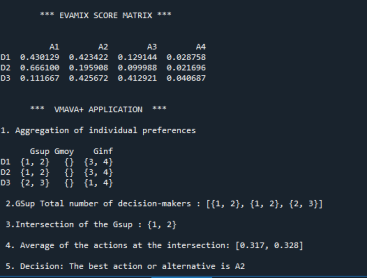
Through the program, the best action is Komcalle (a2), see Figure 11.
Let's now test the program by solving a problem already solved in order to verify the correctness of the operations.
We encourage the reader to consult to familiarize themselves with the problem already solved manually. After import and execution, we obtain the following results:
Figure 12. Presentation of the Result Using the Computer Program from the Example Taken in .
Comparison: Through the Figure 12, we note that the results provided by our computer program are identical to those solved manually in . This confirms the accuracy and validity of our program's results.
5. Critical Analysis of the Computer Program
5.1. Forces
The proposed computer program is distinguished by its rigorous and automatic data management, particularly for mixed data problems (qualitative and quantitative). It is robust, understandable, and easy to improve or reuse. Furthermore, a careful study of its time complexity has revealed that it is quadratic in the worst case, which can allow for optimization of execution time.
5.2. Weaknesses
While the program has advantages, it also has limitations. Given its complexity of O(max(n×k, n² ×m×k)) = O(n² ×m×k), its suitability for massive data processing may be limited. This can lead to slow performance and excessive resource consumption.
6. Conclusion
The MACBEV method has proven its effectiveness and has been approved as an indispensable tool in the decision-making process. It is therefore necessary to develop a computer program to broaden its scope. This has been developed and applied in our work. The analysis of the time complexity of the algorithm of this method and its applicability to any group decision problem reinforce the relevance of the proposed program. However, the program has some shortcomings, particularly its inability to automatically solve problems with weights and interval-based data. Therefore, our future work will first focus on adapting the MACBEV method to solve these types of decision-support problems and then propose a more robust program capable of addressing these shortcomings.
Abbreviations

VMAVA

Voting Method Based on Approval Voting and Arithmetic Mean

EVAMIX

EVAluation of MIXed Data

MACBEV

Collective Aggregation Model Based on the Hybridization of the EVAMIX Method and the VMAVA+ Voting Method

Data Availability Statement
The data use to support the findings of this study are included within the article.
Conflicts of Interest
The authors declare no conflicts of interest.
References
[1] N. Abbas and Z. Chergui. Performance of multicriteria decision making methods: Study and cases. 7(2): 116_146, 2017.
[2] A. Alinezhad and J. Khalili. New methods and applications in multiple attribute decision making (MADM). ISBN: 9783030150099.
[3] N. Bakhta. Multi-agent model for the design of collective decision support systems. Doctoral thesis, University of Oran. pages 542_569, 2013-2014.
[4] F. Nikiema. Extension of some multi-criteria aggregation functions to group decision problems and applications: Case of the ahp method and the electre I method thesis, joseph ki-zerbo university, burkina faso. 2022.
[5] Z. Savadogo, K. Koumbebare, and S. J. Y. Zare. Extension of the ELECTRE II method to group decision-making, 2(11): 48-59, 2023.
[6] Z. Savadogo and H. Yiogo. Collective aggregation model based on the hybridization of the evamix method and the vmava+ voting method, 2025(1): 22, 2025.
[7] W. Zongo, Z. Savadogo, S J Y. Zare, S. Sawadogo, and B. Some. Vmava+:(voting method based on approval voting and arithmetic mean)+. Advances and Applications in Discrete Mathematics, 35: 87_102, 2022.
[8] Ruffin-Benoît M. Ngoie, S. K. Kasereka, Jean-Aime B. Sakulu, and K. Kyamakya. Mean-Median Compromise Method: A Novel Deepest Voting Function Balancing Range Voting and Majority Judgment, (12): 3631, 2024.
[9] A. Zoungrana, A. Tougma, and K. Some Operator Preserving Optimum Method for solving multiobjective optimization problems. IAENG International Journal of Applied Mathematics, Volume 55, Issue 9, september 2025, pages 3062-3070.
[10] K. Kambire, Z. Savadogo, F. Nikiema. Implementation of the VMAVA method in order to make applications with a large number of candidates and voters. Pure and Applied Mathematics Journal. Vol. 12, No. 3, 2023, pp. 49-58,
[11] H. Yiogo, Z. Savadogo. Implementation of a voting method based on mean-deviation evaluation for a large-scale election. Pure and Applied Mathematics Journal. Vol. 14, No. 2, 2025, pp. 13-23,
Cite This Article
  • APA Style

    Yiogo, H., Bamogo, H., Savadogo, Z. (2026). Algorithm and Implementation of MACBEV Method for Solving Large-data Problems. American Journal of Applied Mathematics, 14(1), 27-38. https://doi.org/10.11648/j.ajam.20261401.14

    Copy | Download

    ACS Style

    Yiogo, H.; Bamogo, H.; Savadogo, Z. Algorithm and Implementation of MACBEV Method for Solving Large-data Problems. Am. J. Appl. Math. 2026, 14(1), 27-38. doi: 10.11648/j.ajam.20261401.14

    Copy | Download

    AMA Style

    Yiogo H, Bamogo H, Savadogo Z. Algorithm and Implementation of MACBEV Method for Solving Large-data Problems. Am J Appl Math. 2026;14(1):27-38. doi: 10.11648/j.ajam.20261401.14

    Copy | Download

  • @article{10.11648/j.ajam.20261401.14,
      author = {Hadarou Yiogo and Hamado Bamogo and Zoïnabo Savadogo},
      title = {Algorithm and Implementation of MACBEV Method for Solving Large-data Problems},
      journal = {American Journal of Applied Mathematics},
      volume = {14},
      number = {1},
      pages = {27-38},
      doi = {10.11648/j.ajam.20261401.14},
      url = {https://doi.org/10.11648/j.ajam.20261401.14},
      eprint = {https://article.sciencepublishinggroup.com/pdf/10.11648.j.ajam.20261401.14},
      abstract = {Group decision-making is now an essential approach in our daily lives. It plays a crucial role in the decision-making process. This compels certain human structures or decision-makers to seek external assistance in order to reach a consensus that is accepted by all stakeholders. This is why many multi-criteria decision-making methods have been developed and are widely used to clarify complex decision-making situations where intuition alone is insufficient. Among these existing methods, a new one has recently been developed, the scientific validity of which has been proven: the MACBEV method. It is obtained by hybridizing the EVAMIX method and the VMAVA+ voting method. The collective aggregation method based on the EVAMIX method and the VMAVA+ voting method (MACBEV) is one of these very recent methods that generates good properties but is unfortunately used to solve problems with small datasets where calculations are performed manually. Given the importance of the MACBEV method, it is essential to develop a computer program to broaden its scope. This will facilitate its application to concrete cases. In this work, we propose an algorithm and a computer program for this method that efficiently solves group decision problems, particularly large-scale problems whose manual processing is impractical. We then conduct a theoretical and graphical complexity study to demonstrate the efficiency of our program. Our computer model has been applied to large-scale data problems, and this has produced satisfactory results.},
     year = {2026}
    }
    

    Copy | Download

  • TY  - JOUR
    T1  - Algorithm and Implementation of MACBEV Method for Solving Large-data Problems
    AU  - Hadarou Yiogo
    AU  - Hamado Bamogo
    AU  - Zoïnabo Savadogo
    Y1  - 2026/01/26
    PY  - 2026
    N1  - https://doi.org/10.11648/j.ajam.20261401.14
    DO  - 10.11648/j.ajam.20261401.14
    T2  - American Journal of Applied Mathematics
    JF  - American Journal of Applied Mathematics
    JO  - American Journal of Applied Mathematics
    SP  - 27
    EP  - 38
    PB  - Science Publishing Group
    SN  - 2330-006X
    UR  - https://doi.org/10.11648/j.ajam.20261401.14
    AB  - Group decision-making is now an essential approach in our daily lives. It plays a crucial role in the decision-making process. This compels certain human structures or decision-makers to seek external assistance in order to reach a consensus that is accepted by all stakeholders. This is why many multi-criteria decision-making methods have been developed and are widely used to clarify complex decision-making situations where intuition alone is insufficient. Among these existing methods, a new one has recently been developed, the scientific validity of which has been proven: the MACBEV method. It is obtained by hybridizing the EVAMIX method and the VMAVA+ voting method. The collective aggregation method based on the EVAMIX method and the VMAVA+ voting method (MACBEV) is one of these very recent methods that generates good properties but is unfortunately used to solve problems with small datasets where calculations are performed manually. Given the importance of the MACBEV method, it is essential to develop a computer program to broaden its scope. This will facilitate its application to concrete cases. In this work, we propose an algorithm and a computer program for this method that efficiently solves group decision problems, particularly large-scale problems whose manual processing is impractical. We then conduct a theoretical and graphical complexity study to demonstrate the efficiency of our program. Our computer model has been applied to large-scale data problems, and this has produced satisfactory results.
    VL  - 14
    IS  - 1
    ER  - 

    Copy | Download

Author Information
  • Abstract
  • Keywords
  • Document Sections

    1. 1. Introduction
    2. 2. Preliminary
    3. 3. Main Results
    4. 4. Digital Application
    5. 5. Critical Analysis of the Computer Program
    6. 6. Conclusion
    Show Full Outline
  • Abbreviations
  • Data Availability Statement
  • Conflicts of Interest
  • References
  • Cite This Article
  • Author Information