Abstract
The world's population continues to grow up, and the urban population has quadrupled from 1950 to the present day. This urban growth has given rise to serious problems such as environmental degradation, which is worrying, even dramatic, in most of Senegal's municipalities. The Mbour’s municipality, is certainly not spared from this phenomenon. The aim of this study on local perceptions of urban forestry is to identify the importance of trees for local population. To achieve this, three methodology approaches were engaged: the preparatory phase, which included a literature review, the development of data collection tools, sampling and a pre-survey. The data collection consisted of field surveys and the data processing for data integration and analysis. The results show a decline in floristic diversity linked to urbanization and drought, among other factors. People are interested in trees; through the financial flows they came up to generate through young seedlings and the care they take with their growth. Trees play a couple of roles in people's daily lives: family meetings, beautification, medicine, entertainment, small trades and food in the city. However, the shade service makes trees more popular. The forestry service is the key player in urban forestry.
|
Published in
|
American Journal of Agriculture and Forestry (Volume 14, Issue 4)
|
|
DOI
|
10.11648/j.ajaf.20261404.14
|
|
Page(s)
|
193-201 |
|
Creative Commons
|

This is an Open Access article, distributed under the terms of the Creative Commons Attribution 4.0 International License (http://creativecommons.org/licenses/by/4.0/), which permits unrestricted use, distribution and reproduction in any medium or format, provided the original work is properly cited.
|
|
Copyright
|
Copyright © The Author(s), 2026. Published by Science Publishing Group
|
Keywords
Urban Forestry, Trees, Perception, Mbour, Senegal
1. Introduction
The importance of urban trees is well established
| [1] | K. Nilsson and T. B. Randrup, "Urban forestry in the Nordic Countries," in Proceedings of a Nordic Workshop on Urban Forestry, Reykjavik, Iceland, 21-24 September 1996. Danish Forest and LandscapeResearch Institute, 1996.
https://doi.org/10.1007/3-540-27684-X_17 |
| [2] | G. Kuchelmeister, "Trees for the urban millennium: An update on urban forestry," Unasylva, vol. 200, pp. 49-55, 2000.
https://www.fao.org/uploads/media/Trees_for_the_urban_millenium_urban_forestry_update.pdf |
[1, 2]
. They are an essential part of the urban infrastructure for a liveable and sustainable environment. Urban forestry is a modern approach to managing trees in cities, covering the long-term planning, design and management of trees and forest stands with amenity values in or near urban areas.
Demographic growth
| [1] | K. Nilsson and T. B. Randrup, "Urban forestry in the Nordic Countries," in Proceedings of a Nordic Workshop on Urban Forestry, Reykjavik, Iceland, 21-24 September 1996. Danish Forest and LandscapeResearch Institute, 1996.
https://doi.org/10.1007/3-540-27684-X_17 |
[1]
and environmental degradation, particularly of natural resources, are closely linked phenomena. In the year 2000, more than half of the world's inhabitants lived in cities. The acceleration of urbanisation has been most spectacular in the developing world, where the number of city-dwellers has more than quadrupled since 1950. Two-thirds of population growth in developing countries is absorbed by cities. This unprecedented acceleration in urban development has had a considerable impact on man's relationship with trees and forests
.
In Africa, there is a growing awareness of the need for forests and peri-urban parks to satisfy physical and material needs, and for recreation. This need is evolving in line with Africa's urbanization rate, which jumped from 18% to 21% between 1950 and 1970 to 32% in 1984
. Africa is a "young" continent where traditional relationships between people and their environment, particularly trees and forests, are as much alive in their food and material aspects as in their spiritual and cultural aspects. These relationships influence, and will continue to strongly influence, the arrangements and measures taken by modern administrations to define the place and role of trees and forests in and around urban areas
. In most cases in Africa, the management and development of towns and cities are beyond the control of decision-makers, with worrying ecological and sociological repercussions. Faced with this situation, this study analyses the perception of trees by the various players in urban forestry and the role and place of trees in urban environments.
2. Study Area
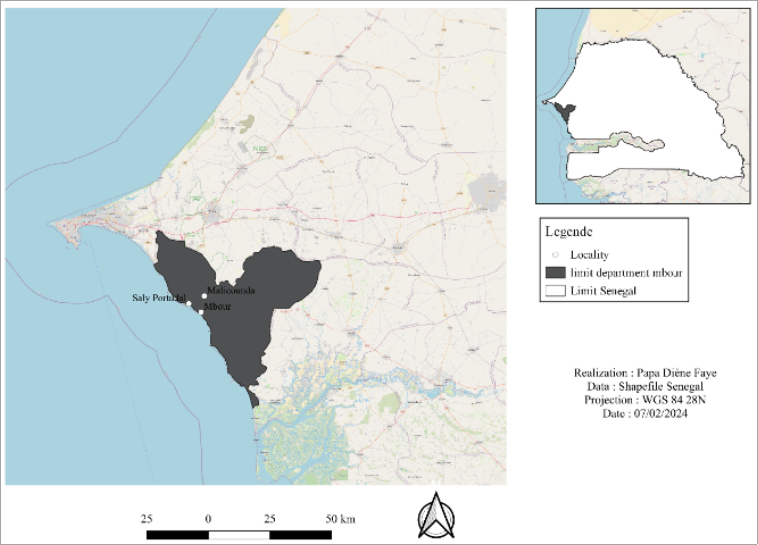
The commune of Mbour is located on the coast, south of the department of Thies and 83 km from Dakar, between 14°24'42''N and 16°57'57''W. It is bounded to the west by the Atlantic Ocean and to the north by the town of Saly. It is surrounded on the other sides by the commune of Malicounda (
Figure 1).
Figure 1. Location and administrative organization.
The municipality is influenced by the maritime trade winds and the cold Canary Current, giving it a relatively mild climate. Average temperatures range from 20°C to 35°C, with an annual average of around 26°C. Minimum temperatures can be as low as 16°C between January and February, and maximum temperatures can rise to 35°C between March and October. The average amount of sunshine varies between 8 and 9 hours a day, and the climate is tropical, with a 9-month dry season alternating with a 3-month rainy season. Rainfall varies between 400 and 600 mm. Due to its proximity to the ocean, the average relative humidity is 70%
| [5] | Mairie de Mbour, "Municipal Development Plan," 2017. |
[5]
. The Department of Mbour is relatively flat, with the Diass massifs rising to an altitude of 90m. Tropical ferruginous soils, brown and red-brown soils, lateritic outcrops and clayey soils are the four main soil types covering the department
| [6] | Water and Forestry Sector of Mbour, "Annual report for the department of Mbour," 2019. |
[6]
. Water resources are underground. They are contained in the water tables of the Continental Terminal or Eocene, with the sedimentation of the basin formed by the geological formations of the Secondary and Tertiary
| [5] | Mairie de Mbour, "Municipal Development Plan," 2017. |
[5]
.
The department of Mbour has various types of vegetation facies. There is a tree layer composed mainly of Mimosaceae (
Faidherbia albida, Acacia raddiana, Acacia senegal, Acacia seyal, etc.) and
Balanites aegyptica, a shrub layer dominated by Combretaceae (
Guiera senegalensis, Combretum sp.) and the herbaceous layer dominated by shortcycle Poaceae (
Zornia glochidiata, Cenchrus biflorus, Andropogon gayanus, Schoenefeldia gracilis) in wooded areas, notably the classified forests of Nianing and Bandia
| [6] | Water and Forestry Sector of Mbour, "Annual report for the department of Mbour," 2019. |
[6]
.
3. Materials and Methods
The method adopted to achieve our objectives consists of 3 complementary phases:
1) the preparatory phase, including literature review, development of data collection tools, sampling and pre-surveys;
2) the sampling phase, during which a representative sample of the commune's population was selected and surveyed. This is a data collection phase consisting of field surveys and; - finally, the data processing phase, involving data entry and analysis.
The procedure for selecting the inventory and survey sample was as follows: as the Commune of Mbour is made up of 27 neighborhoods, we took half of them, giving us 13 neighbourhoods, i.e. a sampling rate of 50%. It should be noted that the old (central) neighbourhoods are those with dense vegetation and the new (peripheral) neighbourhoods are those with less dense vegetation. Seven central neighbourhoods and six peripheral neighbourhoods were explored.
To select the concessions to be surveyed, we used the Fisher method with the help of the table of 13 neighbourhoods and their populations, using the following formula:
Nf: sample size, n: degree of representativeness of the sample n=1/d2, N: total population of the 13 neighbourhoods, and d: Selected degree of precision
We have assumed a degree of precision of 10%
n=1/(10/100)2=100 and N=178561 Nf=100/ (1+100/178561) =99.99=100
people to be surveyed Polling rate = Nf*100/N = 100*100/178561=0.056%
This sampling rate enabled us to determine the population to be surveyed for each neighbourhood (
Table 1). It should be noted that the people to be surveyed were chosen at random, one person per concession. The heads of the concessions were therefore interviewed. In all, 100 people were interviewed.
Table 1. Neighbourhoods and population to be surveyed.
Vegetation structure | Neighbourhoods | Population | Interviewed |
Neighbourhoods with vegetation | Santessou | 10155 | 6 |
West Thioce | 26060 | 14 |
East Thioce | 35107 | 20 |
11 November | 19317 | 11 |
Darou salam | 9605 | 5 |
Tefess | 22453 | 13 |
Mbour toucouleur | 9655 | 5 |
Neighbourhoods with less vegetation | Gouye mouride | 7088 | 4 |
Golf | 5128 | 3 |
Grand Mbour 1 | 6904 | 4 |
Grand Mbour 2 | 10585 | 6 |
Liberte 1 | 8164 | 4 |
Liberte 2 | 8340 | 5 |
| Total | 178561 | 100 |
Before the actual survey, we carried out a pre-survey of a section of the population. This pre-survey enabled us to clarify certain questions that were not well understood when the questionnaire was drawn up, and to see whether the information obtained was credible and would enable us to achieve our objectives. The questionnaire, which was essentially semi-open, was administered to the population after the data collection tools had been validated, and according to a pre-established schedule. At the same time, interviews were also conducted. At the level of each structure, we sent letters of administrative correspondence to request an interview date.
The data processing was the last step used. The data collected was compiled in Excel. The survey forms were compiled first, then the data was analysed and summarised in tables. For each aspect of the research covered, the data analysis consisted of interpreting the proportion of certain specific opinions in relation to the opinions of all respondents. These proportions are determined by calculating percentages as follows: % = Po * 100 /Pt, where Po = Proportion surveyed and Pt = Total proportion of the sample.
We used Word to enter the text and Qgis to draw up the maps. All the results were extrapolated to the scale of the municipality.
4. Result
4.1. Description and Perception of the Tree by the Interviewed Population
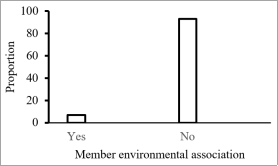
During our surveys, seven out of hundred people, taking part of the socio-professional association related to an environmental field have been identified. They were involved in environmental clubs at secondary school level, the NEBEDAY movement, the Climate Action Group and environmentalists (
Figure 2).
Figure 2. Membership of an environmental association.
4.2. Origin of the Trees
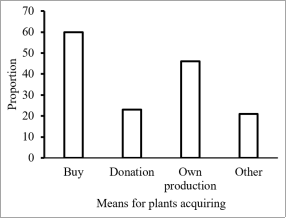
Figure 3 shows the means used by urban dwellers to obtain seedlings. In the urban area of Mbour, the majority of players (60%) buy seedlings, 46% produce them, 23% acquire them as gifts and 21% say they found them locally.
Figure 3. Plant acquisition methods.
4.3. Plant Care
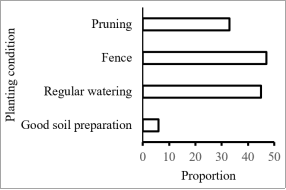
As for the care taken, this is related to the technical nature of the work. The people we met said that, to grow trees in their plots, they had to rely on a number of techniques and resources. In fact, 45% of people watered regularly, 47% protected their plants with fencing, 33% pruned and 6% prepared the soil well (
Figure 4).
Figure 4. Carefulness for good planting results.
4.4. Changes in Plant Cover
Figure 5 shows the population's perception of changes in the commune's forest potential. The majority of respondents (75.67%) in neighbourhoods with dense vegetation spoke of a decrease in vegetation cover in the commune, compared with 24.32%. However, in neighbourhoods with less dense vegetation cover, all the respondents spoke of an increase.
4.5. Causes of the Loss of Floral Biodiversity in Cities
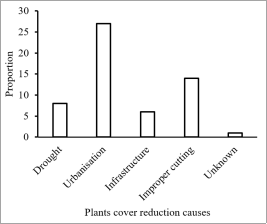
Figure 6 shows the causes of the reduction in vegetation cover. They are many and varied. Thus, 27% said it was due to urbanization, 14% to over-cutting, 8% to drought, 6% to infrastructure and 1% did not know the causes.
Figure 6. Cause of the reduction in vegetation cover.
4.6. Disadvantages of Urban Trees
The
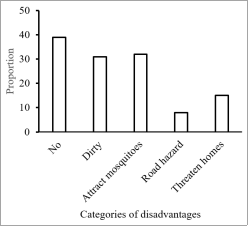
Figure 7 shows that 39% of respondents said that there were no disadvantages to having trees in their concessions, 33% said that they attracted mosquitoes, 31% that they were dirty and 15% that they threatened the houses.
Figure 7. Negative effects of trees in concessions.
4.7. Importance of the Trees
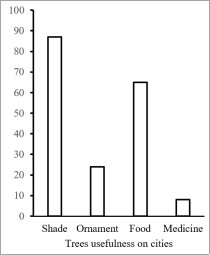
In the context of this study, particular emphasis is placed on shade, pharmacopoeia, embellishment and entertainment. Eighty-seven percent (87%) of the sampled populations stated that they had planted trees for shade, 65% for food, 24% for ornamental purposes and 8% for medicinal purposes (
Figure 8).
Figure 8. Utility of trees in the city.
4.8. Use of Trees in the City
The
Table 2 shows the use of products from the plants surrounding the population. Fruit trees are used most for food.
Moringa oleifera Lam. comes first, followed by Mangifera indica L., Citrus limon (L.) Burm.f., Manilkara zapota (L.) P. Royen, Punica granatum L. and Musa sinensis L. For pharmacopoeia, the species most used are Moringa oleifera Lam. and Khaya senegalensis (Desr) A. Juss. Fuelwood and service wood are not much used. Only Khaya senegalensis (Desr) A. Juss. and Azadirachta indica A. Juss were mentioned, but only to a small extent.
Table 2. Use of products obtained from plants.
Species | Use |
Food | Pharmacopoeia | Firewood |
Moringa oleifera Lam. | 1st | 1st | |
Mangifera indica L. | 2e | 3e | |
Citrus limon (L.) Burm.f. | 3e | 5 e | |
Manilkara zapota (L.) P. Royen | 4e | | |
Punica granatum L. | 4e ex. | | |
Musa sinensis L | 4e ex. | | |
Adansonia digitata L. | 4e ex. | | |
Khaya senegalensis (Desr) A. Juss. | | 2e | 1st |
Azadirachta indica A. Juss | | 4e | 1st ex. |
Hura crepitans L. | | 5e ex. | |
Gmelina arborea Roxb. | | 5e ex. | |
Pluchea odorata (L.) Cass. | | 3e ex. | |
Calotropis procera (Aiton) W. T. Aiton | | 5e ex. | |
4.9. Reasons for the Absence of Vegetation
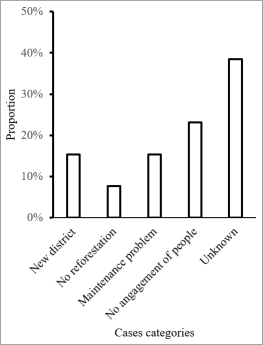
As the graph below shows, the causes of the absence of vegetation are many and varied. Of the 26 people surveyed, almost half did not know the causes (10 people), while the others spoke of a lack of commitment on the part of the local population (6 people), a problem with the maintenance of the plants (4 people), a new neighbourhood (4 others) and, finally, the remaining 2 spoke of a lack of reforestation.
Figure 9. Causes of the lack of vegetation in neighbourhoods with less dense vegetation.
4.10. Species and Location Preferences
Table 3 shows the distribution of the species preferred by the population in neighbourhoods with less dense vegetation. The location of fruit species in the plot is the most popular. The next most popular combination is green spaces in front of the plot with shade species.
Table 3. Species requirements their location.
Species | In front of dealership | In the concession | Green spaces |
Azadirachta indica A.Juss | | | 3 |
Citrus limon (L.) Burm.f. | | 7 | |
Cordia sebetina L. | | | 2 |
Delonix regia (Bojer ex Hook.) Raf. | | 1 | 4 |
Eucalyptus camaldulensis Dehnh. | | | |
Ficus sp L. | 3 | | 3 |
Gmelina arborea Roxb. | 1 | | 5 |
Psidium guajava L. | | 8 | |
Punica granatum L. | | | |
Hura crepitans L. | | | 1 |
Citrus reticulata Blanco. | | 8 | |
Mangifera indica L. | | 1 | |
Moringa oleifera Lam. | | | |
Citrus sinensis (L.) Osbeck | | 6 | |
Citrus paradisi Macfad. | | 2 | |
Carica papaya L. | | 2 | |
Annona squamosa L. | | | |
Diospyros digyna Jacq. | | 1 | |
Terminalia mantaly H. Perrier | 4 | | 4 |
Totale | 7 | 37 | 22 |
Within the plot, Citrus reticuluta Blanco, Psidium guajava L., Citrus limon (L.) Burm. f. and Citrus sinensis (L.) Osbeck are the most desired, in front of the plot Terminalia mantaly H. Perrier, Ficus sp L. and Gmelina arborea Roxb. are listed and in the green areas Gmelina arborea Roxb., Terminalia mantaly H. Perrier and Delonix regia (Bojer ex Hook.) Raf. were cited
5. Discussion
The presence of trees on concessions in the commune of Mbour can be explained by the interest shown in trees, by the investment made in acquiring young seedlings and by the care taken to ensure that these seedlings grow. When it comes to acquiring seedlings, people invest a lot in purchasing and self-propagating. Trees play a number of roles in people's lives, providing shade, beautification, medicine, entertainment, odd jobs and food in the city. In the commune of Mbour, shade is the role most appreciated by the population. These comments corroborate those of
| [7] | B. Dutrève, "Study on Urban Forestry in the Sahel Region: Nouakchott, Mauritania," University of Paris XII, 1997. |
[7]
. According to this source, the shaded area is used in a wide variety of ways: "There is the shop tree, the lounge tree, the games room tree, the palaver tree, the workshop tree".
All these uses have a common denominator, "the shade tree, seen as an extension of the house or shop".
So, in front of the concessions, the tree is not planted for its own sake or to embellish the neighborhood:
"It is, above all, a means of taking over an additional living space and transforming a public space into a semi-private one, in front of concessions that are too small. What's more
| [8] | G. A. Ndour, D. A. Badara, N. Moustapha, N. A. Abou, and S. Mamadou, "Contribution to the study of urban forestry in the municipality of Saint-Louis, Senegal," vol. 4, no. 1, pp. 1-21, 2024. https://doi.org/10.59384/recopays.tg.v4i1.95 |
[8]
, reveals that shady areas are highly valued by city dwellers, as trees provide a way for families and friends to get together socially, chat and exchange ideas. In the city, people come into daily contact with trees, whether in parks or along avenues. Then there are the secondary roles, such as food, ornamentation and pharmacopoeia, which are little known to the public. These comments confirm those of Sene
. Several local species whose bark, leaves or roots have medicinal properties are used and intensively exploited in the Guesselbodi peri-urban forest near Niamey, where participatory management has not neglected either the harvesting of stubble for small-scale urban livestock farming or the collection of wild fruit for human consumption. Plants provide substances essential to life, such as carbohydrates, proteins, lipids and vitamins, thus contributing to the nutritional balance of humans
| [9] | L. Sanou, J. Koala, S. Ouédraogo, and B. Ouattara, "Perceptions, ecosystem services, and vulnerability of multi-purpose tree species at the 20th Ramsar site in Burkina Fasa, West Africa," Afrique Sci. vol. 20, no. (3), pp. 25-40, 2022. |
[9]
. Forest products collected by local people are eaten raw (fruit), cooked (flowers, leaves) or processed (juice, jam, marmalade). Fruits, seeds and leaves are the main plant parts used
| [10] | A. Assogbadjo, F. Chadare, R. Kakaï, B. Fandohan, and J. J. Baiduforson, "Variation in the biochemical composition of baobab (Adansonia digitata) pulp, leaves and seeds as a function of soil type and tree provenance," Agric. Ecosystems Environ. vol. 157, 2012. |
| [11] | J. Betti, C. Ngankoué, S. Dibong, and A. E. Singa, "Ethnobotanical study of wild edible plants sold in markets in Yaounde, Cameroon," International Journal of Biological and Chemical Sciences, 2016. https://doi.org/10.4314/ijbcs.v10i4.19 |
[10, 11]
. The use of woody species in a given region generally depends on their abundance
| [12] | A. Laouali, G. I. Dan, M. Larwanou, M. M. Inoussa, and A. Mahamane, "Use of Prosopis africana (G. et Perr.) Taub in the southern part of the Aguie Department in Niger: the different forms and their significance," Int. J. Biol. Chem. Sci. 2014,
https://doi.org/10.4314/ijbcs.v8i3.20 |
[12]
, the preferences of the local population
| [13] | D. Ngom, "Plant diversity and quantification of ecosystem services in the Ferlo Biosphere Reserve (NorthSenegal)," UCAD, 2013. |
[13]
and specific ethnic characteristics
| [14] | H. Rabiou, B. A. Bationo, K. Adjonou, A. D. Kokutse, A. Mahamane, and K. Kokou, "Farmers perceptions and the sociocultural and ethnobotanical importance of Pterocarpus erinaceus in Burkina Faso and Niger," Afrique Sci. vol. 13, no. 5, pp. 43-60, 2017. |
[14]
. These observations reinforce the need to consider multiple uses.
To grow trees, people use technical means to ensure that the plants develop properly. Nearly half the people surveyed water their plants regularly and protect them with a fence. Some of them prune their plants, but very few prepare the soil properly. Managing urban forests involves costs - planting trees, maintaining and repairing infrastructure (pavements, sewers) - but an evaluation carried out in five US cities by
| [15] | G. McPherson, J. R. Simpson, P. J. Peper, S. E. Maco, and Q. Xiao, "Municipal forest benefits and costs in five US cities," J. For., vol. 103, no. 8, pp. 411-416, 2005.
https://www.fs.usda.gov/psw/publications/mcpherson/psw_2005_mcpherson003.pdf |
[15]
showed that the benefits of urban trees outweigh the costs by a ratio of 1.37 to 3.09. The analysis considered the following costs: tree planting and maintenance, including pruning, removal and disposal of damaged trees; damage to infrastructure; inspection; waste collection; claims for damage following a fall.
The population's perception of changes in tree cover provides an insight into the dynamics of vegetation in the town of Mbour. It also enables us to measure whether efforts have been made in recent years in terms of planting and protecting nature. The majority of the population of Mbour believe that vegetation is declining in neighborhoods with dense vegetation, in contrast to neighborhoods with less dense vegetation. These comments corroborate those of
| [16] | FAO, "Study on urban and peri-urban forestry in N'Djamena, Chad. The role and importance of trees in urban and peri-urban areas: Supporting the development of an urban an peri-urban forestry strategy and action plan for N’Djamena, Republic of Chad," 2012.
https://www.fao.org/4/i2850fwp6/i2850fwp6.pdf |
[16]
. With urban growth and the oppressive heat of recent years, people are increasingly planting trees for shade. In addition, the government's 2008 ban on cutting green wood and making charcoal has had the effect of regenerating the vegetation cover, especially in rural areas; pressure on forest resources has decreased significantly following the repressive actions of the joint surveillance and nature protection brigade set up for this purpose.
For neighborhoods with less dense vegetation, the absence of vegetation is due to their status as new neighborhoods, built all over the place, lacking space, with an uncommitted population, problems with plant maintenance or, lastly, the absence of reforestation. These results are comparable to those of
| [17] | J. B. Ndamiyehe, E. Ndamiyehe, F. Habiyaremy, and B. Kadiata, "Role, presence, and need for trees in the urban landscape of Kinshasa," p. 7, 2017. |
[17]
in Kinshasa, who state that in the city, the major constraint to planting trees in residences is the lack of space. The same is true of
| [18] | G. Buisseres et al, "Urban forestry" In Quebec Order of Forest Engineers (ed.). Forestry Manual. 2nd edition. Collective work. Edition multi monde, Québec," 2009, pp. 721-769. |
[18]
, who acknowledge that in the city, trees and city dwellers are in competition for the use of space, and that soil as a growing medium for trees is in short supply because the urban space above and below ground is furnished by several types of structures and infrastructure. The population prefers fruit species to forest species, especially nonfood species. They prefer them inside their concessions to better protect them from fruit theft, livestock or wind.
6. Conclusion
This study, entitled "Local perception of urban forestry in the commune of Mbour, Senegal", focuses on the sociological aspect of trees in towns. It shows that local people have a very clear idea of the role and importance of trees in the urban environment. The main role recognized is that of shade, to which other benefits can be added: food, medicines, firewood, service wood, etc. With the pressure exerted on forest resources, the evolution of plant cover remains negative. Indeed, the people we met noted a reduction in the number of trees in recent years. This reduction is due, on the one hand, to the spontaneous actions of the population in planting trees in the town, and on the other hand, to urbanization. People are looking for housing.
Acknowledgments
The authors thank the people of the commune of Mbour for their healthy collaboration in enabling the collection of data.
Author Contributions
Papa Diene Faye: Data curation, Formal Analysis, Funding acquisition, Investigation, Methodology, Resources, Software, Writing – original draft, Writing – review & editing
Aliousseyni Ly: Visualization, Writing – original draft, Writing – review & editing
Omar Cisse Faye: Software, Writing – original draft, Writing – review & editing
Assane Ka: Visualization
Elhadji Faye: Conceptualization, Data curation, Methodology, Project administration, Supervision, Validation
Data Availability Statement
Data will be available on request.
Conflicts of Interest
The authors declare no conflicts of interest.
References
| [1] |
K. Nilsson and T. B. Randrup, "Urban forestry in the Nordic Countries," in Proceedings of a Nordic Workshop on Urban Forestry, Reykjavik, Iceland, 21-24 September 1996. Danish Forest and LandscapeResearch Institute, 1996.
https://doi.org/10.1007/3-540-27684-X_17
|
| [2] |
G. Kuchelmeister, "Trees for the urban millennium: An update on urban forestry," Unasylva, vol. 200, pp. 49-55, 2000.
https://www.fao.org/uploads/media/Trees_for_the_urban_millenium_urban_forestry_update.pdf
|
| [3] |
D. C. Ngarmari, " Study on Urban and Peri-Urban Forestry in N'Djamena, Chad: The Role and Significance of Trees in Urban and Peri-Urban Areas," 2012.
https://www.fao.org/4/i2850fwp6/i2850fwp6.pdf
|
| [4] |
E. H. Sène, Urban and peri-urbanforests in Sub-Saharan Africa: the Sahel, 1993.
https://www.fao.org/4/u9300e/u9300e09.htm
|
| [5] |
Mairie de Mbour, "Municipal Development Plan," 2017.
|
| [6] |
Water and Forestry Sector of Mbour, "Annual report for the department of Mbour," 2019.
|
| [7] |
B. Dutrève, "Study on Urban Forestry in the Sahel Region: Nouakchott, Mauritania," University of Paris XII, 1997.
|
| [8] |
G. A. Ndour, D. A. Badara, N. Moustapha, N. A. Abou, and S. Mamadou, "Contribution to the study of urban forestry in the municipality of Saint-Louis, Senegal," vol. 4, no. 1, pp. 1-21, 2024.
https://doi.org/10.59384/recopays.tg.v4i1.95
|
| [9] |
L. Sanou, J. Koala, S. Ouédraogo, and B. Ouattara, "Perceptions, ecosystem services, and vulnerability of multi-purpose tree species at the 20th Ramsar site in Burkina Fasa, West Africa," Afrique Sci. vol. 20, no. (3), pp. 25-40, 2022.
|
| [10] |
A. Assogbadjo, F. Chadare, R. Kakaï, B. Fandohan, and J. J. Baiduforson, "Variation in the biochemical composition of baobab (Adansonia digitata) pulp, leaves and seeds as a function of soil type and tree provenance," Agric. Ecosystems Environ. vol. 157, 2012.
|
| [11] |
J. Betti, C. Ngankoué, S. Dibong, and A. E. Singa, "Ethnobotanical study of wild edible plants sold in markets in Yaounde, Cameroon," International Journal of Biological and Chemical Sciences, 2016.
https://doi.org/10.4314/ijbcs.v10i4.19
|
| [12] |
A. Laouali, G. I. Dan, M. Larwanou, M. M. Inoussa, and A. Mahamane, "Use of Prosopis africana (G. et Perr.) Taub in the southern part of the Aguie Department in Niger: the different forms and their significance," Int. J. Biol. Chem. Sci. 2014,
https://doi.org/10.4314/ijbcs.v8i3.20
|
| [13] |
D. Ngom, "Plant diversity and quantification of ecosystem services in the Ferlo Biosphere Reserve (NorthSenegal)," UCAD, 2013.
|
| [14] |
H. Rabiou, B. A. Bationo, K. Adjonou, A. D. Kokutse, A. Mahamane, and K. Kokou, "Farmers perceptions and the sociocultural and ethnobotanical importance of Pterocarpus erinaceus in Burkina Faso and Niger," Afrique Sci. vol. 13, no. 5, pp. 43-60, 2017.
|
| [15] |
G. McPherson, J. R. Simpson, P. J. Peper, S. E. Maco, and Q. Xiao, "Municipal forest benefits and costs in five US cities," J. For., vol. 103, no. 8, pp. 411-416, 2005.
https://www.fs.usda.gov/psw/publications/mcpherson/psw_2005_mcpherson003.pdf
|
| [16] |
FAO, "Study on urban and peri-urban forestry in N'Djamena, Chad. The role and importance of trees in urban and peri-urban areas: Supporting the development of an urban an peri-urban forestry strategy and action plan for N’Djamena, Republic of Chad," 2012.
https://www.fao.org/4/i2850fwp6/i2850fwp6.pdf
|
| [17] |
J. B. Ndamiyehe, E. Ndamiyehe, F. Habiyaremy, and B. Kadiata, "Role, presence, and need for trees in the urban landscape of Kinshasa," p. 7, 2017.
|
| [18] |
G. Buisseres et al, "Urban forestry" In Quebec Order of Forest Engineers (ed.). Forestry Manual. 2nd edition. Collective work. Edition multi monde, Québec," 2009, pp. 721-769.
|
Cite This Article
-
APA Style
Faye, P. D., Ly, A., Faye, O. C., Ka, A., Faye, E. (2026). Local Perception of Urban Forestry in Mbour Municipality, Senegal. American Journal of Agriculture and Forestry, 14(4), 193-201. https://doi.org/10.11648/j.ajaf.20261404.14
 Copy
|
Copy
|
 Download
ACS Style
Faye, P. D.; Ly, A.; Faye, O. C.; Ka, A.; Faye, E. Local Perception of Urban Forestry in Mbour Municipality, Senegal. Am. J. Agric. For. 2026, 14(4), 193-201. doi: 10.11648/j.ajaf.20261404.14
Copy
|
Download
AMA Style
Faye PD, Ly A, Faye OC, Ka A, Faye E. Local Perception of Urban Forestry in Mbour Municipality, Senegal. Am J Agric For. 2026;14(4):193-201. doi: 10.11648/j.ajaf.20261404.14
Copy
|
Download
-
@article{10.11648/j.ajaf.20261404.14,
  author = {Papa Diene Faye and Aliousseyni Ly and Omar Cisse Faye and Assane Ka and Elhadji Faye},
  title = {Local Perception of Urban Forestry in Mbour Municipality, Senegal},
  journal = {American Journal of Agriculture and Forestry},
  volume = {14},
  number = {4},
  pages = {193-201},
  doi = {10.11648/j.ajaf.20261404.14},
  url = {https://doi.org/10.11648/j.ajaf.20261404.14},
  eprint = {https://article.sciencepublishinggroup.com/pdf/10.11648.j.ajaf.20261404.14},
  abstract = {The world's population continues to grow up, and the urban population has quadrupled from 1950 to the present day. This urban growth has given rise to serious problems such as environmental degradation, which is worrying, even dramatic, in most of Senegal's municipalities. The Mbour’s municipality, is certainly not spared from this phenomenon. The aim of this study on local perceptions of urban forestry is to identify the importance of trees for local population. To achieve this, three methodology approaches were engaged: the preparatory phase, which included a literature review, the development of data collection tools, sampling and a pre-survey. The data collection consisted of field surveys and the data processing for data integration and analysis. The results show a decline in floristic diversity linked to urbanization and drought, among other factors. People are interested in trees; through the financial flows they came up to generate through young seedlings and the care they take with their growth. Trees play a couple of roles in people's daily lives: family meetings, beautification, medicine, entertainment, small trades and food in the city. However, the shade service makes trees more popular. The forestry service is the key player in urban forestry.},
 year = {2026}
}
Copy
|
Download
-
TY  - JOUR
T1  - Local Perception of Urban Forestry in Mbour Municipality, Senegal
AU  - Papa Diene Faye
AU  - Aliousseyni Ly
AU  - Omar Cisse Faye
AU  - Assane Ka
AU  - Elhadji Faye
Y1  - 2026/07/28
PY  - 2026
N1  - https://doi.org/10.11648/j.ajaf.20261404.14
DO  - 10.11648/j.ajaf.20261404.14
T2  - American Journal of Agriculture and Forestry
JF  - American Journal of Agriculture and Forestry
JO  - American Journal of Agriculture and Forestry
SP  - 193
EP  - 201
PB  - Science Publishing Group
SN  - 2330-8591
UR  - https://doi.org/10.11648/j.ajaf.20261404.14
AB  - The world's population continues to grow up, and the urban population has quadrupled from 1950 to the present day. This urban growth has given rise to serious problems such as environmental degradation, which is worrying, even dramatic, in most of Senegal's municipalities. The Mbour’s municipality, is certainly not spared from this phenomenon. The aim of this study on local perceptions of urban forestry is to identify the importance of trees for local population. To achieve this, three methodology approaches were engaged: the preparatory phase, which included a literature review, the development of data collection tools, sampling and a pre-survey. The data collection consisted of field surveys and the data processing for data integration and analysis. The results show a decline in floristic diversity linked to urbanization and drought, among other factors. People are interested in trees; through the financial flows they came up to generate through young seedlings and the care they take with their growth. Trees play a couple of roles in people's daily lives: family meetings, beautification, medicine, entertainment, small trades and food in the city. However, the shade service makes trees more popular. The forestry service is the key player in urban forestry.
VL  - 14
IS  - 4
ER  -
Copy
|
Download





 Share This Article
 Twitter
 Linked In
 Facebook