
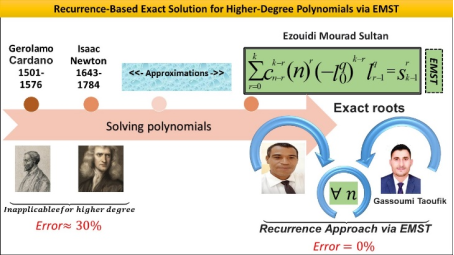
Solving higher-degree polynomial equations remains a fundamental challenge in both pure and applied mathematics. While quadratic, cubic, and quartic equations have known algebraic solutions, no general radical solution exists for degree five and higher (Abel–Ruffini theorem). This work introduces a novel recurrence-based methodology for deriving exact roots of polynomials of arbitrary degree, based on Ezouidi Mourad Sultan's Theorem (EMST). Unlike traditional algebraic techniques that are often restricted to degrees four or less or rely on numerical approximations, this framework allows for the explicit determination of roots, including irrational, complex, and multiple roots, across any polynomial degree. By systematically leveraging the structure of polynomial coefficients through recursive relationships, this approach extends the capabilities of classical methods and enhances their precision. The method is demonstrated through comprehensive examples involving irreducible and high-degree polynomials of degree 8, producing exact roots in closed form. Comparative analyses with established techniques such as Cardano's method, Newton's Method, and the Rational Root Theorem highlight the advantages of this recurrence formulation, including exactness, no reliance on initial guesses, and applicability to any degree. The EMST-based methodology offers a unified pathway toward exact solutions for longstanding algebraic problems.
| Published in | American Journal of Astronomy and Astrophysics (Volume 13, Issue 2) |
| DOI | 10.11648/j.ajaa.20261302.11 |
| Page(s) | 59-73 |
| Creative Commons |
This is an Open Access article, distributed under the terms of the Creative Commons Attribution 4.0 International License (http://creativecommons.org/licenses/by/4.0/), which permits unrestricted use, distribution and reproduction in any medium or format, provided the original work is properly cited. |
| Copyright |
Copyright © The Author(s), 2026. Published by Science Publishing Group |
Recurrence, Polynomial Roots, EMS’s Theorem, Higher-degree Polynomials, Algebraic Equations, Exact Solutions
degree | Polynomial equations | Cardano's method | Newton's method | Present work Ezouidi Mourad Sultan’s Theorem (EMST) |
|---|---|---|---|---|
3 | ≈−4.7669 ≈2.3835+10.1570i,; ≈2.3835−10.1570i | 4.8018, 2.4009+10.202i 2.400910.202i | or -4.8 | |
5 |
| Not applicable | Not applicable |
|
6 |
| Not applicable | Not applicable |
|
7 |
| Not applicable | Not applicable |
|
8 |
| Not applicable | Not applicable |
|
8 |
| Not applicable | Not applicable |
|
Roots |
|
| |
|---|---|---|---|
EMST |
|
|
|
Cardano | x1≈−4.7669, x2 ≈2.3835+10.1570i, x3 ≈2.3835−10.1570i | ||
Newton | x1 ≈−4.8018, x2,3 ≈2.4009±10.202i |
EMST | Ezouidi Mourad Sultan's Theorem |
MAE | Mean Absolute Error |
| [1] | I. M. Isaacs, Roots of Polynomials in Algebraic Extensions of Fields. The American Mathematical Monthly, 87(7) (1980) 543–544. |
| [2] | L. L. Pennisi, A Method for Finding the Real Roots of Cubic Equations by Using the Slide Rule. Mathematics Magazine, 31(4) (1958) 211–214. |
| [3] | D. Redmond, Finding Rational Roots of Polynomials. The College Mathematics Journal, 20(2) (1989) 139–141. |
| [4] | A. Borzì, X. Chen, H. J. Motwani, L. Venturello, M. Vodička, The leading coefficient of Lascoux polynomials, Discrete Mathematics, 346 (2) (2023), 113217, |
| [5] | S. Steinerberger, Free Convolution Powers Via Roots of Polynomials. Experimental Mathematics, 32(4) (2021) 567–572. |
| [6] | C. C. Lee, H. P. Niu, Determination of zeros of polynomials by synthetic division International Journal of Computer Mathematics, 7(2), (1979) 131–139. |
| [7] | K. Bryś, Z. Lonc, Polynomial cases of graph decomposition: A complete solution of Holyer’s problem, Discrete Mathematics, 309(6) (2009) 1294-1326, |
| [8] | M. Sezer, A method for the approximate solution of the second‐order linear differential equations in terms of Taylor polynomials. International Journal of Mathematical Education in Science and Technology, 27(6) (1996) 821–834. |
| [9] | S. Beji†, Investigations on cubic polynomials. International Journal of Mathematical Education in Science and Technology, 23(2) (1992) 167–173. |
| [10] | G. B. Costa, L. E. Levine, Polynomial solutions of certain classes of ordinary differential equations. International Journal of Mathematical Education in Science and Technology, 20(1) (1989) 1–11. |
| [11] | M. Sezer, M. Kaynak, Chebyshev polynomial solutions of linear differential equations. International Journal of Mathematical Education in Science and Technology, 27(4) (1996) 607–618. |
| [12] | J. Gal‐Ezer, G. Zwas, Computational aspects of rational versus polynomial interpolations. International Journal of Mathematical Education in Science and Technology, 19(4) (1988) 567–579. |
| [13] | D. A. Wolfram, Solving change of basis from Bernstein to Chebyshev polynomials, Examples and Counterexamples, 7 (2025) 100178, |
| [14] | L. E. Levine, R. Maleh, Polynomial solutions of the classical equations of Hermite, Legendre, and Chebyshev. International Journal of Mathematical Education in Science and Technology, 34(1) (2003) 95–103. |
| [15] | C. Henriksen, Roots of polynomial sequences in root-sparse regions January (2025) |
| [16] | M. Ito, Generalized Schröder paths arising from a combinatorial interpretation of generalized Laurent bi-orthogonal polynomials, Discrete Mathematics, 348 (1) (2025) 114230 |
| [17] | T. Wang, B. Wu, Induced subgraphs of a tree with constraint degree, Applied Mathematics and Computation, 440 (2023) 127657, |
| [18] | T. Gassoumi, U. F. Alqsair, R. Said, Enhanced discrete ordinates approach for mitigating shadowing effects in obstructed gas-filled spaces: Implications for astrophysical and industrial applications, Results in Engineering, 23 (2024) 102728, |
| [19] | R. C. Mittal, R. Bhatia, Numerical solution of nonlinear system of Klein–Gordon equations by cubic B-spline collocation method. International Journal of Computer Mathematics, 92(10), (2014) 2139–2159. |
| [20] | P. Cheewaphutthisakun, J. Shiraishi, K. Wiboonton, Quantum Corner Polynomials: A Generalization of Super Macdonald Polynomials and Their VOA Correspondence August (2025) |
| [21] | B. Heim, M. Neuhauser, R. Tröger, Zeros of recursively defined polynomials. Journal of Difference Equations and Applications, 26(4) (2020) 510–531. |
| [22] | C. S. Withers, S. Nadarajah, β-reciprocal polynomials. International Journal of Mathematical Education in Science and Technology, 47(5) (2015) 762–766. |
| [23] | H. Wiggins, Sibling curves of cubic polynomials. Quaestiones Mathematicae, 43(8) (2019) 1083–1090. |
| [24] | S. P. Gordon, ON SYMMETRIES OF POLYNOMIALS. PRIMUS, 9(1) (1999) 13–20. |
| [25] | U. Duran, M. Acikgoz, S. Araci, New Families of Certain Special Polynomials: A Kaniadakis Calculus Viewpoint. Symmetry. 17(9) (2025) 1534. |
| [26] | F. Taşdemir, V. Ş. Durusoy, Gaussian Chebyshev Polynomials and Their Properties Symmetry July (2025) 17(7): 1040 |
| [27] | G. Károlyi, A compactness argument in the additive theory and the polynomial method, Discrete Mathematics, 302(1–3) (2005) 124-144, |
| [28] | M. Hadjiat, J. F. Maurras, A strongly polynomial algorithm for the minimum cost tension problem, Discrete Mathematics, 165–166 (1997) 377-394, |
| [29] | I. Lamiri, J. Weslati, Limit relations involving 2-orthogonal polynomials. Integral Transforms and Special Functions, 32(5–8) (2021) 545–559. |
| [30] | P. Tiwari, A. K. Pathak, ‘Incomplete’ Pál type interpolation problems on zeros of polynomials with complex coefficients, Examples and Counterexamples, 5 (2024) 100132, |
| [31] | S. A. Bhanotar, Exploration of novel analytical solutions of boundary layer equation via the modified sumudu transform, Examples and Counterexamples, 5 (2024) 100140, |
| [32] | C. V. Valencia-Negrete, Example of a solution for Dorodnitzyn’s limit formula, Examples and Counterexamples, 3 (2023) 100114 |
| [33] | A. Kyriakoussis, M. G. Vamvakari, Generalization of matching extensions in graphs—combinatorial interpretation of orthogonal and q-orthogonal polynomials, Discrete Mathematics, 296 2–3 (2005) 199-209 |
| [34] | A. Kyriakoussis, M. G. Vamvakari, Asymptotic normality of the coefficients of polynomials related to the classical system orthogonal ones, Discrete Mathematics, 205 (1–3) (1999) 145-169 |
| [35] | Y. Zhou, Y. Zhong, A combinatorial proof of the parity unimodality of the (m,n)-rational q-Catalan polynomial for m=3, Applied Mathematics and Computation, 440 (2023) 127616 |
| [36] | A. Leriche, Cubic, quartic and sextic Pólya fields, Journal of Number Theory, 133 (1) (2013) 59-71, |
| [37] | S. P. Trofimov, Optimization of complex functions and the algorithm for exact geometric search for complex roots of a polynomial, IFAC-PapersOnLine, 51 (32) (2018) 883-888, |
| [38] | S. Monnet, Counting wild quartics with prescribed discriminant and Galois closure group, Journal of Number Theory, 269 (2025) 157-202, |
| [39] | W. Yang, C. Wang, Y. Shi, X. Xin, Construction and exact solution of the nonlocal Kuralay-II equation via Darboux transformation, Applied Mathematics Letters, (2025) 109758, |
| [40] | L. E. Levine, R. Maleh, Polynomial solutions of N th order non-homogeneous differential equations. International Journal of Mathematical Education in Science and Technology, 33(6), (2002) 898–906. |
| [41] | L. E. Levine, R. Maleh, Classroom note: Polynomial solutions of the Laguerre equation and other differential equations near a singular point. International Journal of Mathematical Education in Science and Technology, 34(5) (2003) 781–786. |
| [42] | T. H. Fay, P. H. Kloppers, The Gibbs phenomenon for series of orthogonal polynomials. International Journal of Mathematical Education in Science and Technology, 37(8) (2006) 973–989. |
| [43] | R. G. Kulkarni, Solving cubic equations by polynomial decomposition. International Journal of Mathematical Education in Science and Technology, 42(1) (2010) 105–108. |
| [44] | H. P. Hirst, W. T. Macey, Bounding the Roots of Polynomials. The College Mathematics Journal, 28(4) (1997) 292–295. |
| [45] | N. Tsirivas, A solution of polynomial equations May (2020) |
| [46] | Joab R. Winkler, Xin Lao, Madina Hasan, The computation of multiple roots of a polynomial, Journal of Computational and Applied Mathematics, Volume 236, Issue 14, 2012, 3478-3497, |
| [47] | Fiza Zafar, Sofia Iqbal, Tahira Nawaz, A Steffensen type optimal eighth order multiple root finding scheme for nonlinear equations, Journal of Computational Mathematics and Data Science, 7, 2023, 100079, |
| [48] | Chacha Stephen Chacha, On exact line search method for a polynomial matrix equation, Journal of Computational Mathematics and Data Science, 15, 2025, 100120, |
| [49] | Emil M. Prodanov, On Newton’s Rule of signs, Journal of Computational Mathematics and Data Science, Volume 6, 2023, 100076, |
| [50] | William H. Foster, Ilia Krasikov, Inequalities for real-root polynomials and entire functions, Advances in Applied Mathematics, 29, Issue 1, 2002, 102-114, |
| [51] | Guoce Xin, Chen Zhang, A polynomial time algorithm for Sylvester waves when entries are bounded, Advances in Applied Mathematics, 170, 2025, 102931, |
| [52] | Jun Ma, Kaiying Pan, (M,i)-multiset Eulerian polynomials, Advances in Applied Mathematics, 149, 2023, 102547, |
| [53] | Tiago Fonseca, Philippe Nadeau, On some polynomials enumerating Fully Packed Loop configurations, Advances in Applied Mathematics, 47, Issue 3, 2011, 434-462, |
| [54] | Christoph Koutschan, Martin Neumüller, Cristian-Silviu Radu, Inverse inequality estimates with symbolic computation, Advances in Applied Mathematics, 80, 2016, 1-23, |
| [55] | A. Gheffar, S. Abramov, Valuations of rational solutions of linear difference equations at irreducible polynomials, Advances in Applied Mathematics, 47, Issue 2, 2011, 352-364, |
| [56] | Alexander P Morgan, Andrew J Sommese, Charles W Wampler, Computing singular solutions to polynomial systems, Advances in Applied Mathematics, 13, Issue 3, 1992, 305-327, |
| [57] | A. J. Sommese and C. W. Wampler, II., The Numerical Solution of Systems of Polynomials, World Scientific Publishing Co. Pte. Ltd., Hackensack, NJ, 2005. Arising in engineering and science, |
| [58] | Danish Zaidi, Imran Talib, Muhammad Bilal Riaz, Md. Nur Alam, Extending spectral methods to solve time fractional-order Bloch equations using generalized Laguerre polynomials, Partial Differential Equations in Applied Mathematics, Volume 13, 2025, 101049, |
| [59] | Sandeep Kumar Yadav, Giriraj Methi, Application of fractional differential transform method and Bell polynomial for solving system of fractional delay differential equations, Partial Differential Equations in Applied Mathematics, Volume 12, 2024, 100971, |
| [60] | Imane Zemmouri, Amor Menaceur, Abdelhamid Laouar, Salah Boulaaras, Limit cycles of septic polynomial differential systems bifurcating from the periodic annulus of cubic center, Partial Differential Equations in Applied Mathematics, Volume 9, 2024, 100622, |
| [61] | T. Dangal, B. Khatri Ghimire, A. R. Lamichhane, Localized method of particular solutions using polynomial basis functions for solving two-dimensional nonlinear partial differential equations, Partial Differential Equations in Applied Mathematics, Volume 4, 2021, 100114, |
APA Style
Ezouidi, M. S., Gassoumi, T. (2026). Advancing Solutions to Higher-Degree Polynomials: A Novel Recurrence Approach via EMS’s Theorem. American Journal of Astronomy and Astrophysics, 13(2), 59-73. https://doi.org/10.11648/j.ajaa.20261302.11
ACS Style
Ezouidi, M. S.; Gassoumi, T. Advancing Solutions to Higher-Degree Polynomials: A Novel Recurrence Approach via EMS’s Theorem. Am. J. Astron. Astrophys. 2026, 13(2), 59-73. doi: 10.11648/j.ajaa.20261302.11
@article{10.11648/j.ajaa.20261302.11,
  author = {Mourad Sultan Ezouidi and Taoufik Gassoumi},
  title = {Advancing Solutions to Higher-Degree Polynomials:
A Novel Recurrence Approach via EMS’s Theorem},
  journal = {American Journal of Astronomy and Astrophysics},
  volume = {13},
  number = {2},
  pages = {59-73},
  doi = {10.11648/j.ajaa.20261302.11},
  url = {https://doi.org/10.11648/j.ajaa.20261302.11},
  eprint = {https://article.sciencepublishinggroup.com/pdf/10.11648.j.ajaa.20261302.11},
  abstract = {Solving higher-degree polynomial equations remains a fundamental challenge in both pure and applied mathematics. While quadratic, cubic, and quartic equations have known algebraic solutions, no general radical solution exists for degree five and higher (Abel–Ruffini theorem). This work introduces a novel recurrence-based methodology for deriving exact roots of polynomials of arbitrary degree, based on Ezouidi Mourad Sultan's Theorem (EMST). Unlike traditional algebraic techniques that are often restricted to degrees four or less or rely on numerical approximations, this framework allows for the explicit determination of roots, including irrational, complex, and multiple roots, across any polynomial degree. By systematically leveraging the structure of polynomial coefficients through recursive relationships, this approach extends the capabilities of classical methods and enhances their precision. The method is demonstrated through comprehensive examples involving irreducible and high-degree polynomials of degree 8, producing exact roots in closed form. Comparative analyses with established techniques such as Cardano's method, Newton's Method, and the Rational Root Theorem highlight the advantages of this recurrence formulation, including exactness, no reliance on initial guesses, and applicability to any degree. The EMST-based methodology offers a unified pathway toward exact solutions for longstanding algebraic problems.},
 year = {2026}
}
TY  - JOUR
T1  - Advancing Solutions to Higher-Degree Polynomials:
A Novel Recurrence Approach via EMS’s Theorem
AU  - Mourad Sultan Ezouidi
AU  - Taoufik Gassoumi
Y1  - 2026/04/29
PY  - 2026
N1  - https://doi.org/10.11648/j.ajaa.20261302.11
DO  - 10.11648/j.ajaa.20261302.11
T2  - American Journal of Astronomy and Astrophysics
JF  - American Journal of Astronomy and Astrophysics
JO  - American Journal of Astronomy and Astrophysics
SP  - 59
EP  - 73
PB  - Science Publishing Group
SN  - 2376-4686
UR  - https://doi.org/10.11648/j.ajaa.20261302.11
AB  - Solving higher-degree polynomial equations remains a fundamental challenge in both pure and applied mathematics. While quadratic, cubic, and quartic equations have known algebraic solutions, no general radical solution exists for degree five and higher (Abel–Ruffini theorem). This work introduces a novel recurrence-based methodology for deriving exact roots of polynomials of arbitrary degree, based on Ezouidi Mourad Sultan's Theorem (EMST). Unlike traditional algebraic techniques that are often restricted to degrees four or less or rely on numerical approximations, this framework allows for the explicit determination of roots, including irrational, complex, and multiple roots, across any polynomial degree. By systematically leveraging the structure of polynomial coefficients through recursive relationships, this approach extends the capabilities of classical methods and enhances their precision. The method is demonstrated through comprehensive examples involving irreducible and high-degree polynomials of degree 8, producing exact roots in closed form. Comparative analyses with established techniques such as Cardano's method, Newton's Method, and the Rational Root Theorem highlight the advantages of this recurrence formulation, including exactness, no reliance on initial guesses, and applicability to any degree. The EMST-based methodology offers a unified pathway toward exact solutions for longstanding algebraic problems.
VL  - 13
IS  - 2
ER  -
Faculty of Sciences of Gafsa, University of Gafsa, Gafsa, Tunisia
Faculty of Sciences of Gafsa, University of Gafsa, Gafsa, Tunisia

Information



 Share This Article
 Twitter
 Linked In
 Facebook

 Copy
Copy Download