Research Article | | Peer-Reviewed

A Survey of Constraints to Greenhouse and Open-field Tomato Production Among Smallholder Farmers in Nakuru County, Kenya

Received: 24 February 2026     Accepted: 14 March 2026     Published: 16 April 2026
Views:       Downloads:
Abstract

The tomato is an important crop in Nakuru County, Kenya. However, its production has been declining, causing massive losses to the farmers. A survey was conducted in major tomato-growing regions to investigate the causes of losses. Tomato production was constrained by diseases such as late blight, early blight and bacterial wilt. Data was collected from one hundred and seventy-one farmers who were randomly selected within the regions and interviewed using a structured questionnaire. Data collected included production systems, varieties of tomatoes grown and diseases that hinder production, and control methods. Data was analyzed using R software version 4.4.1. Data was tabulated to calculate frequencies and their percentages from the counts of each response. One-way ANOVA was used to test for overall significance among the groupings. The result indicated that the majority of the farmers (96.4%) were using an open field production system compared to a greenhouse system (3.6%). The most grown varieties were Cal J (Kamongo) (20.6%), DRD F1 (20.0%), and Rio Grande (15.8%). The most important diseases affecting the tomato crops were late blight (Phytophthora infestans) (26.8%), early blight (Alternaria solani) (25.5%), and bacterial wilt (Ralstonia solanacearum) (25.0%). Farmers had access to information from sources, making them knowledgeable of farming, though there are still major gaps in knowledge of insect pests, diseases, and control methods.

Published in Agriculture, Forestry and Fisheries (Volume 15, Issue 2)
DOI 10.11648/j.aff.20261502.14
Page(s) 86-93
Creative Commons

This is an Open Access article, distributed under the terms of the Creative Commons Attribution 4.0 International License (http://creativecommons.org/licenses/by/4.0/), which permits unrestricted use, distribution and reproduction in any medium or format, provided the original work is properly cited.

Copyright

Copyright © The Author(s), 2026. Published by Science Publishing Group

Keywords

Green House, Open Field, Small Scale Farmers, Tomato Production, Pests and Diseases, Nakuru County

1. Introduction
Kenya, like other Sub-Saharan African nations, still depends heavily on agriculture for both food and economic growth. . This industry is a major driver of the economy, accounting for 24% of the GDP at home and almost 65% of exports. . With farms ranging in size from 0.2 to 3 hectares, smallholder farmers predominate the sector and account for more than 70% of all agricultural output . Vegetables account for 60% of exports and 80% of horticultural growers, highlighting their dominance in agricultural sector . Tomatoes are a popularly grown vegetable that comes in second place after potatoes in terms of both production and value .
Tomatoes (Solanum lycopersicum L.) contribute 7% of all horticultural produce and 14% of the total vegetable produce . The vegetable is also one of the most consumed in most Kenyan households, providing lycopene and vitamins A and C . Additionally, the crop has potential for employment creation, improving living standards, generating income in rural areas, and serving as a source of foreign exchange . Farming of horticultural products is the main economic activity in Nakuru County. Tomato is one of the key vegetable crops grown in the county, contributing to 410,033 tonnes of produce in Kenya . Other crops grown include maize, beans, potatoes, green peas, French beans, cabbages, and kales.
Tomato production has intensified, though yields have remained low due to many challenges such as abiotic (drought, excessive rainfall, and high temperature) and biotic factors (insect pests and diseases) . Additionally, it was reported by that the amount of land available for agricultural production has decreased as a result of significant population growth, widespread soil degradation, and increased land fragmentation, all of which have lowered productivity.
The benefits of greenhouse crop farming include increased yields, year-round crop production, crop protection, the ability to produce vegetables on smaller plots of land, and superior quality produce . Large-scale horticultural farms in Kenya often and successfully use greenhouses , while small-scale farmers are gradually adopting these practices to cultivate vegetables for food security . Large-scale horticultural and floricultural farmers have been successful in greenhouse farming for many years, but smallholder greenhouse farming has numerous difficulties that have caused some of these greenhouses to be abandoned. The main reason that caused abandonment of greenhouses by tomato farmers in Nakuru County was bacterial wilt disease. The disease also affected farmers who grew tomatoes in open fields, and this has caused tomato farmers to get demoralized, making them abandon greenhouses and even the tomato production. Bacterial wilt (Ralstonia solanacearum) is a major and the most widespread disease in tomato production, causing significant yield losses . In Kenya, bacterial wilt causes 64% losses on crops grown in open fields and 100% losses on crops grown in the greenhouse . Management of the disease is very difficult since the pathogen can survive long in the soil even in the absence of host plants. Being a soil-borne disease makes it difficult to control. Small-scale farmers rely heavily on synthetic chemicals in the management of biotic factors (insect pests and diseases) . However, synthetic pesticides are associated with side effects such as produce contamination, health hazards to producers and consumers, harm to non-target organisms, and pollution of the environment . High residue levels of the synthetic chemicals on export products limit tomato market access . The objective of this study was, therefore, to assess the challenges and constraints in greenhouse and open-field tomato production by small-scale farmers in Nakuru County, Kenya. Gaining insight into the obstacles that farmers experience will help develop sustainable solutions that smallholder tomato producers need to implement to boost yield and revenue.
2. Materials and Methods
2.1. The Study Area
A survey was conducted in May 2024 in Nakuru County situated in Rift valley region of Kenya. This study was conducted in Rongai, Njoro, Subukia and Naivasha sub counties of Nakuru County which are the major tomato growing zones. Rongai is found on LH4 (lower highlands -4) lies between 0°17’05’’ S and 35°85’53’’ E receiving 650 to 800 mm/annum with an altitude range of 1890 to 2110 m ASL. Njoro lies between 0°37’ 43’’ S and 35°94’ 49’’ E, Subukia lies between 0°37’ 43’’ S and 35°94’ 49’’ E, Naivasha lies between 0°92’ 10’’ S and 36°44’73’’ E and are all located on LH3 (lower highland -3) which receives a rainfall of 1890 and 2190 mm/annum with an altitude range of 800 to 900 m ASL.
2.2. Sample Size and Sampling Procedure
The study adopted a multistage sampling technique to choose tomato farmers for the survey. In the first step, four sub-counties were purposively picked from the eleven sub-counties in Nakuru County based on their predominance in tomato production. This ensured that areas with considerable tomato farming activities were properly represented in the study. In the second step, tomato growers within the designated sub-counties were stratified into two groups according to the production system used, namely open-field tomato production and greenhouse tomato production. Stratification was needed to illustrate any changes in production restrictions between the two farming systems. Because greenhouse tomato farmers were exceptionally rare in the research area, they were purposively included in the sample to insure proper representation. Open-field tomato growers, who formed the bulk of producers, were randomly selected from farmer lists supplied from local agricultural extension administrations and farmer associations within the indicated sub-counties. A total of 150 tomato farmers participated in the survey. Data were acquired using a standardized questionnaire, which includes information on tomato production methods, disease occurrence, and management measures, with specific emphasis on the prevention of bacterial wilt caused by Ralstonia solanacearum.
2.3. Data Analysis
Data on production systems, tomato types farmed, diseases affecting tomatoes, and management techniques were entered and arranged in Microsoft Excel and analyzed using R software version 4.4. 1. Descriptive statistics were generated, and responses were summarized as frequencies and percentages. For comparisons among groups, one-way analysis of variance (ANOVA) was employed to assess for significant variations in the mean frequencies of responses across the four groupings. Where significant differences were observed, Tukey’s Honest Significant Difference (HSD) post-hoc test was employed to separate the means at a 95% confidence level (p < 0.05). The results of the Tukey HSD test were shown using Compact Letter Display (CLD) to indicate statistically significant differences across group means. In addition, chi-square tests of independence were employed to investigate relationships between categorical variables collected from the survey responses. Graphical representations of the results were developed in R using bar charts based on the frequencies of replies.
3. Results and Discussions
3.1. Tomato Production Systems
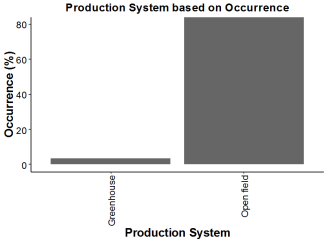
The data demonstrate that most smallholder farmers in Nakuru County planted tomatoes in open fields (96.4%), while just 3.6% grew them in greenhouses (Figure 1). The fact that very few smallholder farmers in the area employ greenhouse systems shows that protected farming is still not very widespread.
One of the main reasons for this poor adoption is that establishing and keeping up a greenhouse takes a lot of money up front, which many smallholder farmers can't afford . Even though greenhouse manufacturing could considerably enhance productivity , the expenses and skills needed to set it up may make it less popular. For instance, greenhouse tomato plants can generate substantially larger yields per plant than plants grown in the open field because the growth environment is regulated and resources are used more efficiently . Research indicates that greenhouse tomato culture can yield many times higher than that of open-field cultivation, suggesting a potentially lucrative production strategy for farmers with enough finance and technical expertise .
Even while these benefits could be helpful, not many individuals in Kenya have adopted greenhouses, and statistics claim that between 30% and 70% of them fail . There are a lot of reasons why these failures happened, such as inadequate greenhouse design, farmers not getting enough training in how to manage greenhouses, not being able to access extension services, and having problems selling high-value products. Farmers also have a hard time controlling pests and diseases in greenhouses. For example, Ralstonia solanacearum causes Bacterial Wilt, which can affect tomato yield a lot.
Field observations during the survey suggested that farmers engaged in greenhouse production often specialized only in tomato growing, but open-field farmers frequently exploited crop diversification, including the cultivation of crops such as cabbage. In open-field settings, cultivating different crops may minimize production risks because farmers can still generate money from other crops if tomato production fails. On the other side, greenhouse systems are riskier because the building is usually only used for one crop.
Another reason why farmers might favor open-field agriculture is that it affords them more alternatives for dealing with disease outbreaks. When illnesses like bacterial wilt arise in open-field systems, producers can relocate their tomato crops to a different field in the next season. However, in greenhouse systems, it can be tougher to control disease outbreaks since the environment for growing plants is limited and soil-borne pathogens may linger in the building.
Farmers also reported that they had problems gaining credit for greenhouse upkeep, high input costs, not enough technical knowledge, and not enough extension support. These obstacles collectively prolong the prevailing superiority of open-field tomato agriculture in Nakuru County, notwithstanding the anticipated improvements in productivity associated with greenhouse farming.
Figure 1. Production Systems by Nakuru Small Scale Tomato Farmers.
3.2. Tomato Varieties Grown by Farmers
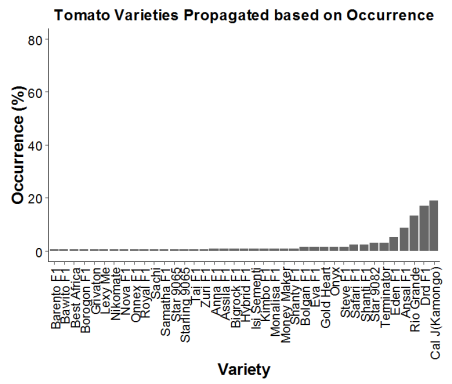
The results show that tomato production in Nakuru County is largely concentrated among a few dominant varieties (Cal J, 20.6%). Cal J (Kamongo) was the most frequently grown tomato variety, cultivated by 20.6% of small-scale farmers in Nakuru County. This was closely followed by DRD F1 (20.0%), while Rio Grande accounted for 15.8% of farmers. Ansal accounted for 10.3% (Figure 2). The close percentages between Cal J (Kamongo) and DRD F1 suggest comparable levels of farmer preference of the two varieties. Farmers mentioned that these tomato varieties were favored by customers due to their sizes and longer shelf life. Some farmers were also embracing hybrid tomato varieties like Ansal F1 and Eden F1 and the two varieties there documented to be high yielders and disease resistant. This study was in agreement with the study by in Mwea West sub-county, where farmers planted a wide range of tomato varieties with different preferred attributes like disease and pest resistance and high yield and that have longer harvesting periods, which leads to increased tomato production.
Figure 2. Tomato Varieties grown by small scale farmers in Nakuru County.
3.3. Diseases That Affect Tomato Crop
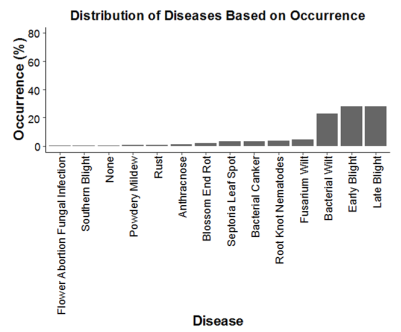
One of the major causes of loss in tomato production was found to be diseases. The most important diseases recorded was late blight (26.8%) and early blight (25.5%) followed by bacterial wilt disease (25.0%). Fusarium wilt (6.3%), root knot nematodes (5.4%) and septoria leaf spot (4.5%) were moderately reported. Bacterial canker (3.9%) and anthracnose (2.7%) were less frequently mentioned, while other diseases accounted for 4.1% of the responses (Figure 3).
Together, early blight (Alternaria solani) and late blight (Phytophthora infestans) are thought to be responsible for (95.8%) of Kenyans pre harvest tomato crop losses . Late blight disease might be related to an abundance of rain that provided a climate favorable for fungus that causes the disease, leading to low yields. Bacterial wilt disease might be linked with scarce rainfall causing prolonged drought, which favors the disease’s development. It was also found that some farmers irrigated their fields with water from rivers infected with Ralstonia solanacearum, introducing the disease to their farms. This soil borne disease can be spread by water, farm tools, infected seed and previously infected crop residue .
Figure 3. Diseases affecting Tomato Production in Nakuru County.
3.4. Management of Bacterial Wilt
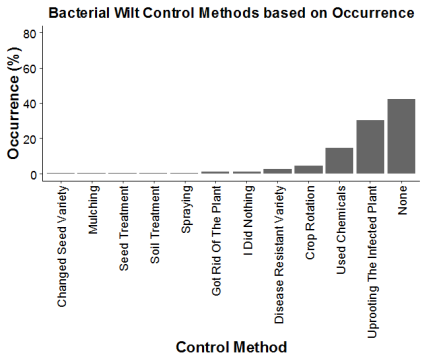
Management of bacterial wilt has remained a challenge, especially among smallholder farmers in Kenya. Most farmers who experienced bacterial wilt just did nothing (52.5%). Uprooted the infected plant (22.9%) to avoid spreading of the disease and it’s also inexpensive. Chemical control measures such as use of pesticides and fungicides accounted for (6.8%). Bacterial wilt is a soil borne disease and has a wide host range, therefore, management of the disease is a challenge leading to widespread and high incidence. Numerous strategies have been documented for the control of bacterial wilt, including crop rotation, the use of resistant types, grafting with disease free wild rootstock, soil fumigation, pesticides etc. . Most farmers in open field and greenhouse just uprooted the infected tomato plants and practiced crop rotation, rotating tomato crop with non solanaceous crops to break tomato disease cycle . The tolerance of various tomato types to the pathogens that cause bacterial wilt varies. Use of the disease resistance varieties reduces the degree and rate of disease occurrence. Since Ralstonia solanacearum is a soil borne pathogen that spreads through seeds, the two main methods for prevention are to plant in healthy soils and utilize disease free planting material . Farmers have continuously used synthetic chemical as other methods alone are often ineffective and chemicals are more economically viable in the short term . However, use of synthetic chemicals is associated with chemical residues on the products, harm on non-target beneficial organism and environmental pollution. Synthetic chemicals are also expensive to a small scale farmers as compared to the other methods because farmers applied them frequently to combat the disease.
Figure 4. Control Methods Used by Nakuru Small Scale Farmers to Control Bacteria Wilt.
4. Conclusion
This study revealed that tomato production among smallholder farmers in Nakuru County is constrained by significant biotic and production system challenges, with open-field farming being more dominant than greenhouse production due to high establishment costs, technical limitations, and frequent greenhouse failures mainly caused by bacterial wilt. Major diseases identified included bacterial wilt, early blight, and late blight, while key insect pests were Tuta absoluta, whiteflies, leaf miners, and spider mites, all of which contributed substantially to yield losses. Farmers largely relied on uprooting infected plants, crop rotation, and synthetic pesticides for disease and pest management, though these approaches were often inadequate when applied independently and raised concerns related to cost, environmental safety, and health risks. Although farmers accessed information from multiple sources, notable knowledge gaps persisted in pest and disease identification and integrated management practices. The findings underscore the need for strengthened extension services, promotion of integrated pest and disease management strategies, adoption of resistant or grafted tomato varieties, and improved soil and water sanitation to enhance sustainable tomato production and reduce losses in Nakuru County.
Acknowledgments
The authors express gratitude to the department of plant science of Chuka University, Ministry of Agriculture and the respondents of Nakuru County for the valuable suggestion throughout the research period.
Author Contributions
Murithi Diana Mwende: Formal Analysis, Methodology, Resources, Writing – original draft, Writing – review & editing
Njogu Martin Kagiki: Conceptualization, Formal Analysis, Methodology, Resources, Supervision, Validation, Writing – original draft, Writing – review & editing
Nderitu Peris Wangari: Data curation, Formal Analysis, Methodology, Resources, Supervision, Validation, Writing – original draft, Writing – review & editing
Funding
The research was self- sponsored and received no funding.
Data Availability Statement
The data is available from the corresponding author upon reasonable request.
Conflicts of Interest
The authors declare no conflicts of interest.
References
[1] Asante, B. O., Osei, M. K., Dankyi, A. A., Berchie, J. N., Mochiah, M. B., Lamptey, J. N. L.,... & Bolfrey-Arku, G. (2013). Producer characteristics and determinants of technical efficiency of tomato based production systems in Ghana.
[2] Aslam, M. N., Mukhtar, T., Hussain, M. A., & Raheel, M. (2017). Assessment of resistance to bacterial wilt incited by Ralstonia solanacearum in tomato germplasm. Journal of Plant Diseases and Protection, 124, 585-590.
[3] Atiya, B. (2006). Comparative advantages of tomato. National Agricultural Policy Center.
[4] Chengo, D. G., Mutitu, E. W., & Muiru, W. M. (2022). Evaluation of Tomato Cultivars for Resistance to Bacterial Wilt caused by Ralstonia Solanacearum. East African Agricultural and Forestry Journal, 86(1-2), 8-8.
[5] Choudhary, D. K., Nabi, S. U., Dar, M. S., & Khan, K. A. (2018). Ralstonia solanacearum: A wide spread and global bacterial plant wilt pathogen. Journal of Pharmacognosy and Phytochemistry, 7(2), 85-90.
[6] FAOSTAT (2013). FAOSTAT, Statistical data base. Rome: Food and Agricultural Organization of the United Nations.
[7] FAOSTAT (2022). FAOSTAT, Statistical data base. Rome: Food and Agricultural Organization of the United Nations.
[8] Geoffrey, S. K., Hillary, N. K., Kibe, M. A., Mariam, M., & Mary, M. C. (2014). Challenges and strategies to improve tomato competitiveness along the tomato value chain in Kenya. International Journal of Business and Management, 9(9), 205.
[9] Islam, M. R., Mondal, C., Hossain, I., & Meah, M. B. (2014). Compost tea as soil drench: an alternative approach to control bacterial wilt in brinjal. Archives of Phytopathology and Plant Protection, 47(12), 1475-1488.
[10] Jallow, M. F., Awadh, D. G., Albaho, M. S., Devi, V. Y., & Ahmad, N. (2017). Monitoring of pesticide residues in commonly used fruits and vegetables in Kuwait. International journal of environmental research and public health, 14(8), 833.
[11] Justus, F., & Yu, D. (2014). Spatial distribution of greenhouse commercial horticulture in Kenya and the role of demographic, infrastructure and topo-edaphic factors. ISPRS International Journal of Geo-Information, 3(1), 274-296.
[12] Kariathi, V., Kassim, N., & Kimanya, M. (2017). Risk of exposures of pesticide residues from tomato in Tanzania.
[13] Makunike, C. (2007). Kenya to test greenhouse tomato production model for small scale farmers Africa News Network. farmers in Kenya (Doctoral dissertation, M. Sc. Thesis, Wageningen University, the Netherlands).
[14] Malook, M. B., Ijaz, M., Ijaz, R., Shang, J., Lv, L., Ahmed, T.,... & Li, B. (2026). Nanotechnology-based strategies for sustainable management of bacterial plant diseases: mechanisms, applications, and future directions. Environmental Science: Nano, 13(2), 723-747.
[15] Mitra, S., & Yunus, M. (2018). Determinants of tomato farmers’ efficiency in Mymensingh district of Bangladesh: Data Envelopment Analysis approach. J Bangladesh Agril Univ, 16(1), 93-97.
[16] Mollah, M. I., Rahman, M., & Alam, Z. (2013). Effect of insecticides on lady bird beetle (Coleoptera: Coccinellidae) in country bean field. Middle-East Journal of Scientific Research, 17(11), 1607-1610.
[17] Munyaneza, J. E., & Bizimungu, B. (2022). Management of potato pests and diseases in Africa. Insect Pests of Potato, 407-426.
[18] Muthomi, J. W., Lengai, G. M. W., Fulano, A. M., Wagacha, J. M., Narla, R. D., & Mwang'ombe, A. W. (2016). Biopesticide-based IPM systems to reduce synthetic pesticide residues in vegetables for niche market access by small holder growers.
[19] Mwangi, M. W., Kimenju, J. W., Narla, R. D., Kariuki, G. M., & Muiru, W. M. (2015). Tomato management practices and diseases occurrence in Mwea West Sub County. Journal of Natural Sciences Research, 5(20), 119-124.
[20] Nashwa, S. M., & Abo-ElyouSr, K. A. (2012). Evaluation of various plant extracts against the early blight disease of tomato plants under greenhouse and field conditions. Plant Protection Science, 48(2), 74-79.
[21] Ndirangu, S. N., Mbogoh, S. G., & Mbatia, O. L. E. (2018). Evaluation of the Elasticity of Farm Output among Smallholder Farmers in Selected Agro-Ecological Zones of Embu County, Kenya.
[22] Nion, Y. A., & Toyota, K. (2015). Recent trends in control methods for bacterial wilt diseases caused by Ralstonia solanacearum. Microbes and environments, 30(1), 1-11.
[23] Nordey, T., Basset-Mens, C., De Bon, H., Martin, T., Déletré, E., Simon, S.,... & Malézieux, E. (2017). Protected cultivation of vegetable crops in sub-Saharan Africa: limits and prospects for smallholders. A review: Protected cultivation of vegetable crops in sub-Saharan Africa: limits and 3 prospects for smallholders. A review. Agronomy for sustainable development, 37(6), 53.
[24] Nyamwamu, R. O. (2016). Implications of human-wildlife conflict on food security among small holder agropastoralists: a case of smallholder maize (Zea mays) farmers in Laikipia County, Kenya. World Journal of Agricultural Research, 4(2), 43-48.
[25] Ochilo, W. N., Nyamasyo, G. N., Kilalo, D., Otieno, W., Otipa, M., Chege, F.,... & Lingeera, E. K. (2019). Characteristics and production constraints of smallholder tomato production in Kenya. Scientific African, 2, e00014.
[26] Omoro, P., Shitandi, A. A., Maobe, S. N., & Ogata, R. B. (2014). Evaluation of small scale farmers’ educational level, experience, age and effects on performance of greenhouse technology production of high value horticultural crops in Gusii Highlands, Kenya. Advances in Research, 2(12), 766-781.
[27] Sanzua, L. J., Saha, H. M., & Mwafaida, J. (2018). Status of greenhouse farming in the coastal humid climatic region of Kenya. Universal journal of agricultural research, 6(5), 165-172.
[28] Tunca, H., Kilinçer, N., & Özkan, C. (2014). Toxicity and repellent effects of some botanical insecticides on the egg-larval parasitoid Chelonus oculator Panzer (Hymenoptera: Braconidae). Scientific Research and Essays, 9(5), 106-113.
[29] Van der Spijk, C. A. (2018). Greenhouse technology adoption among small and medium-scale tomato.
[30] Wachira, J. M. (2012). Comparative analysis of greenhouse versus open-field small-scale tomato production in Nakuru-North district, Kenya (Doctoral dissertation, Egerton University).
[31] Wachira, J. M., Mshenga, P. M., & Saidi, M. (2014). Comparison of the profitability of small-scale greenhouse and open-field tomato production systems in Nakuru-North District, Kenya. Asian Journal of Agricultural Sciences, 6(2), 54-61.
[32] Waiganjo, M. M., Wabule, N. M., Nyongesa, D., Kibaki, J. M., Onyango, I., Wepukhulu, S. B., & Muthoka, N. M. (2006). Tomato production in Kirinyaga district, Kenya, a baseline survey report. Kenya Agricultural Research Institute, Nairobi, Kenya, 1-43.
[33] Wanjiku, G. G. (2015). Post-harvest Fungi Diversity and Level of Aflatoxin Contamination in Stored Maize: Cases of Kitui. Nakuru and Transnzoia Counties in Kenya (Doctoral dissertation, Kenyatta University).
[34] Yabs, J. K., & Awuor, E. O. (2016). Market orientation and performance of fruit exporting firms in Kenya: A theoretical perspective. European Journal of Business and Management, 8(9), 23-33.
Cite This Article
  • APA Style

    Mwende, M. D., Kagiki, N. M., Wangari, N. P. (2026). A Survey of Constraints to Greenhouse and Open-field Tomato Production Among Smallholder Farmers in Nakuru County, Kenya. Agriculture, Forestry and Fisheries, 15(2), 86-93. https://doi.org/10.11648/j.aff.20261502.14

    Copy | Download

    ACS Style

    Mwende, M. D.; Kagiki, N. M.; Wangari, N. P. A Survey of Constraints to Greenhouse and Open-field Tomato Production Among Smallholder Farmers in Nakuru County, Kenya. Agric. For. Fish. 2026, 15(2), 86-93. doi: 10.11648/j.aff.20261502.14

    Copy | Download

    AMA Style

    Mwende MD, Kagiki NM, Wangari NP. A Survey of Constraints to Greenhouse and Open-field Tomato Production Among Smallholder Farmers in Nakuru County, Kenya. Agric For Fish. 2026;15(2):86-93. doi: 10.11648/j.aff.20261502.14

    Copy | Download

  • @article{10.11648/j.aff.20261502.14,
      author = {Murithi Diana Mwende and Njogu Martin Kagiki and Nderitu Peris Wangari},
      title = {A Survey of Constraints to Greenhouse and Open-field Tomato Production Among Smallholder Farmers in Nakuru County, Kenya},
      journal = {Agriculture, Forestry and Fisheries},
      volume = {15},
      number = {2},
      pages = {86-93},
      doi = {10.11648/j.aff.20261502.14},
      url = {https://doi.org/10.11648/j.aff.20261502.14},
      eprint = {https://article.sciencepublishinggroup.com/pdf/10.11648.j.aff.20261502.14},
      abstract = {The tomato is an important crop in Nakuru County, Kenya. However, its production has been declining, causing massive losses to the farmers. A survey was conducted in major tomato-growing regions to investigate the causes of losses. Tomato production was constrained by diseases such as late blight, early blight and bacterial wilt. Data was collected from one hundred and seventy-one farmers who were randomly selected within the regions and interviewed using a structured questionnaire. Data collected included production systems, varieties of tomatoes grown and diseases that hinder production, and control methods. Data was analyzed using R software version 4.4.1. Data was tabulated to calculate frequencies and their percentages from the counts of each response. One-way ANOVA was used to test for overall significance among the groupings. The result indicated that the majority of the farmers (96.4%) were using an open field production system compared to a greenhouse system (3.6%). The most grown varieties were Cal J (Kamongo) (20.6%), DRD F1 (20.0%), and Rio Grande (15.8%). The most important diseases affecting the tomato crops were late blight (Phytophthora infestans) (26.8%), early blight (Alternaria solani) (25.5%), and bacterial wilt (Ralstonia solanacearum) (25.0%). Farmers had access to information from sources, making them knowledgeable of farming, though there are still major gaps in knowledge of insect pests, diseases, and control methods.},
     year = {2026}
    }
    

    Copy | Download

  • TY  - JOUR
    T1  - A Survey of Constraints to Greenhouse and Open-field Tomato Production Among Smallholder Farmers in Nakuru County, Kenya
    AU  - Murithi Diana Mwende
    AU  - Njogu Martin Kagiki
    AU  - Nderitu Peris Wangari
    Y1  - 2026/04/16
    PY  - 2026
    N1  - https://doi.org/10.11648/j.aff.20261502.14
    DO  - 10.11648/j.aff.20261502.14
    T2  - Agriculture, Forestry and Fisheries
    JF  - Agriculture, Forestry and Fisheries
    JO  - Agriculture, Forestry and Fisheries
    SP  - 86
    EP  - 93
    PB  - Science Publishing Group
    SN  - 2328-5648
    UR  - https://doi.org/10.11648/j.aff.20261502.14
    AB  - The tomato is an important crop in Nakuru County, Kenya. However, its production has been declining, causing massive losses to the farmers. A survey was conducted in major tomato-growing regions to investigate the causes of losses. Tomato production was constrained by diseases such as late blight, early blight and bacterial wilt. Data was collected from one hundred and seventy-one farmers who were randomly selected within the regions and interviewed using a structured questionnaire. Data collected included production systems, varieties of tomatoes grown and diseases that hinder production, and control methods. Data was analyzed using R software version 4.4.1. Data was tabulated to calculate frequencies and their percentages from the counts of each response. One-way ANOVA was used to test for overall significance among the groupings. The result indicated that the majority of the farmers (96.4%) were using an open field production system compared to a greenhouse system (3.6%). The most grown varieties were Cal J (Kamongo) (20.6%), DRD F1 (20.0%), and Rio Grande (15.8%). The most important diseases affecting the tomato crops were late blight (Phytophthora infestans) (26.8%), early blight (Alternaria solani) (25.5%), and bacterial wilt (Ralstonia solanacearum) (25.0%). Farmers had access to information from sources, making them knowledgeable of farming, though there are still major gaps in knowledge of insect pests, diseases, and control methods.
    VL  - 15
    IS  - 2
    ER  - 

    Copy | Download

Author Information
  • Department of Plant Sciences, Chuka University, Chuka, Kenya

    Biography: Murithi Diana Mwende is currently pursuing a Master of Science (MSc) degree in Crop Protection at Chuka University, Kenya. She obtained her Bachelor’s degree in Agriculture from Meru University of Science and Technology. Her academic interests focus on crop protection, sustainable agriculture, and integrated pest and disease management. She has participated in various academic and field-based agricultural activities aimed at improving crop productivity and promoting environmentally friendly pest control strategies. Her current research work focuses on crop health management and sustainable approaches to controlling pests and diseases affecting agricultural production. Diana is passionate about advancing agricultural research and contributing to food security through innovative crop protection practices.

    Research Fields: Agricultural Sciences specialist in Crop Protection

  • Department of Plant Sciences, Chuka University, Chuka, Kenya

    Biography: Njogu Martin Kagiki is a Lecturer at Chuka University, Plant Sciences Department. He completed his PHD in Horticulture From Nanjing Agricultural University in China and his Master of Science in Horticulture from University of Nairobi. His field of specialization is General Agriculture and Horticultural Breeding on Varietal Selection in Relation to Climate Smart Agriculture. He is a self-starter results oriented Agricultural Expert with strong focus on sustainable crop productionsysytems including developments of germplasm and environment management to improve food and nutrition security in line with climate smart agriculture. He is devoted to support an organization that provides challenges, upholds advancement and operates towards achievenments. Interested in initiating partnerships in research, training and dissemination in areas of agriculture, environment and in line with Vision 2030.

    Research Fields: Agricultural Sciences specialist in Horticulture

  • Department of Plant Sciences, Chuka University, Chuka, Kenya

    Biography: Nderitu Peris Wangari is a Crop Protection Researcher. She completed her PhD in Crop Protection from University of Embu in 2020, she holds a Masters in Crop Protection from Moi University which she completed in 2011. She has contributed to climate smart pest management in dryland areas on sustainable sorghum pest management, bacterial wilt control, Tomato leaf miner control and the deployment of climate-smart agriculture technologies for improved resilience and productivity. Dr. Nderitu has successfully attracted and implemented competitive, multi-partner research projects as a Co-Principal Investigator. Dr. Nderitu is the current program Leader of Crop Protection at Chuka University

    Research Fields: Agricultural Sciences Specialist in Crop Protection