
Smallholders crop production systems in Africa are constrained by a variety of factors: among them nutrient deficiency and low soil organic matter status. Groundnut (Arachis hypogea L) production in these areas is usually practiced with no artificial fertilisers or cattle manure as fertilizers are preferably used for staple crops production like maize. Organic composts from municipal landfills provide an alternative source of organic amendment for peri-urban groundnut production. Greenhouse and field studies were conducted during the 2010-11 season to determine whether municipal phosphocomposts can increase groundnut productivity as measured by dry matter, P uptake and yield. The field studies were carried out at two sites, namely Africa University farm and Nyamazura, both in Manicaland province of Zimbabwe. The studies were carried out during the 2010/2011 seasons. Municipal phosphocomposts used in the experiment were made from sewage sludge (SL), vegetable vending waste (VW) and wood processing waste (WW) collected from various sites in the city of Mutare. The wastes were composted with Zimbabwe (Dorowa) phosphate rock (DPR) and sulphur for a period of 56 days before being used for the experiments. Application of the three-municipal organic phosphocomposts produced comparable dry matter with inorganic fertilisers (SSP). Addition of sewage sludge/DPR composts improved dry matter of groundnuts. Leaf P and residual P2O5 were significantly (P<0.05) higher with organic amendments than with other soil ameliorants, except for SSP. The amount of residual phosphorous from sewage sludge compost amended plots was enough to support a succeeding crop of maize (>30 ppm resin extractable). Municipal composts significantly (P<0.001) improved groundnut pod yield compared to control and sole DPR. The study showed that the use of municipal phosphocompost is beneficial in improving groundnut nutrition and productivity. They can therefore be used for groundnut production in areas where soil nutrient sources are scarce and have potential for building phosphorous stocks. Apart from increasing current crop growth, the composts can also help build soil organic matter.
| Published in | Agriculture, Forestry and Fisheries (Volume 15, Issue 2) |
| DOI | 10.11648/j.aff.20261502.11 |
| Page(s) | 53-60 |
| Creative Commons |
This is an Open Access article, distributed under the terms of the Creative Commons Attribution 4.0 International License (http://creativecommons.org/licenses/by/4.0/), which permits unrestricted use, distribution and reproduction in any medium or format, provided the original work is properly cited. |
| Copyright |
Copyright © The Author(s), 2026. Published by Science Publishing Group |
Groundnuts, Municipal Phosphocomposts, DPR, Yield and Residual Phosphorous
Compost type | pH 0.01 M CaCl2 | Total N % | Total P ppm | Mehlich extractable P2O5 of uncomposted wastes | Mehlich extractable P2O5 of the beneficiated composts | ||
|---|---|---|---|---|---|---|---|
0 kg DPR | 50 kg P2O5 (DPR) | 100 kg P2O5 (DPR) | |||||
ppm | |||||||
Sludge | 4.88 | 1.8 | 1068 | 77 | 270 | 313.3 | 303.3 |
Vending Waste | 5.91 | 0.5 | 780 | 53 | 283.3 | 303.3 | 233.3 |
Wood P Waste | 4.85 | 0.7 | 130 | 21.5 | 60 | 70 | 83 |
Treatment | Composition |
|---|---|
VW | Vegetablevendingwaste |
WW | Wood waste |
SL | Sewagesludge |
CVW-L1 | 4t VW /ha containing 50kg P2O5 (DPR) +20kg S compost |
CWW-L1 | 4t WW /ha containing 50kg P2O5 (DPR) +20kg S compost. |
CSL-L1 | 4t SL /ha containing 50kg P2O5 (DPR) +20kg S compost. |
CVW-L2 | 4t VW /ha containing 100kg P2O5 (DPR) +20kg S compost. |
CWW-L2 | 4t WW /ha containing 100kg P2O5 (DPR) +20kg S compost. |
CSL-L2 | 4t SL /ha containing 100kg P2O5 (DPR) +20kg S compost. |
DPR-L1 | 50 kg P2O5 (DPR) (ground) |
DPR-L2 | 100kg P2O5 (DPR) (ground) |
SSP-50 | SSP at 50kg P2O5/ha. |
SSP-100 | SSP at 100kg P2O5/ha. |
Farmer Practice/ | No soil ameliorant applied |
(Control) |
Soil Type | Texture | pH 0.01M CaCl2 | Mineral N (ppm) | Available P (ppm) | Ca | Mg | Zn | Cu |
|---|---|---|---|---|---|---|---|---|
meq (%) | ||||||||
Marange soil | Sandy loam | 4.92 | 23 | 15 | 0.14 | 0.11 | 0.218 | Trace |
Soil Type | Texture | pH 0.01M CaCl2 | Mineral N (ppm) | Available P (ppm) | Ca | Mg | Zn | Cu |
|---|---|---|---|---|---|---|---|---|
meq (%) | ||||||||
AU soil | Sandy clay | 4.96 | 57 | 52 | 8.83 | 2.42 | 0.372 | Trace |
Nyamazura soil | Sandy loam | 5.82 | 24 | 25 | 0.18 | 0.13 | 0.14 | Trace |
Treatments | Groundnut Dry Matter | ||
|---|---|---|---|
GH (42 days) | AU (56 days) | NY (56 days) | |
SL | 2.66 | 6.37 | 5.39 |
SL50 | 3 | 6.38 | 5.48 |
SL100 | 3.45 | 7.42 | 5.57 |
WW | 2.44 | 6.53 | 4.61 |
WW50 | 2.84 | 6.82 | 4.53 |
WW100 | 2.8 | 6.28 | 4.95 |
VW | 2.8 | 6.56 | 4.41 |
VW50 | 2.55 | 6.13 | 4.31 |
VW100 | 3 | 6.52 | 6.58 |
SSP50 | 3.1 | 4.45 | 5.07 |
SSP100 | 2.47 | 8.44 | 4.9 |
DPR50 | 2.53 | 5.54 | 5.25 |
DPR100 | 2.94 | 5.01 | 5.41 |
Control (Farmer Practice) | 2.21 | 5.46 | 4.32 |
CV% | 20.1 | 14.9 | 14.1 |
LSD0.05 | 0.8943 | 1.309 | 1.18 |
Mean | 2.73 | 5.91 | 5.01 |
P-value | >0.05 | <0.05 | <0.05 |
DPR | Dorowa Phosphate Rock |
SSP | Single Super Phosphate |
SL | Sewage Sludge |
VW | Vegetable Vending Waste |
WW | Wood Waste |
| [1] | R. G. Chikowo. Soil fertility management for improved groundnut (Arachishypogaea. L), production in the smallholder sector in Zimbabwe. A Thesis submitted in fulfilment of the Degree of Master of Philosophy. University of Zimbabwe. Mount Pleasant. Harare. 1998. pp 83. |
| [2] | S. R. Waddington, D. W. Sakala and Mekuria M. Progress in lifting soil fertility in Southern Africa. CIMMYT African Livelihoods Program (Zimbabwe) and Maize Commodity Research Team, DARS (Malawi). 1998. |
| [3] | P. M. Grant. The fertilisation of sandy soils in peasant agriculture. Zimbabwe Agricultural Journal 78: 1981, 169-175. |
| [4] | M. L. Kay. The Termite Strategy: Transforning rural Africa from within. Southern Africa Regional Poverty Network Document. 2006. Pp 17-28. |
| [5] | F. Pinamonti, L. Sicher. Compost utilization in fruit production systems. In: Compost utilization in horticultural cropping systems (editor(s) Stoffella, P. J.; Kahn, B. A.). Boca Raton, FLA: Lewis: 2001 177-195. |
| [6] | L. M. Mugwira, H. K. Murwira. A review of research on cattle manure as a soil fertility amandment in Zimbabwe: Some perspectives. In Waddington, S. R., Murwira, H. K., Kumwenda, J. D. T., Hikwa, D. and Tagwira, F. (eds). Soil fertility research for maize-based farming systems in Malawi and Zimbabwe. Proceedings of a Soil Fert Net Results and Planning Workshop held from 7-11 July 1997 at Africa University, Mutare, Zimbabwe. Soil Fert Net and CIMMYT-Zimbabwe, Harare, Zimbabwe. 1998, pp 312. |
| [7] | D. Dhliwayo. Evaluation of the agronomic potential and effectiveness of Zimbabwe (Dorowa) phosphate rock-based phosphate fertiliser materials. PhD Thesis. University of Zimbabwe, 1999 pp 248. |
| [8] | F. Tagwira, Soil Fertility: The challenges to increased food production in sub-saharan Africa. Paper presented at Africa University. Facalty of Agriculture and Natural resources. Mutare. Zimbabwe. 2002. |
| [9] | V. S. Peter,. Earth Sciences. Farming with rocks and minerals: challenges and opportunities. Anais Academica Brasileira Scenz. 2005. Vol 78(4). |
| [10] | S. S Rajan, Ways of improving the agronomic effectiveness of phosphate rocks. Fertiliser and Plant Nutrition Bulletin 13. Use of phosphate rocks for sustainable agriculture, FAO. Rome, 2004. |
| [11] | K. Nyamapfene, The soils of Zimbabwe. Nehanda Publishers. Harare. Zimbabwe. 1991. Pp 28-65. |
| [12] | P. J. Brinn, Communal land physical resource inventory: Mutare District. Chemistry and Soil Research Institute. Soils Report No A546. 1987. pp 14-30. |
| [13] | A. Mehlich, Mehlich 3 soil test extractants: A modification of Mehlich 2 extractant. Communication in Soil Science and Plant Analysis 15: 1984. 1409-1416. |
| [14] | J. J. Hanway, R. A. Olson, Phosphate nutrition of corn, sorghum, soyabeans and small grains. In: Khasawneh F. E., E. C. Sample and Kamprath, E. J. 1980. The role of phosphorous in agriculture: Proceedings of a symposium held on 1 June 1976 at the National Fertiliser Centre, Tennessee Valley Authority- Muscle Shoals, Alabama. 1980. pp 681-690. |
| [15] | F. Tagwira, T. Oloya, Management and fertilisation of upland soils in Zimbabwe. Proc of Int. Conference on management of upland soils in the tropics and subtropics. Nanjing. People’s Republic of China. 1986. |
| [16] | E. L. Sommers, A. L. Sutton, Use of waste material as source of phosphorous. In: Khasawneh F. E., E. C. Sample and E. J. Kamprath. 1980. The role of phosphorous in agriculture: Proceedings of a symposium held on 1 June 1976 at the National Fertiliser Centre, Tennessee Valley Authority- Muscle Shoals, Alabama. 1980. Pp 515-538. |
| [17] | W. Gwenzi, M. Muzava, F. Mapanda, T. P. Tauro, Comparative short-term effects of sewage sludge and its biochar on soil properties, maize growth and uptake of nutrients on a tropical clay soil in Zimbabwe, Journal of Integrative Agriculture, Volume 15, Issue 6, 2016, Pages 1395-1406. |
| [18] | Cicek H, Bhullar GS, Mandloi LS, Andres C, Riar AS. Partial Acidulation of Rock Phosphate for Increased Productivity in Organic and Smallholder Farming. Sustainability. 2020; 12(2): 607. |
APA Style
Muziri, T., Pahla, I., Tagwira, F. (2026). Effects of Municipal Phosphocomposts on Groundnut Growth, Yield and Residual Soil Phosphorous. Agriculture, Forestry and Fisheries, 15(2), 53-60. https://doi.org/10.11648/j.aff.20261502.11
ACS Style
Muziri, T.; Pahla, I.; Tagwira, F. Effects of Municipal Phosphocomposts on Groundnut Growth, Yield and Residual Soil Phosphorous. Agric. For. Fish. 2026, 15(2), 53-60. doi: 10.11648/j.aff.20261502.11
@article{10.11648/j.aff.20261502.11,
  author = {Tavagwisa Muziri and Innocent Pahla and Fanuel Tagwira},
  title = {Effects of Municipal Phosphocomposts on Groundnut Growth, Yield and Residual Soil Phosphorous},
  journal = {Agriculture, Forestry and Fisheries},
  volume = {15},
  number = {2},
  pages = {53-60},
  doi = {10.11648/j.aff.20261502.11},
  url = {https://doi.org/10.11648/j.aff.20261502.11},
  eprint = {https://article.sciencepublishinggroup.com/pdf/10.11648.j.aff.20261502.11},
  abstract = {Smallholders crop production systems in Africa are constrained by a variety of factors: among them nutrient deficiency and low soil organic matter status. Groundnut (Arachis hypogea L) production in these areas is usually practiced with no artificial fertilisers or cattle manure as fertilizers are preferably used for staple crops production like maize. Organic composts from municipal landfills provide an alternative source of organic amendment for peri-urban groundnut production. Greenhouse and field studies were conducted during the 2010-11 season to determine whether municipal phosphocomposts can increase groundnut productivity as measured by dry matter, P uptake and yield. The field studies were carried out at two sites, namely Africa University farm and Nyamazura, both in Manicaland province of Zimbabwe. The studies were carried out during the 2010/2011 seasons. Municipal phosphocomposts used in the experiment were made from sewage sludge (SL), vegetable vending waste (VW) and wood processing waste (WW) collected from various sites in the city of Mutare. The wastes were composted with Zimbabwe (Dorowa) phosphate rock (DPR) and sulphur for a period of 56 days before being used for the experiments. Application of the three-municipal organic phosphocomposts produced comparable dry matter with inorganic fertilisers (SSP). Addition of sewage sludge/DPR composts improved dry matter of groundnuts. Leaf P and residual P2O5 were significantly (P30 ppm resin extractable). Municipal composts significantly (P<0.001) improved groundnut pod yield compared to control and sole DPR. The study showed that the use of municipal phosphocompost is beneficial in improving groundnut nutrition and productivity. They can therefore be used for groundnut production in areas where soil nutrient sources are scarce and have potential for building phosphorous stocks. Apart from increasing current crop growth, the composts can also help build soil organic matter.},
 year = {2026}
}
TY  - JOUR
T1  - Effects of Municipal Phosphocomposts on Groundnut Growth, Yield and Residual Soil Phosphorous
AU  - Tavagwisa Muziri
AU  - Innocent Pahla
AU  - Fanuel Tagwira
Y1  - 2026/03/04
PY  - 2026
N1  - https://doi.org/10.11648/j.aff.20261502.11
DO  - 10.11648/j.aff.20261502.11
T2  - Agriculture, Forestry and Fisheries
JF  - Agriculture, Forestry and Fisheries
JO  - Agriculture, Forestry and Fisheries
SP  - 53
EP  - 60
PB  - Science Publishing Group
SN  - 2328-5648
UR  - https://doi.org/10.11648/j.aff.20261502.11
AB  - Smallholders crop production systems in Africa are constrained by a variety of factors: among them nutrient deficiency and low soil organic matter status. Groundnut (Arachis hypogea L) production in these areas is usually practiced with no artificial fertilisers or cattle manure as fertilizers are preferably used for staple crops production like maize. Organic composts from municipal landfills provide an alternative source of organic amendment for peri-urban groundnut production. Greenhouse and field studies were conducted during the 2010-11 season to determine whether municipal phosphocomposts can increase groundnut productivity as measured by dry matter, P uptake and yield. The field studies were carried out at two sites, namely Africa University farm and Nyamazura, both in Manicaland province of Zimbabwe. The studies were carried out during the 2010/2011 seasons. Municipal phosphocomposts used in the experiment were made from sewage sludge (SL), vegetable vending waste (VW) and wood processing waste (WW) collected from various sites in the city of Mutare. The wastes were composted with Zimbabwe (Dorowa) phosphate rock (DPR) and sulphur for a period of 56 days before being used for the experiments. Application of the three-municipal organic phosphocomposts produced comparable dry matter with inorganic fertilisers (SSP). Addition of sewage sludge/DPR composts improved dry matter of groundnuts. Leaf P and residual P2O5 were significantly (P30 ppm resin extractable). Municipal composts significantly (P<0.001) improved groundnut pod yield compared to control and sole DPR. The study showed that the use of municipal phosphocompost is beneficial in improving groundnut nutrition and productivity. They can therefore be used for groundnut production in areas where soil nutrient sources are scarce and have potential for building phosphorous stocks. Apart from increasing current crop growth, the composts can also help build soil organic matter.
VL  - 15
IS  - 2
ER  -
Department of Horticulture and Agronomy, Midlands State University, Gweru, Zimbabwe;Department of Horticulture and Sustainable Agriculture, Women’s University in Africa, Marondera, Zimbabwe
Department of Horticulture and Agronomy, Midlands State University, Gweru, Zimbabwe
Faculty of Natural Resources and Agriculture, Africa University, Mutare, Zimbabwe
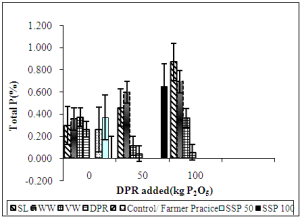
Figure 1. Groundnut leaf P content as affected by different municipal phosphocomposts, sole DPR, SSP, farmer practice/control (%) from greenhouse experiment.
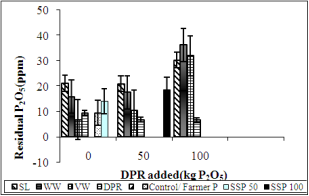
Figure 2. Residual soil phosphorous after planting groundnuts under different municipal phosphocomposts, sole DPR, SSP, farmer practice/control.
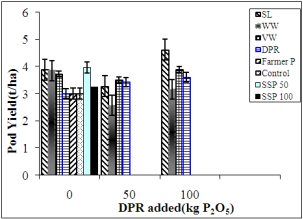
Figure 3. Groundnut pod yield as affected by municipal organic waste phosphocomposts, SSP and sole DPR on at Africa University site in Zimbabwe.

Information



 Share This Article
 Twitter
 Linked In
 Facebook
 Copy
Copy Download