
 ,
Combo Agnan Marie-Michel,
Ya Kouamé Claude,
N’goran Amani Anicet,
Karou Damintoti Simplice,
Beugré Avit Maxwel,
Konaté Ibrahim,
Kouassi Kouassi Clément
,
Combo Agnan Marie-Michel,
Ya Kouamé Claude,
N’goran Amani Anicet,
Karou Damintoti Simplice,
Beugré Avit Maxwel,
Konaté Ibrahim,
Kouassi Kouassi Clément
Infant malnutrition remains a major public health concern in many developing countries, particularly in sub-Saharan Africa, where cereal-based artisanal infant flours constitute one of the main complementary foods. In this context, improving the nutritional quality and safety of these flours through traditional processes such as fermentation represents an important challenge. This study aimed to evaluate the physicochemical and biochemical characteristics of infant flours produced from local cereals (maize, millet and rice) fermented for different durations (0 h, 12 h and 24 h). An inventory of cereals sold in markets in the city of Daloa was first conducted to justify the choice of raw materials. The flours obtained were then subjected to physicochemical (pH, moisture content, dry matter, ash and fiber), biochemical and microbiological analyses using standard methods. Statistical analyses were performed to determine significant differences among fermentation times. The results showed a significant decrease in pH during fermentation for all flours, from 6.49 to 5.23 for maize, from 6.28 to 4.69 for millet and from 6.28 to 4.75 for rice. Conversely, moisture content increased with fermentation time, reaching maximum values of 22.62% for maize, 20.33% for millet and 16.22% for rice, while dry matter decreased to 77.37%, 79.67% and 83.78%, respectively. Ash content slightly decreased but remained within Codex Alimentarius standards (≥ 3%). In contrast, fiber content markedly decreased, particularly in maize flours (from 3.88% to 1.48%). Microbiological analyses revealed a progressive increase in lactic acid bacteria with fermentation time, confirming effective fermentation. In conclusion, fermentation significantly alters the physicochemical and biochemical properties of cereal-based infant flours; therefore, nutritional enrichment or complementation is necessary to meet infant nutritional requirements, while the marked increase in moisture content highlights the need for post-fermentation drying to ensure product stability and adequate shelf life.
| Published in | Advances in Biochemistry (Volume 14, Issue 1) |
| DOI | 10.11648/j.ab.20261401.12 |
| Page(s) | 9-20 |
| Creative Commons |
This is an Open Access article, distributed under the terms of the Creative Commons Attribution 4.0 International License (http://creativecommons.org/licenses/by/4.0/), which permits unrestricted use, distribution and reproduction in any medium or format, provided the original work is properly cited. |
| Copyright |
Copyright © The Author(s), 2026. Published by Science Publishing Group |
Fermentation, Infant Flours, Local Cereals, Physico-chemical Properties, Nutritional Quality
Cereals | Number of mothers | Percentage (%) |
|---|---|---|
Maize | 110 | 44,71 |
Millet | 64 | 26,02 |
Rice | 38 | 15,45 |
Sorghum | 25 | 10,16 |
Fonio | 9 | 3,66 |
Total | 246 | 100 |
Cereals | Fermentation time | AMG (UFC/g) | YM (UFC/g) | LAB (UFC/g) |
|---|---|---|---|---|
Maize | T0 (0h) | 3,11.103a | 8,98.101a | 3,05.102a |
T1 (12h) | 1,36.104b | 3,41.102b | 1,67.103b | |
T2 (24h) | 6,5.104a | 3,3.101a | 4,5.104a | |
Millet | T0 (0h) | 5,13.103d | 8,25.102d | 7,76.101d |
T1 (12h) | 7,41.103d | 8,98.102d | 3,38.102d | |
T2 (24h) | 8,48.103a | 8,7.101a | 7,96.103a | |
Rice | T0 (0h) | 6,5.102b | 2,9.102b | 6,9.101b |
T1 (12h) | 3,76.103c | 5,23.102c | 3,77.102c | |
T2 (24h) | 5,01.103a | 7.101a | 4,68.103a |
Flours | Fermentation time (h) | Lipid (%) | Protein (%) | Glucid (%) | EV (Kcal/100g) |
|---|---|---|---|---|---|
Maize | T0 (0h) | 6,75h±0,02 | 8,65h±0,03 | 80,32h±0,04 | 416,65h±0,28 |
T1 (12h) | 2,74f±0,21 | 6,43f±0,09 | 86,58f±0,24 | 396,74f±1,28 | |
T2 (24h) | 1,67f±0,04 | 6,28f±0,05 | 87,89f±0,00 | 391,71f±0,15 | |
Millet | T0 (0h) | 3,46e±0,01 | 5,85e±0,06 | 86,91e±0,12 | 402,26e±0,16 |
T1 (12h) | 3,52d±0,09 | 5,15d±0,00 | 87,84d±0,08 | 401,86d±0,23 | |
T2 (24h) | 2,80c±0,01 | 4,93c±0,1 | 88,98c±0,15 | 400,84c±0,55 | |
Rice | T0 (0h) | 0,19g±0,02 | 6,78g±0,04 | 87,73g±0,01 | 380,79g±0,08 |
T1 (12h) | 0,32b±0,01 | 4,63b±0,04 | 89,80b±0,07 | 380,66b±0,02 | |
T2 (24h) | 0,29a±0,02 | 4,32a±0,02 | 90,16a±0,02 | 379,59a±0,21 | |
Codex Alimentarius 2010 | ≥ 7 | ≥ 15 | ≥ 68 | ≥ 400 |
Flours | Fermentation time (h) | Calcium (mg/100g) | Iron (mg/100g) | Magnesium (mg/100g) |
|---|---|---|---|---|
Maize | T0 | 28,98i±0,78 | 65,89i±3,15 | 100,54i±0,48 |
T1 | 45,60g±1,16 | 53,54g±2,83 | 50,76g±0,19 | |
T2 | 24,67h±1,14 | 70,86h±1,26 | 53,95h±0,19 | |
Millet | T0 | 44,53f±0,32 | 53,94f±1,39 | 45,46f±0,32 |
T1 | 34,49e±1,12 | 49,53e±0,69 | 31,09e±0,31 | |
T2 | 24,54d±1,23 | 54,73d±5,84 | 22,39d±0,04 | |
Rice | T0 | 18,16b±0,98 | 52,79b±3,85 | 15,17b±0,08 |
T1 | 16,23a±0,51 | 51,44a±2,83 | 7,81a±0,01 | |
T2 | 92,15c±2,24 | 55,32c±4,45 | 16,66c±0,02 | |
CODEX Alimentarius 2010 | ≥ 500 | ≥ 16 | ≥ 19 |
Flours | Fermentation time (h) | pH | Moisture (%) | Dry Matter (%) | Ashes (%) | Fibres (%) |
|---|---|---|---|---|---|---|
Maize | T0 | 6,49±0,12a | 10,95±0,35a | 89,05±0,35a | 4,27±0,03a | 3,88±0,01a |
T1 | 5,82±0,01b | 20,52±0,62b | 79,44±0,62a | 4,24±0,05a | 2,11±0,16b | |
T2 | 5,23±0,01b | 22,62±0,38c | 77,37±0,38c | 4,16±0,01b | 1,48±0,24c | |
Millet | T0 | 6,28±0,04a | 10,46±0,08a | 89,54±0,08a | 3,77±0,04a | 3,16±0,24a |
T1 | 5,49±0,06b | 18,05±0,07b | 81,94±0,07b | 3,49±0,01b | 2,30±0,03b | |
T2 | 4,69±0,02c | 20,33±0,04c | 79,67±0,04c | 3,42±0,03b | 2,23±0,07c | |
Rice | T0 | 6,28±0,07a | 9,48±0,02a | 90,51±0,02a | 5,29±0,01a | 0,46±0,11a |
T1 | 5,78±0,04b | 15,07±0,04b | 84,93±0,04b | 5,24±0,01a | 0,44±0,07a | |
T2 | 4,75±0,07c | 16,22±0,03c | 83,78±0,03c | 5,22±0,02a | 0,34±0,03b | |
Codex Alimentarius | 2010 | _ | ≤ 5 | ≥95 | ≥3 | ≥ 5 |
AMG | Aerobic Mesophilic Germs |
ANOVA | Analysis of Variance |
AAS | Atomic Absorption Spectrophotometry |
CFU | Colony Forming Units |
DM | Dry Matter |
EV | Energy Value |
LAB | Lactic Acid Bacteria |
MCPC | Maternal and Child Protection Center |
RHC | Regional Hospital Center |
YM | Yeasts and Molds |
ISO | International Organization for Standardization |
AOAC | Association of Official Analytical Chemists |
AOCS | American Oil Chemists’ Society |
| [1] | FAO. (2010). The State of Food Insecurity in the World: Addressing Food Insecurity in Protracted Crisis. Rome (Italy), 32 p. |
| [2] | Asirvatham, R.., Demi, S. M., Ezezika, O. Are sub-Saharan African national food and agriculture policies nutrition-sensitive? A case study of Ethiopia, Ghana, Malawi, Nigeria, and South Africa. Agric & Food Secur, 2022, 11, 60. |
| [3] | Rice, A. L., Sacco, L., Hyder, A., Black, R. E. Malnutrition as an underlying cause of childhood deaths associated with infectious diseases in developing countries. Bull World Health Organ, 2000, 78(10): 1207-21. |
| [4] | World Health Organization. (2023). WHO guideline for complementary feeding of infants and young children 6–23 months of age. World Health Organization. |
| [5] | Agbo, A. E., Kouamé, C., N'Doua, N. D., Kouassi, A., Brou, K. Assessment of Cocoa Producers’ Children Nutritional Status in the Nawa Region, Côte d’Ivoire. Journal of Food and Nutrition Research. 2017, 5(8), 606-613. |
| [6] | N'zi, F. A. A., Kouakou-Kouamé, C. A., N'guessan, F. K., Poss, C., Teyssier, C., Durand, N., Montet, D. Occurrence of mycotoxins and microbial communities in artisanal infant flours marketed in Côte d'Ivoire. World J Microbiol Biotechnol. 2023, 39(5), 128. |
| [7] | Nout, M. J. Rich nutrition from the poorest - cereal fermentations in Africa and Asia. Food Microbiol. 2009, 26(7), 685-92. |
| [8] | Saubade, F. Potentiel nutritionnel du microbiote d'aliments fermentés à base de céréales: Le cas des folâtes [Nutritional potential of the microbiota of cereal-based fermented foods: The case of folates]. Thèse de doctorat en Agroressources, Procédés, Aliments, Bioproduits. Université de Montpellier, France. 2016. |
| [9] | Fofana, I., Soro, D., Yeo, M. A., Koffi, E. K. Influence de la fermentation sur les caractéristiques physicochimiques et sensorielles de la farine composite à base de banane plantain et d’amande de cajou [Influence of fermentation on the physicochemical and sensory characteristics of composite flour based on plantain banana and cashew almond], European Scientific Journal, 2017, 13(30), 395-416. 2017. |
| [10] | Ghosh, S., Bornman, C., Meskini, M., Joghataei, M. Microbial Diversity in African Foods and Beverages: A Systematic Assessment. Curr Microbiol, 2023, 81(1), 19. |
| [11] | Gbogouri, G. A., Bamba, M. S, Digbeu, D. Y., Brou K. Elaboration d’une Farine infantile composée à base d’ingrédients locaux de Côte d’Ivoire: quelles stratégies d’enrichissement en acides gras polyinsaturés oméga 3 [Development of a composite infant flour based on local ingredients from Côte d’Ivoire: What strategies for enrichment in omega-3 polyunsaturated fatty acids]. Int. J. Biol. Chem. Sci, 2019, 13(1), 63-75. |
| [12] | Gboko, K. M, Koné, K. Y., Soro D., Yao K. B. Characterizations of infant flours and profiles of populations using them in the center of Côte d'Ivoire. Heliyon, 10(10), 1-12, 2021. |
| [13] | Sanni, A., Asiedu, V., Ayernor, G. Microflora and chemical composition of momoni, a Ghanaian fermented fish condiment. Journal Food Composition Analysis, 2002, 15(5), 577–583. |
| [14] | Traoré, T., Vieu, M. C., Alfred, T. S., Serge, T. Effects of the duration of the habituation period on energy intakes from low and high energy density gruels by Burkinabè infants living in free conditions. Appetite, 2005, 45(3), 279-86. |
| [15] | N’Zakilizou, F. A. Contribution des activités Artisanales et industrielles à la dégradation de l’environnement urbain de Daloa [Contribution of artisanal and industrial activities to the degradation of the urban environment of Daloa]. European Scientific Journal, 2016, 12(17), 397- 413. |
| [16] | RGPH. Résultats définitif du recensement générale de la population et de l’habitat 2021 [Final results of the 2021 General Population and Housing Census]. Ministère du Développement et du Plan de la République de Côte d’Ivoire. 2022. |
| [17] | Kouassi, K. C. Caractérisation nutritive des plantes aromatiques du Département de Daloa (Région du Haut Sassandra, Côte d’Ivoire) [Nutritional characterization of aromatic plants from the Department of Daloa (Haut Sassandra Region, Côte d’Ivoire)]. Mémoire de Master de Biotechnologie et Biosécurité Alimentaire (Option Biotechnologie Agroalimentaire). UFR Agroforesterie, Université Jean Lorougnon Guédé, Daloa, Côte d’Ivoire, 2021. |
| [18] | Aly, M. O., Ghobashy, S. M., Aborhyem, S. M. Authentication of protein, fat, carbohydrates, and total energy in commercialized high protein sports foods with their labeling data. Sci Rep, 2023, 13 (15359). |
| [19] | Nunes, A. M., Acunha, T. S., Oreste, E. Q., Lepri, F. G., Vieira, M. A., Curtius, A. J., & Ribeiro, A. S. Determination of Ca, Cu, Fe, and Mg in fresh and processed meat treated with tetramethylammonium hydroxide by atomic absorption spectrometry. Journal of the Brazilian Chemical Society, 2011, 22(10), 1850–1857. |
| [20] | Akanvou, L., Akanvou, R., Toto, K. Effects of maize and legumevarieties in the fightagainst Striga hermontica in thesavannahzone of Côted'Ivoire. African Agronomy, 2009, 18(1), 13-21. |
| [21] | Kouamé, D., Biego H. M., Niamketchi, G. L., Konan, Y., Sidibé, D. Assessment of Nutritive Quality of Maize (Zea maysL.) Produced and Stocked from Rural Conditionsin Côte d’Ivoire. Asian J. Res. Crop Sci, 2021, 6(3), 22-32. |
| [22] | Mokoena, M. P. Lactic Acid Bacteria and Their Bacteriocins: Classification, Biosynthesis and Applications against Uropathogens: A Mini-Review. Molecules, 2017, 22(8), 1255. |
| [23] | Chen, W., Narbad, A., Wu, W., Li, H. Metabolites of lactic acid bacteria. In Lactic Acid Bacteria in Foodborne Hazards Reduction: Physiology to Practice; Springer: Berlin/Heidelberg, Germany, 2018; pp. 87–113. |
| [24] | Zapaśnik, A., Sokołowska, B., Bryła, M. Role of Lactic Acid Bacteria in Food Preservation and Safety. Foods. 2022, 28; 11(9), 1283. |
| [25] | Kaur, H., Gill, B. S. Changes in physicochemical, nutritional characteristics and ATR-FTIR molecular interactions of cereal grains during germination. J Food Sci Technol, 2021, 58(6), 2313-2324. |
| [26] | Adebo, O. A., Medina-Meza G., I. Impact of Fermentation on the Phenolic Compounds and Antioxidant Activity of Whole Cereal Grains: A Mini Review. Molecules. 2020, 25(4), 927. |
| [27] | Nkhata, S. G., Ayua, E., Kamau, E. H., Shingiro, J. B. Fermentation and germination improve nutritional value of cereals and legumes through activation of endogenous enzymes. Food Sci Nutr, 2018, 6(8), 2446-2458. |
| [28] | Magala, M., Kohajdová, Z., Karovičová, J. Degradation of phytic acid during fermentation of cereal substrates. Journal of Cereal Science, 2015, 61, 94-96. |
| [29] | Arya, P., Vaidya, D., Devi, S., Kaushal, M., Myathtwe, H., Devi, D., Gupta, A. 2025. Fermentation-driven bioactive enhancement in cereal grains: Mechanisms, nutritional improvements, and functional food applications. Trends in Food Science & Technology, 2025, 166, 105403. |
| [30] | Bamba, M., Gbogouri, G., Agbo, A., Digbeu, D., Brou, K. Infant feeding practices using local flours in relation to nutritional status of children aged 6 to 24 months surveyed in maternal and child protection centers of Abidjan (Côte d’Ivoire). International Journal of Child Health and Nutrition, 2018, 7(3), 102-108. |
| [31] | Sholly, D., M., Jørgensen, H., Sutton, A. L., Richert, B. T., Bach Knudsen, K. E. Effect of fermentation of cereals on the degradation of polysaccharides and other macronutrients in the gastrointestinal tract of growing pigs, Journal of Animal Science, 2011, 89(7), 2096–2105. |
| [32] | Qiu, C., Liu, N., Diao, X., He, L., Zhou, H., Zhang, W. 2024. Effects of Cellulase and Xylanase on Fermentation Characteristics, Chemical Composition and Bacterial Community of the Mixed Silage of King Grass and Rice Straw. Microorganisms, 2024, 12(3), 1-14. |
| [33] | Tsafrakidou, P., Michaelidou A. M., Biliaderis, G. C. Fermented Cereal-based Products: Nutritional Aspects, Possible Impact on Gut Microbiota and Health Implications. Foods, 2020, 9(6), 1-24. |
APA Style
Constant, Z. A., Marie-Michel, C. A., Claude, Y. K., Anicet, N. A., Simplice, K. D., et al. (2026). Biochemical and Microbiological Characteristics of Infant Flours Produced from Cereals Fermented for Different Durations. Advances in Biochemistry, 14(1), 9-20. https://doi.org/10.11648/j.ab.20261401.12
ACS Style
Constant, Z. A.; Marie-Michel, C. A.; Claude, Y. K.; Anicet, N. A.; Simplice, K. D., et al. Biochemical and Microbiological Characteristics of Infant Flours Produced from Cereals Fermented for Different Durations. Adv. Biochem. 2026, 14(1), 9-20. doi: 10.11648/j.ab.20261401.12
@article{10.11648/j.ab.20261401.12,
  author = {Zébré Arthur Constant and Combo Agnan Marie-Michel and Ya Kouamé Claude and N’goran Amani Anicet and Karou Damintoti Simplice and Beugré Avit Maxwel and Konaté Ibrahim and Kouassi Kouassi Clément},
  title = {Biochemical and Microbiological Characteristics of Infant Flours Produced from Cereals Fermented for Different Durations},
  journal = {Advances in Biochemistry},
  volume = {14},
  number = {1},
  pages = {9-20},
  doi = {10.11648/j.ab.20261401.12},
  url = {https://doi.org/10.11648/j.ab.20261401.12},
  eprint = {https://article.sciencepublishinggroup.com/pdf/10.11648.j.ab.20261401.12},
  abstract = {Infant malnutrition remains a major public health concern in many developing countries, particularly in sub-Saharan Africa, where cereal-based artisanal infant flours constitute one of the main complementary foods. In this context, improving the nutritional quality and safety of these flours through traditional processes such as fermentation represents an important challenge. This study aimed to evaluate the physicochemical and biochemical characteristics of infant flours produced from local cereals (maize, millet and rice) fermented for different durations (0 h, 12 h and 24 h). An inventory of cereals sold in markets in the city of Daloa was first conducted to justify the choice of raw materials. The flours obtained were then subjected to physicochemical (pH, moisture content, dry matter, ash and fiber), biochemical and microbiological analyses using standard methods. Statistical analyses were performed to determine significant differences among fermentation times. The results showed a significant decrease in pH during fermentation for all flours, from 6.49 to 5.23 for maize, from 6.28 to 4.69 for millet and from 6.28 to 4.75 for rice. Conversely, moisture content increased with fermentation time, reaching maximum values of 22.62% for maize, 20.33% for millet and 16.22% for rice, while dry matter decreased to 77.37%, 79.67% and 83.78%, respectively. Ash content slightly decreased but remained within Codex Alimentarius standards (≥ 3%). In contrast, fiber content markedly decreased, particularly in maize flours (from 3.88% to 1.48%). Microbiological analyses revealed a progressive increase in lactic acid bacteria with fermentation time, confirming effective fermentation. In conclusion, fermentation significantly alters the physicochemical and biochemical properties of cereal-based infant flours; therefore, nutritional enrichment or complementation is necessary to meet infant nutritional requirements, while the marked increase in moisture content highlights the need for post-fermentation drying to ensure product stability and adequate shelf life.},
 year = {2026}
}
TY  - JOUR
T1  - Biochemical and Microbiological Characteristics of Infant Flours Produced from Cereals Fermented for Different Durations
AU  - Zébré Arthur Constant
AU  - Combo Agnan Marie-Michel
AU  - Ya Kouamé Claude
AU  - N’goran Amani Anicet
AU  - Karou Damintoti Simplice
AU  - Beugré Avit Maxwel
AU  - Konaté Ibrahim
AU  - Kouassi Kouassi Clément
Y1  - 2026/03/12
PY  - 2026
N1  - https://doi.org/10.11648/j.ab.20261401.12
DO  - 10.11648/j.ab.20261401.12
T2  - Advances in Biochemistry
JF  - Advances in Biochemistry
JO  - Advances in Biochemistry
SP  - 9
EP  - 20
PB  - Science Publishing Group
SN  - 2329-0862
UR  - https://doi.org/10.11648/j.ab.20261401.12
AB  - Infant malnutrition remains a major public health concern in many developing countries, particularly in sub-Saharan Africa, where cereal-based artisanal infant flours constitute one of the main complementary foods. In this context, improving the nutritional quality and safety of these flours through traditional processes such as fermentation represents an important challenge. This study aimed to evaluate the physicochemical and biochemical characteristics of infant flours produced from local cereals (maize, millet and rice) fermented for different durations (0 h, 12 h and 24 h). An inventory of cereals sold in markets in the city of Daloa was first conducted to justify the choice of raw materials. The flours obtained were then subjected to physicochemical (pH, moisture content, dry matter, ash and fiber), biochemical and microbiological analyses using standard methods. Statistical analyses were performed to determine significant differences among fermentation times. The results showed a significant decrease in pH during fermentation for all flours, from 6.49 to 5.23 for maize, from 6.28 to 4.69 for millet and from 6.28 to 4.75 for rice. Conversely, moisture content increased with fermentation time, reaching maximum values of 22.62% for maize, 20.33% for millet and 16.22% for rice, while dry matter decreased to 77.37%, 79.67% and 83.78%, respectively. Ash content slightly decreased but remained within Codex Alimentarius standards (≥ 3%). In contrast, fiber content markedly decreased, particularly in maize flours (from 3.88% to 1.48%). Microbiological analyses revealed a progressive increase in lactic acid bacteria with fermentation time, confirming effective fermentation. In conclusion, fermentation significantly alters the physicochemical and biochemical properties of cereal-based infant flours; therefore, nutritional enrichment or complementation is necessary to meet infant nutritional requirements, while the marked increase in moisture content highlights the need for post-fermentation drying to ensure product stability and adequate shelf life.
VL  - 14
IS  - 1
ER  -
Department of Biochemistry-Microbiology, University Jean Lorougnon Guede, Daloa, Côte d’Ivoire
Department of Biochemistry-Microbiology, University Jean Lorougnon Guede, Daloa, Côte d’Ivoire
Department of Biochemistry-Microbiology, University Jean Lorougnon Guede, Daloa, Côte d’Ivoire
Department of Biochemistry-Microbiology, University Jean Lorougnon Guede, Daloa, Côte d’Ivoire
Higher School of Biological and Food Technology (ESTBA), University of Lomé, Lomé, Togo
Department of Biochemistry-Microbiology, University Jean Lorougnon Guede, Daloa, Côte d’Ivoire
Department of Biochemistry-Microbiology, University Jean Lorougnon Guede, Daloa, Côte d’Ivoire
Department of Biochemistry-Microbiology, University Jean Lorougnon Guede, Daloa, Côte d’Ivoire
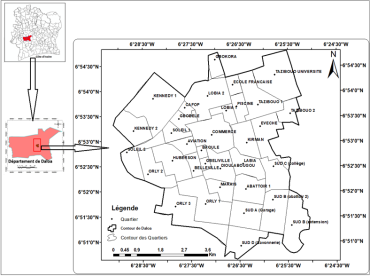
Figure 1. Map of the city of Daloa and its neighbourhoods [17].
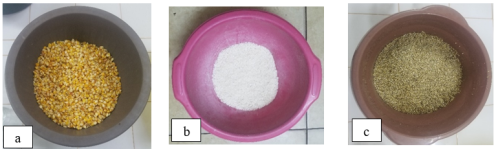
Figure 2. Cereals used in our study: a) Maize grains; b) Rice grains; c) Millet grains.
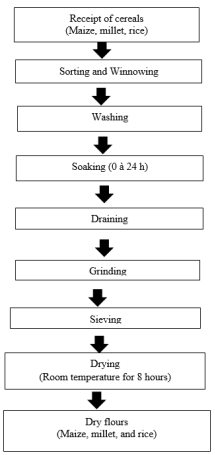
Figure 3. Flowchart of maize, millet, and rice flour production according to the surveyed mothers.
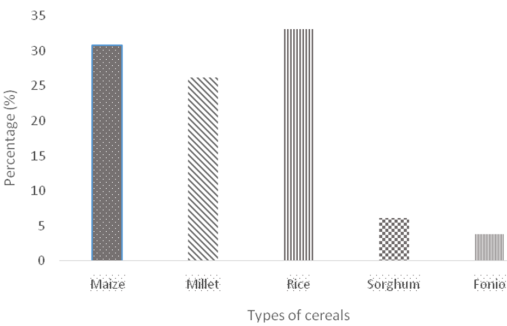
Figure 4. Distribution of cereals sold in Daloa markets.

Information


 Share This Article
 Twitter
 Linked In
 Facebook
 Copy
Copy Download